
← Back to Class 9 Science Notes
Exploring Mixtures and Their Separation is an important chapter in Class 9 Science that explains mixtures, solutions, colloids, suspensions, and different methods of separating substances. Students learn about homogeneous and heterogeneous mixtures, concentration of solutions, crystallisation, distillation, chromatography, sublimation, centrifugation, and the Tyndall effect through simple explanations and real-life examples. These notes help students understand concepts easily and prepare effectively for exams.
Exploring Mixtures And Their Separation Class 9 Notes
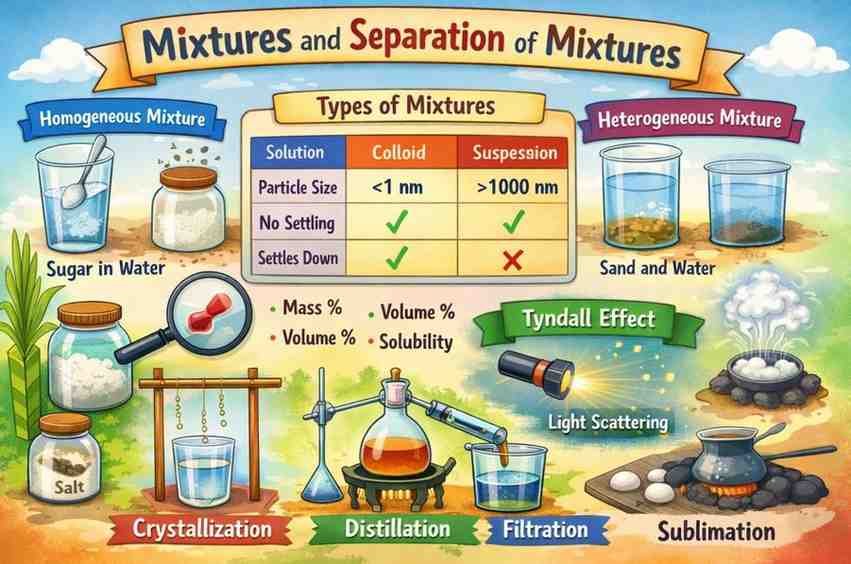
Have you ever wondered how we get sugar crystals from sugarcane or how doctors detect diseases like malaria from a few drops of blood? All these processes are possible because of separation of mixtures.
What are mixtures?
A mixture is a substance formed by combining two or more substances in any proportion, where each substance retains its own properties. For example, air (mixture of gases), sugar + water, sand + water, etc.
How Can We Classify Mixtures?
Mixtures can be classified into two types based on their composition:
- Homogeneous Mixture
- Heterogeneous Mixture
1. Homogeneous Mixture
A mixture in which the composition is uniform throughout is called a homogeneous mixture. For example, sugar and water are equally sweet in the first and the last sip. Other examples of homogeneous mixtures are vinegar (acetic acid in water), aerated drinks like soda (carbon dioxide in water), etc. A solution always remains homogeneous.
2. Heterogeneous Mixture
A mixture in which the composition is not uniform is called a heterogeneous mixture. Sand and water are not uniform. The sand particles are easily visible in the water and settle with time. It is the mixture of oil and water.
What is solutions?
A solution is a type of mixture in which one substance is completely dissolved in another. A solution is a homogeneous mixture where everything is evenly mixed. For example, sugar in water and salt in water. Here, we cannot see the sugar or salt separately because it is fully dissolved.
Parts of a Solution
Solutions are prepared when a solute is mixed with a solvent. In the mixture of sugar and water, sugar is the solute, and water is the solvent.
- Solute → Substance that dissolves (e.g., sugar)
- Solvent → Substance in which it dissolves (e.g., water)
Concentration of a solution
Concentration of a solution tells us how much solute is present in a given amount of solvent or solution. A solution’s concentration is the amount of solute dissolved in a fixed amount of solvent. For example, more sugar in water has a more concentrated solution (sweeter), and less sugar in water has a less concentrated solution (less sweet).
- The right proportion is always essential when preparing a solution.
- The amount of solute dissolved in a given amount of solvent or solution is termed asthe concentration of the solution.
- Understanding concentration is essential not only in science laboratories but also in everyday life, like in medicine, agriculture, food, cosmetics, or even while making a simple cup of tea!
How do we express concentration?
The express concentration means how we show the amount of solute in a solution using numbers. The common way to find this is percentage (%). There are three ways to express concentration:
A. Mass by mass percentage (% (m/m or % w/w)
It tells us how many grams of solute are present in 100 grams of the totla solution. This you can find with the help of a mathematical formula.
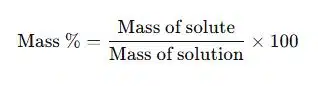
Example: If 10 g of salt is dissolved in 90 g of water, calculate the mass by mass percentage of the solution formed.
Answer:
- Mass of solute (salt) = 10 g
- Mass of solvent (water) = 90 g
- Mass of solution = 10 + 90 = 100 g
- Mass % = (10/100) x 100 = 10%
- Mass by mass percentage = 10%
B. Mass by volume percentage (w/v)
Mass by volume percentage tells us how many grams of solute are present in 100 mL of solution. for example, in medicines and laboratories.

Example: If 5 g of glucose is dissolved in water to make 100 mL of solution, calculate its concentration in mass by volume percentage.
Answer:
- Mass of glucose = 5 g
- Volume of solution = 100 mL
- Mass/Volume % = (5/100)X100
- Mass by volume percentage = 5%
- A 5% glucose solution means 5 g of glucose is present in 100 mL of solution.
C. Volume-by-volume percentage (v/v)
Volume by volume percentage tells us how many millilitres (mL) of solute are present in 100 mL of solution.

Example: If 1 mL of a liquid pesticide is mixed with a sufficient amount of water to form 100 mL of a pesticide spray for rice crop, calculate its volume by volume percentage.
Answer:
- Volume of solute (pesticide) = 1 mL
- Volume of solution = 100 mL
- Volume/Volume %=(1/100)X100
- Volume by volume percentage = 1%
- A 1% solution means 1 mL of solute in 100 mL of solution.
Solubility of substances
Solubility is the maximum amount of solute that can dissolve in a fixed amount of solvent (100 g or 100 mL) at a given temperature. Solubility tells us how much substance can dissolve in a liquid. For example, sugar dissolves easily in water because of high solubility; on the other hand, sand does not dissolve because of no solubility.
Saturated Solution
A saturated solution is a solution in which no more solute can dissolve at that temperature. For example, add sugar to water until it stops dissolving; the dissolved part is a saturated solution.
Solid in Liquids: When you increase temperature, then more solute can dissolve. For example, less sugar dissolves in cold water, but more sugar dissolves in hot water, meaning solubility increases with temperature.
Gases in Liquids: When the temperature increases, the gas starts escaping. For example, a cold drink has more gas inside, but when the cold drink becomes warm, the gas comes out.
Unsaturated Solution
An unsaturated solution is a solution in which more solute can still dissolve. For example, sugar dissolves easily in water, but still space for more solute can be added; this is known as an unsaturated solution.
Methods of Separation of Homogeneous Mixtures
Crystallisation
When you prepare a hot saturated solution and then cool it, the solubility decreases. This causes excess solute to come out as crystals. Crystallisation is the process of forming pure solid crystals from a saturated solution by cooling. Crystallisation helps to purify the substance or separate the solids. For example, rock salt, sugar (mishri), snowflakes, and frost on windows.
Simple Crystal Activity at Home:
- You will need:
- Water
- Sugar or salt
- A glass
- A thread and stick
- Step 1: Heat water and dissolve sugar/salt until no more dissolves (make a saturated solution).
- Step 2: Pour into a glass.
- Step 3: Tie a thread to a stick and dip it into the solution.
- Step 4: Leave it undisturbed for a few days.
- You’ll see crystals forming on the thread!
Distillation
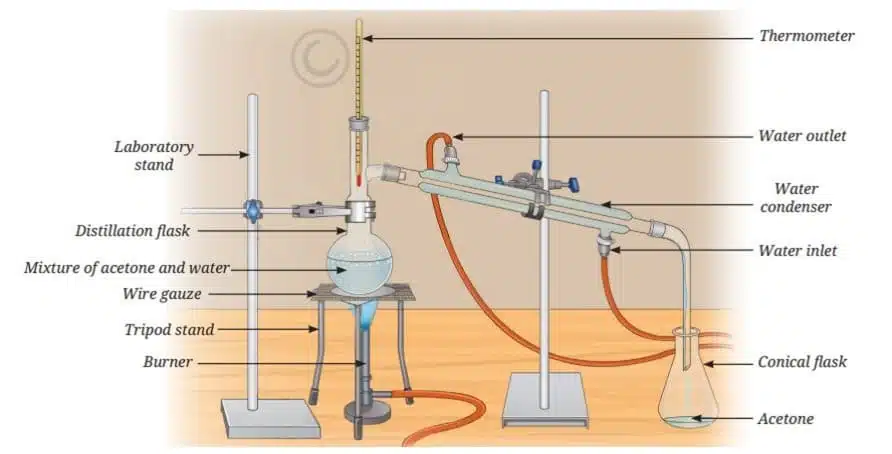
Distillation is a method used to separate two miscible liquids (liquids that mix completely) based on their difference in boiling points. The liquid with the lower boiling point evaporates first, and then it is cooled and collected back as liquid.
During the process, vapours of the lower-boiling liquid are passed through a condenser where they are cooled, usually by circulating water or air, and condensed as a pure liquid. The pure liquid is collected in a separate vessel, while the solid or other liquid from the mixture remains in the distillation flask.
Paper Chromatography
Paper chromatography is a method used to separate different components of a mixture based on how they move with a solvent.
Activity: Let us investigate
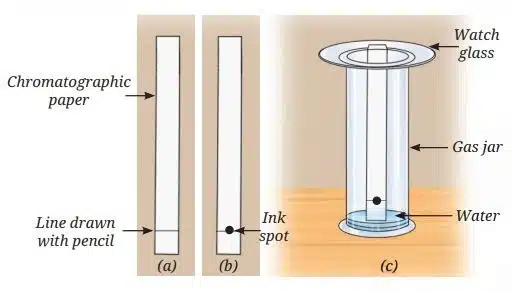
- Take a 3 cm wide strip of chromatographic paper and draw a straight, horizontal line 2 cm from the bottom of the paper with a pencil. Alternatively, you can use a strip of filter paper.
- Mark a spot with a black sketch pen at the centre of the line.
- Take enough water to make a thin layer at the bottom of a gas jar, a measuring cylinder, or a beaker.
- Place the paper strip with the ink spot vertically into the container, so that its lower end dips into the water. The water level should be below the spot, as shown.
- Observe the paper as the water rises through the paper. What do you notice?
- As the water rises, the ink starts to separate into different colour spots. What can you infer from this?
This method of separating the components of a mixture is known as paper chromatography.
How Can We Separate the Components of Heterogeneous Mixtures?
Separation of two immiscible liquids
Immiscible liquids are liquids that do not mix and form separate layers. for example, oil and water. When the mustard oil and water are mixed, then two layers form: one layer of oil on the upper side and a second layer of water on the lower side. This happens because of the difference in density; the water is more dense than the oil, so the water settles at the bottom, and the oil is less dense of they float dense, so on top.
Method of Separation:
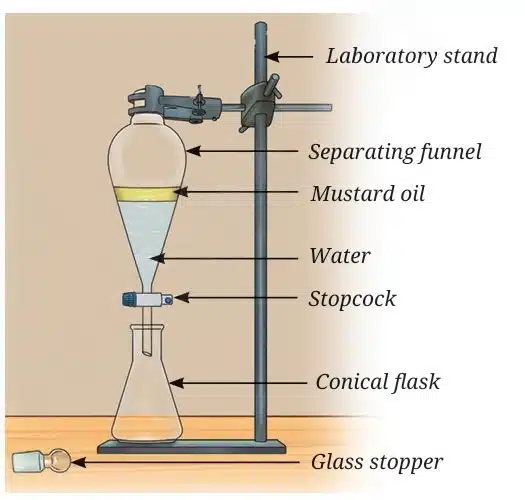
- Pour a mixture of 5 mL mustard oil and 20 mL water into a 50 mL using a separating funnel:
- Pour the mixture into the funnel.
- Allow it to stand → layers form
- Open the stopcock slowly.
- Collect the lower layer (water) first.
- Close the tap before oil starts coming.
- Then collect the upper oil layer separately.
Can you think of any heterogeneous mixtures with a gas as one of the components?
Gas particles are free to move in all directions, so they mix easily and uniformly with other gases. Hence, most mixtures of gases are homogeneous, such as a mixture of hydrogen and oxygen, which is used as a rocket fuel. On the other hand, smoke (solid particles suspended in air), fog (tiny liquid water droplets present in air) and dust in the air are some heterogeneous mixtures with gas as one of the components. Most of the solid-solid mixtures are heterogeneous. You can use a property of one of the solids to separate the mixture.
Sublimation
Sublimation is a process in which a substance changes directly from solid to gas without becoming liquid. An example is camphor, which turns into vapour when heated and forms a solid again on cooling. This reverse process is called ‘deposition’.
Separation by Sublimation
Sublimation is used to separate the mixture, like camphor and sand. When heated, the camphor changes into vapour and sticks to the cooler surface while sand remains behind. Other substances like naphthalene and dry ice (solid carbon dioxide) also show sublimation.
What are alloys?
Metals do not mix at room temperature, but when heated and melted, they can combine to form a homogeneous mixture called an alloy. Alloys are made to improve strength, durability and resistance to rust. Examples of alloys are brass – copper + zinc, bronze – copper + tin and stainless steel. – Iron + Carbon + Chromium + Nickel
Suspensions
A suspension is a type of mixture where solid particles do not dissolve in liquid and remain spread throughout it. This mixture is heterogeneous, meaning that particles can be seen easily.
What is Suspension?
In a suspension, substances like sand in water do not mix completely. Even after stirring, the particles remain visible and may settle down after some time.
How can we separate mud from water?
The muddy water is a mixture of water and fine mud particles; sometimes just letting it settle or filtering is not enough to make the water clean. In such cases, special methods like centrifugation and coagulation are used.
Sedimentation and Filtration
- When muddy water is left undisturbed, heavier mud particles settle at the bottom (sedimentation).
- The clear water on top can be poured out (decantation).
- Filtration can remove larger particles, but very fine particles may still remain.
Centrifugation
Centrifugation is a process in which a mixture is spun at high speed. Due to centrifugal force, heavier particles move outward and settle at the bottom. The lighter liquid remains on top. For example, separating components of blood (RBCs and plasma)
Coagulation
Coagulation is the process of adding a substance (like alum/fitkari) to make tiny particles clump together. These larger clumps settle down and can be easily removed. For example, cleaning muddy water using alum and making paneer (cheese) from milk using lemon juice or vinegar
Colloids
A colloid is a type of mixture that is neither a true solution nor a suspension. In a colloid, very small particles are spread evenly throughout another substance. For example, blood
- We cannot see its particles with the naked eye.
- Particles do not settle down.
- So, blood is a colloid, not a solution or suspension.
What are colloids?
Colloids are mixtures where particles are small but larger than solution particles. They are evenly distributed, but they do not settle down on standing. For example, milk, blood, tomato sauce, ice cream, etc.
Difference Between Solution, Colloid, and Suspension
| Property | Solution | Colloid | Suspension |
|---|---|---|---|
| Particle Size | Very small (<1 nm) | Medium (1–1000 nm) | Large (>1000 nm) |
| Visibility | Not visible | Not clearly visible | Visible |
| Settling | Do not settle | Do not settle | Settle on standing |
| Nature | Homogeneous | Appears homogeneous | Heterogeneous |
Tyndall Effect
The Tyndall effect is the scattering of light by small particles present in a mixture. When a beam of light passes through certain mixtures, its path becomes visible because the particles spread the light. This effect was explained by John Tyndall.
What Happens in Different Mixtures?
- In a solution, light passes through, and the path is not visible.
- In a colloid, Light is scattered; the path is visible.
- In a suspension, Light is strongly scattered; the path is clearly visible.
Important Points
- The Tyndall effect occurs in colloids and suspensions.
- It does not occur in true solutions.
- It helps us identify the type of mixture.
Disclaimer: The content that is present on our website is based on the NCERT Class 9 Science textbook and is provided for educational purposes only. All the content and images have been taken from Science Class 9 NCERT Textbook and CBSE Support material. Images and content shown above are the property of individual organizations and are used here for reference purposes only. To make it easy to understand, some of the content and images are generated by AI and cross-checked by the teachers.
Great notes
Good notes for examination learning 🥰
This notes was best for study
It is very helpful
Good
It’s tooo good to understand easily and to make notes .
good
nice
So nice details and easy for people like me who study one day 🤣 before exams