
← Back to Class 9 Science Notes
Atoms are the tiny building blocks of all matter. Everything around us, from the air we breathe to the objects we use every day, is made up of atoms. In this chapter, Atomic Foundations of Matter Class 9 Notes, students will learn how scientists developed the concept of atoms, understand the laws of chemical combination, explore Dalton’s Atomic Theory, and study the structure and significance of atoms in explaining the properties of matter.
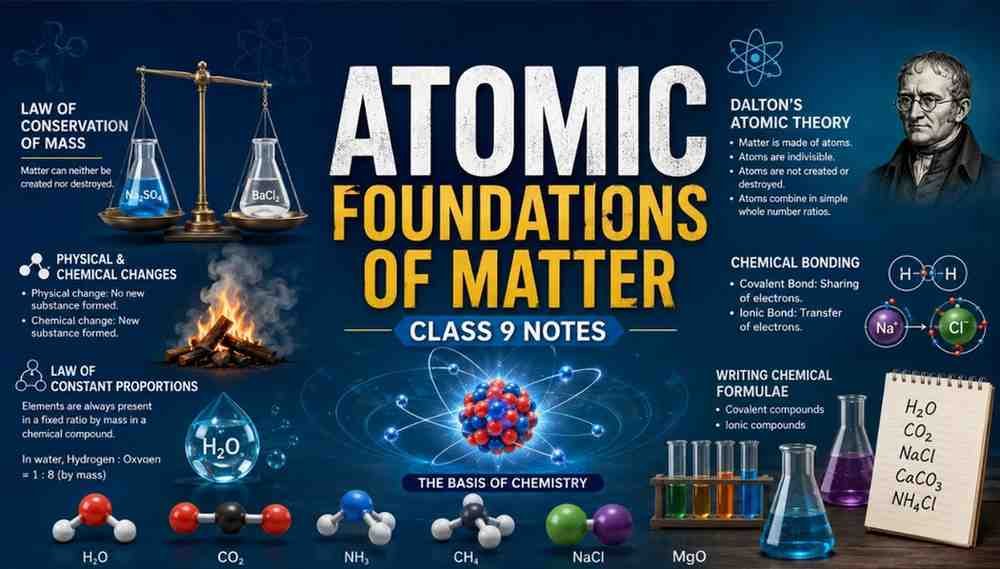
Law of Conservation of Mass
In chemistry, one of the most important laws is the Law of Conservation of Mass, proposed by Antoine Lavoisier in 1789. It states that Matter can neither be created nor destroyed in a chemical reaction.
This means the total mass remains constant before and after a reaction.
What is a Physical Change?
A physical change is a change in which only the form or appearance of a substance changes.
- No new substance is formed
- No change in chemical composition
- Only physical properties like shape, size, and state change
Examples:
- Melting of ice
- Boiling of water
- Cutting paper
What is a Chemical Change?
A chemical change is a change in which a new substance is formed.
- Properties change completely
- Usually irreversible
- Chemical composition changes
Examples:
- Burning of wood
- Rusting of iron
- Formation of water from hydrogen and oxygen
Activity: Verification of Law of Conservation of Mass
Let’s verify this law using a simple experiment.
Materials Required:
- Two conical flasks
- Sodium sulfate (Na₂SO₄) solution
- Barium chloride (BaCl₂) solution
- Weighing balance
Procedure:
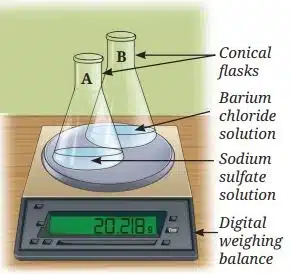
- Take two conical flasks:
- Flask A → Sodium sulfate solution
- Flask B → Barium chloride solution
- Measure the total mass before mixing
- Mix both solutions carefully
- Measure the mass again
Observation
A white precipitate is formed, This is barium sulfate (BaSO₄). The mass before and after mixing remains the same
Chemical Reaction
Na₂SO₄ + BaCl₂ → BaSO₄ ↓ + 2NaCl
Conclusion
- A new substance is formed (chemical change)
- But total mass remains unchanged
This verifies the Law of Conservation of Mass
Law of Constant Proportions
After Antoine Lavoisier, another important law in chemistry was proposed by Joseph Proust. Statement of the Law says in any chemical compound, the elements are always present in a fixed ratio by mass, irrespective of the source. This means:
- No matter where a compound comes from
- Its composition remains constant
Example: Water (H₂O)
Water always contains: Hydrogen and Oxygen in the ratio 1 : 8 (by mass)
- If you take 9 g of pure water:
- Hydrogen = 1 g
- Oxygen = 8 g
This ratio remains the same whether water is taken from River, Ocean, Borewell
This is known as the Law of Constant Proportions, or the Law of Definite Proportions, or sometimes as Proust’s Law.
This law helped John Dalton explain atomic behavior. According to Dalton:
- Atoms are indivisible
- Atoms are not created or destroyed
- Chemical reactions involve rearrangement of atoms
Dalton’s Atomic Theory
John Dalton proposed the Atomic Theory based on several important postulates. These postulates were derived from earlier experiments and became the foundation of modern chemistry.
John Dalton postulated that:
- All matter is made up of very tiny particles called atoms, which participate in chemical reactions.
- Atoms are indivisible particles, which cannot be created or destroyed in a chemical reaction.
- Atoms of a given element are identical in mass and chemical properties.
- Atoms of different elements have different masses and chemical properties.
- Atoms combine in the ratio of simple whole numbers to form compounds.
- The relative number and kinds of atoms are constant in a given compound.
For example, hydrogen and oxygen atoms combine to form water, but the atoms themselves are not destroyed or changed into something else. Similarly, when magnesium burns in air, a white powder of magnesium oxide forms. This shows that the atoms of magnesium have combined with those of oxygen to form magnesium oxide.
How Atoms Combine?
Atoms combine to become stable. If their outer shell is not complete, they try to complete it by losing, gaining, or sharing electrons. This happens in two main ways:
- Sharing of electrons, where atoms share their valence electrons with each other, and
- Transfer of electrons, where one atom gives electrons and another atom accepts them.
When atoms join together, they form molecules or compounds, and the force holding them together is called a chemical bond.
Bonding by sharing of electrons — Covalent Bond
A. Molecules of elements
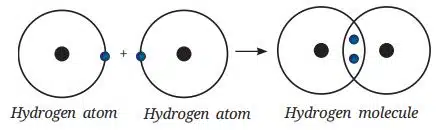
A covalent bond is formed when atoms share electrons to become stable. For example, in a hydrogen molecule (H₂), each hydrogen atom has one electron and needs one more to complete its shell. So, two hydrogen atoms share one electron each, forming a single bond (H—H).
Similarly, in a chlorine molecule (Cl₂), each chlorine atom has seven valence electrons and needs one more to complete its octet, so they share one pair of electrons and form a single covalent bond (Cl—Cl).
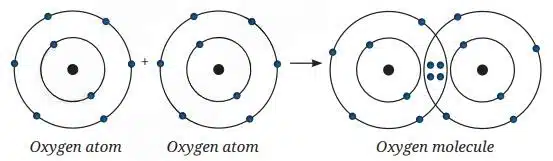
In an oxygen molecule (O₂), each oxygen atom has six valence electrons and needs two more, so they share two pairs of electrons, forming a double bond (O=O).
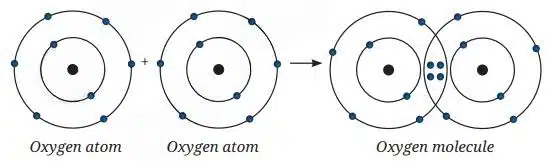
Thus, sharing of electrons between atoms forms covalent bonds and makes the molecules stable.
B. Molecules of compounds
When atoms of different elements combine by sharing electrons, they form molecules of compounds. Such compounds are called covalent compounds.
Formation of Hydrogen Chloride (HCl)
- Hydrogen has atomic number 1 and electronic configuration 1.
- Chlorine has atomic number 17 and electronic configuration 2, 8, 7.
Hydrogen needs 1 electron to complete its duplet, and chlorine needs 1 electron to complete its octet.
Both atoms share one electron each. Due to this sharing, a hydrogen chloride molecule (HCl) is formed.
The bond formed by sharing one pair of electrons is called a single covalent bond and is represented as:
H—Cl
Thus, HCl is a covalent compound.
Formation of Water (H₂O)
Oxygen has electronic configuration 2, 6 and needs 2 electrons to complete its octet.
Each hydrogen atom needs 1 electron. Therefore, two hydrogen atoms share one electron each with one oxygen atom.
This forms a water molecule represented as:
H₂O
It shows that one water molecule contains:
- 2 hydrogen atoms
- 1 oxygen atom
In water, oxygen forms two single covalent bonds with two hydrogen atoms.
C. Naming covalent compounds
Covalent compounds are named by showing the number of atoms of each element present in the molecule. A prefix system is used for naming.
Rules for Naming
- The first element keeps its normal name.
- The second element ends with “-ide.”
- Prefixes show the number of atoms present.
| Number of Atoms | Prefix |
|---|---|
| 1 | mono |
| 2 | di |
| 3 | tri |
| 4 | tetra |
| 5 | penta |
- The prefix mono- is usually not used for the first element.
- If a prefix ends with o or a and the next word starts with a vowel, the last vowel is removed.
- Example: monoxide, pentoxide
- If the prefix ends with i, it is kept.
- Example: dioxide, trioxide
Example,
| Formula | Name |
|---|---|
| CO | carbon monoxide |
| CO₂ | carbon dioxide |
| CS₂ | carbon disulfide |
| PCl₃ | phosphorus trichloride |
| SF₆ | sulfur hexafluoride |
| N₂O₄ | dinitrogen tetroxide |
Special Rule for Hydrogen
When hydrogen is written first in the formula, no prefix is added before hydrogen, even if there are two atoms.
Example:
H₂S → hydrogen sulfide (not dihydrogen sulfide)
Common Names of Some Compounds
Some covalent compounds are better known by their common names.
| Formula | Systematic Name | Common Name |
|---|---|---|
| H₂O | hydrogen monoxide | water |
| NH₃ | nitrogen trihydride | ammonia |
Bonding by electron transfer — Ionic bond
Atoms become stable by completing their outermost shell.
- Atoms with less than 4 valence electrons usually lose electrons.
- Atoms with more than 4 valence electrons usually gain or share electrons to complete their octet.
Examples among the first 18 elements that tend to lose electrons are:
- Lithium (Li)
- Beryllium (Be)
- Sodium (Na)
- Magnesium (Mg)
Formation of Sodium Chloride (NaCl)
Sodium Atom (Na)
- Atomic number of sodium = 11
- Electronic configuration = 2, 8, 1
Sodium has 1 valence electron. It becomes stable by losing this electron.
Na → Na+ + e−
After losing one electron:
- Protons = 11
- Electrons = 10
So sodium gets a +1 charge and forms a sodium cation (Na⁺).
Chlorine Atom (Cl)
- Atomic number of chlorine = 17
- Electronic configuration = 2, 8, 7
Chlorine needs 1 electron to complete its octet.
Cl + e− → Cl−
After gaining one electron, chlorine gets a –1 charge and forms a chloride anion (Cl⁻).
Formation of Ionic Bond
The positively charged sodium ion (Na⁺) and negatively charged chloride ion (Cl⁻) attract each other due to electrostatic force.
Na+ + Cl− → NaCl
Na+ + Cl− → NaCl
This force of attraction between oppositely charged ions is called an ionic bond.
Ions
- Cation → Positively charged ion
- Example: Na⁺
- Anion → Negatively charged ion
- Example: Cl⁻
Both together are called ions.
Example of Sulfur Ion
Sulfur has:
- Electronic configuration = 2, 8, 6
It needs 2 electrons to complete its octet. After gaining two electrons, it forms:
S + 2e− → S2−
S + 2e− → S2−
The sulfur ion carries a 2– charge and is represented as S²⁻.
A. Naming ionic compounds
What are ionic compounds?
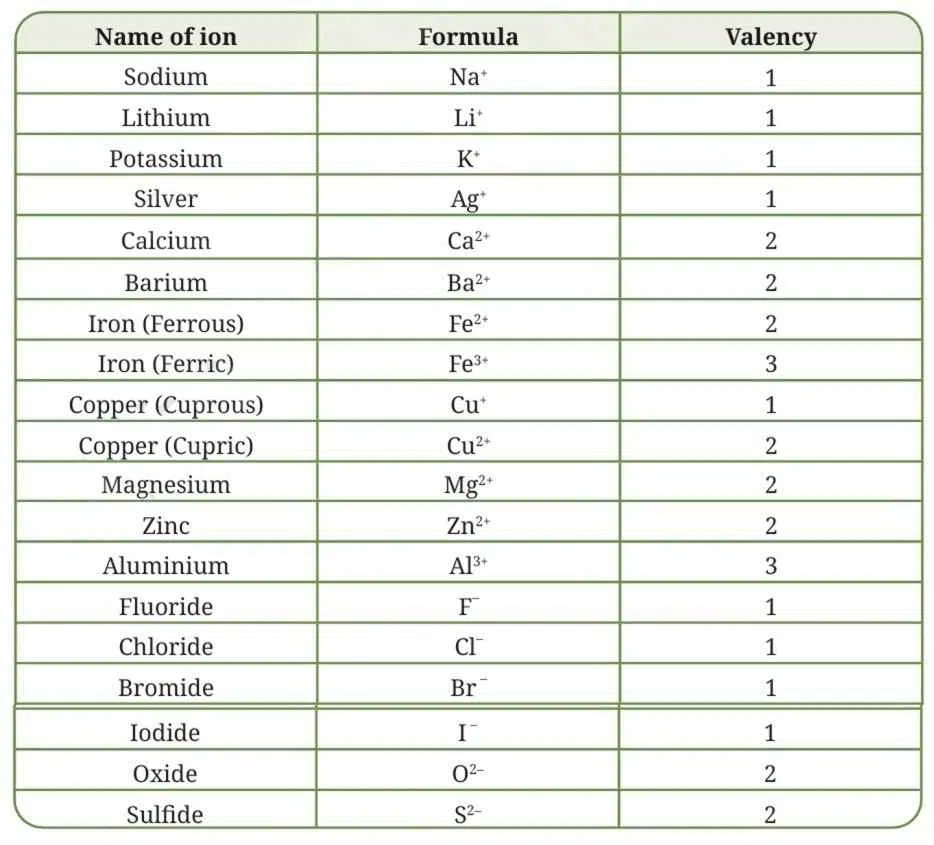
Ionic compounds are made when the metal joins with a non-metal. Metals lose electrons and become positive ions (cations). Non-metals gain electronics and become negative ions (anions). This opposite charge attract each other and make a ionic compound.
- The name of the cation (positive ion) is always written first.
- The name of the anion (negative ion) is written second.
If the anion is a simple one, its name ends with “-ide”. For example:
- NaCl -> Sodium chloride
- CaO -> Calcium oxide
- MgS -> Magnesium sulfide
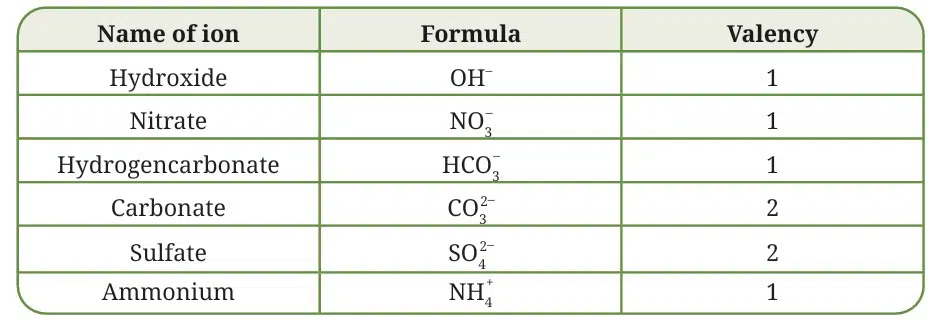
What about special ions?
If ions made of more than one atom then it is called polyatomic ions. Their name do not end with “-ide”. Insted they keep their special name. For example,
- NaOH -> Sodium hydroxide
- NaNO₃ -> Sodium nitrate
- CaCO₃ -> Calcium carbonate
- NH₄Cl -> Ammonium chloride
Some common monoatomic ions
Some common polyatomic ions
Writing Chemical Formulae
Writing chemical formulae of covalent compounds
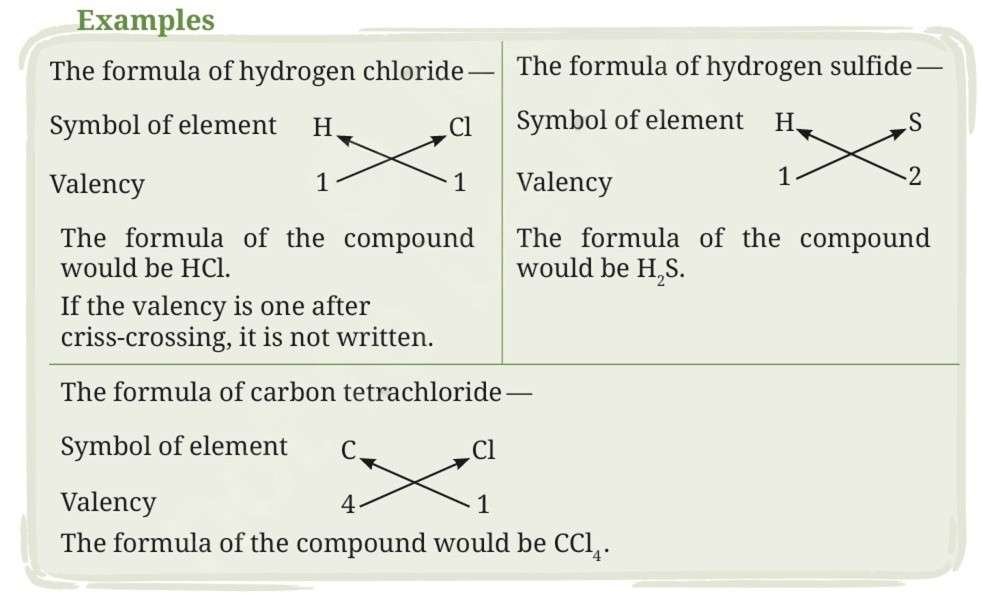
Follow these steps to write the chemical formula of a covalent compound:
- (i) Write the symbols of the constituent elements of the compound.
- (ii) Write the valencies of these elements (refer to Table 9.1).
- (iii) Crossover the valencies of the combining atoms and write them as subscripts after the symbols of elements, as shown below.
Writing chemical formulae of ionic compounds
Follow the steps given below to write the chemical formula of an ionic compound:
- (i) Write the symbol of the cation first, followed by the symbol of the anion.
- (ii) Write the charges under the symbols rather than as superscripts.
- (iii) Crossover the charges (only the numbers) as shown below to obtain the formula.
- (iv) The chemical formula gives the simplest ratio of the elements in a compound. Therefore, after criss-crossing, the subscripts are divided by a common factor, if any. For example, if we get the subscripts 2 and 4, they are divided by 2 to get 1 and 2, which are then used as subscripts in the formula.
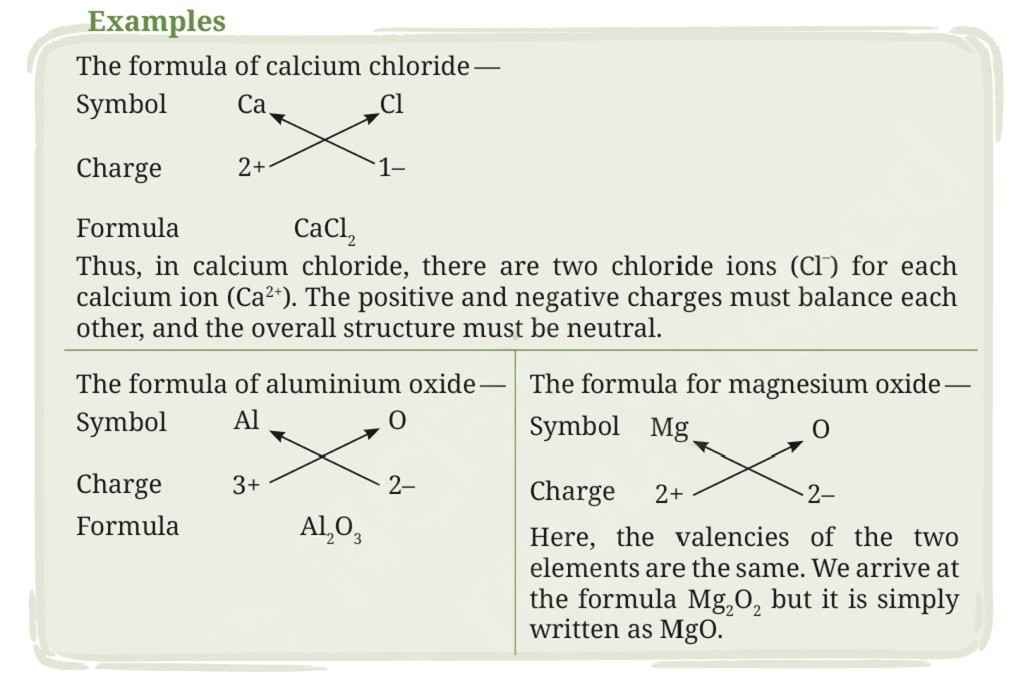
This method can also be used to write formulae of compounds of metals with other polyatomic ions, such as calcium carbonate.
For magnesium hydroxide, we write the symbol of the cation (Mg2+) first, followed by the symbol of the anion (OH–). Then, their charges (only the numbers) are criss-crossed to get the formula.
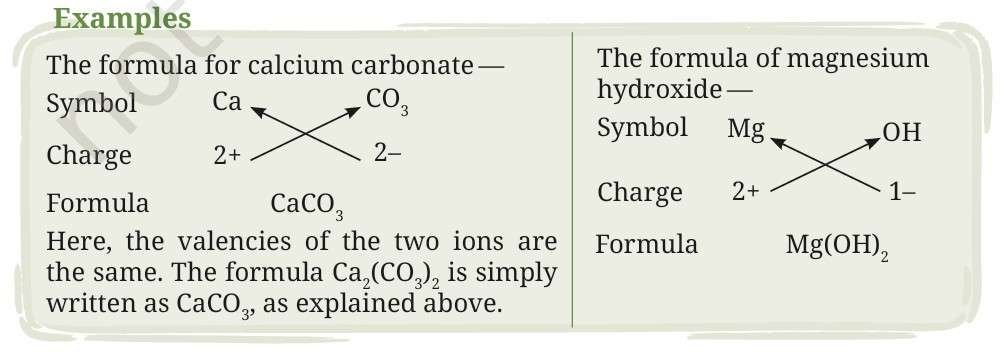
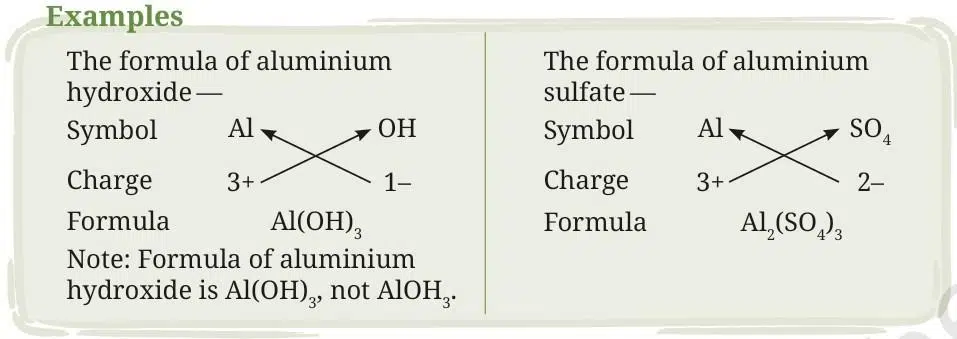
Thus, in magnesium hydroxide, there are two hydroxide ions (OH–) for each magnesium ion (Mg2+). We use brackets ( ) when we have two or more polyatomic ions of the same type in a formula. In the example of aluminium hydroxide given below, the bracket around OH with a subscript 3 indicates that there are three hydroxide (OH–) ions bound to one aluminium ion. Brackets are not required when only one polyatomic anion is present.
Disclaimer: The content that is present on our website is based on the NCERT Class 9 Science textbook and is provided for educational purposes only. All the content and images have been taken from Science Class 9 NCERT Textbook and CBSE Support material. Images and content shown above are the property of individual organizations and are used here for reference purposes only. To make it easy to understand, some of the content and images are generated by AI and cross-checked by the teachers.