
← Back to Class 9 Science Notes
Sound Waves Characteristics and Applications Class 9 Notes based on the latest NCERT syllabus. In these easy-to-understand notes, you will learn how sound is produced, how sound waves travel through different mediums, the characteristics of sound waves such as wavelength, frequency, amplitude, time period, and speed, along with human perception of sound, echo, reverberation, SONAR, echolocation, ultrasonic waves, infrasonic waves, and their real-life applications.
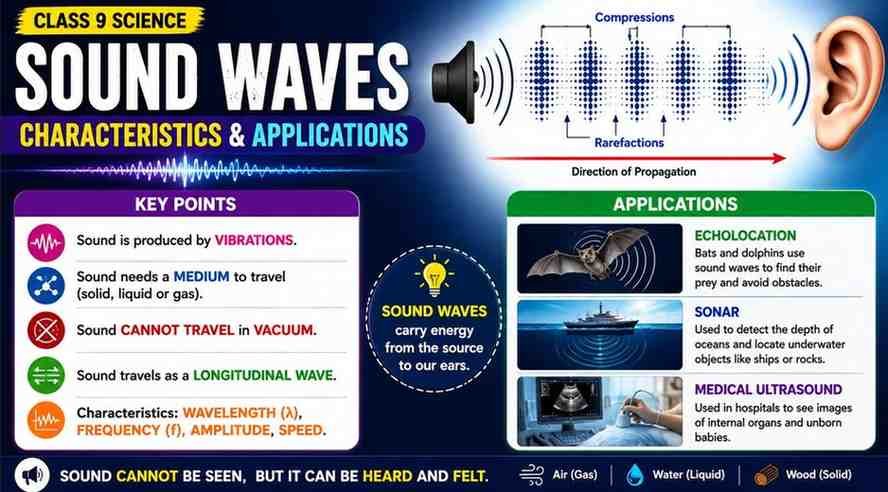
Sound Waves Characteristics and Applications Class 9 Notes
Sound is a type of energy that helps us to know what is happening around us, like birds singing, people talking, thunder clapping, or honking. When something vibrates, then its mechanical energy converts into sound energy.
Production of Sound
When an object vibrates, it creates sound. When the vibrations stop, the sound also stops. These vibrations travel as sound waves until they reach our ears. The vibrating object is called the source of sound.
Activity – Rubber Band Experiment
- Materials: Cardboard box and a rubber band.
- When you pluck a stretched rubber band, it vibrates and produces sound.
- When vibrations stop, the sound stops.
- A rubber band stretched over a box produces a louder sound.
Observation: When you stretch the rubber band and pluck it, then it vibrates and produces sound. When the vibration stops, then the sound also stops. Tightening or loosening the rubber band changes the sound.
Conclusion: Sound is produced due to vibration. The pitch of the sounds depends on the tension of the rubber band.
Tuning fork
A tuning fork is a U-shaped metal instrument used to perform experiments on sound. The tuning fork has two arms called prongs and the handle called the stem. The tuning fork is usually made up of steel or aluminum. When you strike the prongs on a soft pad, they start vibrating.
Activity with Tuning Fork
- Hold the tuning fork by its stem.
- Hit it gently on a soft rubber pad.
- Bring it near your ear.
- Touch one prong to the water surface.
- Observe the water surface.
Observation: You will hear a sound when the prong touches the water, and then the vibration makes waves on the water, which proves that the prongs are moving back and forth.
Conclusion: Sound is produced by vibrating objects. The tuning fork makes sound because its prongs vibrate.
Propagation of Sound
We know that sound is produced by vibrations, but these vibrations need a medium like air, water or solid. This medium carries the sound waves from the source to your ear.
Activity – Sound Travels Through Solids
- When your friend taps or scratches the desk.
- You will hear sound in the air.
- When you place your ear on the desk, the sound is louder.
Conclusion: The sound can travel through solids.
Activity – Sound Travels Through Liquids
- Fill the bucket with water.
- Tap two metal spoons together above the water.
- Now, put the spoons under the water and tap them again; you will hear the sound.
Conclusion: You can hear the sound under the water, which means sound can travel through liquids.
Sound Travels Through Gases
When any two people are talking, then we can hear the sound; it means that the sound can travel through air.
Sound in Vacuum
Sound cannot travel without a medium. For example, in space, astronauts cannot talk to each other in space without radios because there is no air in space.
Sound needs a medium to propagate
Medium helps to travel sound from one place to another place. For example, air, water, wood, or metal.
Vacuum Bell Jar Experiment
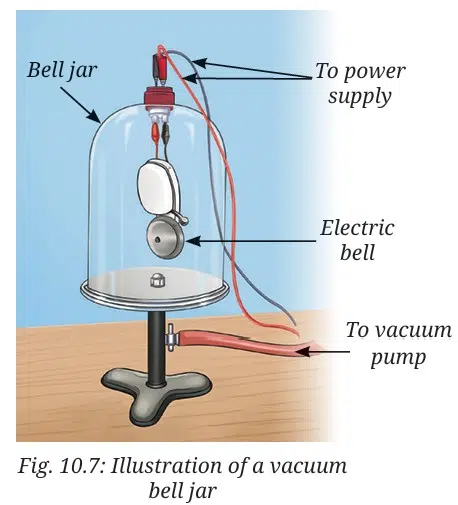
- Put an electric bell inside a bell jar.
- Switch on the bell.
- You can hear the bell ringing.
- Remove some air from the bell jar using a vacuum pump.
- The sound becomes softer.
- When almost all the air is removed, you cannot hear the bell, but you can still see it ringing.
- Let the air back into the bell jar.
- The sound becomes loud again.
Observation: When some air is removed, the sound becomes weaker, and when all the air is removed, you cannot hear the bell. It means that no sound is heard without air.
Conclusion: Sound needs a medium to travel; sound cannot travel in a vacuum.
Sound Waves
Sound travels in the form of sound waves. A sound wave helps to carry sound from the source to our ears. Sound requires a medium like solid, liquid, or gas to travel, but the particles do not travel with the sound. They only move back and forth in one place. This movement passes the sound energy from one particle to the next until it reaches your ear.
Activity – Slinky Experiment
- Materials: A slinky and a marker
- Stretch the slinky with the help of a friend.
- Make a mark on one coil.
- Push one end of the slinky forward.
- Quickly pull it back.
- Watch what happens.
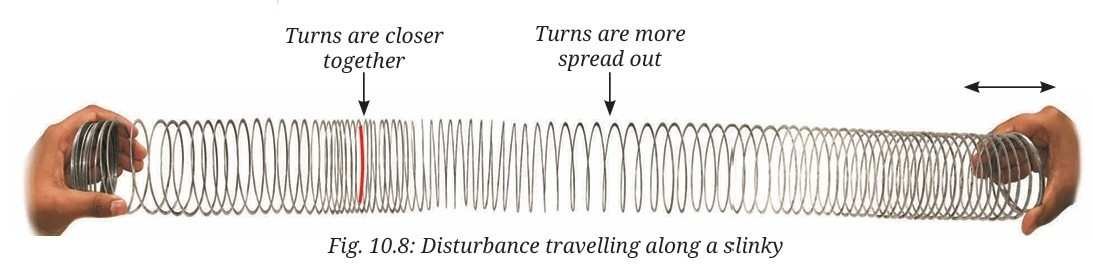
Observation: When you push one end forward and pull it back, then a disturbance moves along the slinky. The coils of the slinky only move back and forth. This is exactly how the air particles behave when sound travels.
Conclusion: Sound travels as a wave, and the wave moves forward. The particles of the medium move back and forth, but the medium does not travel with the wave.
How Sound Travels
Sound travels in the form of compressions (particles close together, high density) and rarefactions (particles spread apart, low density). These compressions and rarefactions move forward, carrying sound energy. The particles themselves only oscillate in their place. Example: In a slinky, some coils come close (compression) and some spread out (rarefaction). The disturbance moves forward, but each coil only vibrates in its own position.
Direction of Propagation
The direction in which the sound wave moves is called the direction of propagation.
Everyday Examples
- Clapping hands: When the air particles compress and spread, then the sound can be heard.
- Tuning fork: The vibrating prongs create compression and rarefaction in air.
- Musical instruments: Musical instruments like strings, membranes, or air columns vibrate to produce sound.
What is a Longitudinal Wave?
In a sound wave, the particles of the medium move back and forth. They move in the same direction as the sound wave. This type of wave is called a longitudinal wave.
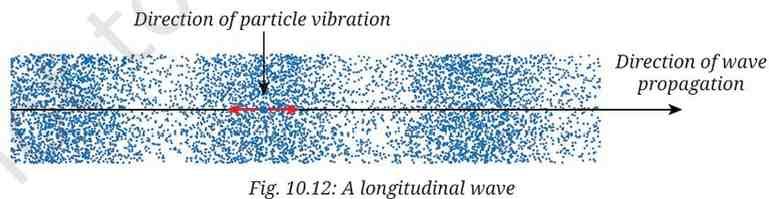
Medium is necessary.
Sound cannot travel in vacuum because there are no particles to vibrate. That’s why sound is a mechanical wave; it always needs a medium (solid, liquid, or gas).
Energy of Sound Waves
Sound energy is the energy carried by sound waves. It can make objects vibrate or move.
Activity – Does Sound Have Energy?
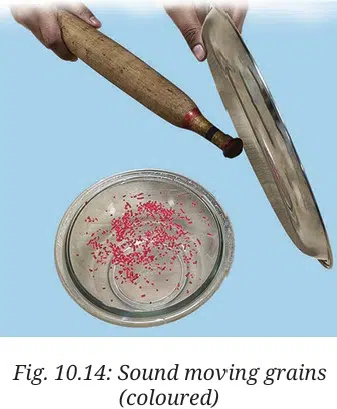
- Materials: Bowl, balloon or rubber sheet, rubber band, rice grains, and loud sound source (speaker or bell)
- Stretch the balloon or rubber sheet over the bowl.
- Fix it tightly with a rubber band or tape.
- Sprinkle a few rice grains on the sheet.
- Make a loud sound near the bowl.
- Watch the rice grains carefully.
Observation: In the experiment, the rice grains jump, and the sound source does not touch the bowl. The experiment proves sound is a form of energy because it can make grains move without direct contact.
Graphical Representation of a Sound Wave
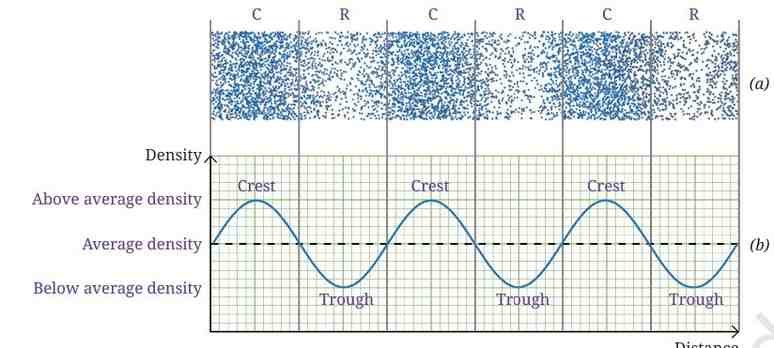
We can show the sound wave using a graph. The graph shows how the density of air changes as the sound travels.
- X-axis: Distance
- Y-axis: Density of the medium (air)
- Compression: When the air particles are close together, then density is high. On the graph, this is the highest point. The highest point in a graph is called a crest.
- Rarefaction: When the air particles are far apart, then the density is low. On the graph this is the lowest point. The lowest point is called a trough.
Average Density
The dashed line in the graph shows the average density of the air, and the graph moves above and below this line.
Characteristics of a Sound Wave
Wavelength, frequency and time period
Wavelength (λ)
The distance between two consecutive crests or two consecutive troughs of a wave is called the wavelength.
- Symbol: λ (Lambda)
- SI Unit: metre (m)
Example: If the distance between two crests is 2 m, then wavelength = 2 m.
Frequency (ν or f)
The number of complete density oscillations produced at a fixed point is one second is called the frequency.
- Symbol: ν (Nu) or f
- SI Unit: Hertz (Hz)
Formula,
\[ \nu = \frac{\text{Number of oscillations}}{\text{Time}} \]\[ \nu = \frac{1}{T} \]Example: 10 oscillations in 2 seconds
\[ \nu = \frac{10}{2} = 5 \,\text{Hz} \]Time Period (T)
The time taken to complete one oscillation is called the time period.
- Symbol: T
- SI Unit: second (s)
Formula:
\[ T = \frac{1}{\nu} \]Example: If frequency = 5 Hz
\[ T = \frac{1}{\nu} = \frac{1}{5} = 0.2 \,\text{s} \]Relationship Between Frequency and Time Period
Frequency and time period are inversely proportional.
\[ T = \frac{1}{\nu} \]or\[ \nu = \frac{1}{T} \]Remember
- High frequency means Short time period
- Low frequency means Long time period
Activity: Musical Notes and Frequency
The musical notes are:
Sa -> Re -> Ga -> Ma -> Pa -> Dha -> Ni -> Sa
As we move from Sa to the next Sa:
- Frequency gradually increases.
- Each musical note has its own unique frequency.
- Different frequencies produce different musical sounds.
Example 10.1: If there are 10 density oscillations in 2 seconds at a given position, then calculate the
- (i) frequency of sound wave, and
- (ii) its time period.
Answer:
Frequency of sound wave =
\[ \nu = \frac{\text{Number of oscillations}}{\text{Time}} \]\[ \nu = \frac{10}{2} = 5 \,\text{Hz} \]Time taken for a single density oscillation at a position =\[ T = \frac{1}{\nu} = \frac{2s}{10} = 0.2 \,\text{s} \]Amplitude and intensity of the sound waves
What is Amplitude?
Amplitude tells us how loud or soft the sound is. The amplitude of a sound wave is the maximum change in the density of air in a compression (or a rarefaction) compared to the average density.
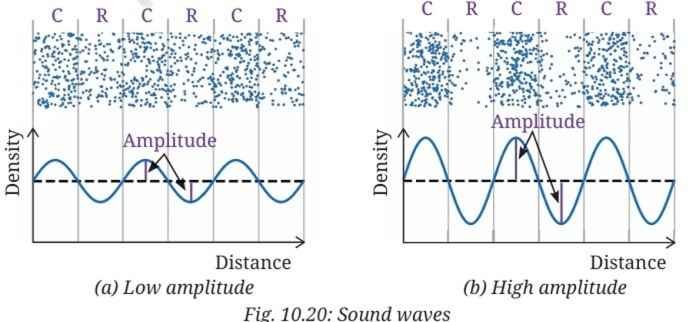
For example,
Imagine two people beating a drum.
Person 1: The person hit the drum gently.
- Small vibrations
- Small amplitude
- Soft sound
Person 2: The person hit the drum hard.
- Large vibrations
- Large amplitude
- Loud sound
Relationship Between Amplitude and Energy
The amplitude and the energy are directly related to each other.
- Large amplitude means more energy.
- Small amplitude means less energy.
Intensity of Sound
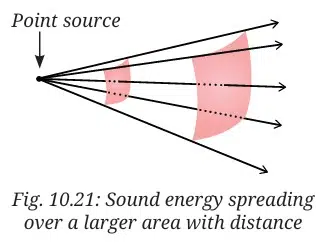
Intensity tells us how strong the sound is at a particular place. Intensity is the amount of sound energy passing through a unit area in one second, perpendicular to the direction of the sound wave.
Why Does Intensity Decrease?
When the sound travels away from the source, then—
- It spreads in all directions.
- The same energy covers a large area.
- Therefore, the sound becomes weaker.
Because of this, a person standing near a loudspeaker hears a loud sound, and the person standing far from the speaker hears a faint sound.
Relationship Between Distance and Intensity
When the distance from the source increases, then the intensity decreases. When the sounds have large initial amplitude, they carry more energy and can travel farther before becoming too weak to hear.
Speed of Sound
The speed of sound tells us how fast sound travels through a medium.
Definition: The speed of sound can be defined as the distance that a point on a wave, such as a crest (or a trough), travels in a unit time.
Example:
Suppose your friend claps; the sound travels through the air and reaches your ears. The speed of sound tells how fast the sound reaches you.
Formula of Speed
\[ \text{Speed} = \frac{\text{Distance}}{\text{Time}} \]Formula for sound waves,
u = λ x u
Where,
- v = Speed of sound (m/s)
- λ (Lambda) = Wavelength (m)
- ν (Nu) = Frequency (Hz)
Speed = Wavelength × Frequency
v = λν
Speed of Sound in Different Mediums
Sound needs a medium like a solid, liquid, or gas to travel.
| Medium | Speed of Sound | Why |
|---|---|---|
| Solid | Fastest | In solids particles are packed very closely so vibration pass quickly. |
| Liquid | Faster | In liquids particles are less closely packed so the sound travels slower than the solids. |
| Gas (Air) | Slowest | In gases the particles are far so the sournd travels the slowest. |
Effect of Temperature
As temperature increases, the speed of sound increases.
Example,
- At 0°C -> Speed ≈ 331 m/s
- At 22°C -> Speed ≈ 344 m/s
Means,
- Higher temperature -> Faster sound
- Lower temperature -> Slower sound
Example: Human hearing roughly spans 20 Hz to 20 kHz. What are the corresponding wave lengths in air for these two frequencies? Use the speed of sound in air as 344 m s–1.
Answer: The human ear can hear sounds from 20 Hz to 20,000 Hz (20 kHz).
Given:
Speed of sound = 344 m/s
Formula,
\[ \lambda = \frac{v}{\nu} \]where
- λ = Wavelength
- v = Speed of sound
- ν = Frequency
(i) For 20 Hz
Given
- Speed = 344 m/s
- Frequency = 20 Hz
Calculation
\[ \lambda = \frac{344}{20} = 17.2 \,\text{m} \]Wavelength = 17.2 m
(ii) For 20,000 Hz (20 kHz)
Given
- Speed = 344 m/s
- Frequency = 20,000 Hz
Calculation
\[ \lambda = \frac{344}{20000} = 0.0172 \,\text{m} \]Convert metre into centimetre
\[ 0.0172 \times 100 = 1.72 \,\text{cm} \]Wavelength = 1.72 cm
Example: During a thunderstorm, lightning is seen before thunder is heard because sound travels much slower than light. If the time delay between seeing the lightning flash and hearing the thunder is measured to be 5 s, estimate the distance to the lightning strike. Use the speed of sound in air as 340 m s–1. Assume that light (speed = 300000 km s–1) reaches you almost instantaneously.
Answer: The lightning is seen first and then thunder is heard 5 seconds later. To find the distance of the lightning is.
Given
- Speed of sound = 340 m/s
- Time = 5 s
Formula for distance,
\[ \text{Distance} = \text{Speed} \times \text{Time} \]Calculation
- =340 × 5
- =1700 m
Convert into kilometre
- 1700 ÷ 1000 = 1.7 km
Distance = 1700 m = 1.7 km
Example: From the graphical representation of a sound wave propagating in steel, find its wavelength. Calculate its frequency and time period if the speed of sound in steel is 5000 m s–1.
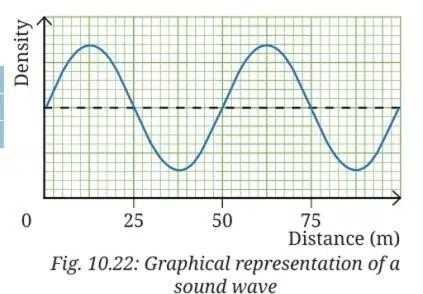
Answer: From the graph,
- Wavelength = 50 m
- Speed of sound in steel = 5000 m/s
Find
- Frequency
- Time Period
(i) Frequency
Formula,
\[ \nu = \frac{v}{\lambda} \]\[ \nu = \frac{5000}{50} = 100 \,\text{Hz} \]Frequency = 100 Hz
(ii) Time Period
Formula,
\[ T = \frac{1}{\nu} \]Calculation,
\[ T = \frac{1}{100} = 0.01 \,\text{s} \]Time Period = 0.01 s
Human perception of sound
When we hear and feel the sound, it is called the human perception of sound. There are two main perception terms: pitch and loudness.
What is Pitch?
The pitch means how high or low a sound seems to our ears. Pitch depends on the frequency of the sound wave.
| Frequency | Pitch |
|---|---|
| High Frequency | High Pitch |
| Low Frequency | Low Pitch |
Examples,
- High-pitch sounds are police sirens, bird chirping, whistles, etc. This sound has a high frequency.
- Low-pitch sounds include thunder, airplane engines, drums, etc. This sound has a low frequency.
Audible Range of Humans
The humans can hear the sound between 20 Hz and 20,000 Hz (20 kHz); this range of sound is the audible range for humans. Below 20 Hz, humans cannot hear the sound, and above 20,000 Hz, humans cannot hear.
Infrasonic Waves
The sound waves with a frequency less than 20 Hz are called infrasonic waves. For example, earthquakes, elephant communication, volcanoes, etc.
Ultrasonic Waves
The sound waves with a frequency greater than 20,000 Hz (20 kHz) are called ultrasonic waves. For example, dolphin, bat, dog, cat, etc.
Reflection of Sound
What is reflection of sound?
When a sound wave hits a wall, mountain, or any hard surface, then the sound bounces back; it is called the reflection of sound. Sound bounces back just like light bounces back from a mirror.
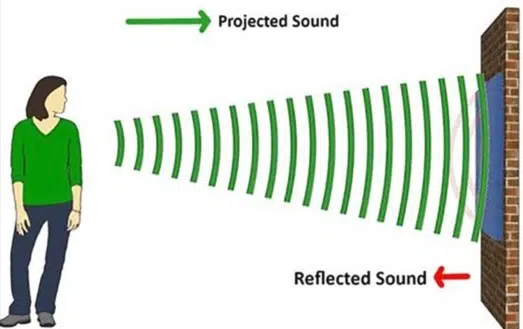
What is an Echo?
An echo is the sound heard again after it reflects from a distant surface. For example, shouting near a mountain, empty hall, or long corridor.
When Can We Hear an Echo?
The reflected sound must come back after at least 0.1 seconds, and then you can hear an echo. If the gap is less than 0.1 seconds, then the brain mixes the two sounds, and no separate echo is heard.
Minimum Distance for an Echo
If we take the speed of sound as 340 m/s, the distance traveled by sound in 0.1 s is
- 340 × 0.1 = 34 m
This 34 m is the total journey going and coming back both.
So the reflecting surface must be at least the following:
- 34 / 2 = 17 m
Minimum distance = 17 m
It means that if the wall is closer than 17 m, then you cannot hear a separate echo.
Example: You clap in an empty corridor and hear an echo after 0.5 s. If the speed of sound in air is 340 m s⁻¹, Calculate your distance from the wall.
Answer: Sound travels to the wall and back; thus,
\[\text{Distance from wall} = \frac{v \times t}{2}\]\[\text{Distance from wall} = \frac{340 \times 0.5}{2}\]\[= \frac{170}{2} = 85 \,\text{m}\]Reverberation
What is reverberation?
When the sound is reflected many times from the walls, roof, and floor in the large hall, then the sound continues to be heard even after the source stops. This is called reverberation. Reverberation is the persistence of sound due to multiple reflections.
For example, if you clap multiple times in the empty hall, then after stopping clapping, you hear the sound for a short time because it keeps bouncing off the walls.
Time Gap
Reverberation occurs when the reflected sound reaches our ears with a time gap of less than 0.05 seconds.
Remember
- Time gap < 0.05 s → Reverberation
- Time gap ≥ 0.1 s → Echo
Difference Between Echo and Reverberation
| Echo | Reverberation |
|---|---|
| Single reflection of sound. | Multiple reflections of sound. |
| Sound is heard again separately. | Sound continues |
| Time gap is 0.1 s or more. | Time gap is less than 0.05 s. |
| Common near mountains or cliffs. | Common in large halls and auditoriums. |
A small amount of reverberation makes speech clearer and music richer and more pleasant. That’s the way the modern auditoriums and concert halls are designed. If the reverberation is too much, then different sounds mix together and make speech difficult to understand.
How to reduce reverberation?
You can use soft materials, which can absorb sound and reduce multiple reflections. For example, curtains, carpets, sound-absorbing panels, or soft porous materials.
Ultrasonic and Infrasonic Waves and Their Applications
Sound waves with frequencies outside the human audible range have important applications in science, medicine, and technology.
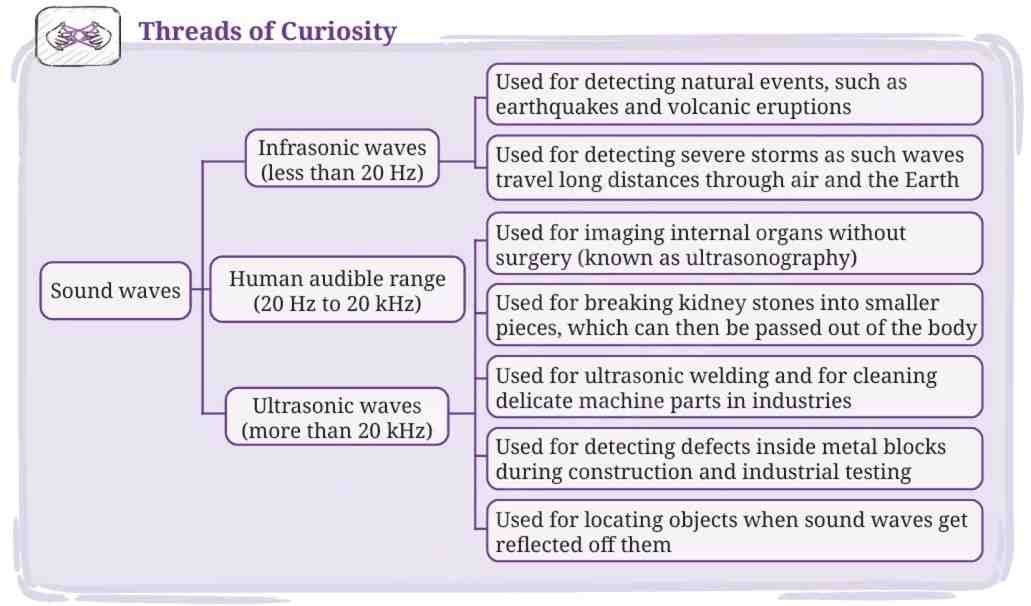
Echolocation
What is echolocation?
Echolocation is a method for finding the position of objects by using reflected sound waves.
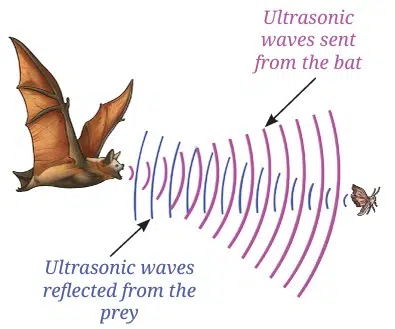
Benefit of Echolocation Work?
- An animal produces ultrasonic sound.
- The sound travels through the air or water.
- Ultrasonics hit the object and reflect back.
- The reflected sound (echo) returns to the animal because of this; the animal can find the object, how far the object is, and what the direction of the object is.
Example of a bat: Bats fly at night when it is dark; the bats do not rely on their eyes. So they use ultrasonic waves, listen to the echoes, avoid obstacles, and catch insects for food.
What type of sound is used by animals?
The animals use ultrasonic waves. This frequency is greater than 20,000 Hz (20 kHz). Humans cannot hear these sounds.
SONAR
What is SONAR?
SONAR stands for Sound Navigation and Ranging. SONAR is a device that works on the principle of echolocation. It uses ultrasonic waves to find objects underwater. A ship uses ultrasonic waves in the water; these waves hit an underwater object and reflect back as echoes. The SONAR device receives the echoes and calculates distance, direction
Example: A naval sonar signal sent into seawater returns after 0.90 s. The speed of sound in seawater is 1530 m s⁻¹. How far is the object?
Answer: Time taken for the signal to reach the object and travel back = 0.90 s
Time taken to reach the object is half of the above time.
\[t_{\text{total}} = 0.90 \,\text{s}\]\[t = \frac{t_{\text{total}}}{2} = \frac{0.90}{2} = 0.45 \,\text{s}\]Thus, distance = speed × time = 1530 m s⁻¹ × 0.45 s = 688.5 m.
Disclaimer: The content that is present on our website is based on the NCERT Class 9 Science textbook and is provided for educational purposes only. All the content and images have been taken from Science Class 9 NCERT Textbook and CBSE Support material. Images and content shown above are the property of individual organizations and are used here for reference purposes only. To make it easy to understand, some of the content and images are generated by AI and cross-checked by the teachers.