
Practice Pressure, Winds, Storms and Cyclones Class 8 MCQs with Answers to strengthen your understanding of air pressure, movement of winds, storms, cyclones, and safety measures. These objective questions are useful for Class 8 Science revision, homework, and exam preparation.
Pressure Winds Storms and Cyclones Class 8 MCQ with Answers
Conceptual Recall
Q. Pressure is defined as:
(a) Force × Area
(b) Force ÷ Area
(c) Area ÷ Force
(d) Mass ÷ Area
Answer: (b) Force ÷ Area
Explanation: Pressure is the force acting per unit area.
Q. The SI unit of pressure is:
(a) Joule
(b) Newton
(c) Pascal
(d) Watt
Answer: (c) Pascal
Explanation: 1 Pa = 1 N/m².
Q. The pressure exerted by the air around us is called:
(a) Buoyant force
(b) Atmospheric pressure
(c) Gravitational force
(d) Magnetic pressure
Answer: (b) Atmospheric pressure
Explanation: The envelope of air surrounding Earth exerts atmospheric pressure.
Q. The practical unit of air pressure often used in weather reports is:
(a) Pascal (Pa)
(b) Newton (N)
(c) Millibar (mb)
(d) Joule (J)
Answer: (c) Millibar (mb)
Explanation: 1 millibar = 100 Pa.
Q. Winds are formed because:
(a) Air moves from low pressure to high pressure
(b) Air moves from high pressure to low pressure
(c) Air moves only due to gravity
(d) Air moves only due to rotation of Earth
Answer: (b) Air moves from high pressure to low pressure
Explanation: Pressure differences drive wind movement.
Q. During the day, which region develops low pressure in coastal areas?
(a) Sea
(b) Land
(c) Both land and sea
(d) Neither land nor sea
Answer: (b) Land
Explanation: Land heats faster, air rises, creating low pressure.
Q. High‑speed winds are accompanied by:
(a) Increase in air pressure
(b) Decrease in air pressure
(c) No change in pressure
(d) Magnetic force
Answer: (b) Decrease in air pressure
Explanation: Faster winds → lower pressure region.
Q. A storm accompanied by lightning and thunder is called:
(a) Cyclone
(b) Thunderstorm
(c) Tornado
(d) Land breeze
Answer: (b) Thunderstorm
Explanation: Thunder + lightning + strong winds = thunderstorm.
Q. A cyclone is formed over:
(a) Cold ocean waters
(b) Warm ocean waters
(c) Deserts
(d) Mountains
Answer: (b) Warm ocean waters
Explanation: Warm moist air rises, creating low pressure and initiating cyclone formation.
Q. The calm region at the centre of a cyclone is called:
(a) Eye of cyclone
(b) Storm zone
(c) Pressure belt
(d) Rain band
Answer: (a) Eye of cyclone
Explanation: Eye has lowest pressure but calm winds.
Application-Based
Q. Why does a bag with broad straps feel more comfortable than one with narrow straps?
(a) Broad straps reduce weight
(b) Broad straps increase pressure
(c) Broad straps spread force over a larger area, reducing pressure
(d) Broad straps make the bag lighter
Answer: (c) Broad straps spread force over a larger area, reducing pressure
Explanation: Larger area → lower pressure → less pain on shoulders.
Q. Why are overhead water tanks placed at a height?
(a) To reduce water pressure
(b) To increase water pressure in taps
(c) To make tanks lighter
(d) To prevent evaporation
Answer: (b) To increase water pressure in taps
Explanation: Greater height of water column → greater pressure at bottom.
Q. Why does a balloon expand in all directions when air is blown into it?
(a) Gravity pulls the balloon outward
(b) Air inside exerts pressure equally in all directions
(c) Balloon becomes lighter
(d) Balloon repels water molecules
Answer: (b) Air inside exerts pressure equally in all directions
Explanation: Air pressure acts uniformly, causing expansion in all directions.
Q. Why does a rubber sucker stick firmly to a smooth surface?
(a) Gravity pulls it down
(b) Air pressure outside is greater than inside the sucker
(c) The sucker becomes magnetic
(d) Friction holds it tightly
Answer: (b) Air pressure outside is greater than inside the sucker
Explanation: Pressure difference keeps the sucker attached to the surface.
Q. Why does a punctured bicycle tube collapse?
(a) Air moves from low pressure to high pressure
(b) Air escapes from high pressure inside to low pressure outside
(c) Gravity pulls air out
(d) Tube becomes heavier
Answer: (b) Air escapes from high pressure inside to low pressure outside
Explanation: Air always flows from high pressure to low pressure regions.
Q. At night, wind blows from land to sea. Why?
(a) Land is cooler, creating high pressure
(b) Sea is cooler, creating high pressure
(c) Land becomes magnetic
(d) Gravity pulls air towards sea
Answer: (a) Land is cooler, creating high pressure
Explanation: Cooler land → high pressure → wind flows towards low pressure over sea.
Q. Why is it safer to keep doors and windows open during a storm with high‑speed winds?
(a) To let rainwater enter
(b) To reduce pressure difference between inside and outside
(c) To make the house cooler
(d) To allow lightning to pass through
Answer: (b) To reduce pressure difference between inside and outside
Explanation: Equalising pressure prevents roofs from being blown away.
Q. Why are lightning conductors installed on tall buildings?
(a) To attract lightning and destroy the building
(b) To provide a safe path for charges to flow into the ground
(c) To reduce wind pressure
(d) To measure atmospheric pressure
Answer: (b) To provide a safe path for charges to flow into the ground
Explanation: Metallic rod directs charges safely into Earth.
Q. Why does a cyclone lose strength after reaching land?
(a) Land is cooler and cuts off moist air supply
(b) Land increases wind speed
(c) Land makes cyclone heavier
(d) Land reduces gravity
Answer: (a) Land is cooler and cuts off moist air supply
Explanation: Moisture from ocean fuels cyclone; cut off → weakening.
Q. Why is it important to follow IMD alerts during cyclones?
(a) To know rainfall amount
(b) To predict cyclone path and reduce damage
(c) To measure soil fertility
(d) To calculate air pressure
Answer: (b) To predict cyclone path and reduce damage
Explanation: Weather satellites and IMD warnings help protect life and property.
Assertion–Reason
Q. Assertion (A): Liquids exert pressure in all directions.
Reason (R): Water flows out through holes made at the same height on the sides of a bottle.
(a) Both A and R are true, R explains A
(b) Both A and R are true, R does not explain A
(c) A true, R false
(d) A false, R true
Answer: (a) Both A and R are true, R explains A
Explanation: Water pressure acts sideways as well as downward.
Q. Assertion (A): The base of a dam is broader than the top.
Reason (R): Water pressure increases with depth.
(a) Both A and R are true, R explains A
(b) Both A and R are true, R does not explain A
(c) A true, R false
(d) A false, R true
Answer: (a) Both A and R are true, R explains A
Explanation: Greater depth → greater horizontal pressure → stronger base needed.
Q. Assertion (A): We are not crushed under atmospheric pressure.
Reason (R): The pressure inside our bodies balances the atmospheric pressure outside.
(a) Both A and R are true, R explains A
(b) Both A and R are true, R does not explain A
(c) A true, R false
(d) A false, R true
Answer: (a) Both A and R are true, R explains A
Explanation: Internal body fluids exert equal pressure, balancing external pressure.
Q. Assertion (A): Effort needed to lift a paper plate covered with unfolded chart paper is greater than with folded chart paper.
Reason (R): Atmospheric pressure increases with the area of the covering sheet.
(a) Both A and R are true, R explains A
(b) Both A and R are true, R does not explain A
(c) A true, R false
(d) A false, R true
Answer: (a) Both A and R are true, R explains A
Explanation: Larger area → greater force exerted by air → more effort required.
Q. Assertion (A): Sea breeze occurs during the day.
Reason (R): Land heats faster than water, creating low pressure over land.
(a) Both A and R are true, R explains A
(b) Both A and R are true, R does not explain A
(c) A true, R false
(d) A false, R true
Answer: (a) Both A and R are true, R explains A
Explanation: Warm air rises over land, cooler sea air moves in.
Q. Assertion (A): Air flow stops when pressure in two connected balloons becomes equal.
Reason (R): Air moves only until pressure difference exists.
(a) Both A and R are true, R explains A
(b) Both A and R are true, R does not explain A
(c) A true, R false
(d) A false, R true
Answer: (a) Both A and R are true, R explains A
Explanation: Equal pressure → no net movement of air.
Q. Assertion (A): Blowing air between two balloons makes them move closer.
Reason (R): High‑speed air creates low pressure between balloons, and higher pressure outside pushes them together.
(a) Both A and R are true, R explains A
(b) Both A and R are true, R does not explain A
(c) A true, R false
(d) A false, R true
Answer: (a) Both A and R are true, R explains A
Explanation: Pressure difference causes balloons to move inward.
Q. Assertion (A): Lightning is caused by charge separation in clouds.
Reason (R): Strong winds cause rubbing between water droplets and ice particles, producing static charges.
(a) Both A and R are true, R explains A
(b) Both A and R are true, R does not explain A
(c) A true, R false
(d) A false, R true
Answer: (a) Both A and R are true, R explains A
Explanation: Rubbing → charges → separation → lightning.
Case/Experiment-Based
Q. In the activity, two pipes of different diameters were filled with water to the same height. Both balloons bulged equally. What does this show?
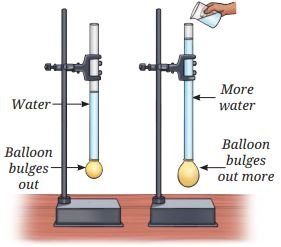
(a) Pressure depends on diameter of pipe
(b) Pressure depends only on height of water column
(c) Pressure depends on weight of water
(d) Pressure does not exist in liquids
Answer: (b) Pressure depends only on height of water column
Explanation: Equal height → equal pressure, regardless of diameter.
Q. In Activity, a paper plate covered with unfolded chart paper was harder to lift than with folded chart paper. What does this prove?
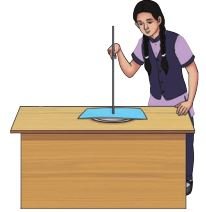
(a) Air has no pressure
(b) Air exerts pressure on surfaces, increasing with area
(c) Chart paper becomes heavier when unfolded
(d) Gravity disappears under paper
Answer: (b) Air exerts pressure on surfaces, increasing with area
Explanation: Atmospheric pressure acts on the sheet, resisting lifting.
Q. In the activity, air moved from the inflated balloon to the uninflated balloon until both became equal in size. What conclusion can be drawn?

(a) Air moves randomly between balloons
(b) Air moves from high pressure to low pressure until balance is reached
(c) Air moves only due to gravity
(d) Air moves only when balloons are punctured
Answer: (b) Air moves from high pressure to low pressure until balance is reached
Explanation: Pressure difference drives air flow until equilibrium.
Q. In Activity, two balloons moved closer when air was blown between them. What conclusion can be drawn?
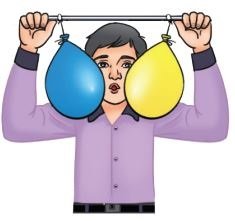
(a) Air pressure increases with wind speed
(b) High‑speed winds reduce air pressure, causing surrounding higher pressure to push balloons together
(c) Balloons are magnetic
(d) Gravity pulls balloons inward
Answer: (b) High‑speed winds reduce air pressure, causing surrounding higher pressure to push balloons together
Explanation: Demonstrates link between wind speed and pressure.
Q. The Amphan cyclone in 2020 had peak wind speeds of 270 km/h and caused flooding, landslides, and power outages. What does this case show?
(a) Cyclones are harmless natural events
(b) Cyclones can cause widespread destruction to life and property
(c) Cyclones reduce soil fertility
(d) Cyclones only affect oceans
Answer: (b) Cyclones can cause widespread destruction to life and property
Explanation: Amphan demonstrated the destructive power of cyclones.
Diagram/Visual-Based
Q. In the figure, balloons attached to pipes bulge more when water column height increases. What does this show?
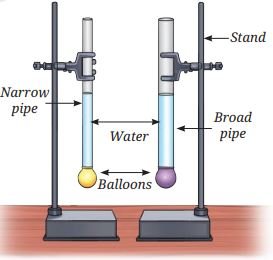
(a) Pressure decreases with height
(b) Pressure increases with height of liquid column
(c) Pressure depends only on pipe material
(d) Pressure is independent of liquid height
Answer: (b) Pressure increases with height of liquid column
Explanation: Taller water column → greater pressure at bottom.
Q. In the figure, water flows out of holes made at the same height on a bottle’s sides. What does this prove?
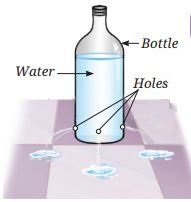
(a) Liquids exert pressure only at the bottom
(b) Liquids exert pressure sideways as well
(c) Liquids exert no pressure
(d) Liquids exert pressure only upwards
Answer: (b) Liquids exert pressure sideways as well
Explanation: Water spurts out due to sideways pressure.
Q. In the figure, a girl blows air into a balloon. Why does the balloon inflate?
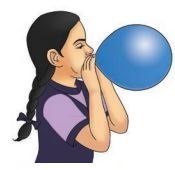
(a) Balloon becomes lighter
(b) Air pressure inside pushes outward in all directions
(c) Gravity pulls balloon walls outward
(d) Balloon absorbs water vapour
Answer: (b) Air pressure inside pushes outward in all directions
Explanation: Air pressure inflates the balloon equally in all directions.
Q. In the figure, a rubber sucker sticks to a smooth surface. What force keeps it attached?
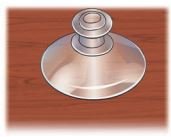
(a) Gravitational force
(b) Atmospheric pressure difference
(c) Magnetic force
(d) Frictional force
Answer: (b) Atmospheric pressure difference
Explanation: Higher external air pressure compared to inside keeps sucker stuck.
Q. In the figure, air moves from one balloon to another. What does this diagram illustrate?

(a) Air moves from low pressure to high pressure
(b) Air moves from high pressure to low pressure
(c) Air does not exert pressure
(d) Balloons collapse due to gravity
Answer: (b) Air moves from high pressure to low pressure
Explanation: Inflated balloon (high pressure) → uninflated balloon (low pressure).
Q. In coastal areas, which diagram correctly shows wind direction at night?
(a) Wind from sea to land
(b) Wind from land to sea
(c) Wind from land to sky
(d) Wind from sea to sky
Answer: (b) Wind from land to sea
Explanation: Cooler land → high pressure → wind flows towards sea.
Q. In the figure, roofs of houses are blown away by strong winds. What causes this?
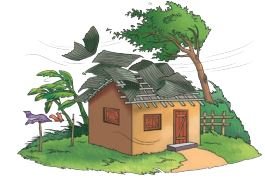
(a) Gravity pulling roofs upward
(b) Pressure above roof lower than pressure inside house
(c) Roofs becoming lighter in storms
(d) Magnetic force acting on roofs
Answer: (b) Pressure above roof lower than pressure inside house
Explanation: Large pressure difference lifts weak roofs.
Q. In the figure, the lower part of a cloud is negatively charged and the ground becomes positively charged. What phenomenon is shown?
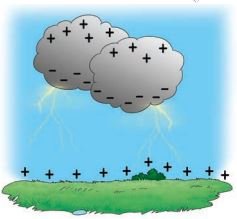
(a) Friction
(b) Lightning formation
(c) Buoyant force
(d) Gravitational pull
Answer: (b) Lightning formation
Explanation: Charge separation between cloud and ground leads to lightning.
Q. In the figure, winds blow from high pressure areas to low pressure areas. What does this diagram illustrate?
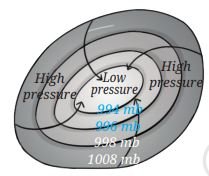
(a) Cyclone formation due to pressure differences
(b) Earth’s gravity pulling winds
(c) Magnetic force acting on winds
(d) Winds moving randomly
Answer: (a) Cyclone formation due to pressure differences
Explanation: Air rushes into low pressure, spins due to Earth’s rotation.
Q. In the figure, the cyclone has a calm centre. What does this represent?
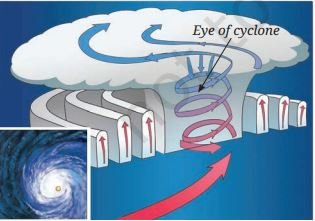
(a) Eye of cyclone
(b) Storm surge
(c) Rain band
(d) Pressure belt
Answer: (a) Eye of cyclone
Explanation: Eye is calm, surrounded by destructive winds and rain.
Disclaimer: The content that is present on our website is based on the NCERT Class 8 Science textbook and is provided for educational purposes only. All the content and images have been taken from Science Class 8 NCERT Textbook. Images and content shown above are the property of individual organizations and are used here for reference purposes only. To make it easy to understand, some of the content and images are generated by AI and cross-checked by the teachers.