
Health The Ultimate Treasure Class 8 Extra Questions and Answers provides important additional questions based on the chapter. These questions help students revise key concepts such as good health, healthy habits, nutrition, physical activity, hygiene, mental well-being, and disease prevention. The answers are written in simple and easy-to-understand language for Class 8 students and are useful for exam preparation and revision.
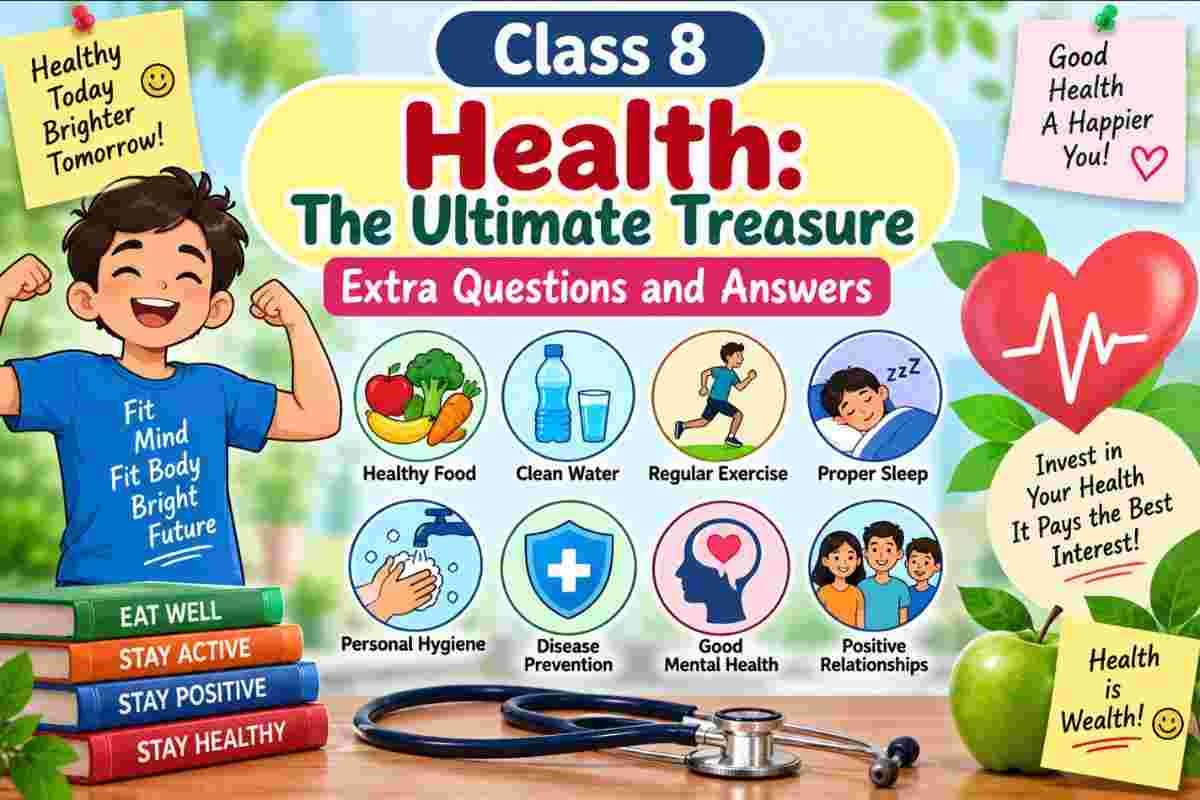
Health The Ultimate Treasure Class 8 Extra Questions and Answers
Short‑Answer Questions
Q. Define health as per the World Health Organization (WHO).
Answer: Health means complete physical, mental, and social well‑being, not just the absence of disease.
Q. List any two good habits that help us stay healthy.
Answer:
- Eating a balanced diet.
- Exercising regularly.
Q. Mention two bad habits that can harm our health.
Answer:
- Spending too much time on mobile phones.
- Eating junk food every day.
Q. Define pathogens and give two examples.
Answer: Pathogens are disease-causing microorganisms or other infectious agents. Examples include bacteria, viruses, fungi, and protozoa.
Q. What are non‑communicable diseases? Give two examples.
Answer: Non‑communicable diseases do not spread from person to person. Examples: diabetes and asthma.
Q. Name two diseases spread through contaminated food or water.
Answer: Cholera and typhoid.
Q. What are vectors? Give one example.
Answer: Vectors are living organisms that carry and spread disease-causing pathogens from one host to another. Mosquitoes are common examples.
Q. What is meant by immunity?
Answer: Immunity is the natural ability of our body to fight diseases.
Q. Define vaccine and give one example.
Answer: A vaccine trains the immune system to fight germs. Example: polio vaccine.
Q. Who discovered the first vaccine and for which disease?
Answer: Edward Jenner discovered the first vaccine for smallpox.
Q. What are antibiotics? Why do they not work against viruses?
Answer: Antibiotics are medicines used to treat bacterial infections. They do not work against viruses because antibiotics act on bacterial structures or processes that viruses do not have.
Reason‑Based Questions
Q. Why is health more than just not having diseases?
Answer: Because health also means feeling good physically, staying positive, and having good relationships, not only being free from illness.
Q. Why is spending too much time on mobile phones harmful for health?
Answer: It can cause eye problems, sleep disorders, obesity, and loneliness.
Q. Why is sleep important for maintaining good health?
Answer: Sleep gives rest to the body and mind, helps recovery, and keeps us active and fresh.
Q. Why should harmful substances such as tobacco and alcohol be avoided to maintain good health?
Answer: They damage organs, cause serious diseases, and reduce life span.
Q. Why are diseases like diabetes and cancer called non‑communicable?
Answer: Because they are not caused by germs and do not spread from one person to another.
Q. Why do people living in polluted areas fall sick more often?
Answer: Polluted air and water carry harmful substances that cause breathing problems, infections, and other diseases.
Q. Why should we cover our mouth and nose while coughing or sneezing?
Answer: To stop germs from spreading to other people.
Q. Why are deficiency diseases also considered non‑communicable?
Answer: Because they are caused by lack of nutrients in food, not by germs, and they do not spread.
Q. Why is prevention considered better than cure?
Answer: Preventing disease saves health, time, and money, and avoids suffering.
Q. Why should antibiotics be taken only when prescribed by a doctor?
Answer: Wrong use can harm the body and lead to antibiotic resistance.
Q. Why are vaccines mainly used to prevent diseases rather than to cure an existing infection?
Answer: Vaccines train the immune system before infection. They cannot cure once the disease has already started.
Q. Why does indiscriminate use of antibiotics lead to antibiotic resistance?
Answer: Indiscriminate or unnecessary use of antibiotics can select bacteria that are resistant to the medicine. These resistant bacteria can survive and multiply, making infections harder to treat.
Application‑Based Questions
Q. A student feels tired and cannot concentrate because he sleeps very late. Explain how this habit affects his health.
Answer: Sleeping late reduces rest for the body and brain. It causes tiredness, poor memory, and weak concentration.
Q. How can practicing yoga or pranayama regularly improve both physical and mental health?
Answer: Yoga and pranayama keep the body flexible, improve breathing, reduce stress, and increase focus.
Q. A person eats junk food every day. What health problems might arise from this habit?
Answer: Eating junk food daily can cause obesity, diabetes, heart problems, and poor growth.
Q. How does keeping the environment clean help people stay healthy?
Answer: Clean surroundings reduce germs, mosquitoes, and pollution. This prevents diseases and makes life healthier.
Q. A child eats street food without washing hands. Explain how this habit can lead to disease.
Answer: Dirty hands carry germs. Eating without washing can cause stomach infections like typhoid or cholera.
Q. How can using mosquito nets and repellents protect people from malaria and dengue?
Answer: Nets and repellents stop mosquito bites. This prevents diseases like malaria and dengue.
Q. A person drinks unboiled water every day. What diseases might they suffer from and why?
Answer: They may suffer from cholera, typhoid, or hepatitis A because unboiled water contains germs.
Q. How can lifestyle changes help prevent diseases like obesity and high blood pressure?
Answer: Eating healthy food, exercising daily, and reducing oil and sugar in diet prevent obesity and high blood pressure.
Q. A child receives a tetanus shot after an injury. Explain how this vaccine protects the child.
Answer: The tetanus vaccine trains the immune system to fight tetanus bacteria, preventing infection.
Q. How can community sanitation campaigns reduce the spread of diarrhoea and infections?
Answer: Campaigns promote toilet use and clean surroundings. This reduces open defecation and prevents diarrhoea and infections.
Q. A person refuses vaccination due to fear. What risks might this cause for both the person and society?
Answer: The person may get serious diseases, and germs can spread to others, causing outbreaks.
Q. How can lifestyle changes help in managing non‑communicable diseases like diabetes or high blood pressure?
Answer: Regular exercise, balanced diet, less sugar and oil, and stress control help manage diabetes and blood pressure.
Case‑Based Questions
Q. Case Study: A Grade 8 student moved to a new school in another city. He had no friends in the new environment, and his parents were busy. To cope with loneliness, he spent more time on his phone and social media. Instead of feeling better, his health started to decline.
Q1. What was the main cause of his health problems?
Answer: The main cause was loneliness and excessive use of social media, which harmed his health.
Q2. How did his habits affect his well‑being?
Answer: Spending too much time on social media and avoiding social interaction affected his mental and social health. It also disturbed his sleep and made him physically weak.
Q3. What advice did the doctor and counsellor give?
Answer: The doctor advised less screen time, and the counsellor helped him make friends.
Q. Case Study: Students visited two playgrounds in their town. One playground was clean, well‑maintained, and free from garbage. The other playground was dirty, full of waste, flies, and stagnant water.
Q1. Which playground is better for health and why?
Answer: The clean playground is better because it is safe, hygienic, and free from germs. Children can play without risk of disease.
Q2. How can a polluted environment affect people’s health?
Answer: Polluted surroundings can cause breathing problems, infections, and frequent sickness. Mosquitoes and flies spread diseases like malaria and diarrhoea.
Q3. What lesson do we learn from this comparison?
Answer: We must keep our surroundings clean to stay healthy. Clean environments support good physical and mental health.
Q. Case Study: Grade 8 students organized a community campaign to spread awareness about communicable diseases. They collected information from books, teachers, and trusted sources. They listed diseases, their causes, and preventive measures to educate people in their locality.
Q1. Name two diseases spread through air.
Answer: Common cold and measles.
Q2. What preventive steps can be taken for these diseases?
Answer: Washing hands regularly, covering mouth and nose while coughing or sneezing, and isolating infected patients.
Q3. Why is vaccination important in such cases?
Answer: Vaccination protects people before infection. It prevents outbreaks and keeps the community safe.
Q. Case Study: A farmer’s family lives in a village where clean drinking water is not easily available. They often drink water directly from wells or ponds without boiling or filtering it. The surroundings are also not very hygienic.
Q1. What is the cause of these diseases?
Answer: The main cause is drinking contaminated water and poor hygiene practices. Germs enter the body through dirty water and food.
Q2. How can the family prevent them?
Answer: By boiling water, eating clean food, and maintaining hygiene.
Q3. What role does hygiene play in this situation?
Answer: Hygiene stops germs from entering the body. Clean water, food, and hands prevent diarrhoea and typhoid.
Q. Case Study: In Bhadrak district of Odisha, many families practiced open defecation. This made the surroundings dirty and contaminated food and water. Children often suffered from diarrhoea and other infections.
Q1. What was the main reason for fewer cases of diarrhoea?
Answer: Building and using toilets reduced open defecation. This stopped germs from spreading into food and water.
Q2. How did sanitation help prevent disease spread?
Answer: Clean surroundings prevented contamination. Germs could not enter drinking water or food, so infections reduced.
Q3. What lesson can other communities learn from this?
Answer: Good sanitation improves child health, prevents infections, and makes the environment safe. Communities should work together to keep surroundings clean.
Q. Case Study: A patient was suffering from a bacterial infection. The doctor prescribed antibiotics for 7 days. However, the patient stopped taking the medicine after 3 days because he felt better.
Q1. How can this lead to antibiotic resistance?
Answer: Incomplete doses allow some bacteria to survive. These bacteria adapt and become resistant to the antibiotic. Later, the same medicine may not work against them.
Q2. What dangers does antibiotic resistance pose to society?
Answer: It makes common infections harder to treat and increases risk of serious illness.
Q3. Suggest two precautions to avoid this problem.
Answer: Take antibiotics only with a doctor’s advice and complete the full dose.
Experiment‑Based Questions
Q. Suggest an activity to show the importance of personal hygiene in staying healthy.
Answer: Students can wash their hands before eating and compare with those who don’t. The group with clean hands will have fewer stomach problems, showing hygiene keeps us healthy.
Q. How can comparing sleep patterns of two students (one with proper sleep, one without) demonstrate the role of rest in health?
Answer: The student with proper sleep will feel fresh and concentrate better, while the one without sleep will feel tired and weak. This shows rest is important for health.
Q. Design a simple activity to show how too much screen time affects social health.
Answer: Observe two groups of students—one spends more time outdoors, the other spends more time on screens. The outdoor group will be more active and social, showing screen time reduces social health.
Q. Suggest an activity to show how diseases can spread through contaminated water.
Answer: Take two clean containers and fill them with safe water. Add a small amount of harmless coloured food dye to one container to represent contamination. Discuss how contaminated water can carry disease-causing pathogens into the body when it is consumed. Students can then list diseases such as cholera and typhoid and ways to prevent them.
Q. Design a simple classroom activity to demonstrate the importance of washing hands in preventing disease.
Answer: Students can handle separate bread slices with clean and unwashed hands and keep them sealed for observation under teacher supervision. Changes in the slices can be compared over several days. The activity helps students understand that microorganisms can be transferred by hands and that handwashing reduces contamination.
Q. How can a survey in your neighbourhood help identify common lifestyle‑related diseases?
Answer: By asking families about health problems like diabetes, obesity, or blood pressure. The survey shows which diseases are common and what lifestyle changes are needed.
Q. Suggest an activity to show how vaccination helps in preventing diseases.
Answer: Students can study a teacher-provided hypothetical outbreak table comparing vaccinated and unvaccinated groups. If fewer cases occur among vaccinated people, students can discuss how vaccination reduces the risk of disease and helps protect communities.
Q. How can observing two groups (one vaccinated, one not) during a disease outbreak show the importance of vaccines?
Answer: In an outbreak, the vaccinated group will be safe, while the unvaccinated group may get infected. This proves vaccines protect people.
Differentiate Questions
Q. Differentiate between symptoms and signs of illness with examples.
Answer:
- Symptoms: What we feel (example – tiredness, pain).
- Signs: What can be seen or measured (example – fever, rash).
Q. Compare the lifestyle of a healthy person and an unhealthy person.
Answer:
- Healthy person: Eats balanced food, exercises, sleeps well, stays positive.
- Unhealthy person: Eats junk food, sleeps late, avoids exercise, feels stressed.
Q. Differentiate between physical health and social health.
Answer:
- Physical health: Strong body, no illness, proper nutrition.
- Social health: Good relationships, ability to adjust with others, feeling happy with friends and family.
Q. Differentiate between communicable and non‑communicable diseases with examples.
Answer:
- Communicable diseases: Spread from one person to another (example – flu, dengue).
- Non‑communicable diseases: Do not spread, linked to lifestyle (example – diabetes, cancer).
Q. Compare diseases spread through air and diseases spread through food/water.
Answer:
- Air‑borne diseases: Spread when an infected person coughs or sneezes (example – measles, TB).
- Food/Water‑borne diseases: Spread by eating or drinking contaminated food/water (example – cholera, typhoid).
Q. Differentiate between chronic diseases and short‑term diseases with examples.
Answer:
- Chronic diseases: Long‑lasting, may continue for years (example – diabetes, asthma).
- Short‑term diseases: Last for a short time (example – common cold, diarrhoea).
Q. Differentiate between natural immunity and acquired immunity.
Answer:
- Natural immunity: Immunity that develops naturally, without receiving a vaccine.
- Acquired immunity: Immunity that develops after exposure to a pathogen or through vaccination.
Q. Compare vaccines and antibiotics in terms of their role in disease prevention and treatment.
Answer:
- Vaccines: Prevent diseases by training the immune system before infection.
- Antibiotics: Medicines used to treat bacterial infections by killing bacteria or stopping their growth.
Q. Differentiate between traditional medicine systems (like Ayurveda) and modern medicine in managing diseases.
Answer:
- Traditional medicine (Ayurveda, Siddha, Unani): Uses herbs, oils, lifestyle balance, focuses on prevention and recovery.
- Modern medicine: Uses scientifically tested drugs, vaccines, and antibiotics for quick treatment and cure.
Competency‑Based Questions
Q. Explain how lifestyle and environment together affect our health.
Answer: Eating habits, exercise, sleep, and hygiene are part of lifestyle. Clean air, water, and surroundings are part of environment. Both together decide if we stay healthy or fall sick.
Q. How does Ayurveda suggest maintaining balance in body, mind, and surroundings?
Answer: Ayurveda advises following daily routine (dinacharya) and seasonal routine (ritucharya), eating fresh food, exercising, sleeping well, and practicing yoga or meditation.
Q. Discuss the importance of family and friends in maintaining mental and social health.
Answer: Spending time with family and friends reduces stress, makes us happy, and helps us feel supported. This keeps our mind and social life healthy.
Q. Explain how adopting good habits and avoiding bad habits can improve overall well‑being.
Answer: Good habits like eating healthy, exercising, and sleeping on time make us strong. Avoiding bad habits like junk food, smoking, or too much screen time prevents diseases.
Q. Explain how lifestyle changes can reduce the risk of non‑communicable diseases.
Answer: Regular exercise, balanced diet, less sugar and oil, and stress control reduce the risk of diabetes, obesity, and heart disease.
Q. Discuss the importance of hygiene and vaccination in preventing communicable diseases.
Answer: Hygiene stops germs from spreading. Vaccination trains the body to fight diseases before they happen. Together they protect people from infections.
Q. How do vectors like mosquitoes contribute to the spread of diseases?
Answer: Mosquitoes carry germs in their bite. They spread diseases like malaria and dengue from one person to another.
Q. Explain how both environment and personal habits affect the spread of diseases.
Answer: Dirty surroundings spread germs, while bad habits like not washing hands increase risk. Clean environment and good habits prevent diseases.
Q. Explain how vaccination campaigns can protect both individuals and communities.
Answer: Vaccines protect each person. When many people are vaccinated, germs cannot spread easily, so the whole community stays safe.
Q. Discuss the importance of using antibiotics wisely to prevent resistance.
Answer: Taking antibiotics only when needed and completing the dose prevents bacteria from becoming resistant. This keeps antibiotics useful for future.
Q. How do traditional practices like Ayurveda support overall well‑being?
Answer: Ayurveda is a traditional system of medicine that uses approaches such as diet, lifestyle practices and plant-based preparations. Modern medicine uses methods and treatments developed and evaluated through modern scientific research.
Q. Explain how community efforts and individual habits together help in preventing diseases.
Answer: Community efforts like sanitation campaigns keep surroundings clean. Individual habits like handwashing and eating healthy protect each person. Together they stop diseases.
HOTS Question
Q. Imagine a city where everyone eats healthy food and exercises but the environment is very polluted. Do you think people will still be healthy? Justify your answer with reasons.
Answer: No, people will not be fully healthy. Pollution makes air and water dirty. Breathing polluted air can cause asthma, cough, and lung disease. Dirty water can spread cholera and typhoid. Even with good food and exercise, polluted surroundings harm health.
Q. Imagine a world without vaccinations. How would this affect the spread of communicable diseases? Give reasons with examples.
Answer: Without vaccination, people would have less protection against vaccine-preventable diseases such as measles and polio. Outbreaks could occur more easily, especially when infections spread among people who are not protected.
Q. Imagine a future where antibiotics no longer work due to resistance. How would this affect healthcare and daily life? Suggest possible solutions.
Answer: If antibiotics stop working, simple infections will become serious and hard to treat. Hospital stays will be longer, and more people may die from common diseases.
Solutions: Use antibiotics only when prescribed, complete the full dose, improve hygiene, and develop new medicines.
Disclaimer: The content that is present on our website is based on the NCERT Class 8 Science textbook and is provided for educational purposes only. All the content and images have been taken from Science Class 8 NCERT Textbook. Images and content shown above are the property of individual organizations and are used here for reference purposes only. To make it easy to understand, some of the content and images are generated by AI and cross-checked by the teachers.