
← Back to Class 10 Study Material
Our Environment Class 10 MCQs are designed to help students revise important concepts from the Class 10 Science chapter Our Environment. These multiple-choice questions cover topics such as ecosystems, food chains, food webs, trophic levels, energy flow, biodegradable and non-biodegradable substances, and ozone layer depletion. Students can use these MCQs for quick revision, self-assessment, and board exam preparation.
Our Environment Class 10 MCQ
Conceptual Recall
Q. An ecosystem consists of:
a) Only living organisms
b) Only physical surroundings
c) Living organisms and non-living components interacting together
d) Only plants and animals
Answer: c) Living organisms and non-living components interacting together
Q. Which of the following is an abiotic component of an ecosystem?
a) Frog
b) Bacteria
c) Grass
d) Soil
Answer: d) Soil
Q. In a food chain, producers occupy the:
a) Second trophic level
b) Third trophic level
c) First trophic level
d) Fourth trophic level
Answer: c) First trophic level
Q. A series of organisms feeding on one another is called a:
a) Food web
b) Ecosystem
c) Trophic level
d) Food chain
Answer: d) Food chain
Q. Ozone is a molecule made up of:
a) One oxygen atom
b) Two oxygen atoms
c) Three oxygen atoms
d) Four oxygen atoms
Answer: c) Three oxygen atoms
Q. The ozone layer protects life on Earth from:
a) Infrared radiation
b) Ultraviolet radiation
c) Radio waves
d) Sound waves
Answer: b) Ultraviolet radiation
Q. Substances that are broken down by biological processes are called:
a) Non-biodegradable substances
b) Biodegradable substances
c) Synthetic substances
d) Toxic substances
Answer: b) Biodegradable substances
Q. Which of the following is non-biodegradable?
a) Vegetable peels
b) Used tea leaves
c) Plastic wrapper
d) Paper waste
Answer: c) Plastic wrapper
Application-Based
Q. An aquarium contains fish, aquatic plants and microorganisms. Why are aquatic plants important in this ecosystem?
a) They act as decomposers
b) They prepare food and release oxygen
c) They consume all microorganisms
d) They increase water temperature
Answer: b) They prepare food and release oxygen
Q. What is likely to happen if decomposers are absent from an ecosystem?
a) Dead organisms will accumulate in the environment
b) Producers will stop photosynthesis immediately
c) Rainfall will decrease
d) Consumers will become producers
Answer: a) Dead organisms will accumulate in the environment
Q. A garden is considered an ecosystem because:
a) It contains only plants
b) It is larger than a pond
c) Living organisms interact with abiotic components there
d) It receives sunlight
Answer: c) Living organisms interact with abiotic components there
Q. A grassland ecosystem has the food chain: Grass → Deer → Tiger. The deer is a:
a) Producer
b) Primary consumer
c) Secondary consumer
d) Decomposer
Answer: b) Primary consumer
Q. If 10,000 units of energy are available in plants, approximately how much energy will be available to the primary consumers according to the 10% law?
a) 100 units
b) 10 units
c) 1,000 units
d) 5,000 units
Answer: c) 1,000 units
Q. Why do food chains generally consist of only three or four trophic levels?
a) Producers are always few in number
b) Most energy is lost at each trophic level
c) Consumers stop feeding after the fourth level
d) Decomposers destroy the food chain
Answer: b) Most energy is lost at each trophic level
Q. Why has it become mandatory to manufacture CFC-free refrigerators?
a) To reduce noise pollution
b) To save electricity
c) To prevent depletion of the ozone layer
d) To increase cooling efficiency
Answer: c) To prevent depletion of the ozone layer
Q. A student buries vegetable peels, paper and plastic bags in soil. After several weeks, the plastic bags remain unchanged. This shows that plastic is:
a) Biodegradable
b) Non-biodegradable
c) Renewable
d) Organic
Answer: b) Non-biodegradable
Q. Which of the following is most likely to decompose naturally in the environment?
a) Plastic bottle
b) Aluminium foil
c) Glass jar
d) Vegetable peels
Answer: d) Vegetable peels
Q. A household separates kitchen waste from plastic waste before disposal. What is the main advantage of this practice?
a) It increases waste generation
b) It helps in separate treatment of biodegradable and non-biodegradable waste
c) It prevents cooking waste from decomposing
d) It reduces the amount of plastic produced
Answer: b) It helps in separate treatment of biodegradable and non-biodegradable waste
Q. Why do plastic bags accumulate in landfills for many years?
a) They are edible for microorganisms
b) They dissolve quickly in water
c) They are not easily broken down by decomposers
d) They produce oxygen during decomposition
Answer: c) They are not easily broken down by decomposers
Q. Which of the following wastes is most suitable for compost preparation?
a) Plastic bottles
b) Glass pieces
c) Aluminium cans
d) Vegetable peels
Answer: d) Vegetable peels
Assertion–Reason
Q. Assertion (A): Producers occupy the first trophic level in a food chain.
Reason (R): Producers convert solar energy into chemical energy and make food available to other organisms.
a) Both A and R are true, and R is the correct explanation of A
b) Both A and R are true, but R is not the correct explanation of A
c) A is true, but R is false
d) A is false, but R is true
Answer: a) Both A and R are true, and R is the correct explanation of A
Q. Assertion (A): Forests and ponds are natural ecosystems.
Reason (R): They are created and maintained entirely by human beings.
a) Both A and R are true
b) A is true, but R is false
c) A is false, but R is true
d) Both A and R are false
Answer: b) A is true, but R is false
Q. Assertion (A): Energy flow in an ecosystem is unidirectional.
Reason (R): Energy transferred to the consumers does not return to the producers.
a) Both A and R are true, and R is the correct explanation of A
b) Both A and R are true, but R is not the correct explanation of A
c) A is true, but R is false
d) A is false, but R is true
Answer: a) Both A and R are true, and R is the correct explanation of A
Q. Assertion (A): Food webs are more complex than food chains.
Reason (R): An organism may be eaten by more than one type of consumer.
a) A is true, but R is false
b) Both A and R are false
c) Both A and R are true, and R is the correct explanation of A
d) A is false, but R is true
Answer: c) Both A and R are true, and R is the correct explanation of A
Q. Assertion (A): Ozone is poisonous at the Earth’s surface.
Reason (R): Ozone present high in the atmosphere protects us from harmful UV radiation.
a) Both A and R are true, but R is not the correct explanation of A
b) Both A and R are true, and R is the correct explanation of A
c) A is true, but R is false
d) A is false, but R is true
Answer: a) Both A and R are true, but R is not the correct explanation of A
Q. Assertion (A): Biodegradable substances do not remain in the environment for long periods.
Reason (R): They can be broken down by biological processes.
a) A is false, but R is true
b) Both A and R are false
c) Both A and R are true, and R is the correct explanation of A
d) Both A and R are true, but R is not the correct explanation of A
Answer: c) Both A and R are true, and R is the correct explanation of A
Q. Assertion (A): Modern lifestyles have increased the amount of waste generated.
Reason (R): More and more products are being used as disposable items.
a) Both A and R are true, and R is the correct explanation of A
b) Both A and R are true, but R is not the correct explanation of A
c) A is true, but R is false
d) A is false, but R is true
Answer: a) Both A and R are true, and R is the correct explanation of A
Q. Assertion (A): Non-biodegradable wastes may remain in the environment for a long time.
Reason (R): They cannot be easily broken down by biological processes.
a) Both A and R are false
b) A is true, but R is false
c) Both A and R are true, and R is the correct explanation of A
d) A is false, but R is true
Answer: c) Both A and R are true, and R is the correct explanation of A
Case Study-Based
Case Study: A student set up an aquarium containing fish, aquatic plants and microorganisms. After several weeks, a few fish died. The microorganisms present in the aquarium started breaking down the dead remains and converting them into simpler substances that could be reused by plants.
Q. The microorganisms involved in breaking down dead organisms are called:
a) Producers
b) Consumers
c) Decomposers
d) Parasites
Answer: c) Decomposers
Q. The simpler substances formed by decomposers are mainly used by:
a) Aquatic plants
b) Fish
c) Insects
d) Birds
Answer: a) Aquatic plants
Case Study: A farmer regularly sprays pesticides on his crops. During rainfall, some pesticides are washed into a nearby pond. Aquatic plants absorb these chemicals, which then pass to small fish and finally to large fish consumed by humans.
Q. The increasing concentration of pesticides at higher trophic levels is known as:
a) Energy flow
b) Biological magnification
c) Photosynthesis
d) Decomposition
Answer: b) Biological magnification
Q. Which organism in the above food chain is likely to have the highest concentration of pesticides?
a) Aquatic plants
b) Small fish
c) Humans
d) Pond water
Answer: c) Humans
Case Study: A city produces a large amount of household waste every day. Scientists observed that fruit peels, leftover food and paper decomposed within a few weeks, whereas plastic wrappers remained unchanged for a very long time.
Q. The fruit peels and leftover food are classified as:
a) Non-biodegradable wastes
b) Biodegradable wastes
c) Hazardous wastes
d) Synthetic wastes
Answer: b) Biodegradable wastes
Q. Why do plastic wrappers remain in the environment for a long time?
a) They absorb sunlight
b) They contain oxygen
c) They are not broken down by decomposers easily
d) They dissolve in water slowly
Answer: c) They are not broken down by decomposers easily
Case Study: A municipal corporation collected waste from a residential colony. The waste contained food leftovers, paper, plastic packets and glass bottles. The biodegradable waste was sent for composting while the remaining waste was processed separately.
Q. Which of the following waste materials will decompose the fastest during composting?
a) Food leftovers
b) Glass bottles
c) Plastic packets
d) Metal cans
Answer: a) Food leftovers
Q. Why are plastic packets treated separately from food waste?
a) They are useful as manure
b) They are non-biodegradable
c) They absorb more water
d) They release oxygen
Answer: b) They are non-biodegradable
Diagram/Visual-Based
Q. Figure Refer to the trophic level diagram (Producer → Herbivore → Small Carnivore → Large Carnivore). Which trophic level is occupied by herbivores?
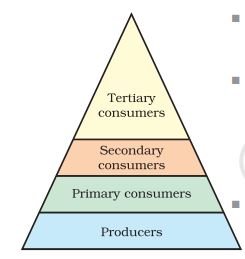
a) First trophic level
b) Second trophic level
c) Third trophic level
d) Fourth trophic level
Answer: b) Second trophic level
Q. Refer to the trophic level pyramid:
- Plants → Rabbit → Snake → Eagle
Which organism occupies the third trophic level?
a) Rabbit
b) Eagle
c) Plants
d) Snake
Answer: d) Snake
Q. Refer to Figure (Food Web). What is the main advantage of a food web over a simple food chain?
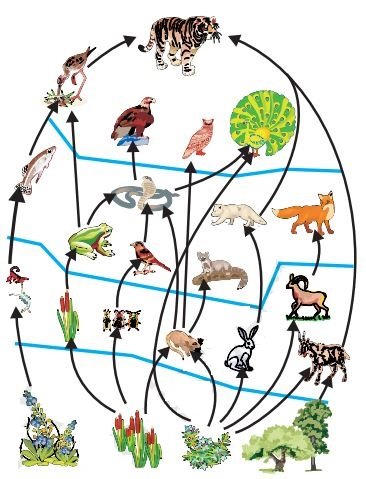
a) It shows only producers and consumers
b) It represents multiple feeding relationships among organisms
c) It prevents energy loss
d) It eliminates trophic levels
Answer: b) It represents multiple feeding relationships among organisms
Q. Refer to the ozone formation process:
- O₂ → O + O (UV rays)
- O + O₂ → O₃
The energy required for the first step is provided by:
a) Wind energy
b) Heat energy
c) Ultraviolet radiation
d) Chemical energy
Answer: c) Ultraviolet radiation
Q. Refer to the waste classification diagram showing ‘Biodegradable’ and ‘Non-biodegradable’ waste. Which of the following belongs to the non-biodegradable category?
a) Used tea leaves
b) Vegetable peels
c) Waste paper
d) Plastic container
Answer: d) Plastic container
Q. Refer to the waste segregation diagram showing two bins labelled “Biodegradable” and “Non-biodegradable”. In which bin should used tea leaves be placed?
a) Non-biodegradable bin
b) Plastic waste bin
c) Metal waste bin
d) Biodegradable bin
Answer: d) Biodegradable bin
Q. Refer to a waste management flow chart where kitchen waste is converted into compost. The process mainly involves the action of:
a) Producers
b) Decomposers
c) Herbivores
d) Carnivores
Answer: b) Decomposers
Disclaimer: The content that is present on our website is based on the NCERT Class 10 Science textbook and is provided for educational purposes only. All the content and images have been taken from Science Class 10 NCERT Textbook. Images and content shown above are the property of individual organizations and are used here for reference purposes only. To make it easy to understand, some of the content and images are generated by AI and cross-checked by the teachers.