
← Back to Class 9 Kaushal Vikas
Practice Additional Vocations Chapter 8 Class 9 MCQs with answers to test your understanding of different vocational opportunities, career options, skills, and their importance in everyday life. These multiple-choice questions will help you revise important concepts, improve your knowledge, and prepare for school examinations.
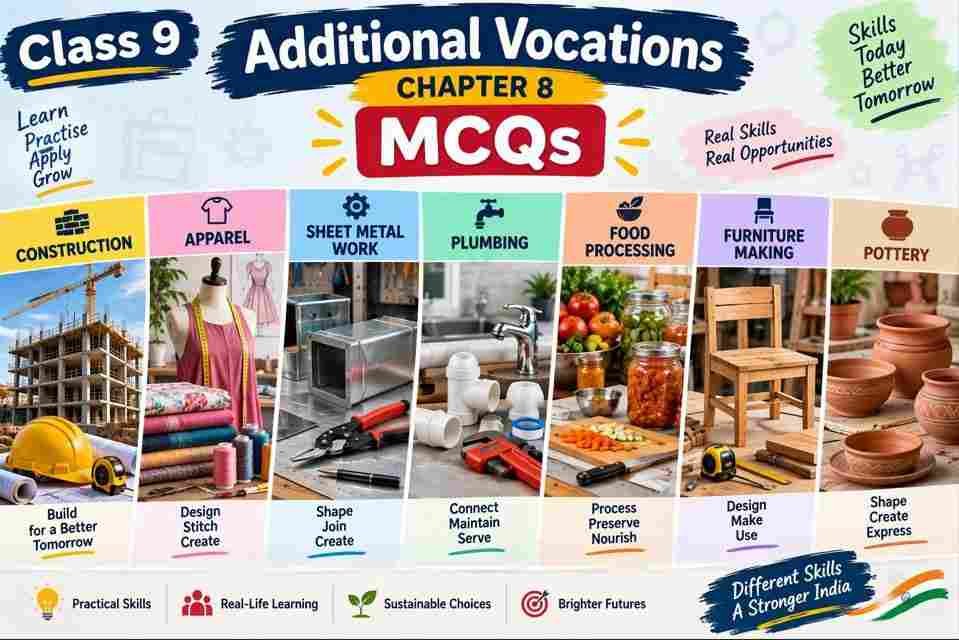
Additional Vocations Chapter 8 Class 9 MCQ
Conceptual Recall MCQs
Q. What is sheet metal work?
(a) Growing crops using metal tools
(b) Shaping thin metal sheets into useful products
(c) Manufacturing plastic products
(d) Designing clothing
Answer: (b) Shaping thin metal sheets into useful products
Q. Which of the following metals is commonly used in sheet metal work?
(a) Wood
(b) Rubber
(c) Aluminium
(d) Paper
Answer: (c) Aluminium
Q. What is a burr?
(a) A joining method
(b) A measuring tool
(c) A decorative design
(d) A sharp unwanted edge after cutting
Answer: (d) A sharp unwanted edge after cutting
Q. A rivet is mainly used to
(a) measure metal sheets
(b) join sheet metal parts
(c) polish surfaces
(d) cut metal
Answer: (b) Join sheet metal parts
Q. What does the term ‘gauge’ indicate in sheet metal work?
(a) Length of sheet
(b) Width of sheet
(c) Thickness of sheet
(d) Weight of sheet
Answer: (c) Thickness of sheet
Q. Which tool is commonly used for manually cutting sheet metal?
(a) Pipe wrench
(b) Tin snips
(c) Tailoring tape
(d) Chisel
Answer: (b) Tin snips
Q. Which tool is mainly used for smoothing sharp edges of metal?
(a) Hammer
(b) Drill
(c) File
(d) Marker
Answer: (c) File
Q. Which step is performed before actual fabrication in sheet metal work?
(a) Finishing
(b) Painting
(c) Making a prototype
(d) Packaging
Answer: (c) Making a prototype
Q. Food processing involves
(a) growing crops only
(b) transforming raw food into useful food products
(c) transporting food
(d) selling food products
Answer: (b) Transforming raw food into useful food products
Q. Raw materials in food processing include
(a) grains, fruits and vegetables
(b) machines only
(c) packaging boxes
(d) labels
Answer: (a) Grains, fruits and vegetables
Q. Preservation is mainly carried out to
(a) improve colour
(b) increase shelf life
(c) increase weight
(d) reduce nutrition
Answer: (b) Increase shelf life
Q. Which item is used for safely cutting food materials?
(a) Pipe wrench
(b) Chopping board
(c) File
(d) Hammer
Answer: (b) Chopping board
Q. Which of the following is a food-processing activity?
(a) Riveting
(b) Fermenting
(c) Threading
(d) Drafting
Answer: (b) Fermenting
Q. A student wants to make dried vegetables. Which processing technique should be used?
(a) Welding
(b) Drying
(c) Plumbing
(d) Riveting
Answer: (b) Drying
Q. Before preparing pickle, vegetables should first be
(a) painted
(b) polished
(c) washed and cleaned
(d) packed
Answer: (c) Washed and cleaned
Q. Why should hands be washed before handling food?
(a) To improve taste
(b) To maintain hygiene
(c) To increase colour
(d) To increase quantity
Answer: (b) To maintain hygiene
Q. Furniture making mainly involves
(a) Processing food materials
(b) Designing and creating useful objects like tables and stools
(c) Repairing pipes
(d) Making garments
Answer: (b) Designing and creating useful objects like tables and stools
Q. Which material is commonly used as the main material for furniture making?
(a) Clay
(b) Wood
(c) Cement
(d) Cotton
Answer: (b) Wood
Q. Which tool is used to check right angles and alignment in furniture making?
(a) Pipe wrench
(b) Try square
(c) Tailoring tape
(d) Scriber
Answer: (b) Try square
Q. Which tool is mainly used for making holes in furniture components?
(a) Hammer
(b) Drill
(c) Plane
(d) Mallet
Answer: (b) Drill
Q. What is the purpose of sandpaper in furniture making?
(a) Measuring dimensions
(b) Joining parts
(c) Smoothing surfaces before finishing
(d) Cutting wood
Answer: (c) Smoothing surfaces before finishing
Q. Which of the following is used to join furniture parts?
(a) Nails and screws
(b) Clay and slip
(c) Fabric and thread
(d) Water and sand
Answer: (a) Nails and screws
Q. Which quality parameter ensures furniture can safely support its intended load?
(a) Finish
(b) Accuracy
(c) Strength and stability
(d) Decoration
Answer: (c) Strength and stability
Q. What is the final step in furniture making?
(a) Measuring
(b) Drawing
(c) Finishing the product
(d) Selecting materials
Answer: (c) Finishing the product
Q. Pottery mainly involves
(a) Stitching fabric
(b) Shaping and hardening clay into useful products
(c) Installing plumbing systems
(d) Working with sheet metal
Answer: (b) Shaping and hardening clay into useful products
Q. What is wedging?
(a) Painting clay
(b) Heating clay
(c) Kneading clay to remove air bubbles
(d) Decorating pottery
Answer: (c) Kneading clay to remove air bubbles
Q. What is firing in pottery?
(a) Cutting clay
(b) Drying clay with a cloth
(c) Heating clay to make it hard and durable
(d) Mixing clay with water
Answer: (c) Heating clay to make it hard and durable
Q. Slip is a mixture of
(a) Sand and cement
(b) Clay and water
(c) Paint and water
(d) Soil and gravel
Answer: (b) Clay and water
Q. Which of the following is a simple pottery product mentioned in the chapter?
(a) Tap
(b) Diya
(c) Apron
(d) Dustpan
Answer: (b) Diya
Q. Which tool is used for cutting clay lumps?
(a) Wire cutter
(b) Pipe cutter
(c) Scissors
(d) Drill
Answer: (a) Wire cutter
Q. Why is sand or grog mixed with clay?
(a) To change colour
(b) To increase cracks
(c) To improve strength and reduce cracking
(d) To make the clay softer
Answer: (c) To improve strength and reduce cracking
Application-Based MCQs
Q. A student wants to check whether a dustpan design will work before cutting metal. What should be made first?
(a) Paint sample
(b) Cardboard prototype
(c) Metal frame
(d) Label
Answer: (b) Cardboard prototype
Q. During sheet metal cutting, sharp edges are found. What should be done next?
(a) Paint immediately
(b) Leave the edges as they are
(c) Smooth them using a file or grinder
(d) Add rivets
Answer: (c) Smooth them using a file or grinder
Q. A worker is marking dimensions on a GI sheet before cutting. Which tool should be used?
(a) Plunger
(b) Scriber
(c) Iron
(d) Needle
Answer: (b) Scriber
Q. Why should gloves and goggles be worn during sheet metal work?
(a) To improve appearance
(b) To increase speed
(c) To protect from cuts and flying particles
(d) To make measurement easier
Answer: (c) To protect from cuts and flying particles
Q. A plumber needs to cut a PVC pipe to the required length. Which tool should be used?
(a) Pipe cutter
(b) Tailoring tape
(c) Hammer
(d) Needle
Answer: (a) Pipe cutter
Q. Before repairing a leaking tap, what should be done first?
(a) Paint the tap
(b) Shut off the water supply
(c) Replace all pipes
(d) Clean the floor
Answer: (b) Shut off the water supply
Q. A blocked drain in a school washroom needs cleaning. Which tool is most suitable?
(a) Scriber
(b) Plunger
(c) Drill
(d) Iron
Answer: (b) Plunger
Q. A student wants to build a small stool. What should be prepared before cutting the material?
(a) Packaging label
(b) Sketch with dimensions
(c) Paint sample
(d) User guide
Answer: (b) Sketch with dimensions
Q. Why is a cardboard prototype prepared before making furniture?
(a) To decorate the furniture
(b) To test shape, joints and stability
(c) To replace wood
(d) To increase cost
Answer: (b) To test shape, joints and stability
Q. A carpenter finds that a shelf is not level. Which tool should be used to check alignment?
(a) Spirit level
(b) Hammer
(c) Sandpaper
(d) Chisel
Answer: (a) Spirit level
Q. After assembling a wooden table, which process will improve its appearance and protection?
(a) Washing
(b) Sanding and applying varnish
(c) Measuring
(d) Marking
Answer: (b) Sanding and applying varnish
Q. A student notices air bubbles in clay before shaping a bowl. What should be done?
(a) Paint the clay
(b) Fire immediately
(c) Wedge the clay properly
(d) Add more water
Answer: (c) Wedge the clay properly
Q. A potter wants to join two clay parts together securely. What should be used?
(a) Nails
(b) Slip
(c) Glue
(d) Thread
Answer: (b) Slip
Q. During pottery making, a product starts developing cracks while drying. Which step was most likely not done properly?
(a) Packaging
(b) Slow and careful drying
(c) Painting
(d) Measuring
Answer: (b) Slow and careful drying
Competency-Based MCQs
Q. Why is a cardboard prototype prepared before making the final sheet metal product?
(a) To increase production cost
(b) To check the design and identify errors
(c) To replace the metal sheet
(d) To improve painting quality
Answer: (b) To check the design and identify errors
Q. A student cuts a sheet metal piece without proper measurement. What problem is most likely to occur?
(a) Better finishing
(b) Material wastage
(c) Stronger joints
(d) Faster assembly
Answer: (b) Material wastage
Q. Which quality parameter ensures that a sheet metal product performs its function properly?
(a) Bright colour
(b) Accurate dimensions
(c) Expensive material
(d) Large size
Answer: (b) Accurate dimensions
Q. Why is efficient use of scrap metal encouraged during fabrication?
(a) To increase waste
(b) To reduce material utilisation
(c) To minimise waste and save resources
(d) To avoid measurement
Answer: (c) To minimise waste and save resources
Q. What is plumbing mainly concerned with?
(a) Designing buildings
(b) Installing and repairing pipe systems
(c) Manufacturing garments
(d) Painting walls
Answer: (b) Installing and repairing pipe systems
Q. What is a valve used for in plumbing?
(a) Measuring water
(b) Changing pipe colour
(c) Controlling water flow
(d) Joining sheets
Answer: (c) Controlling water flow
Q. Which material is commonly used to carry water in plumbing systems?
(a) PVC pipe
(b) Cotton cloth
(c) Wooden plank
(d) Cardboard
Answer: (a) PVC pipe
Q. Which tool is used for tightening and loosening pipe joints?
(a) Sewing machine
(b) File
(c) Pipe wrench
(d) Scriber
Answer: (c) Pipe wrench
Q. What is the purpose of thread seal tape?
(a) Decorating pipes
(b) Measuring pipe sizes
(c) Preventing leakage at joints
(d) Cleaning pipes
Answer: (c) Preventing leakage at joints
Q. Why is proper pipe alignment important in plumbing?
(a) It improves pipe colour
(b) It ensures smooth water flow
(c) It reduces pipe length
(d) It increases water temperature
Answer: (b) It ensures smooth water flow
Q. After installing a pipe system, a plumber restores the water supply. What should be checked immediately?
(a) Paint quality
(b) Pipe colour
(c) Leaks and water flow
(d) Packaging
Answer: (c) Leaks and water flow
Q. Which quality parameter indicates successful plumbing work?
(a) Leak-free joints
(b) Expensive materials
(c) More fittings
(d) Greater pipe thickness
Answer: (a) Leak-free joints
Q. A student uses spoiled vegetables for food processing. Which quality parameter has been ignored?
(a) Freshness
(b) Packaging
(c) Labelling
(d) Measurement
Answer: (a) Freshness
Q. Why should raw and processed food be kept separate?
(a) To improve appearance
(b) To avoid cross-contamination
(c) To reduce weight
(d) To save containers
Answer: (b) To avoid cross-contamination
Q. Which action best reflects good food-processing practices?
(a) Using dirty containers
(b) Ignoring food quality
(c) Maintaining cleanliness throughout processing
(d) Storing food in open areas
Answer: (c) Maintaining cleanliness throughout processing
Q. A furniture maker wants to reduce material wastage while constructing a bench. Which quality parameter is being followed?
(a) Accuracy
(b) Material efficiency
(c) Stability
(d) Appearance
Answer: (b) Material efficiency
Q. Why should tools be kept sharp, clean and stored properly after use?
(a) To increase weight
(b) To improve safety and efficiency
(c) To reduce furniture size
(d) To decorate the workshop
Answer: (b) To improve safety and efficiency
Q. A table looks attractive but cannot support weight properly. Which quality parameter has been neglected?
(a) Finish
(b) Strength and stability
(c) Material efficiency
(d) Accuracy
Answer: (b) Strength and stability
Q. Why is checking alignment important while assembling furniture?
(a) To improve colour
(b) To ensure proper fit, balance and usability
(c) To reduce polishing time
(d) To increase wood consumption
Answer: (b) To ensure proper fit, balance and usability
Q. Why is maintaining uniform thickness important in pottery?
(a) It improves colour only
(b) It helps the product dry and harden evenly
(c) It reduces decoration work
(d) It prevents polishing
Answer: (b) It helps the product dry and harden evenly
Q. A student places a clay bowl directly under strong sunlight and it cracks. What lesson can be learned?
(a) Pottery should be dried slowly and carefully
(b) Pottery should never be dried
(c) Firing is unnecessary
(d) More water should be added
Answer: (a) Pottery should be dried slowly and carefully
Q. Why is a test piece created before making the final pottery product?
(a) To decorate the workspace
(b) To check cracking, drying behaviour and strength
(c) To save water
(d) To replace the final product
Answer: (b) To check cracking, drying behaviour and strength
Q. Which quality parameter indicates good pottery workmanship?
(a) Uneven wall thickness
(b) Well-prepared clay and balanced shape
(c) Maximum decoration only
(d) Bright colours alone
Answer: (b) Well-prepared clay and balanced shape
Case Study MCQs
Case Study: Students of a school participated in a vocational skills exhibition. One group made a sheet metal dustpan using a cardboard prototype before cutting the metal sheet. Another group repaired a leaking tap by replacing a damaged pipe joint and checking for leaks after restoring the water supply. A third group prepared dried vegetable snacks by washing, cutting, drying and safely packaging the food product.
Q. Why did the sheet metal group prepare a cardboard prototype first?
(a) To replace metal sheets
(b) To test the design before fabrication
(c) To decorate the product
(d) To reduce painting work
Answer: (b) To test the design before fabrication
Q. Why did the plumbing group check the system after restoring the water supply?
(a) To improve appearance
(b) To check for leaks and proper water flow
(c) To increase pipe length
(d) To reduce water pressure
Answer: (b) To check for leaks and proper water flow
Q. Which food-processing practice helped ensure that the snack product was safe to consume?
(a) Ignoring hygiene
(b) Using dirty containers
(c) Washing and processing the vegetables properly
(d) Leaving the food uncovered
Answer: (c) Washing and processing the vegetables properly
Q. What common principle was followed by all three groups?
(a) Proper planning, safety and quality checks
(b) Avoiding measurements
(c) Working without tools
(d) Ignoring waste management
Answer: (a) Proper planning, safety and quality checks
Q. Which skill is most important across sheet metal work, plumbing and food processing?
(a) Branding
(b) Safety consciousness and attention to quality
(c) Painting skills
(d) Fashion designing
Answer: (b) Safety consciousness and attention to quality
Case Study: Students of a school vocational club decided to create products for an exhibition. One group designed a wooden stool using recycled wood. They prepared a sketch, made a cardboard prototype, measured carefully and assembled the stool using screws. After checking stability, they sanded and varnished the surface.
Another group made clay diyas. They wedged the clay to remove air bubbles, shaped the diyas, joined decorative parts using slip and dried them slowly before firing.
Q. Why did the furniture group prepare a cardboard prototype before constructing the stool?
(a) To replace the wooden material
(b) To test the design, shape and stability
(c) To paint the product
(d) To reduce measurements
Answer: (b) To test the design, shape and stability
Q. Which action contributed most to the durability and appearance of the stool?
(a) Measuring tape
(b) Sanding and varnishing
(c) Cardboard use
(d) Sketching
Answer: (b) Sanding and varnishing
Q. Why did the pottery group wedge the clay before shaping the diyas?
(a) To increase weight
(b) To remove air bubbles and ensure uniform moisture
(c) To add decoration
(d) To speed up firing
Answer: (b) To remove air bubbles and ensure uniform moisture
Q. What was the purpose of using slip while making the diyas?
(a) To harden the clay
(b) To paint the diya
(c) To join clay parts securely
(d) To dry the clay
Answer: (c) To join clay parts securely
Q. What common principle was followed by both groups?
(a) Ignoring quality checks
(b) Using expensive materials only
(c) Planning, testing and ensuring quality before final completion
(d) Avoiding measurement and design
Answer: (c) Planning, testing and ensuring quality before final completion
Disclaimer: The content that is present on our website is based on the NCERT Class 9 Kaushal Vikas textbook and is provided for educational purposes only. All the content and images have been taken from Kaushal Vikas Class 9 NCERT Textbook and CBSE Support material. Images and content shown above are the property of individual organizations and are used here for reference purposes only. To make it easy to understand, some of the content and images are generated by AI and cross-checked by the teachers.