
← Back to Class 9 Science Notes
Reproduction: How Life Continues Class 9 Notes explain the process by which living organisms produce new individuals to continue their species. These easy NCERT-based notes cover asexual and sexual reproduction, vegetative propagation, pollination, fertilisation, human reproduction, pregnancy, and reproductive health in simple language with diagrams, tables, and important points for quick revision.
Reproduction How Life Continues Class 9 Notes
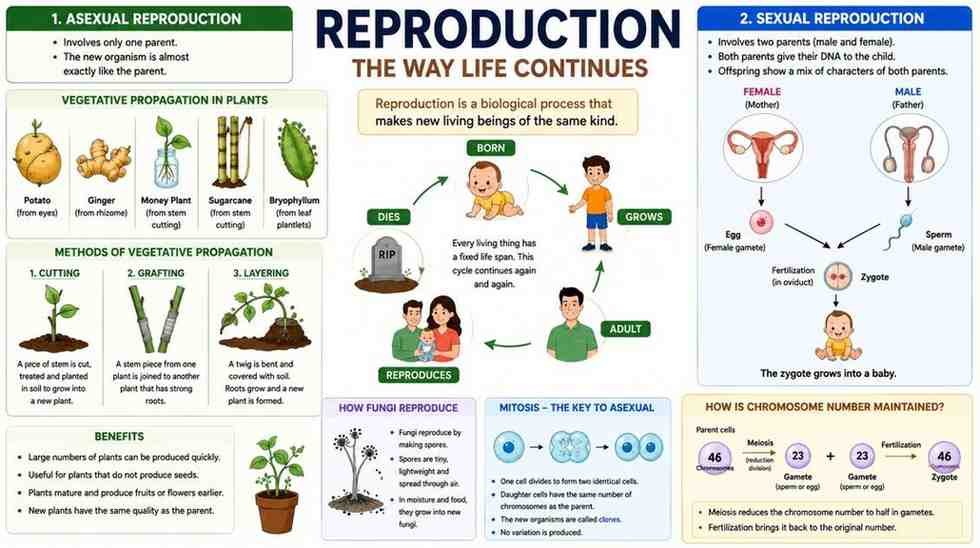
Every living thing has a fixed life span. This living thing is born, grows, becomes an adult, reproduces, and finally dies. This cycle continues again and again.
What is reproduction?
Reproduction is a biological process that makes new living beings of the same kind. This is how life continues on Earth. For example, a mango tree grows old and dies, but the seeds develop into new mango plants. Similarly, cows give birth to calves, etc.
Types of Reproduction
There are two types of reproduction:
- Asexual Reproduction
- Sexual Reproduction
1. Asexual Reproduction
In asexual reproduction only one parent is involved. The new organism looks almost exactly like the parents. Asexual reproduction is common in unicellular organisms like amoeba, bacteria, and yeast. This reproduction also happens in single multicellular organisms such as hydra and sponges.
Some plants use asexual reproduction.
Many plants also reproduce using asexual reproduction. These plants grow into new plants from their vegetative parts like root, stem, or leaf instead of seeds. This process is called vegetative propagation.
- Potato – New plants grow from the “eyes” of the potato.
- Ginger – New plants grow from its underground stem (rhizome).
- Money Plant – A stem cutting placed in water or soil grows into a new plant.
- Sugarcane – Stem cuttings produce new sugarcane plants.
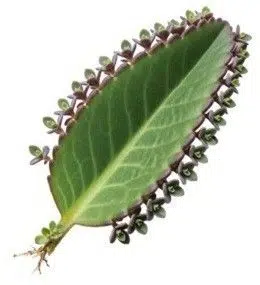
- Bryophyllum – Tiny plantlets grow along the edges of its leaves and develop into new plants.
How is vegetative propagation in plants helpful in agriculture?
Vegetative propagation helps the farmers and gardeners to grow plants quickly and efficiently. It helps the farmer to grow plants with good qualities like good taste, high yield, disease resistance, and attractive flowers.
Benefits of Vegetative Propagation
- Large numbers of plants can be produced in a short time.
- Useful for the plants that do not produce seeds.
- The plants can mature and produce fruits or flowers earlier.
- The new plants have the same quality as the parent plants.
What are the different methods used in vegetative propagation
Scientists and farmers use different techniques of vegetative propagation:
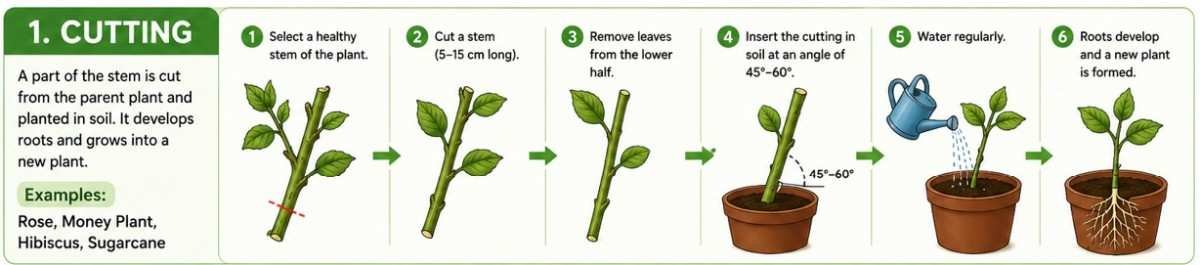
1. Cutting
- A small piece of the stem is cut from the parent plant.
- Remove the leaves from the lower half of the cutting.
- This cutting is then planted in soil with compost.
- Place the stem slanting, about 45–60° from the soil surface.
2. Grafting
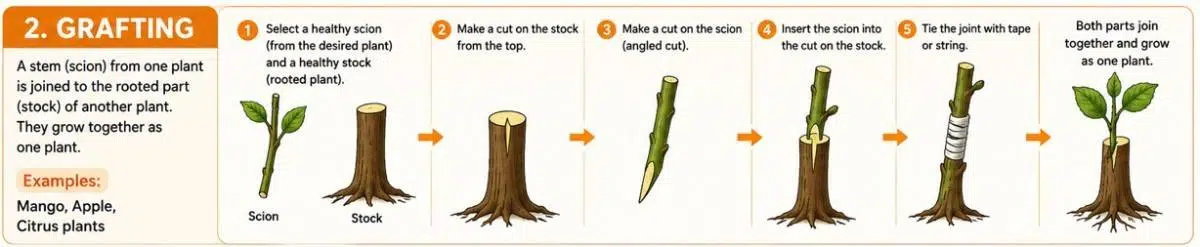
- In grafting two plants are used—
- Plant A (a healthy plant with strong roots)
- Plant B (a stem piece taken from another variety).
- A small cut or wound is made on a twig of Plant A.
- The stem piece from Plant B is carefully placed inside the slit of Plant A.
- The joint is wrapped with cloth or film to protect it from pests and to keep it firm.
- Plant B’s stem starts growing, but it uses the strong roots of Plant A for support.
3. Layering
- A soft, flexible twig is selected from a plant or shrub (like lemon).
- The middle section of the twig is bent down and covered with soil, while the ends remain outside.
- In about 10–15 days, roots start to grow from the buried part.
- Once roots are formed, the twig is cut off from the parent plant.
- The rooted twig now grows independently as a new plant.

Because of the above techniques, farmers can grow crops like sugarcane, bananas, potatoes, and many fruits on a large scale. This helps to improve agriculture and horticulture, both.
What is budding?
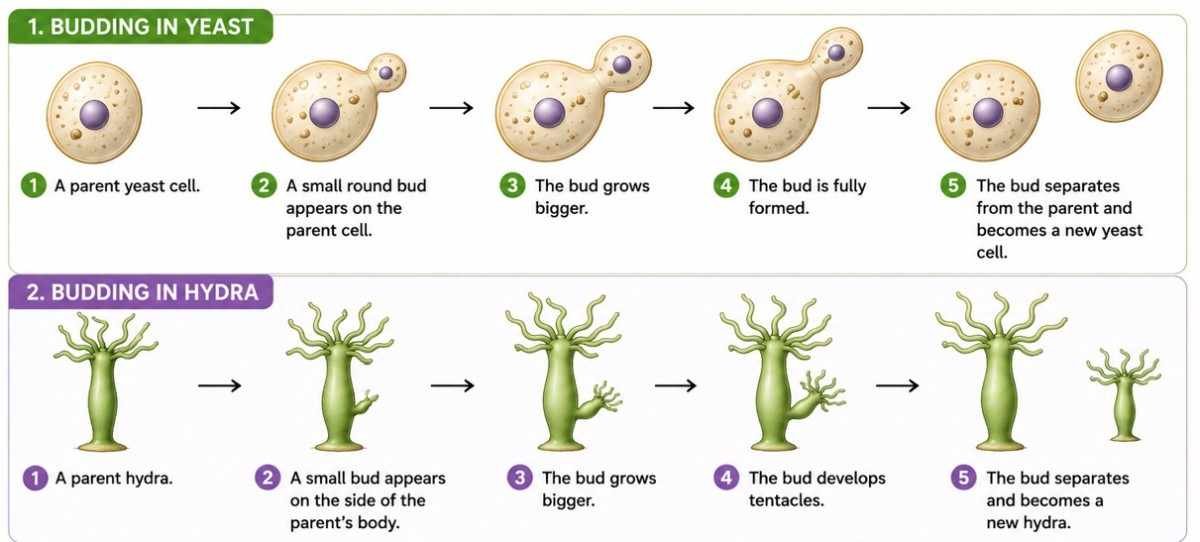
Budding is a simple type of asexual reproduction. In this process, a small outgrowth called a bud forms on the parent’s body. This bud slowly grows bigger, and when it is strong enough, it separates from the parent and lives as a new individual.
Examples of Budding
- Yeast: Small round buds grow from the parent yeast cell. These buds later become new yeast cells.
- Hydra: Tiny buds grow on the parent’s body. Many buds can grow at the same time, and each one becomes a new hydra.
How Do Fungi Reproduce?
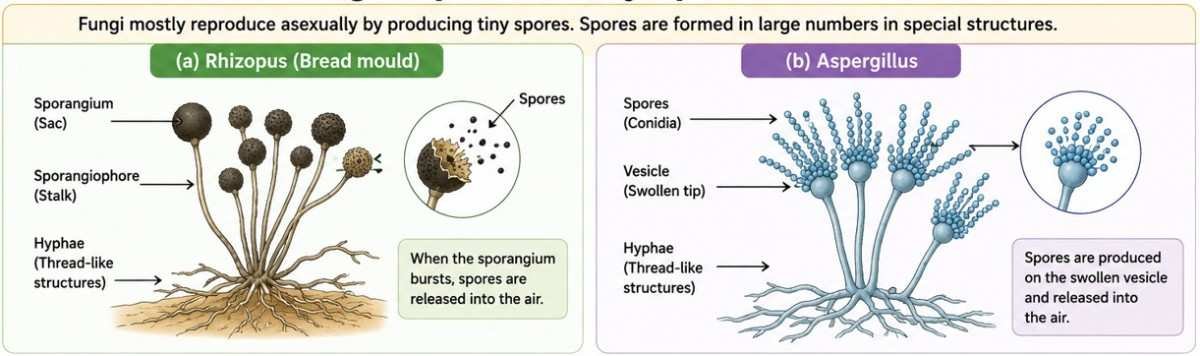
Fungi are living organisms that include molds, yeasts, and mushrooms. Fungi reproduce by making spores. Spores are tiny particles that can grow into new fungi when they land on a moist surface with food.
Features of Spores
- Spores are lightweight and usually single‑celled.
- They are produced in huge numbers — millions can come from one mould colony.
- They spread easily through air currents.
- When spores find moisture and nutrients, they germinate quickly into new fungi.
Example: Mould on Bread
The mould you see on bread comes from spores already present in the air. These spores settle on moist bread and start growing rapidly.
Louis Pasteur’s Discovery
Louis Pasteur proved that new life always comes from pre‑existing life. His experiments showed that microorganisms like fungi do not appear on their own — they come from spores already present.
- His work led to the germ theory of disease.
- It also introduced practices like sterilisation of food and instruments to prevent contamination.
What is the Central Process Behind Asexual Reproduction?
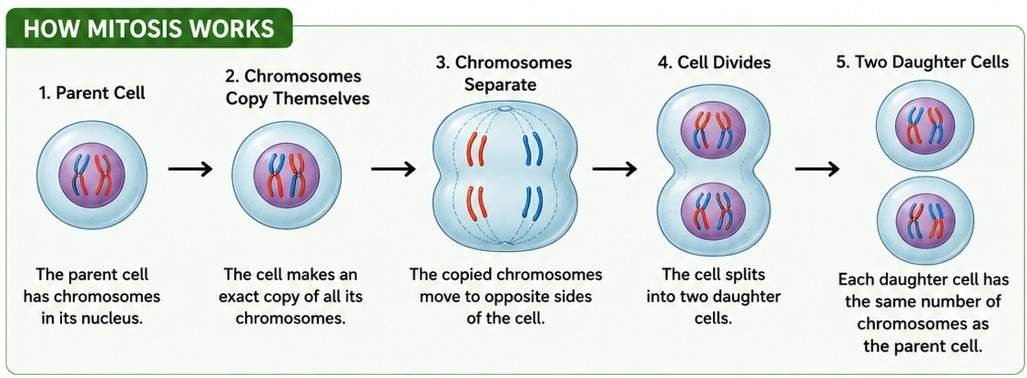
The main process behind asexual reproduction is mitosis. Mitosis is a type of cell division where one cell divides to form two new cells.
How Mitosis Works
- The parent cell makes an exact copy of its chromosomes.
- Then it divides into two daughter cells.
- Each daughter cell has the same number of chromosomes as the parent.
Result of Mitosis
- The new organisms are genetically identical to the parent.
- These identical organisms are called clones.
- There is no variation because traits are not mixed.
Why It Is Useful
- Asexual reproduction is a fast process.
- It helps organisms increase their population quickly.
- This is especially useful when the environment is favourable (good food, water, temperature).
Sexual Reproduction
In sexual reproduction two parents (male and female) are involved. Both parents give their DNA to their child. This is why the children look a bit like both parents.
How is the chromosome number maintained?
Every living being has a fixed number of chromosomes; chromosomes are tiny structures carrying DNA. If a child got the full set of chromosomes from both parents, then it will create cell imbalance. For example, if humans have 46 chromosomes, the next generation would have 92 chromosomes from both parents (46 from the male and 46 from the female), and so on. That would be impossible!
To prevent this, nature uses a special type of cell division called meiosis.
Meiosis occurs in the reproductive organs. In meiosis, the number of chromosomes is halved in reproductive cells (sperm and egg). So, sperm has 23 chromosomes, and egg has 23 chromosomes. When they join, the child gets 46 chromosomes — the correct number of chromosomes.
Sexual reproduction = two parents + meiosis → correct chromosome number in every generation.
Sexual reproduction in flowering plants
Flowering plants are called angiosperms. They reproduce by sexual reproduction using flowers. A flower is the reproductive organ of a flowering plant.
Plants have different parts that perform different functions:
- Roots absorb water and minerals from the soil.
- Stems provide support and transport water and food.
- Leaves prepare food by photosynthesis.
- Flowers help in sexual reproduction.
What is a flower bud?
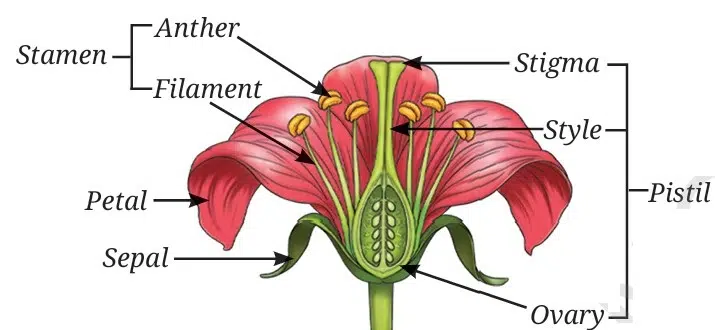
Before a flower opens, it is called a flower bud. The green outer covering is called sepals. Sepals protect the flower bud. Inside the sepals are the petals. The petals are brightly colored and often fragrant. They attract bees, butterflies, birds, and other insects. These animals help in pollination.
There are four main parts of a flower—
- Sepals: Green in color and protect the flower bud.
- Petals: Petals are bright and colorful and attract pollinators.
- Stamen (Male Part): It is the male reproductive part of the flower. It produces pollen grains, which contain male gametes, and has two parts: the anther and the filament.
- Pistil (Female Part): The female reproductive part of the flower. The pistil receives pollen and contains ovules and has three parts.
- Stigma – Sticky top that receives pollen.
- Style – Tube connecting stigma to ovary.
- Ovary – Contains ovules (egg cells).
How does the process of pollination occur in flowers?
Pollination is a method where the pollen grains go from the anther (male part) to the stigma (female part) of a flower. This helps to make fruits and seeds.
Types of Pollination
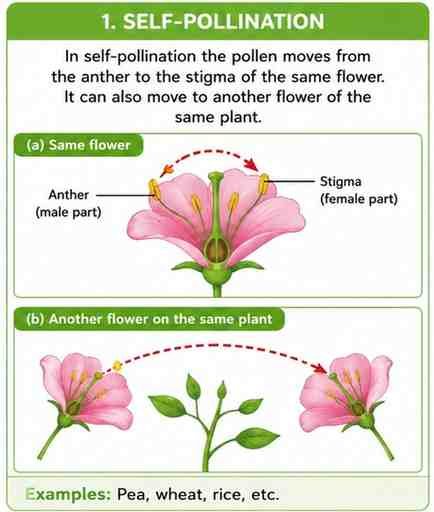
1. Self-Pollination
In self-pollination the pollen moves from the anther to the stigma of the same flower. It can also move to another flower of the same plant. Examples: peas, wheat, rice, etc.
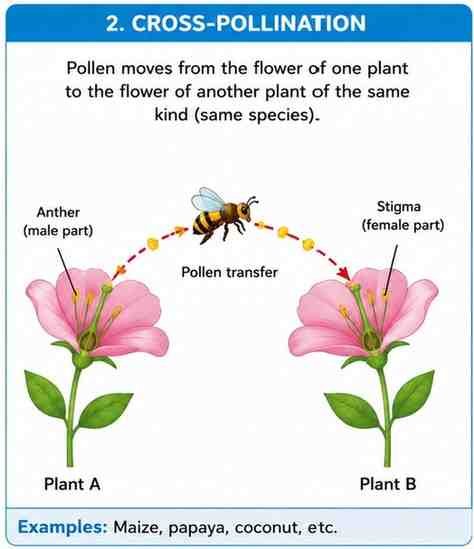
2. Cross-Pollination
Pollen moves from the flower of one plant to the flower of another plant of the same kind (same species). Examples: maize, papaya, coconut, etc.
Pollination strategies and reproductive success
The plants use different methods to transfer pollen from the anther to the stigma.
- Wind Pollination: In this method, the wind carries pollen from one flower to another flower. There are some corps that produce huge numbers of pollen grains, approx. 500,000 to 1,000,000 per flower. Wind pollination works on quantity; they carry millions of pollen grains and increase the chance that some pollen will land on a stigma. For example, wheat, maize, and rice.
- Insect Pollination: The flowers are bright in color; the flowers produce nectar and fragrance to attract bees, butterflies, and other insects to carry pollen. For example, sunflower, hibiscus, and marigold.
- Bird Pollination: Some birds carry pollen while drinking nectar. For example, coral trees, hibiscus, etc.
- Water Pollination: The water carries pollen from one flower to another. When the pollen floats on water, then water currents carry pollen to another flower. Examples: Vallisneria, Hydrilla.
Comparison table of pollination efficiency
| Pollination strategy | Pollen grains per flower | Seeds formed | Efficiency |
|---|---|---|---|
| Wind pollination | 5,00,000 – 10,00,000 | 50 – 200 | Low (lots of waste) |
| Insect pollination | 20,000 – 40,000 | 800 – 1,000 | High (accurate transfer) |
Why Do Wind-Pollinated Plants Produce So Much Pollen?
Wind cannot carry pollen accurately. Many pollen grains are lost before reaching another flower. So, wind-pollinated plants produce a very large number of pollen grains to increase the chance that some pollen will reach the stigma and form seeds.
Fertilization and seed formation
Once the pollen reaches a compatible stigma, the process begins. Pollen grains produce pollen tubes that grow down through the style into the ovary. The male gamete travels through the pollen tube and reaches the ovule. The male gamete joins with the egg cell. This process is called fertilization.
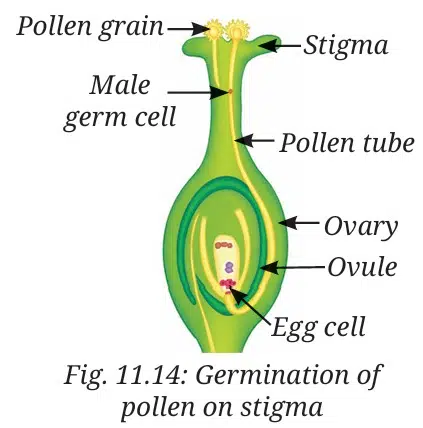
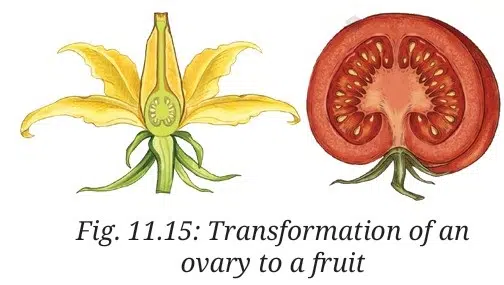
The fertilized egg is called a zygote. The zygote grows into an embryo. The ovary changes into a fruit and becomes seeded.
Sexual Reproduction in Animals
The animals reproduce in two different ways: asexual reproduction or sexual reproduction. In sexual reproduction, the male sperm joins with the female egg (ovum). This process is called fertilisation.
- External Fertilisation: In this, the fertilisation happens outside the female’s body. This is found in frogs and most fish. The female lays eggs in water; the male releases sperm over the eggs. Many eggs are washed away by water or eaten by other animals. So that way these animals lay many eggs.
- Internal Fertilisation: In this, the fertilisation happens inside the female’s body. Found in reptiles, birds and mammals. The fertilised egg (embryo) develops inside the female. The embryo is safe and protected. This helps more young ones to survive.
Variation in reproductive strategies among animals
| Animal | Habitat | Mode of fertilisation | Number of eggs produced | Estimated survival of young ones |
|---|---|---|---|---|
| Fish | Water | External | 100s – 1000s at a time | Low |
| Frog | Water/land | External | 5,000 – 50,000 at a time | Low |
| Lizard | Land | Internal | 2 – 20 at a time | Moderate |
| Bird | Water/land | Internal | 1 – 15 at a time | Moderate to High |
Some important key points
- Yolk is the food stored inside an egg for the developing embryo.
- Larva is the young stage of some animals.
- Metamorphosis is the process in which a larva changes into an adult.
- Fish, amphibians, and insects usually have a larval stage.
- Reptiles and birds hatch from eggs with enough yolk.
- Mammals develop inside the mother’s body and are fed with breast milk after birth.
Reproduction in Human Beings
Reproductive Maturity
When the children grow, then their bodies go through many physical and emotional changes. This stage is called puberty. During the time of puberty the reproductive organs become mature. They start producing gametes. Males produce sperm, and females produce eggs (ova).
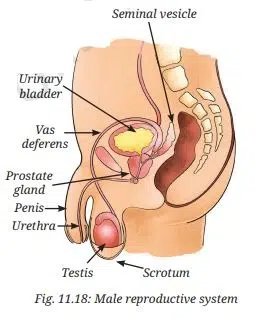
What are the parts of the male reproductive system?
The male reproductive system makes sperm and sends them to the female body.
- Testes: There are two testes which make sperm. They also make the hormone testosterone. Testosterone changes during puberty and helps in the growth of facial hair, a deep voice and strong muscles.
- Scrotum: The scrotum is a skin pouch that holds the testes and keeps the testes cool and helps to make healthy sperm.
- Vas Deferens (Sperm Duct): It is a long tube that carries sperm from the testes to the urethra.
- Urethra: It is a tube through which sperm leaves the body and carries urine, but not at the same time.
- Seminal Vesicles and Prostate Gland: These glands add fluid to the sperm. This fluid gives food and energy to the sperm and helps the sperm swim.
What are the different parts of sperm?
Sperm have 3 parts: head, middle part and tail.
- Head – Contains genetic material.
- Middle Part – Gives energy.
- Tail – Helps the sperm swim.
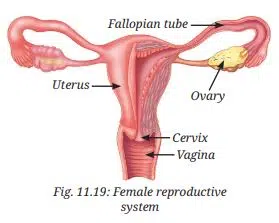
What are the parts of the female reproductive system?
The female reproductive system makes eggs and helps in the development of a body.
- Ovaries: A female has two ovaries which help to produce eggs (ova). They also produce female hormones. These hormones cause changes during puberty.
- Oviducts (Fallopian Tubes): There are two oviducts. They connect the ovaries to the uterus. The egg travels through the oviduct. Fertilisation usually happens here.
- Uterus (Womb): The uterus is a bag-like organ; it’s the place where the baby (foetus) grows and develops.
- Cervix: The cervix is a narrow opening of the uterus and connects the uterus to the vagina.
- Vagina: The vagina is a tube-like passage which is used to receive the sperm during reproduction. It is also the birth canal from where the baby is born.
How are reproductive cells made?
The process of the formation of gametes is called gametogenesis. It takes place in the testes and the ovaries. The gametes are made by a special type of cell division called meiosis. In meiosis, the number of chromosomes becomes half.
Difference Between Sperm and Egg
| Sperm | Egg |
|---|---|
| Small in size | Large in size |
| Can move | Cannot move |
| Produced in large numbers | Usually one egg is released at a time |
| Made in the testes | Made in the ovaries |
What happens when a sperm meets an egg?
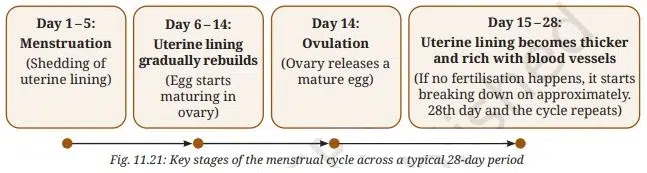
- At birth, a girl’s ovaries have millions of immature eggs, but after puberty, one mature egg is usually released every month. The process is called ‘ovulation’.
- Before ovulation, the uterus prepares for pregnancy. Its inner lining becomes thick and soft.
- The released egg travels through the oviduct (fallopian tube). During sexual intercourse millions of sperm enter the female body through the vagina.
- The sperm swim towards the oviduct, and if any one sperm joins with the egg, fertilisation takes place.
- A zygote is formed and divides into many cells. It travels to the uterus. It attaches to the thick inner lining of the uterus. This process is called implantation.
- After implantation the embryo receives food and oxygen from the mother, and it grows and develops into a foetus.
Ovulation → Egg enters oviduct → Sperm meets egg → Fertilisation → Zygote forms → Zygote divides → Implantation in uterus → Pregnancy begins
What happens when an egg is not fertilised?
If the egg does not meet a sperm, fertilisation does not happen. The egg lives for about one day and then breaks down.
Pregnancy and childbirth
Pregnancy in humans lasts about nine months and is divided into three stages called trimesters.
- First Trimester (1st–3rd Month): The fertilised egg develops into an embryo and important body parts and organs begin to form. Around the 9th week, the embryo is called a foetus.
- Second Trimester (4th–6th Month): The foetus grows bigger and stronger and the mother can usually feel the baby’s movements.
- Third Trimester (7th–9th Month): The baby grows quickly and baby’s body gets ready for life outside the womb. The uterus protects and nourishes the baby.
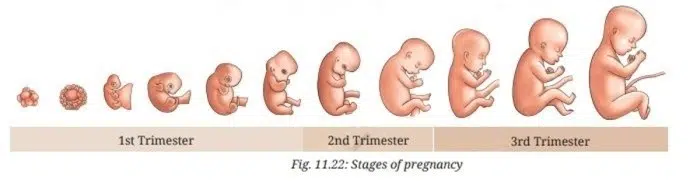
After about 9 months, the baby is ready to be born. During childbirth, strong contractions of the muscles of the uterus help push the foetus out through the birth canal. If a normal birth is not safe, doctors may perform a Caesarean section (C-section) to deliver the baby safely.
Mother’s health during pregnancy
A woman’s health during pregnancy plays a vital role in the baby’s growth and safety. She should eat a balanced diet rich in proteins, vitamins and minerals, attend regular medical check-ups, and follow her doctor’s advice regarding light exercise and rest. Her emotional well-being is also important, and support from family members helps her remain healthy and stress-free.
What does it mean to be sexually mature?
When the child grows into a teenager (adolescence), their body changes. These changes are called puberty. During puberty the body becomes able to reproduce. This state is called sexual maturity. In boys the testes start producing sperm, and in girls the ovaries start releasing eggs.
How can unwanted pregnancies and infections be prevented?
- Responsible decisions help prevent unwanted pregnancy and infections.
- STIs spread through sexual contact.
- Condoms help prevent both pregnancy and many STIs.
- Oral pills, Copper-T, and surgery are methods to prevent pregnancy.
- Abortion is the medical removal of a pregnancy.
- Prenatal sex determination and sex-selective abortion are illegal in India.
Disclaimer: The content that is present on our website is based on the NCERT Class 9 Science textbook and is provided for educational purposes only. All the content and images have been taken from Science Class 9 NCERT Textbook and CBSE Support material. Images and content shown above are the property of individual organizations and are used here for reference purposes only. To make it easy to understand, some of the content and images are generated by AI and cross-checked by the teachers.
I want to say that ‘understanding is very easy and good notes for us’ THANKING YOU!
Clear concept
Understanding is very much easy
Good 👍 notes
helpful
Good
Nice notes 👍🏻
Understanding is very easy ☺️