
← Back to Class 9 Social Science MCQs
Building Blocks in Economics: The Problem of Choice Class 9 MCQ questions based on the latest CBSE syllabus. This collection includes important multiple-choice questions covering concepts such as scarcity, choice, opportunity cost, resources, wants, and basic economic principles.
Building Blocks in Economics the Problem of Choice Class 9 MCQ
Conceptual Recall
Q1. What is a market?
a) Only a physical shop
b) A place where buying and selling happens
c) A government office
d) A school library
Answer: b) A place where buying and selling happens
Q2. Which of the following is not a factor of production?
a) Land
b) Labor
c) Capital
d) Entertainment
Answer: d) Entertainment
Q3. What does the Production Possibility Curve (PPC) show?
a) Unlimited resources
b) Trade-off between two goods
c) Only production of wheat
d) Only production of barley
Answer: b) Trade-off between two goods
Q4. The word “economics” comes from the Greek word “oikonomia.” What does “oikos” mean?
a) Market
b) Household
c) Money
d) Trade
Answer: b) Household
Q5. Which of the following is not an economic entity?
a) Consumers
b) Producers
c) Governments
d) Painters
Answer: d) Painters
Q6. Which of the following is a labor-intensive activity?
a) Automobile manufacturing
b) Steel production
c) Handicrafts
d) Aircraft manufacturing
Answer: c) Handicrafts
Q7. What is the opportunity cost of producing sugarcane?
a) High profits from the sugar industry
b) Saved water and improved soil health
c) More land for pulses
d) Increased demand for paddy
Answer: b) Saved water and improved soil health
Q8. In a planned economy, who makes all major economic decisions?
a) Private companies
b) Central planning authority of the government
c) Consumers
d) Banks
Answer: b) Central planning authority of the government
Q9. Which of the following is an example of a market economy?
a) North Korea
b) Cuba
c) United States of America
d) Former Soviet Union
Answer: c) United States of America
Q10. A mixed economy combines features of:
a) Market and planned economies
b) Agriculture and industry
c) Labor and capital
d) Public and private goods
Answer: a) Market and planned economies
Q11. Which of the following countries is an example of a mixed economy after reforms?
a) North Korea
b) Cuba
c) India (post-1991)
d) Soviet Union
Answer: c) India (post-1991)
Application-Based
Q12. If a farmer’s soil is suitable for rice and rainfall is high, but market demand is for wheat, what should the farmer ideally grow?
a) Rice only
b) Wheat only
c) Both rice and wheat
d) Ignore demand and grow rice.
Answer: b) Wheat only (aligning with demand)
Q14. A family spends money on food, medicines, and school supplies. These expenses are examples of:
a) Non-essential items
b) Essential items
c) Luxury items
d) Entertainment
Answer: b) Essential items
Q15. A garment manufacturer finds machines too costly. Which method of production will he likely choose?
a) Capital-intensive
b) Labor-intensive
c) Automated production
d) Technology-driven production
Answer: b) Labor-intensive
Q16. In a planned economy, enterprises often lack motivation to innovate. Why?
a) Because competition is restricted
b) Because demand is unlimited
c) Because resources are unlimited
d) Because the government provides free goods
Answer: a) Because competition is restricted
Q17. Why did India shift towards a more market-oriented system after 1991?
a) To increase government control
b) To face serious economic difficulties and encourage private enterprise
c) To reduce competition
d) To stop global trade
Answer: b) To face serious economic difficulties and encourage private enterprise
Assertion–Reason
Q18. Assertion (A): Human wants are unlimited.
Reason (R): People always remain satisfied after fulfilling one want.
a) Both A and R are true, and R is the correct explanation of A.
b) Both A and R are true, but R is not the correct explanation of A.
c) A is true, R is false.
d) A is false, R is true.
Answer: c) A is true, R is false.
Q19. Assertion (A): Opportunity cost is the value of the next best alternative given up.
Reason (R): Choosing one option means sacrificing another.
a) Both A and R are true, and R explains A.
b) Both A and R are true, but R does not explain A.
c) A is true, R is false.
d) A is false, R is true.
Answer: a) Both A and R are true, and R explains A.
Q20. Assertion (A): Economics deals with choices made due to scarcity of resources.
Reason (R): Resources are unlimited and can satisfy all wants.
a) Both A and R are true, and R explains A.
b) Both A and R are true, but R does not explain A.
c) A is true, R is false.
d) A is false, R is true.
Answer: c) A is true, R is false.
Q21. Assertion (A): Producers must decide for whom to produce based on income levels and demand.
Reason (R): Different groups of consumers have different needs and purchasing power.
a) Both A and R are true, and R explains A.
b) Both A and R are true, but R does not explain A.
c) A is true, R is false.
d) A is false, R is true.
Answer: a) Both A and R are true, and R explains A.
Q22. Assertion (A): In a market economy, prices are determined by demand and supply.
Reason (R): Government directly fixes the prices of goods and services.
a) Both A and R are true, and R explains A.
b) Both A and R are true, but R does not explain A.
c) A is true, R is false.
d) A is false, R is true.
Answer: c) A is true, R is false.
Q23. Assertion (A): In a mixed economy, both government and private enterprises play important roles.
Reason (R): This system allows private ownership with some government regulation.
a) Both A and R are true, and R explains A.
b) Both A and R are true, but R does not explain A.
c) A is true, R is false.
d) A is false, R is true.
Answer: a) Both A and R are true, and R explains A.
Case Study-Based MCQ
Q24. Case: In a school library, there are 5 copies of a new storybook, but 20 students want to read it.
Which of the following is the best economic solution?
a) Give books only to toppers.
b) Allow students to share and take turns
c) Refuse to lend the books
d) Buy more copies immediately.
Answer: b) Allow students to share and take turns.
Q25. Case: A farmer can grow barley and wheat in different combinations. At point A, he produces 100 kg of wheat and 0 kg of barley. At point E, he produces 100 kg of barley and 0 kg of wheat.
What does this situation highlight?
a) Unlimited wants
b) Scarcity of resources and opportunity cost
c) Free goods
d) No trade-off
Answer: b) Scarcity of resources and opportunity cost
Q26. Case: The government collects revenue through taxation. It must decide whether to spend more on infrastructure or welfare programs.
What does this situation highlight?
a) Unlimited resources
b) Economic choice and allocation of scarce resources
c) Free goods
d) No opportunity cost
Answer: b) Economic choice and allocation of scarce resources
Q27. Case: A sports shoe company decides to use synthetic rubber soles instead of leather.
What does this decision reflect?
a) Producing for high-income customers only
b) Producing for affordability and durability
c) Producing only for office workers
d) Ignoring consumer demand
Answer: b) Producing for affordability and durability
Q28. Case: In Cuba, the government owns most factories, banks, and transport. Enterprises follow government targets instead of market demand.
Which type of economy does this represent?
a) Market economy
b) Planned economy
c) Mixed economy
d) Free economy
Answer: b) Planned economy
Q29. Case: In India after 1991, the government reduced excessive regulations, encouraged private enterprise, and opened the economy to global trade.
What does this reflect?
a) Planned economy
b) Market economy only
c) Transition towards a mixed economy
d) No government involvement
Answer: c) Transition towards a mixed economy
Diagram-Based MCQ
Q30. Refer to table (Needs vs. Wants). Which of the following correctly matches the category?
a) Shelter → Want
b) Vacation → Need
c) Food → Need
d) Smartphone → Need
Answer: c) Food → Need
Q31. Refer to Figure (PPC curve). Which statement is correct?
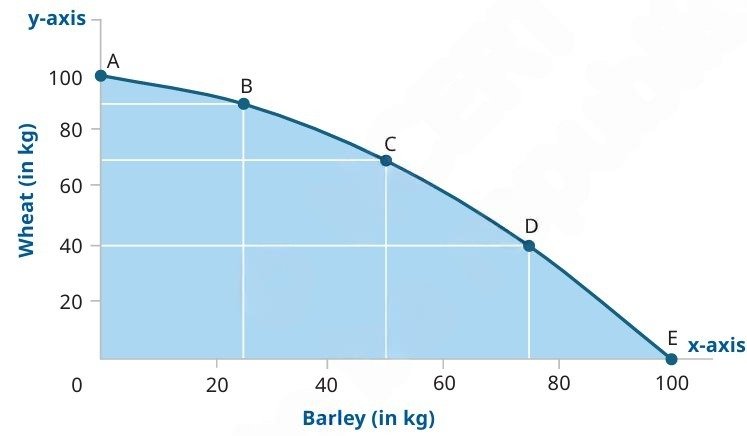
a) Moving from A to E increases barley but reduces wheat.
b) Moving from A to E increases wheat but reduces barley.
c) PPC shows unlimited production.
d) PPC shows wastage of resources.
Answer: a) Moving from A to E increases barley but reduces wheat.
Q32. Refer to Fig. 8.5 (Key Questions in Economics). Which of the following is not a key economic question?
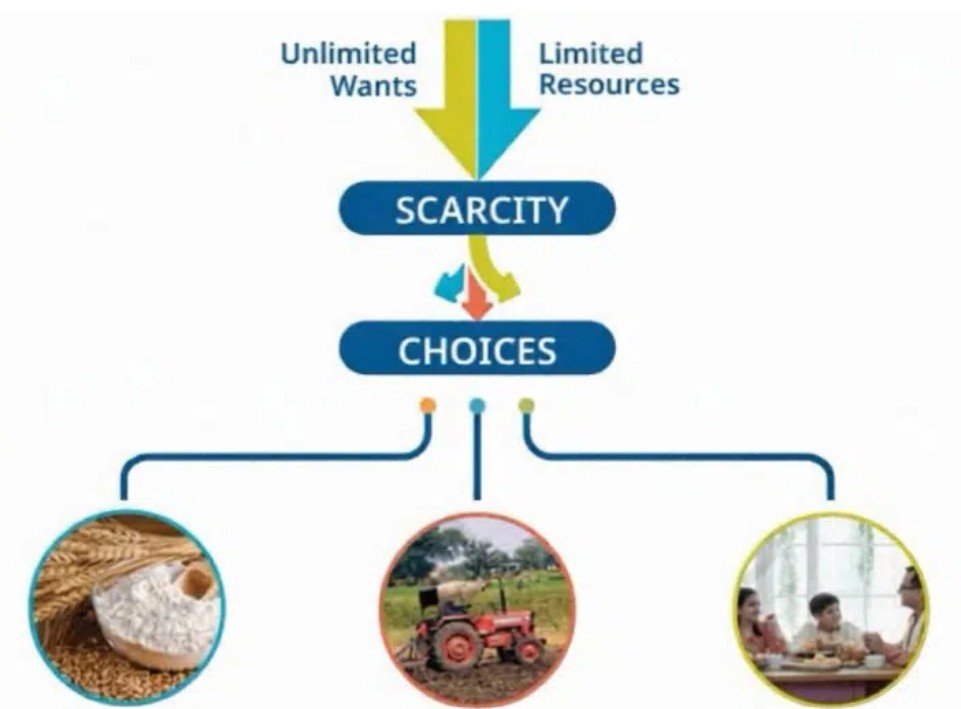
a) What to produce
b) How to produce
c) For whom to produce
d) Why to produce
Answer: d) Why to produce
Q34. If Fig. 8.6 (Factors of Production) is applied to a market economy, who owns most of the resources?
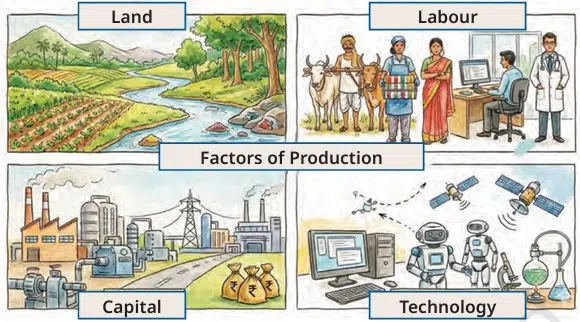
a) Government
b) Private individuals and companies
c) International organizations
d) No one
Answer: b) Private individuals and companies
Q35. Refer to Figure (Role of government and market in a mixed economy). Which of the following is a role of the government?
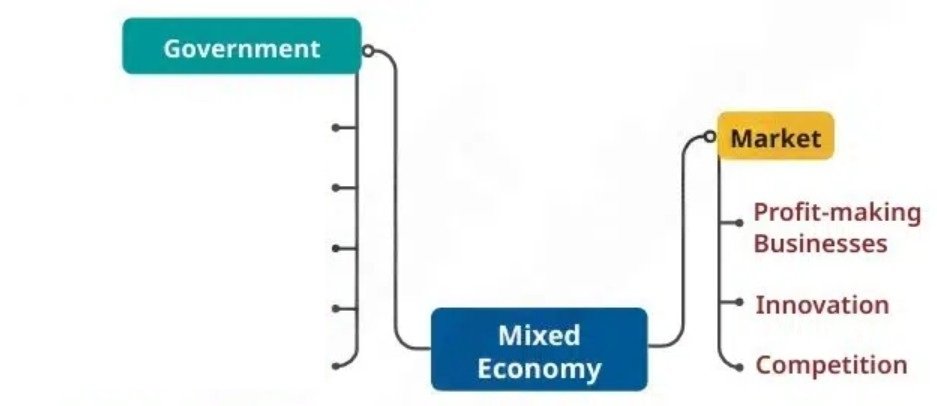
a) Profit-making
b) Innovation
c) Consumer protection
d) Competition
Answer: c) Consumer protection
HOT Question
Q36. The government has limited funds. If it spends more on highways, hospitals may get less funding. What does this situation represent?
a) Unlimited resources
b) Economic choice and opportunity cost
c) Free goods
d) No scarcity
Answer: b) Economic choice and opportunity cost
Q37. Why is the PPC curve downward sloping?
a) Because resources are unlimited
b) Because producing more of one good requires sacrificing another
c) Because both goods can be produced infinitely
d) Because demand is constant
Answer: b) Because producing more of one good requires sacrificing another
Q38. Why is the Economic Survey of India important for policymakers?
a) It provides entertainment data.
b) It reviews economic performance and guides the Union Budget.
c) It only studies agriculture.
d) It is prepared by private companies.
Answer: b) It reviews economic performance and guides the Union Budget.
Q39. Why might a government encourage capital-intensive production through incentives?
a) To reduce dependence on technology
b) To increase efficiency and large-scale output
c) To make labor more expensive
d) To discourage industrial growth
Answer: b) To increase efficiency and large-scale output
Q40. Why does a market economy encourage better quality and innovation compared to a planned economy?
a) Because government controls production
b) Because competition among producers motivates improvement
c) Because resources are unlimited
d) Because consumers have no choice
Answer: b) Because competition among producers motivates improvement
Q41. Why do most modern economies adopt a mixed system instead of purely planned or purely market systems?
a) To balance efficiency with welfare
b) To remove government completely
c) To stop innovation
d) To avoid global trade
Answer: a) To balance efficiency with welfare
Disclaimer: The content that is present on our website is based on the NCERT Class 9 Social Science textbook and is provided for educational purposes only. All the content and images have been taken from Social Science Class 9 NCERT Textbook and CBSE Support material. Images and content shown above are the property of individual organizations and are used here for reference purposes only. To make it easy to understand, some of the content and images are generated by AI and cross-checked by the teachers.