
← Back to Class 9 Social Science MCQs
Elections Class 9 MCQ helps students revise the important concepts from the Class 9 Social Science Civics chapter “Electoral Politics”. These multiple-choice questions are based on NCERT concepts and cover topics such as the importance of elections, democratic representation, Election Commission of India, electoral systems, political parties, election laws, and challenges in free and fair elections.
Elections Class 9 MCQ
Conceptual Recall MCQs
Q1. Which of the following is an example of direct election in India?
a) President of India
b) Vice President of India
c) Members of Lok Sabha
d) Members of Rajya Sabha
Answer: c) Members of Lok Sabha
Q2. How often are direct elections for Lok Sabha and Vidhan Sabha held in India?
a) Every 3 years
b) Every 4 years
c) Every 5 years
d) Every 6 years
Answer: c) Every 5 years
Q3. Which electoral system is used to elect members of the Lok Sabha in India?
a) Majority system
b) Proportional representation
c) First-Past-The-Post (FPTP) system
d) Single transferrable vote system
Answer: c) First-Past-The-Post (FPTP) system
Q4. In how many Indian states does the legislature have a bicameral structure?
a) Four
b) Six
c) Eight
d) Ten
Answer: b) Six
Q5. The Representation of the People Act, 1950, mainly deals with:
a) Nomination of candidates
b) Allocation of seats and electoral rolls
c) Election campaigns
d) Post-election disputes
Answer: b) Allocation of seats and electoral rolls
Q6. Which Act lists electoral offences and corrupt practices?
a) RPA, 1950
b) RPA, 1951
c) Presidential Elections Act, 1952
d) Delimitation Act
Answer: b) RPA, 1951
Q7. When was the Election Commission of India (ECI) established?
a) 15 August 1947
b) 25 January 1950
c) 26 January 1950
d) 2 October 1952
Answer: b) 25 January 1950
Q8. Articles 324 to 329 of the Constitution deal with the following:
a) Fundamental Rights
b) Directive Principles of State Policy
c) Powers and duties of the Election Commission
d) Emergency provisions
Answer: c) Powers and duties of the Election Commission
Q9. Which app is exclusively designed for contesting candidates to get nomination forms and apply for permissions?
a) Voter Helpline App
b) Suvidha App
c) CVIGIL App
d) Saksham App
Answer: b) Suvidha App
Q10. Which app allows voters to report Model Code of Conduct violations instantly?
a) Sugam
b) Saksham
c) cVIGIL
d) Suvidha
Answer: c) cVIGIL
Q11. What is the main role of political parties in a democracy?
a) To organise public opinion and contest elections
b) To conduct elections directly
c) To decide the boundaries of constituencies
d) To prepare electoral rolls
Answer: a) To organise public opinion and contest elections
Q12. The Anti-Defection Law in India was passed in
a) 1975
b) 1985
c) 1995
d) 2005
Answer: b) 1985
Q13. A political party is recognised as a national party if it secures not less than 6% of valid votes in four or more states and wins at least:
a) 2 seats in Lok Sabha
b) 4 seats in Lok Sabha
c) 6 seats in Lok Sabha
d) 8 seats in Lok Sabha
Answer: b) 4 seats in Lok Sabha
Q14. The Anti-Defection Law was passed through which constitutional amendment act?
a) 42nd Amendment Act
b) 44th Amendment Act
c) 52nd Amendment Act
d) 61st Amendment Act
Answer: c) 52nd Amendment Act
HOT Question MCQ
Q15. Elections are held regularly to ensure accountability and representation. Suppose a government decides to extend its rule without holding elections, claiming it will save money and maintain stability. Which of the following BEST explains why this action is undemocratic?
a) Because elections are costly and time-consuming.
b) Because citizens lose their right to choose representatives.
c) Because the government will remain stable without elections.
d) Because only one political party will contest elections.
Answer: b) Because citizens lose their right to choose representatives.
Q16. India uses the FPTP system for Lok Sabha elections. Some critics argue that this system allows a candidate to win without majority support. Which alternative system could address this issue by ensuring seats are distributed according to vote share?
a) Majority system
b) Proportional representation system
c) Single transferrable vote system
d) Lottery system
Answer: b) Proportional representation system
Q17. Suppose a candidate appeals to voters on the basis of religion and caste. Why is this considered a corrupt practice under RPA, 1951?
a) Because it saves campaign costs
b) Because it divides voters and violates equality
c) Because it helps candidates win easily
d) Because it is allowed by the Constitution
Answer: b) Because it divides voters and violates equality
Q18. Suppose elections are conducted but many citizens face accessibility issues, votes are miscounted, and candidates use personal favours to influence voters. Why would such elections lose democratic value?
a) Because elections are costly
b) Because fairness and transparency are missing
c) Because only one party contests
d) Because the ECI registers political parties
Answer: b) Because fairness and transparency are missing.
Q19. India’s electoral process uses apps like Suvidha, cVigil, Saksham, and ETPBS. How do these digital tools strengthen democracy?
a) By reducing the number of voters
b) By making elections more inclusive, transparent, and efficient
c) By allowing only political parties to vote
d) By avoiding the need for electoral rolls
Answer: b) By making elections more inclusive, transparent, and efficient
Q20. Defection is often seen as political opportunism, but sometimes it is argued to be an act of conscience. How does the Anti-Defection Law balance these two views?
a) By allowing free switching between parties
b) By disqualifying members who defy party discipline to maintain stability
c) By ignoring defections completely
d) By letting voters decide immediately through re-election
Answer: b) By disqualifying members who defy party discipline to maintain stability
Q21. India has a multi-party system with national parties, state parties, and registered unrecognised parties. How does this system strengthen democracy?
a) By limiting the number of parties
b) By reflecting India’s diversity and offering meaningful choices to voters
c) By ensuring only national parties contest elections
d) By preventing alliances and coalitions
Answer: b) By reflecting India’s diversity and offering meaningful choices to voters
Application-Based MCQs
Q22. Gurmat was elected as Class Representative (CR) in Grade 8. If she continues in Grade 9 without a fresh election, which democratic principle is being violated?
a) Accountability
b) Equality
c) Representation
d) Legitimacy
Answer: a) Accountability
Q23. If only one political party contests elections, which democratic value is lost?
a) Equality of votes
b) Freedom of choice
c) Legitimacy of government
d) Accountability of leaders
Answer: b) Freedom of choice
Q24. If a candidate wins an election with only 40% of the votes in their constituency, which electoral system allows this?
a) Majority system
b) Proportional representation
c) First-Past-The-Post (FPTP) system
d) Single transferrable vote system
Answer: c) First-Past-The-Post (FPTP) system
Q25. In the Vidhan Parishad elections, if a candidate does not get the required quota of votes, what happens?
a) The candidate is declared elected automatically.
b) Votes are transferred based on second preference.
c) The election is cancelled.
d) The Governor nominates the candidate
Answer: b) Votes are transferred based on second preference.
Q26. A candidate offers free gifts to voters to gain support. Under which law is this considered a corrupt practice?
a) RPA, 1950
b) RPA, 1951
c) Delimitation Commission Act
d) None of these
Answer: b) RPA, 1951
Q27. Why is delimitation necessary in elections?
a) To reduce the number of constituencies
b) To ensure equal representation based on population
c) To help candidates win easily
d) To fix permanent boundaries
Answer: b) To ensure equal representation based on population
Q28. A young citizen turns 18, but their name is missing from the electoral roll. Which initiative of the ECI ensures their inclusion?
a) Electoral Symbols Allocation
b) Electoral Roll Revision
c) Delimitation Commission
d) National Voters’ Day
Answer: b) Electoral Roll Revision
Q29. If a service voter is posted outside their constituency, which system allows them to cast their vote electronically?
a) FPTP system
b) ETPBS system
c) Proportional representation
d) Postal service only
Answer: b) ETPBS system
Q30. A service voter is posted outside their constituency. Which app/system helps them cast their vote electronically?
a) Suvidha
b) ETPBS
c) Sugam
d) Voter Helpline
Answer: b) ETPBS
Q31. A person with disabilities (PwD) wants customised services for voter registration and polling station details. Which app should they use?
a) Saksham App
b) Suvidha App
c) Sugam App
d) Voter Helpline App
Answer: a) Saksham App
Q32. If a candidate elected on a party’s ticket votes against the party’s whip in the legislature, what can happen under the Anti-Defection Law?
a) The candidate is promoted.
b) The candidate is disqualified.
c) The candidate is given a new symbol.
d) The candidate is allowed to form a new party immediately.
Answer: b) The candidate is disqualified.
Q33. How do political parties help voters make informed decisions during elections?
a) By preparing electoral rolls
b) By presenting manifestos and campaigning on issues
c) By conducting delimitation
d) By registering voters directly
Answer: b) By presenting manifestos and campaigning on issues
Q34. A party secures 8% of valid votes in a state election but does not win any seat. Can it be recognised as a State Party?
a) Yes, because 8% of votes are enough
b) No, because winning seats is compulsory.
c) Yes, because it had contested elections.
d) No, because only national parties can be recognised.
Answer: a) Yes, because 8% of votes are enough.
Explanation:
- get 6% votes AND
- win at least one Assembly seat OR one Lok Sabha seat from that state
Q35. Why was the Janata Party alliance in 1977 historically significant?
a) The first non-Congress government at the Centre.
b) It introduced proportional representation.
c) It abolished defection.
d) It created the Election Commission
Answer: a) The first non-Congress government at the Centre.
Assertion–Reason MCQs
Q36. Assertion (A): Elections ensure that representatives remain accountable to the people.
Reason (R): Because citizens can vote them out if they fail to perform.
a) Both A and R are true, and R is the correct explanation of A.
b) Both A and R are true, but R is not the correct explanation of A.
c) A is true, R is false.
d) A is false, R is true.
Answer: a) Both A and R are true, and R is the correct explanation of A.
Q37. Assertion (A): Elections to the Rajya Sabha are conducted using proportional representation.
Reason (R): This system ensures that seats are distributed fairly among different political parties based on their vote share.
a) Both A and R are true, and R is the correct explanation of A.
b) Both A and R are true, but R is not the correct explanation of A.
c) A is true, R is false.
d) A is false, R is true.
Answer: a) Both A and R are true, and R is the correct explanation of A.
Q38. Assertion (A): The RPA, 1950, ensures that every citizen above 18 years has the right to vote.
Reason (R): It deals with preparation and revision of electoral rolls.
a) Both A and R are true, and R is the correct explanation of A.
b) Both A and R are true, but R is not the correct explanation of A.
c) A is true, R is false.
d) A is false, R is true.
Answer: a) Both A and R are true, and R is the correct explanation of A.
Q39. Assertion (A): The ECI registers political parties and allocates election symbols.
Reason (R): This ensures recognition of parties and helps voters identify candidates easily.
a) Both A and R are true, and R is the correct explanation of A.
b) Both A and R are true, but R is not the correct explanation of A.
c) A is true, R is false.
d) A is false, R is true.
Answer: a) Both A and R are true, and R is the correct explanation of A.
Q40. Assertion (A): The Voter Helpline App provides registration, verification, and election-related updates.
Reason (R): It is a multipurpose app designed for voters.
a) Both A and R are true, and R is the correct explanation of A.
b) Both A and R are true, but R is not the correct explanation of A.
c) A is true, R is false.
d) A is false, R is true.
Answer: a) Both A and R are true, and R is the correct explanation of A.
Q41. Assertion (A): Political parties are essential for democracy.
Reason (R): They provide accountability, governance, and representation.
a) Both A and R are true, and R is the correct explanation of A.
b) Both A and R are true, but R is not the correct explanation of A.
c) A is true, R is false.
d) A is false, R is true.
Answer: a) Both A and R are true, and R is the correct explanation of A.
Q42. Assertion (A): Alliances in Indian politics began after 1967.
Reason (R): The era of single-party dominance ended, and coalition politics emerged.
a) Both A and R are true, and R is the correct explanation of A.
b) Both A and R are true, but R is not the correct explanation of A.
c) A is true, R is false.
d) A is false, R is true.
Answer: a) Both A and R are true, and R is the correct explanation of A.
Case Study MCQ
Q43. Read the case and answer:
In a village, elections for the Panchayat were held after five years. Citizens voted directly to choose their representatives. The elected members promised to improve roads and water supply. After two years, villagers felt the promises were not fulfilled.
Which democratic principle allows villagers to hold representatives accountable in the next election?
a) Equality of votes
b) Legitimacy of government
c) Accountability of leaders
d) Indirect election process
Answer: c) Accountability of leaders
Q44. Read the case and answer:
In Haritbhumi, elections are held using the FPTP system. Party A wins 40% of the votes, Party B wins 35%, and Party C wins 25%. Party A forms the government.
Which democratic principle is most challenged in this situation?
a) Representation of all voters
b) Accountability of leaders
c) Equality of votes
d) Legitimacy of government
Answer: a) Representation of all voters
Q45. Read the case and answer:
In a constituency, one MP represents 25 lakh people, while another MP represents only 5 lakh people. Citizens complain that this is unfair.
Which process can correct this imbalance?
a) Nomination of candidates
b) Delimitation of constituencies
c) Electoral roll revision
d) Presidential Elections Act
Answer: b) Delimitation of constituencies
Q46. Read the case and answer:
During the 2024 general elections, senior citizens above 85 years and persons with disabilities (PwDs) were allowed to vote from home.
Which democratic principle was strengthened by this initiative?
a) Accountability
b) Inclusiveness and accessibility
c) Representation of parties
d) Legitimacy of government
Answer: b) Inclusiveness and accessibility
Q47. Read the case and answer:
During an election rally, a voter notices that loudspeakers are being used without permission. The voter immediately reports this violation using an app.
Which app was used, and what democratic principle does it strengthen?
a) Suvidha App – Accountability
b) cVIGIL App – Fairness in elections
c) Saksham App – Inclusiveness
d) Sugam App – Transparency in vehicle use
Answer: b) cVIGIL App – Fairness in elections
Q48. Read the case and answer:
A candidate wins elections on Party X’s ticket. Later, the candidate leaves Party X and joins Party Y to gain ministerial benefits.
Which law prevents such opportunism, and what is its purpose?
a) RPA, 1950 – To prepare electoral rolls
b) RPA, 1951 – To regulate campaigns
c) Anti-Defection Law – To ensure political stability
d) Delimitation Act – To fix constituency boundaries
Answer: c) Anti-Defection Law – To ensure political stability
Q49. Read the case and answer:
In a Lok Sabha election, Party X wins 2% of seats, with candidates elected from three different states.
According to the criteria, how will Party X be recognised?
a) As a State Party
b) As a National Party
c) As a Registered Unrecognised Party
d) As an Independent Group
Answer: b) As a National Party
Diagram-Based MCQs
Q50. In Fig. 7.1, two boxes are already filled with accountability and representation. Which of the following can fill the remaining two boxes?
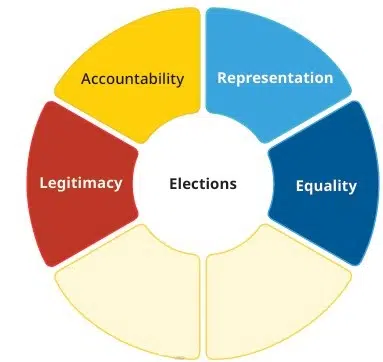
a) Equality and Legitimacy
b) Freedom and Justice
c) Rights and Duties
d) Power and Authority
Answer: a) Equality and Legitimacy
Q51. How is equality ensured through elections?
a) Every citizen has one vote of equal value.
b) Only educated citizens can vote.
c) Rich citizens have more votes.
d) Leaders decide who can vote.
Answer: a) Every citizen has one vote of equal value.
Q52. In the single transferrable vote system, what happens to the votes of the candidate who receives the lowest number of first-preference votes?
a) They are cancelled.
b) They are transferred to other candidates based on second preference.
c) They are added to the top candidate.
d) They are counted again in the next round.
Answer: b) They are transferred to other candidates based on second preference.
Q53. In proportional representation, if Party M gets 40% of the votes in a 100-seat parliament, how many seats will it get?
a) 25
b) 35
c) 40
d) 50
Answer: c) 40
Q54. In proportional representation, what happens to the votes of a candidate who is eliminated?
a) They are cancelled permanently.
b) They are transferred to the next preferred candidate.
c) They are given to the governor.
d) They are counted again in the next election.
Answer: b) They are transferred to the next preferred candidate
Q55. Which of the following ensures equal representation across constituencies?
a) Electoral rolls
b) Delimitation Commission
c) Election campaigns
d) Presidential Elections Act
Answer: b) Delimitation Commission
Q56. In Figure, the officer is verifying voter names from the electoral roll. Why is this step important?
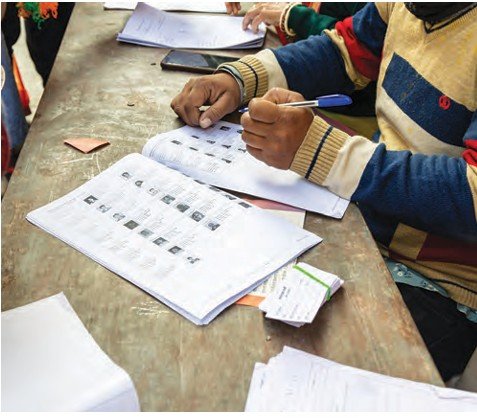
a) To ensure only eligible citizens vote
b) To help candidates campaign
c) To decide election symbols
d) To register political parties
Answer: a) To ensure only eligible citizens vote
Q57. The Voters’ Pledge taken on National Voters’ Day emphasises voting:
a) Based on religion and caste
b) Fearlessly and without inducement
c) Only for national parties
d) Only during General Elections
Answer: b) Fearlessly and without inducement
Q58. Based on the Figure, which app manages vehicles requisitioned for election work?
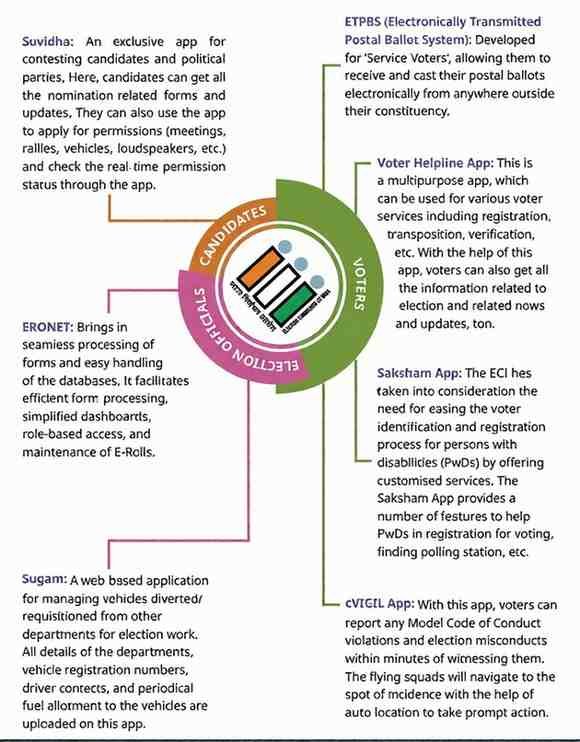
a) Suvidha
b) Sugam
c) Saksham
d) Voter Helpline
Answer: b) Sugam
Q59. Which app ensures seamless processing of electoral forms and maintenance of e-rolls?
a) ERONET
b) Suvidha
c) Saksham
d) Voter Helpline
Answer: a) ERONET
Q60. According to Figure, which of the following is NOT a function of political parties?
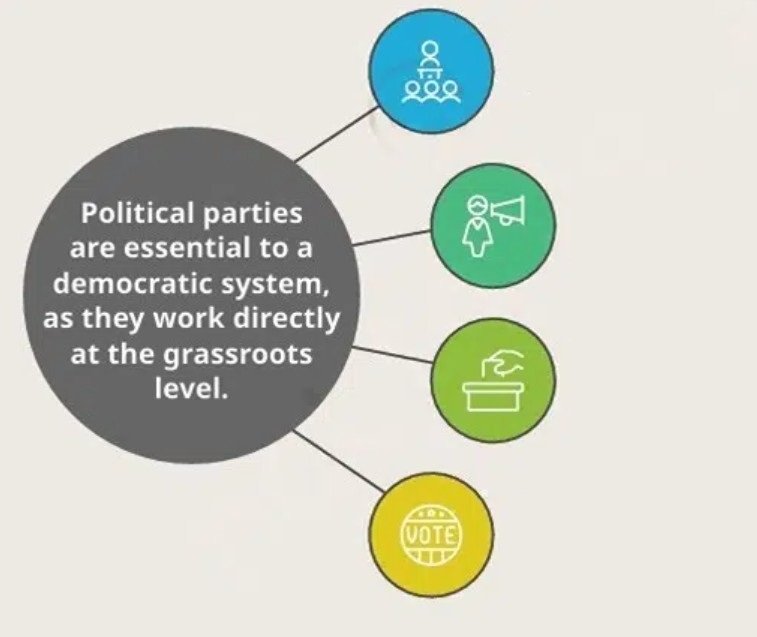
a) Organising public opinion
b) Campaigning on issues
c) Preparing electoral rolls
d) Offering voters meaningful choices
Answer: c) Preparing electoral rolls
Q61. What is the role of the opposition party in democracy?
a) To form government
b) To ensure accountability and participate in debates
c) To conduct elections
d) To prepare manifestos for the ruling party
Answer: b) To ensure accountability and participate in debates
Q62. Which of the following is NOT a challenge to free and fair elections in India?
a) Misinformation and fake news
b) Intimidation of voters
c) VVPAT verification
d) Model Code of Conduct violations
Answer: c) VVPAT verification
Q63. Which measure ensures transparency in vote counting?
a) Electoral rolls
b) VVPAT (Voter Verifiable Paper Audit Trail)
c) Model Code of Conduct
d) Alliances of parties
Answer: b) VVPAT (Voter Verifiable Paper Audit Trail)
Disclaimer: The content that is present on our website is based on the NCERT Class 9 Social Science textbook and is provided for educational purposes only. All the content and images have been taken from Social Science Class 9 NCERT Textbook and CBSE Support material. Images and content shown above are the property of individual organizations and are used here for reference purposes only. To make it easy to understand, some of the content and images are generated by AI and cross-checked by the teachers.
Very good 👍