
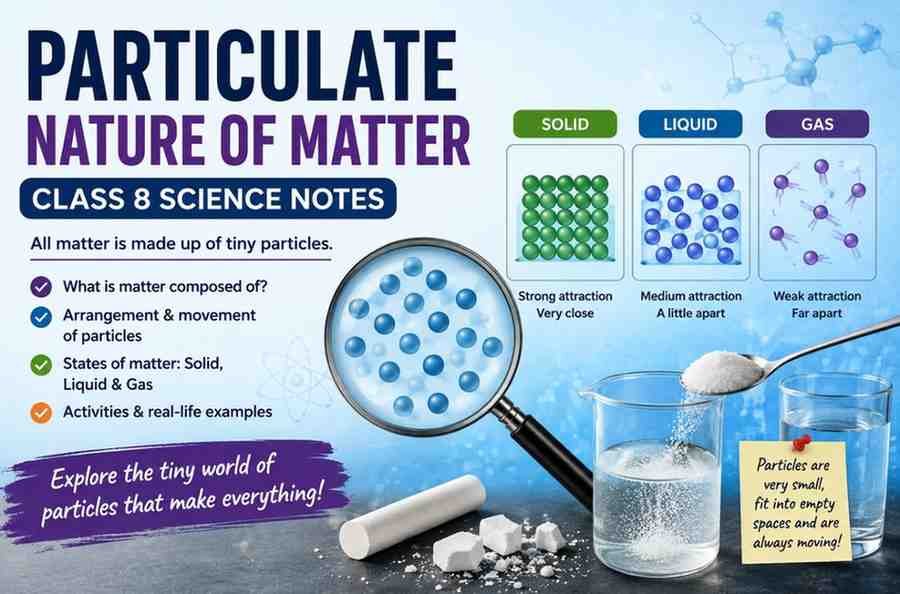
Particulate Nature of Matter Class 8 Notes provides a simple and student-friendly explanation of the idea that all matter is made up of tiny particles. These notes explain the arrangement and movement of particles in solids, liquids, and gases, along with activities that help students understand the properties of matter. The chapter also covers how particles interact, occupy space, and change their arrangement during different physical processes.
Particulate Nature of Matter Class 8 Notes
You have seen the pebbles or stones on a riverbank or a beach. These pebbles or stones are made up of big rocks; these big rocks break into stones or pebbles because of wind, rain, and flowing water. This breaking process is called erosion.
Over time these pebbles and stones break into tiny grains; these grains become sand and clay. The sand grains look tiny, but it is not the smallest unit. Each grain of sand is made of minerals, and these minerals can be broken further into smaller particles. The scientists study this particle to understand the building blocks of rocks.
What Is Matter Composed of?
There are a lot of things around us, like chalk, a grain of sand, sugar, water, and even air. These all are made of tiny particles. These particles are very small, so we cannot see them with our eyes. Let’s understand with a simple activity.
Activity – Breaking Chalk
- Take a stick of chalk.
- Break it into two pieces.
- Keep breaking until it becomes very small.
- Grind the small pieces into fine powder.
- Look at the powder with a magnifying glass.
Observation: When you observe, even if the chalk has become very small, each tiny grain is still chalk. Braking or grinding chalk is called a physical change because its size changed, not its properties. If you grind the chalk again and again, you will finally find the smallest particles that cannot be broken further by ordinary methods. These smallest particles are called constituent particles.
What Are Constituent Particles?
A constituent particle is the smallest building block that makes up a substance. A whole piece of chalk is made up of millions of tiny constituent particles just like chalk, rocks, sand, and clay.
Activity – Dissolving Sugar in Water
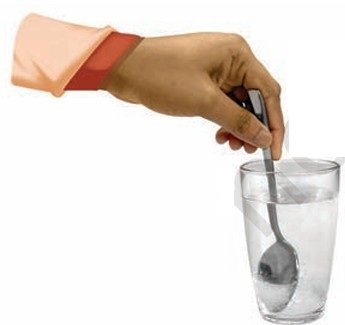
- Fill a glass with water.
- Add two spoons of sugar.
- Taste the top layer before stirring – it may not taste sweet.
- Stir until sugar dissolves.
- Taste again – now it tastes sweet.
Observation: Before stirring, the water does not taste very sweet. After stirring, the water tastes sweet even though you cannot see the sugar.
What Does This Mean?
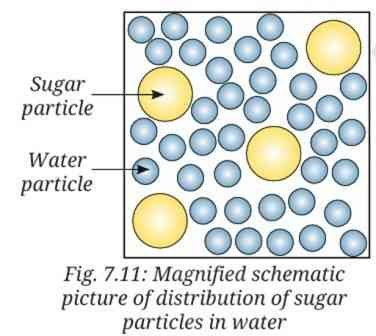
When you are stirring, the sugar particles are not disappearing. It is broken into very tiny particles, and these particles fit into the empty space between the water particles. These empty spaces are called interparticle spaces. Because the sugar particles are extremely small, we cannot see them, but we can taste them.
What Decides Different States of Matter?
The different states of matter are solid, liquid, and gas. These states are decided by the force of attraction between particles, which is called interparticle attraction.
- If the force of attraction is strong, the particles stay close together, and the substance is a solid.
- If the force of attraction is medium, the particles can move a little, and the substance is a liquid.
- If the force of attraction is weak, the particles move freely and the substance is a gas.
The force of attraction depends on—
- The type of substance
- The distance between the particles.
| State of Matter | Force of Attraction | Distance Between Particles |
|---|---|---|
| Solid | Strong | Very close |
| Liquid | Medium | A little apart |
| Gas | Weak | Far apart |
Solid state
What is a solid?
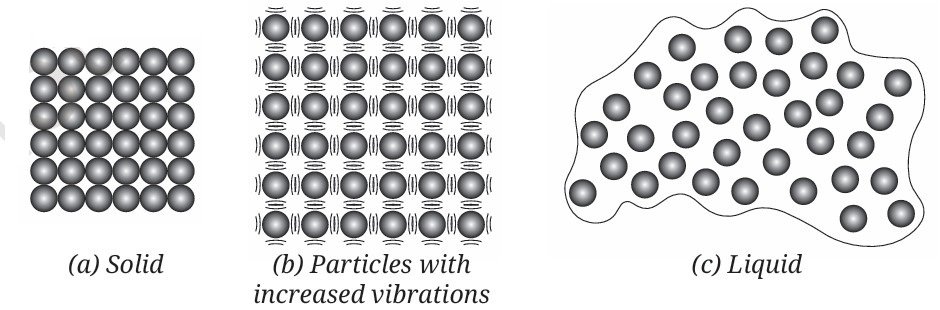
A solid is the state of matter that has a fixed shape and a fixed volume. The particles in a solid are very close to each other. They are held together with very strong forces of attraction. These strong forces keep the particles fixed in one place; because of this, the particles cannot move freely. They can only vibrate in their position.
What happens when a solid is heated?
When the solid is heated, then the particles vibrate faster and the temperature increases; the particles gain more energy. At a certain temperature the particles leave their fixed position, and the force of attraction becomes weaker, and the solid changes into liquid.
What is the melting point?
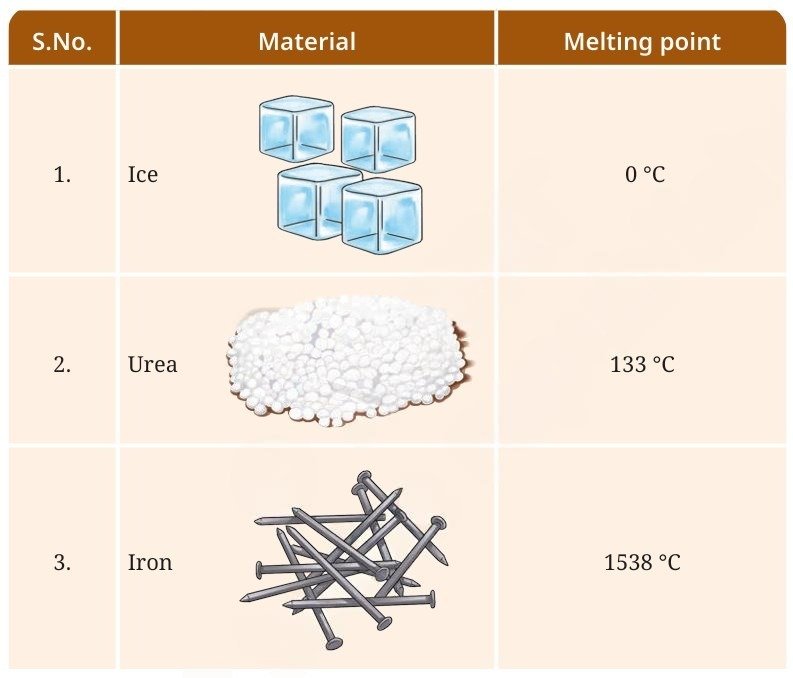
Melting point is the minimum temperature at which a solid becomes liquid at normal atmospheric pressure.
- Solids with weak force of attraction have a low melting point.
- Solids with a strong force of attraction have a high melting point.
Note: Most of the particles in a liquid are farther apart than in a solid. Only ice is different; the particles in the ice are farther apart than in water.
Melting points of some solids
Liquid state
What is a liquid?
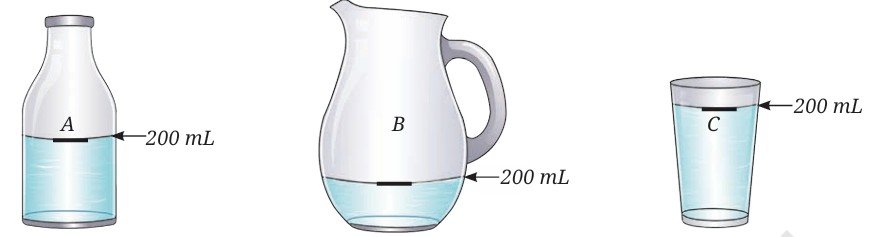
A liquid is a state of matter that has a fixed volume but no fixed shape. In liquid the particles are very close to each other. They are not fixed in one place. The particles can move and slide past one another; because of this, the liquid takes the shape of the container in which it is kept.
Force of attraction in liquids
The force of attraction between the liquid is weaker than in a solid, but it is strong enough to keep the particles close together.
What happens when a liquid is heated?
When the liquid is heated, then the particles move faster. At a certain temperature they get enough energy to escape into the air. The liquid changes into a gas (vapor).
What is the boiling point?
Boiling point is a temperature when the liquid changes into a gas at normal atmospheric pressure.
Boiling vs Evaporation
| Boiling | Evaporation |
|---|---|
| Happens at the boiling point only | Happens at all temperatures |
| Takes place throughout the liquid | Takes place only at the surface |
| Vapour forms very fast | Vapour forms slowly |
| Bubbles are formed | No bubbles are formed |
Gaseous state
What is a gas?
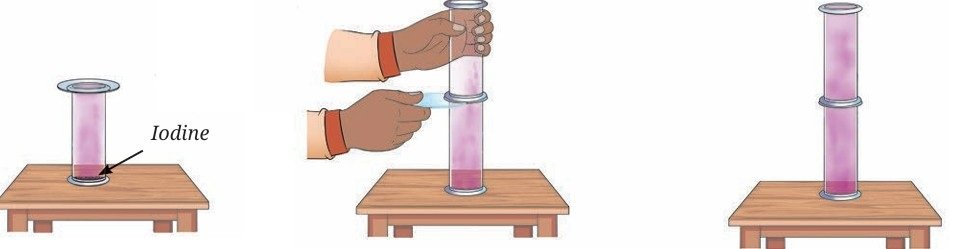
A gas is a state of matter that has no fixed shape and no fixed volume. In gas the particles are very far apart. The force of attraction between the particles is very weak, almost zero. The particles can move freely in all directions, so that way the gas can fill all the available space in the container.
For example, when the smoke is collected in one gas jar and another empty gas jar is placed on the top, then the smoke spreads into both jars. Which shows that the gas particles move freely. So, the gases do not have a fixed volume.
Force of attraction in gases
In gas the particles are very far from each other, and the force of attraction is very weak. So the particle moves freely in every direction.
What are fluids?
The liquids and gas can flow. They do not have a fixed shape. Therefore, the liqids and gases are called fluids.
How Does the Interparticle Spacing Differ in the Three States of Matter?
The space between particles is called interparticle spacing.
- Solids have the least space between particles.
- Liquids have more space than solids.
- Gases have the maximum space between particles.
The amount of space between particles affects the properties of matter.
Interparticle Spacing in Gases
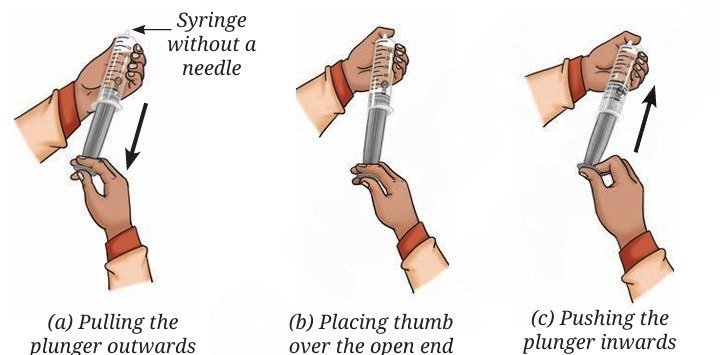
The air can be compressed easily by pushing the syringe plunger. This happens because the gas particles are very far from each other. When the plunger is pushed, then the gas particles come closer, and when the plunger is released, then the gas particles spread out again. The conclusion is that gases have large spaces between their particles, so they are compressible.
Interparticle Spacing in Liquids
When the sugar is added to the water, then the water level rises. After stirring, the sugar dissolves with water, and the water level decreases slightly. This happens because there is a small space between water particles. The dissolved sugar particles fit into these spaces. The conclusion is liquids have the same pace between their particles.
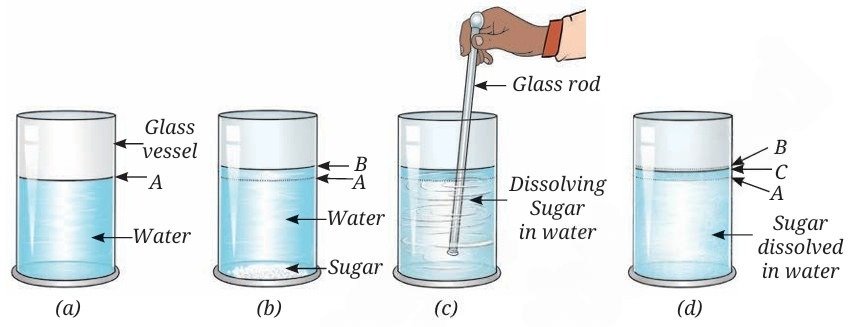
When the sand is added to the water, then the sand does not dissolve. It settles at the bottom and the volume increases. Because of this, the sand particles cannot fit into the space between water particles.
Interparticle Spacing in Solids
In solid particles are very close together. The space between them is very small. They are held together with strong attraction force. In solids, particles cannot move freely. In a solid there is a very tiny space between the particles, but it is empty, meaning not filled with air.
How Particles Move in Different States of Matter?
The particles of matter are always moving. It depends on the amount of heat (thermal energy) they have.
- More heat → Particles move faster.
- Less heat → Particles move slower.
Movement of Particles in Liquids
When the potassium permanganate is added into the water, then water near the potassium permanganate crystal becomes pink. After some time the whole water turns pink. This happens because water particles are always moving. They carry the potassium permanganate particles throughout the water. This shows that the particles in a liquid are always moving.
Effect of Heat on Particle Movement
If potassium permanganate is added to –
- In hot water the color spreads faster.
- In room temperature water, color spreads moderately.
- In ice water the color spreads the slowest.
This shows heating increases the movement of particels and cooling decreases the movement of particels.
Movement of Particles in Gases
What happens when an incense stick is lit?
At first the people near the incense stick can smell it, but after a few minutes the fragrance spreads throughout the room. This happens because gas particles move freely in all directions. For example, perfume smells spread across a room, the smell of food reaches another room, and LPG gas spreads quickly if there is a leak.
Thermal Energy and States of Matter
Thermal energy is heat energy present in the particles.
- Solid: In a solid the particles have low thermal energy. They only vibrate.
- Liquid: In liquid the thermal energy is more than in solids. They can move and slide past each other.
- Gas: Gas has high thermal energy and moves freely in all directions.
Change of State
Solid → Liquid
- When a solid is heated, the particles gain energy.
- At the melting point, the solid changes into a liquid.
Liquid → Gas
- When a liquid is heated more, the particles gain more energy.
- At the boiling point, the liquid changes into a gas.
Disclaimer: The content that is present on our website is based on the NCERT Class 8 Science textbook and is provided for educational purposes only. All the content and images have been taken from Science Class 8 NCERT Textbook. Images and content shown above are the property of individual organizations and are used here for reference purposes only. To make it easy to understand, some of the content and images are generated by AI and cross-checked by the teachers.
Nice