
Nature of Matter: Elements, Compounds and Mixtures Class 8 Notes provides simple and easy-to-understand explanations of elements, compounds, mixtures, pure substances, and minerals. These notes help students understand how different substances are made, how elements combine to form compounds, and how mixtures differ from pure substances.
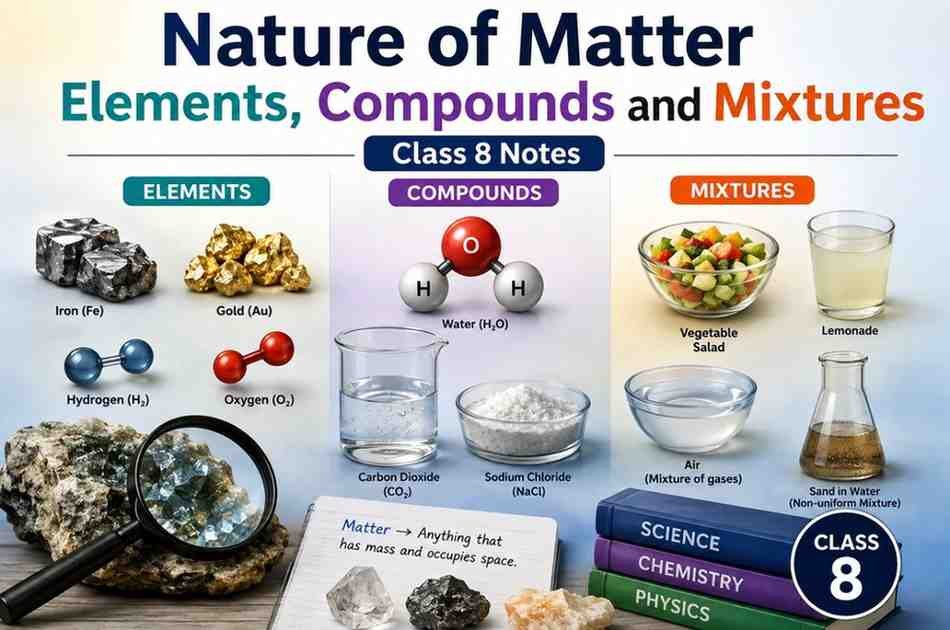
Nature of Matter Elements Compounds and Mixtures Class 8 Notes
There are a lot of things around us, like air, water, food, clothes, shoes, books, trees, balls, and sticks, which are all examples of matter. The matter is made up of very tiny particles. Most of the matter around us is made of two or more substances together. When two or more substances are mixed together, they form a mixture.
What Are Mixtures?
A mixture is formed when two or more substances are combined without any chemical reaction. Each substance keeps its own properties. The substances that make up a mixture are called its components.
There are two types of mixture—
- Non-uniform mixtures
- Uniform mixtures
Non-uniform mixtures
There are some mixtures where we can easily see the different components. For example, in a sprout salad we can see green gram, check peas, onion, and tomato separately. This mixture is called a non-uniform mixture because its components are not evenly mixed. For example,
- Vegetable salad
- Fruit salad
- Sand and stones
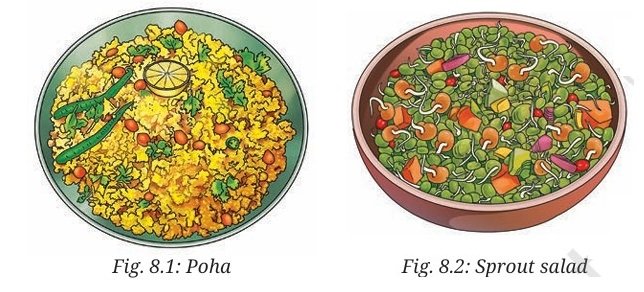
Uniform Mixture
There are some mixtures where the different components cannot be seen separately. For example, sugar dissolves in water; we cannot see the sugar particles separately. The components are spread evenly throughout the mixture. This type of mixture is called a uniform mixture. Examples include:
- Sugar solution
- Salt solution
- Lemonade
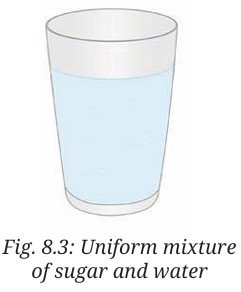
Is air a mixture?
Yes, air is a mixture. It is a uniform mixture (homogeneous) of several gases –
- Nitrogen (78%) → does not support combustion.
- Oxygen (21%) is essential for breathing and burning.
- Argon, carbon dioxide, and water vapour are present in small amounts.
In air these gases are evenly distributed and cannot be seen separately, so that way it is a uniform mixture.
Activity: Lime Water Test
When the carbon dioxide reacts with the calcium hydroxide (lime water), then it forms calcium carbonate (tiny white particles). This makes lime water milky, which proves the presence of carbon dioxide in air.
Ca(OH)2 + CO 2 → CaCO3 + H2O
Activity: Dust in Air
If you keep a black sheet near a window, you will see dust particles settle on the sheet. These particles are not part of air but are pollutants. Some other pollutants include carbon monoxide, ozone, nitrogen dioxide and sulfer dioxide.
Types of mixtures
The mixture is made when the two or more pure substances are combined physically, without chemical reaction. Mixtures can be classified based on the physical state of their components.
| Type of Mixture | Examples | Nature of Mixture |
|---|---|---|
| Solid + Solid | Poha, sprout salad | Non-uniform (heterogeneous) |
| Solid + Liquid | Salt in water, sugar in water | Uniform (homogeneous) |
| Liquid + Liquid | Lemon juice in water, milk in tea | Uniform (homogeneous) |
| Gas + Gas | Air (nitrogen + oxygen + carbon dioxide + water vapour) | Uniform (homogeneous) |
| Gas + Solid | Smoke, dust in air | Non-uniform (heterogeneous) |
| Gas + Liquid | Aerated drinks (CO₂ in water), soda | Uniform (homogeneous) |
Separation of Mixture
In everyday life, the mixtures are separated to get the useful component, like removing stones from rice. In science, the mixtures are separated to obtain pure substances for study or experiments. Separation methods include:
- Filtration → separating solids from liquids.
- Evaporation → separating dissolved solids from liquids.
- Distillation: separating liquids with different boiling points.
- Magnetic separation → separating magnetic substances from non-magnetic ones.
What Are Pure Substances?
In daily life, pure means that a product has not been mixed with cheaper or harmful substances. Adding such substances is called adulteration.
In science, a pure substance contains only one type of substance or particles.
For example:
- Pure gold contains only gold particles.
- Pure copper contains only copper particles.
- Distilled water contains only water particles.
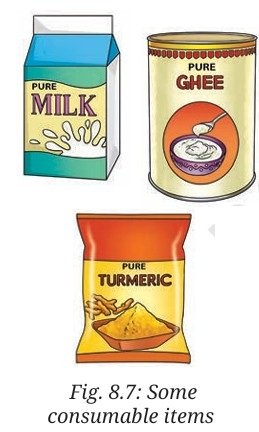
A pure substance cannot be separated into different substances by physical methods.
What Are the Types of Pure Substances?
The pure substances are mainly two types—
- Elements
- Compounds
To understand this, let us first see what happens when we change the state of water.
What happens when water is heated or cooled?
When water is cooled, it becomes ice. When the water is heated, it becomes water vapor. We can change ice back into water and water vapor back into water. Here, the substance remains water. Only the state changes. This is called physical change.
What happens when electricity passes through water?
When the electricity passed through water, it could break water into two gases, hydrogen and oxygen. Hydrogen and oxygen are both different substances.
- Hydrogen gives a pop sound when tested with a flame.
- Oxygen makes a flame burn brighter.
This shows that the water is made up of hydrogen and oxygen.
Is water an element or a compound?
The water is compound because it is made up of two different elements: hydrogen and oxygen. A compound is a pure substance made when the two elements are combined chemically.
The change can be represented as:

1. Elements
Elements are made of only one type of atom. It cannot be broken down into simpler substances by chemical methods. Examples: Hydrogen (H), Oxygen (O), Iron (Fe), and Gold (Au).
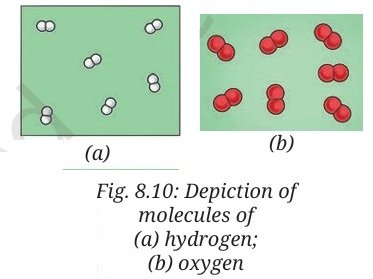
Molecules of Elements
Atoms of some elements cannot exist alone. Two or more atoms join together to form a molecule.
For example:
- 2 hydrogen atoms → 1 hydrogen molecule (H₂)
- 2 oxygen atoms → 1 oxygen molecule (O₂)
Types of Elements
Elements are mainly classified as
- Metals – gold, silver, iron, aluminum, magnesium
- Non-metals—carbon, sulfur, hydrogen, oxygen
- Metalloids—elements such as silicon and boron that have some properties of both metals and non-metals.
There are 118 known elements.
At room temperature:
- Most elements are solids.
- 11 elements are gases.
- Only 2 elements, mercury and bromine, are liquids.
2. Compounds
The compounds are formed when two or more elements combine chemically in fixed proportions. It can be broken down into simpler substances by chemical methods. Examples: Water (H₂O), carbon dioxide (CO₂), and sodium chloride (NaCl).
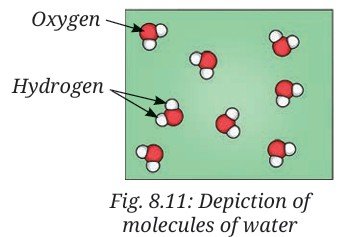
Example, Water is made from hydrogen and oxygen.
- Hydrogen + Oxygen → Water
Water has hydrogen and oxygen combined in a fixed ratio of 2:1.
Important Point
The properties of a compound are usually different from the properties of the elements that form it.
For example:
- Hydrogen is a fuel.
- Oxygen supports burning.
- Water is used to extinguish fire.
So, water has very different properties from hydrogen and oxygen.
Can a compound be separated physically?
No, the elements present in a compound cannot be separated by ordinary physical methods like filtration, handpicking, or evaporation. They can generally be separated by chemical methods. For example, common salt is sodium chloride (NaCl). It is formed when
- Sodium + Chlorine → Sodium chloride
Sodium is a reactive metal, and chlorine is a poisonous gas. When they combine chemically, they form sodium chloride, which is common salt. The ratio of sodium and chlorine is 1:1.
Is Sugar an Element or a Compound?
Sugar is a compound, not an element. When the sugar is heated strongly, then—
- Sugar → Carbon + Water
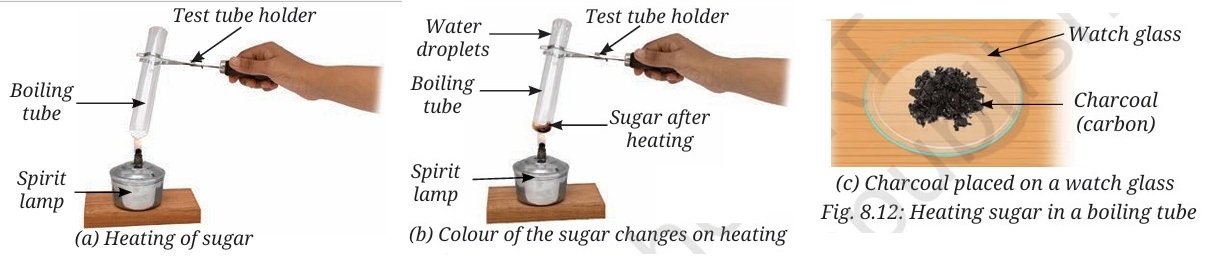
You can observe that—
- Black carbon left behind
- Water droplets formed near the top of the tube
Sugar contains the elements:
- Carbon
- Hydrogen
- Oxygen
Activity — Iron + Sulfur
The purpose of this activity is to understand the difference between a mixture and a compound. For this activity we will take two substances—
- Iron
- Sulfur
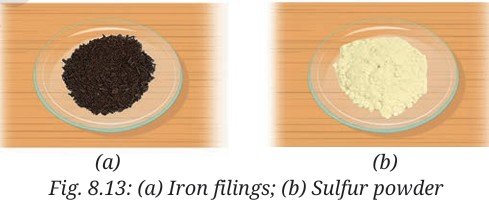
Step 1: Mix iron and sulfur.
First mix the iron and sulfur powder together. They are only mixed together. They have not chemically joined. This will be Sample A.
Take a magnet near. Sample A: the iron is attracted to the iron, while sulfur is left behind. With the help of a magnet, we can separate the iron and sulfur.
Step 2: Heat the mixture.
Now take Sample A and heat it. Now the iron and sulfur chemically combine. A black substance is formed. This is a sample B.
The iron and sulfur chemically combine and make a new substance.
Step 3: Test Sample B with a magnet
Now test the sample B with a magnet; now the magnet will not attract it because iron and sulfur have chemically combined to form a new substance, iron sulfide. So, we cannot use a magnet to separate iron from Sample B.
Step 4: Add dilute hydrochloric acid.
Now test both samples with dilute hydrochloric acid.
Sample A: Iron + Sulfur
In Sample A the iron reacts with dilute hydrochloric acid and produces hydrogen gas.
- Iron + Hydrochloric acid → Iron chloride + Hydrogen
Hydrogen is:
- Colorless
- Odourless
- Burns with a pop sound
Sulfur remains as a yellow solid.
Sample B: Iron sulfide
In Sample B the iron sulfide reacts with dilute hydrochloric acid.
- Iron sulfide + Hydrochloric acid → Iron chloride + Hydrogen sulfide
Hydrogen sulfide gas:
- Is colorless
- Has a rotten-egg-like smell
So the gas produced from Sample A and Sample B is different.
The Difference Between Sample A (Iron + sulfur) and Sample B (Iron sulfide)
| Sample A | Sample B |
|---|---|
| Iron + sulfur | Iron sulfide |
| Mixture | Compound |
| Iron and sulfur remain separate | Iron and sulfur chemically combine |
| Iron can be attracted by a magnet | Not attracted by a magnet |
| Components retain their properties | New properties appear |
| Can be separated physically | Cannot be separated physically |
How Do We Use Elements, Compounds, and Mixtures?
The elements, compounds and mixtures are found everywhere around us.
1. Elements: Some of the elements are used to make useful things.
- Iron is used to build bridges, vehicles and buildings.
- Aluminium is used in many everyday objects, in buildings and in vehicles.
2. Compounds: Compounds are also very useful –
- Water is a compound made up of hydrogen and oxygen.
- Compounds are used for making medicines and vaccines.
- Compounds are used to make fertilisers.
3. Mixture: Many things around us are mixtures.
- Air is a mixture of gases like nitrogen, oxygen and carbon dioxide.
- Wood, concrete and steel are mixtures which are used as building materials.
4. Alloys: The scientists can mix different metals to make new materials with better properties.
- Stainless steel is an alloy; stainless steel is stronger and more durable than pure iron.
Easy to remember
| Type | Example | Use |
|---|---|---|
| Element | Iron | Buildings, bridges, vehicles |
| Compound | Water | Essential for life |
| Mixture | Air | Breathing |
| Alloy | Stainless steel | Construction and tools |
What Are Minerals?
Minerals are naturally occurring substances found in rocks. Most rocks are made up of a mixture of minerals, which can be seen with the naked eye, a magnifying glass, or a microscope.
Types of minerals
1. Native Minerals: There are some minerals made of only one element. These minerals are called native minerals. For example,
- Gold – element
- Silver element
- Copper element
- Sulfur element
- Carbon element
2. Minerals Made of Compounds: Most of the minerals are compounds, which means that they contain two or more elements that are chemically combined. For example,
- Quartz
- Calcite
- Mica
- Pyroxene
- Olivine
Where are minerals used?
Many things we use every day are made from minerals or materials obtained from minerals.
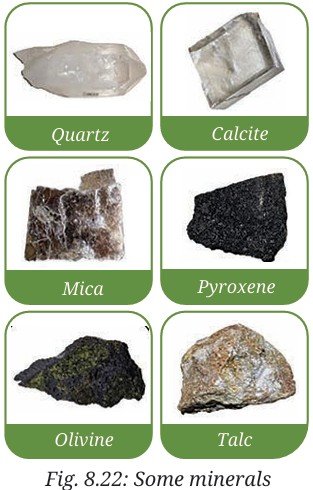
For example:
- Cement is made using materials such as calcite, quartz, alumina, and iron oxide.
- Talcum powder is made from the mineral talc.
What is matter?
Matter is anything that has mass and occupies space. For example, water, air, rocks, wood, metals, etc. Light, heat, electricity, thoughts, and emotions do not matter.
Disclaimer: The content that is present on our website is based on the NCERT Class 8 Science textbook and is provided for educational purposes only. All the content and images have been taken from Science Class 8 NCERT Textbook. Images and content shown above are the property of individual organizations and are used here for reference purposes only. To make it easy to understand, some of the content and images are generated by AI and cross-checked by the teachers.