
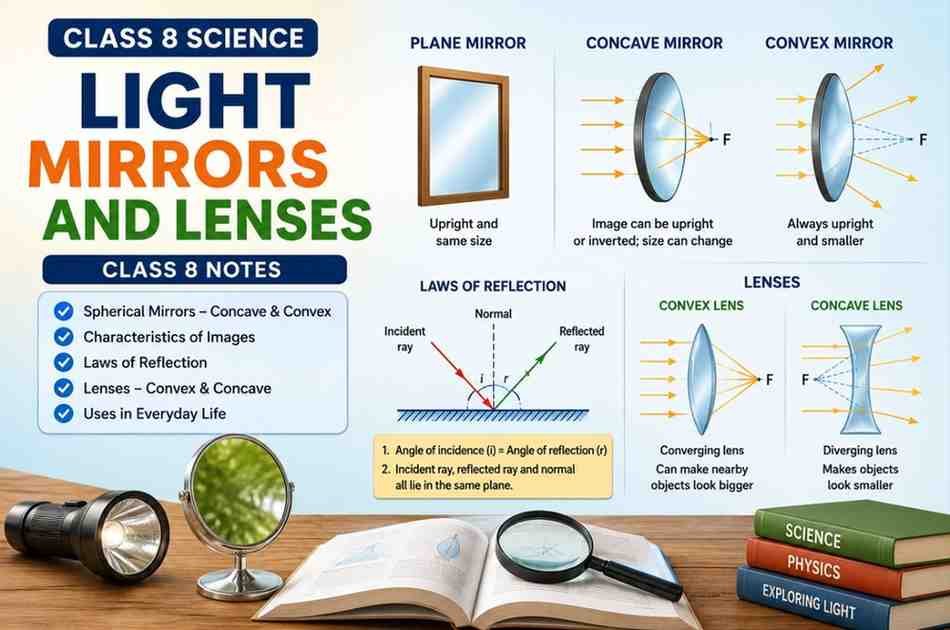
Light: Mirrors and Lenses Class 8 Notes explains how light behaves when it falls on mirrors and passes through lenses. In this chapter, students learn about plane, concave, and convex mirrors, the images formed by different mirrors, and the laws of reflection. The chapter also introduces convex and concave lenses, how they change the path of light, and their uses in everyday life.
Light Mirrors and Lenses Class 8 Notes
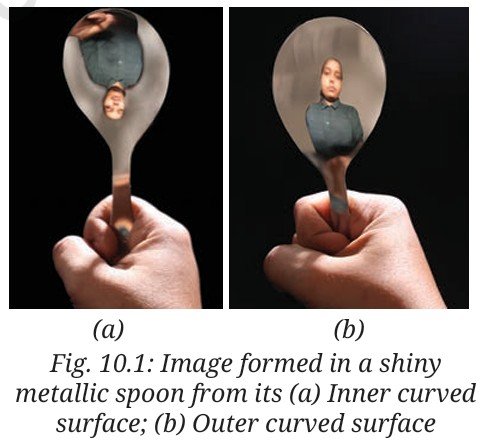
Have you ever looked at the inside and outside of a shiny spoon? The spoon can act like a curved mirror and form different types of images.
Activity: Observe a Shiny Spoon
- Step 1: Hold the curved inner side of the spoon close to your face.
- Step 2: Look at your image.
- Step 3: Slowly move the spoon away from your face and observe any change.
- Step 4: Now turn the spoon around and look at the outer side.
- Step 5: Compare the two images.
When you look at the inner side of the spoon, the image may appear inverted (upside down). When you look at the outer side of the spoon, the image appears erect (upright) and smaller.
What are spherical mirrors?
A spherical mirror is a curved mirror whose reflecting surface is a part of a sphere (ball). If the mirror curves inwards like the inside of a spoon, it is called a concave mirror. If the mirror curves outwards like the back of a spoon, it is called a convex mirror.
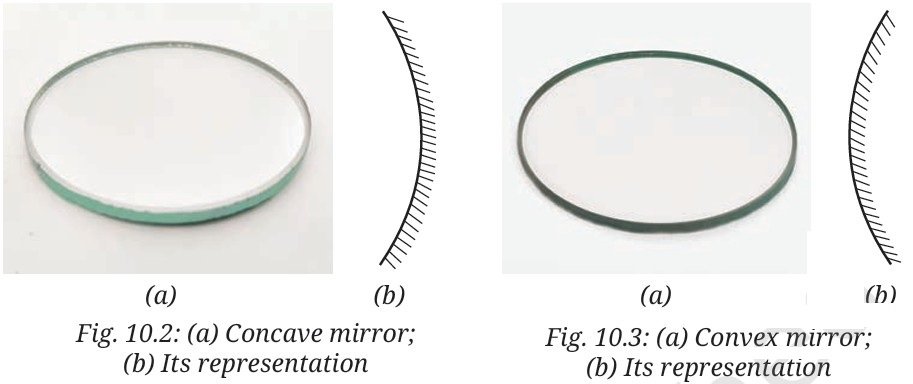
Concave mirrors can make images bigger or upside down, but convex mirrors always make images smaller but upright. These mirrors are used in daily life; for example, concave mirrors are used in dentists’ tools, and convex mirrors are used in vehicle side mirrors.
Difference Between Concave and Convex Mirrors
| Concave Mirror | Convex Mirror |
|---|---|
| Curves inward | Curves outward |
| Like the inside of a spoon | Like the outside of a spoon |
| Can make an upside-down image | Makes an upright image |
| Reflecting surface bends inward | Reflecting surface bends outward |
What Are the Characteristics of Images Formed by Spherical Mirrors?
The spherical mirror can form an image that can be different in size and direction. Let’s do one activity—
Activity: Observe the Images
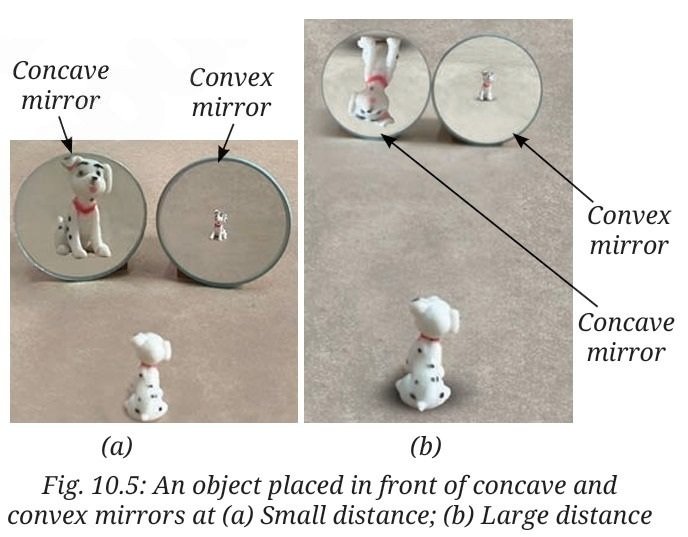
- Take a concave mirror, a convex mirror, and a small toy.
- Place both mirrors upright on a table. Put the toy in front of the mirrors.
- First, keep the toy close to the mirrors. Observe the images.
- Then slowly move the toy farther away.
Image in a Concave Mirror
When the object is close to a concave mirror:
- The image is upright (erect).
- The image is larger than the object.
- The image is called enlarged.
When the object is moved farther away:
- The image becomes upside down (inverted).
- At first, the image is large.
- As the object moves farther away, the image becomes smaller.
Concave mirror: The image can change in size and direction.
Image in a Convex Mirror
A convex mirror behaves differently. The image is always:
- Upright (erect)
- Smaller than the object
When the object is moved farther away, the image becomes slightly smaller.
Convex mirror: The image is always upright and smaller.
What about the plane mirror?
The plane mirror always forms an image that is upright and the same size as the object.
Comparison
| Mirror | Image |
|---|---|
| Plane mirror | Upright and same size |
| Concave mirror | Can be upright or upside down; size can change |
| Convex mirror | Always upright and smaller |
Lateral Inversion
All three images are lateral inversions. This means the left side of an object appears as the right side in the image, and the right side appears as the left side.
Uses of Concave Mirrors
The concave mirrors are used when we want to make an image larger or reflect light.
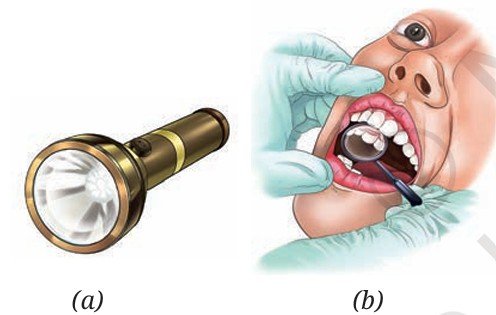
- Torches and headlights
- Dentist’s mirror
- Telescopes
Uses of convex mirror
The convex mirror is used when we want to show a wider area.
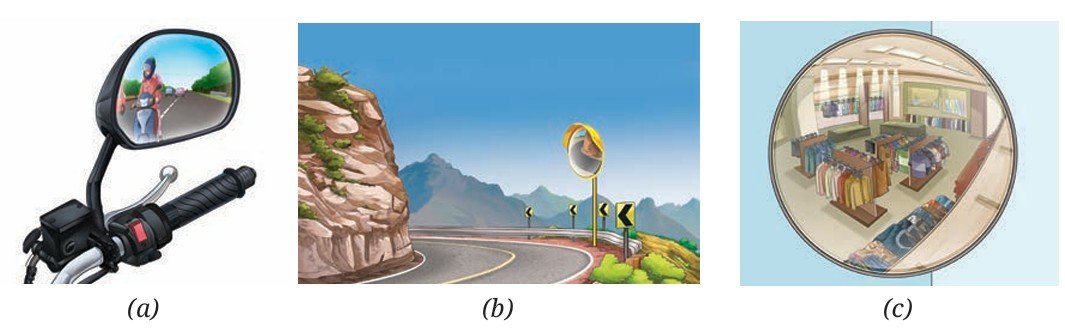
- Vehicle Side Mirrors
- Road Safety Mirrors
- Shops
What Are the Laws of Reflection?
When the light falls on a mirror, it bounces back. This bouncing back of light is known as reflection. The scientist describes how light reflects from a mirror; this rule is called the law of reflection.
Three important things
In the image you will see the light is falling on a mirror.
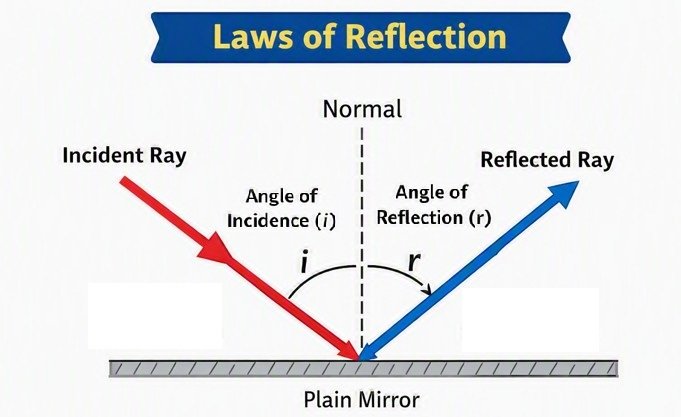
- Incident ray: The light that comes towards the mirror is called the incident ray.
- Reflected ray: The light ray that comes back from the mirror is called the reflected ray.
- Normal: It is a point where the light hits the mirror; we can draw a line at 90° to the mirror. This line is called the normal.
- Angle of Incidence: The angle between the incident ray and the normal is called the angle of incidence; it is represented by i.
- Angle of Reflection: The angle between the reflected ray and the normal is called the angle of reflection; It is represented by r.
First Law of Reflection
The first law says that the angle of incidence is equal to the angle of reflection.
So, i = r
For example, if light falls at 30°, it will reflect at 30°.
If the light falls along the normal, both angles are 0°.
Second Law of Reflection
The second law says that the incident ray, the reflected ray, and the normal all three lines stay on the same flat surface.
If we bend the paper on which the rays are drawn, the reflected ray will no longer appear on the bent part.
Parallel Rays and Different Mirrors
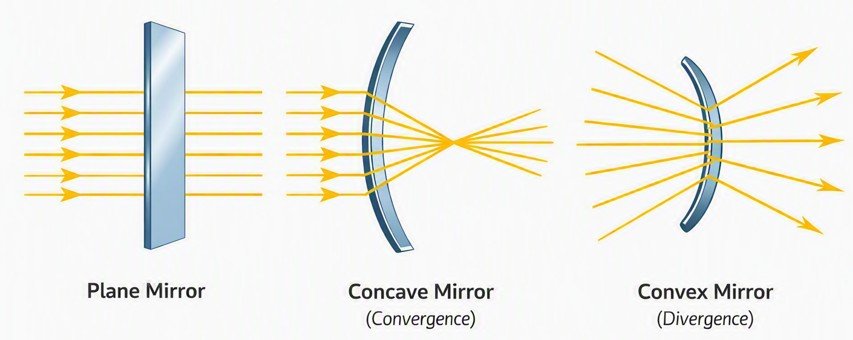
- When many parallel rays fall on a plane mirror: The reflected rays remain parallel.
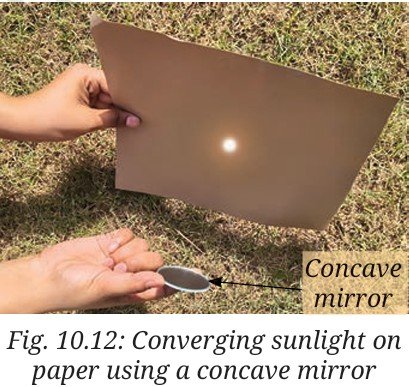
- When parallel rays fall on a concave mirror: The reflected rays come closer together. This is called convergence.
- When parallel rays fall on a convex mirror: The reflected rays spread apart. This is called divergence.
Concave Mirror Can Concentrate Light
The concave mirror brings sunlight to a small bright spot. The sunlight reflected and got concentrated at one point because of this lot of heat at that point. This type of mirror can be used for solar concentrators.
What Is a Lens?
A lens is a transparent object that allows the light to pass through it. The lenses are basically made of glass or plastic. The lens helps to see the object.
For example, you notice the water drop when you see through it, and then the small letters look big. A water drop has a curved surface and acts like a simple lens. A magnifying glass is also used to make small letters big.
Type of lenses
There are mainly two types of lenses.
- Convex lens: A convex lens is thicker in the middle and thinner at the edges. It helps to make nearby objects big.
- Concave lens: A concave lens is thinner in the middle and thicker at the edges. A concave lens makes objects appear smaller.
What Happens to an Object Through a Lens?
Convex Lens
When an object is close to a convex lens:
- It looks upright.
- It can look bigger.
When the object is moved farther away:
- The image can become upside down.
- It can become smaller.
Concave Lens
A concave lens:
- Always gives an upright image.
- The image looks smaller.
What Happens to Light?
- Convex lens: A convex lens makes light rays come together. So, that’s why it is called a converging lens.
- Concave lens: A concave lens makes light rays spread apart. So, that way it is called a diverging lens.
Easy Comparison
| Convex Lens | Convex Lens |
|---|---|
| Thick in the middle | Thin in the middle |
| Thin at the edges | Thick at the edges |
| Brings light rays together | Spreads light rays apart |
| Called a converging lens | Called a diverging lens |
| Can make nearby objects look bigger | Makes objects look smaller |
Disclaimer: The content that is present on our website is based on the NCERT Class 8 Science textbook and is provided for educational purposes only. All the content and images have been taken from Science Class 8 NCERT Textbook. Images and content shown above are the property of individual organizations and are used here for reference purposes only. To make it easy to understand, some of the content and images are generated by AI and cross-checked by the teachers.