
The Amazing World of Solutes, Solvents and Solutions Class 8 Notes provide simple and easy-to-understand explanations of important concepts from the Class 8 Science chapter. Students will learn about mixtures, solutions, solutes, solvents, solubility, saturated and unsaturated solutions, concentration, density, and the factors affecting solubility.
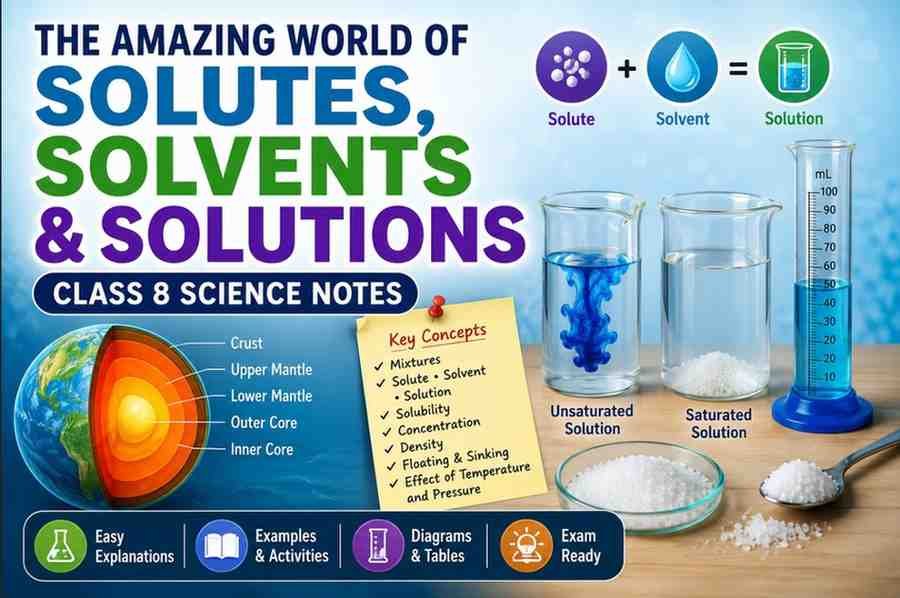
The Amazing World of Solutes Solvents and Solutions Class 8 Notes
When you are sick, you take ORS (Oral Rehydration Solution). ORS is a mixture of water, sugar, and salt in the same proportion. When chalk powder, sand, or sawdust is added to water, they do not dissolve.
A mixture is formed when the two or more substances are mixed together without forming a new substance. This mixture keeps their own properties.
There are two types of mixture: uniform mixture and non-uniform mixture.
- Uniform mixture: When salt and sugar are mixed with water, a uniform mixture is formed.
- Non-uniform mixture: when chalk powder or sand or sawdust is mixed with water, the components are not evenly distributed. Such mixtures are known as non-uniform mixtures.
What Are Solute, Solvent, and Solution?
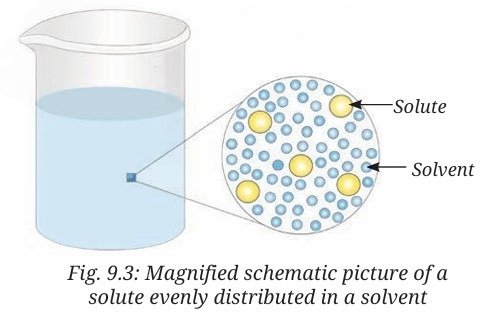
- Solution: A solution is an unformed mixture where the substance dissolves completely in another substance. For example, salt mixed with water dissolves completely and forms a solution.
- Solute & Solvent: Whenever a solid is mixed with a liquid to form a solution, the solid component is called the solute, and the liquid component is called the solvent. The solute dissolves in the solvent to form a solution.
How Much Solute Can a Fixed Amount of Solvent Dissolve?
A solvent can dissolve only a limited amount of solute. Let us understand with one example.
What Happens When We Keep Adding Salt to Water?
Suppose we take a half glass of water—
- Add one spoon of salt and stir; you will find the salt dissolves completely.
- Add another spoon and stir again; now also the salt will dissolve completely.
- Keep adding salt little by little.
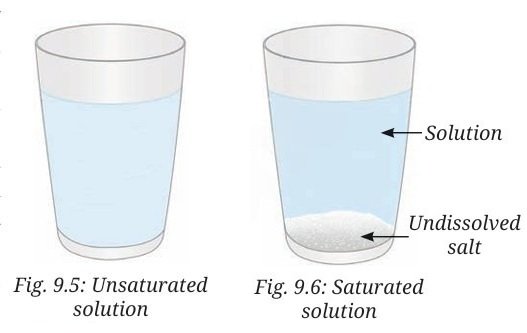
- After some time you will find that the salt stops dissolving and start collecting at the bottom.
This happens because the water has reached its maximum capacity to dissolve salt at that temperature.
Type of solutions:
There are two types of solutions: unsaturated solutions and saturated solutions.
- Unsaturated solution: If the solvent can dissolve more solute, it is called an unsaturated solution. For example, a spoonful of salt dissolved in water and more salt can still dissolve.
- Saturated Solution: If the solvent cannot dissolve any more solute, it is called a saturated solution. For example, adding salt to water, the extra salt remains undissolved at the bottom.
What is concentration?
The concentration tells how much solute is present in a fixed amount of solution or solvent.
- Less solute → Dilute solution
- More solute → Concentrated solution
For example, if a solution contains less solute, it means it is a dilute solution. If a solution containing more solute is a concentrated solution.
What is solubility?
The maximum amount of solute that can dissolve in a fixed amount of solvent at a particular temperature is called its solubility. For example,
- If you keep adding salt to water, at first it dissolves.
- After some spoons, extra salt stays at the bottom.
- This shows water has a limit to dissolving salt.
- That limit is called solubility.
Does Temperature Affect Solubility?
If you heat water, it can dissolve more solute. At 70 °C, water dissolves more baking soda than at 20 °C. So, heating makes a saturated solution behave like an unsaturated one.
Solubility of Gases
Gases can dissolve in the liquids. When the gases dissolve in the liquids, they form a uniform mixture. For example, oxygen dissolves in water.
Note: Only a small amount of oxygen dissolves in water. The dissolved oxygen helps the fish, aquatic plants and other water organisms to live.
Does Temperature Affect the Solubility of Gases?
Yes, the temperature affects how much gas can dissolve in the liquid. The general rule is that when the temperature increases, the solubility of gases decreases.
- Cold water → more oxygen can dissolve
- Warm water → less oxygen can dissolve
Why Do Objects Float or Sink in Water?
Objects float or sink depends on density. The floating object has less density than the liquid, so it floats. For example, oil has a lower density than water, so it floats on water. The object generally sinks when its density is greater than the density of the liquid. For example, an iron road has a greater density than water.
What Is Density?
Density tells us how much matter is packed into a given amount of space. Imagine a crowded bus. Many people are packed inside it. We can say that the bus has a high density of people. If the same bus has only a few people, then we can say it is low density bus.
For example, a wooden stick and an iron rod may be the same size, but the iron rod feels much heavier. This is because iron has a greater density than wood.
The formula for density is:
- Density = Mass ÷ Volume
or
- ρ = m/V
where:
- ρ (rho) = Density
- m = Mass
- V = Volume
Example: Suppose an aluminium block has mass = 27 g and volume = 10 cm³. Find out the density.
The formula is –
- ρ = m/V
- Density = 27 ÷ 10
- Density = 2.7 g/cm³
So, the density of aluminium is 2.7 g/cm³.
Does the Shape or Size Affect Density?
Density does not depend on shape or size. For example, a small piece of aluminum and a large piece of aluminum have the same density, and if they are at the same temperature and pressure, then density can change.
- Pressure has a major effect on the density of gases.
- Pressure has very little effect on the density of solids and liquids.
Units of Density
The SI unit of density is
- kg/m³ (kilogram per cubic meter)
For liquids and other substances, we also commonly use:
- g/mL (gram per milliliter)
- g/cm³ (gram per cubic centimeter)
Density of Water
At room temperature:
- 1 mL of water ≈ 1 g
Therefore:
- 10 mL of water ≈ 10 g
- 100 mL of water ≈ 100 g
So, the density of water is approximately
- 1 g/mL or 1 g/cm³
What Is Relative Density?
When we compare the density of a substance with the water, it is known as relative density. The relative density does not have a unit because it is a comparison of two densities.
The formula is –
- Relative density = Density of substance ÷ Density of water
Example: Aluminium
- Density of aluminium = 2.7 g/cm³
- Density of water ≈ 1 g/cm³
Therefore:
- Relative density of aluminium = 2.7 ÷ 1 = 2.7
So, the relative density of aluminium is 2.7.
Determination of density
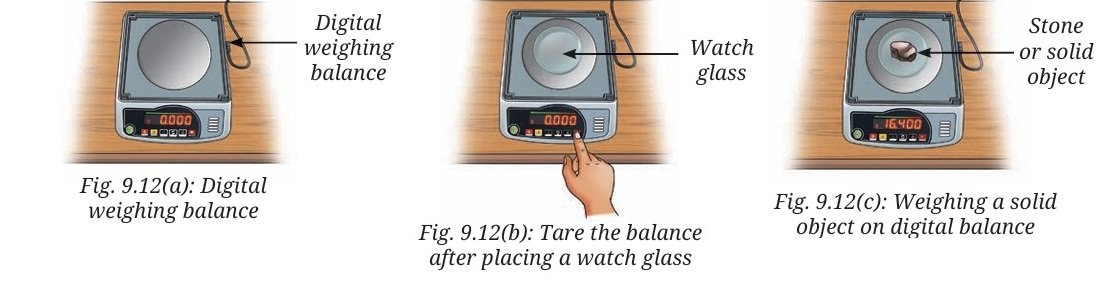
Mass is the amount of matter present in an object. We use a balance to measure the mass of an object. There are different types of balance that are used to measure mass. In this activity we use a digital weight balance.
Activity: Measuring the Mass of a Solid Object
Suppose we want to find the mass of a stone.
- Switch ON the digital weighing balance.
- Observe the initial reading on the digital weighing balance display.
- It should show a zero reading.
- Place a dry and clean watch glass or butter paper on the pan.
- Note the reading on the digital weighing balance.
- Reset the digital weighing balance reading to zero.
- Now, carefully place the object stone.
Note the reading displayed on the balance, which gives the mass of the stone, say 16.400 g.
How to measure volume?
Volume means the amount of space occupied by an object. For example, when a buttermilk packet says 200 ml, it means the packet holds 200 ml of space filled with liquid.
The SI unit of volume is cubic meter (m³).
For smaller objects, we commonly use:
- dm³ (cubic decimeter)
- cm³ (cubic centimeter)
For liquids, we commonly use:
- liter (L)
- milliliter (mL)
Important conversions:
- 1 L = 1 dm³
- 1 mL = 1 cm³
Measuring the Volume of Liquids
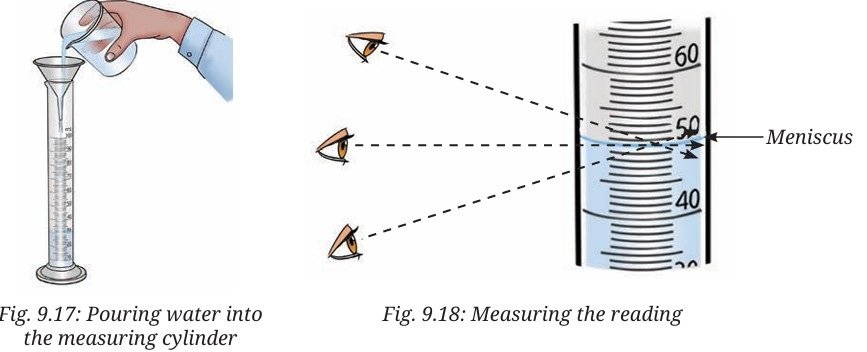
To measure the volume of a liquid, we commonly use a measuring cylinder. measuring cylinder is a tall, transparent container with a marking on it. The size of the measuring cylinder can be different, such as 5 mL, 10 mL, 25 mL, 50 mL, 100 mL, 250 mL, 500 mL, etc.
- Step 1: Place the cylinder on a flat surface.
- Step 2: Pour liquid slowly up to the required mark.
- Step 3: Look at the meniscus (curved surface of liquid).
- Step 4: Read the mark at the bottom of the meniscus for water or clear liquids.
- Step 5: For colored liquids, read at the top of the meniscus.
Example: In a 100 mL cylinder, the smallest division = 1 mL.
What Is a Meniscus?
The curved surface formed by a liquid inside a measuring cylinder is called the meniscus. For water and other colorless liquids, we read the bottom of the meniscus. Keep your eyes at the same level while taking the reading. This helps us get an accurate measurement.
How to Measure the Volume of Solids
Objects with a regular shape, such as a cuboid, can be measured using a ruler or scale.
We measure:
- Length (l)
- Width (w)
- Height (h)
Then use the formula:
- Volume = Length × Width × Height
Example
Suppose a notebook has:
- Length = 25 cm
- Width = 18 cm
- Height = 2 cm
Therefore:
- Volume = 25 × 18 × 2
- Volume = 900 cm³
- So, the volume of the notebook is 900 cm³.
Measuring the Volume of an Irregular Object
There are some objects, like stones and metal keys, that do not have a regular shape. In this we can use the water displacement method to measure the volume. Suppose we want to find the volume of a stone.
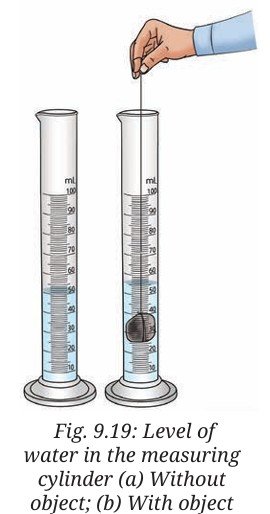
Step 1: Put water into a measuring cylinder.
Suppose the initial water level is 50 mL.
Step 2: Carefully put the stone completely into the water.
Suppose the new water level becomes 55 mL.
Step 3: Find the difference:
Volume of stone = Final volume − Initial volume
- = 55 − 50
- = 5 mL
Since:
- 1 mL = 1 cm³
Therefore:
- Volume of stone = 5 cm³
Let us calculate the density
Once we know the mass and volume of an object, we can calculate its density.
- Density = Mass ÷ Volume
For example:
- Mass of stone = 16.400 g
- Volume of stone = 5 cm³
Therefore:
- Density = 16.400 ÷ 5
- Density = 3.28 g/cm³
Quick Revision
| Measurement | Instrument/Method |
|---|---|
| Mass | Balance |
| Liquid volume | Measuring cylinder |
| Regular solid volume | Formula |
| Irregular solid volume | Water displacement |
| Density | Mass ÷ Volume |
Let us dig deeper!
Density can change when the temperature or pressure changes. For example, the earth has several layers like the crust, upper mantle, lower mantle, outer core, and inner core.
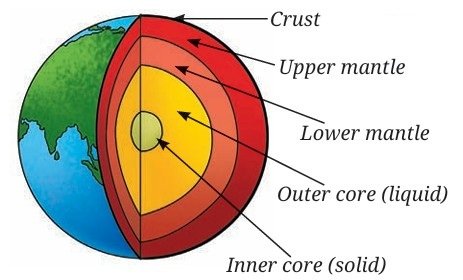
The crust is the outermost layer and is generally the least dense. When we go deeper, then the mental becomes more dense. This happens due to pressure and temperature increase. The high pressure makes the materials more compact.
Effect of temperature on density
When the substance is heated, then the density decreases, and when the substance is cooled, then the density increases. We know that the matter is made up of tiny particles.
When we heated, then the particles moved faster, and the particles moved apart; because of this, the volume increased.
When the substance cools, then the particles come closer and density increases. Example: A hot air balloon rises because hot air is less dense than cool air.
Effect of pressure on density
The effect of pressure is different for gases, liquids, and solids.
- Gases: The pressure has a large effect on gases. When the pressure on a gas increases, the particles become closer, and the volume decreases, but the density increases.
- Liquids: The pressure has only a small effect on liquids. Liquids are difficult to compress, so their volume changes very little when pressure is increased.
- Solids: The pressure has an even smaller effect on solids. In a solid, the particles are already packed, meaning very close together. So, if pressure is applied, then there will be very little change in their volume and density.
Disclaimer: The content that is present on our website is based on the NCERT Class 8 Science textbook and is provided for educational purposes only. All the content and images have been taken from Science Class 8 NCERT Textbook. Images and content shown above are the property of individual organizations and are used here for reference purposes only. To make it easy to understand, some of the content and images are generated by AI and cross-checked by the teachers.