
Evolution of Physical Education and Well Being Class 9 Notes helps students understand how physical education has developed over time and why physical activity is important for a healthy and balanced life. This chapter explains the role of physical education in improving physical fitness, mental well-being, social skills, discipline, and overall health. These easy-to-understand notes cover the important concepts, key points, and terms from the chapter to help Class 9 students prepare effectively for their exams.
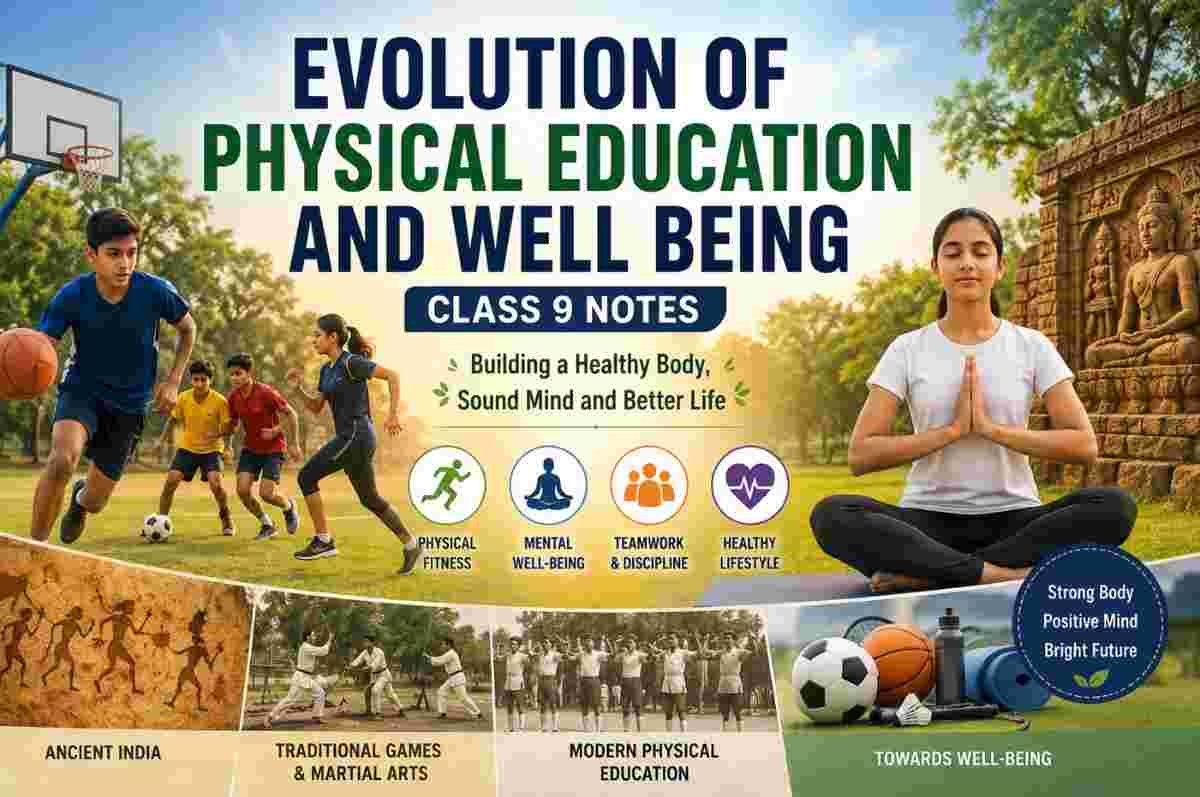
Evolution of Physical Education and Well Being Class 9 Notes
Chapter 1: Physical Education and Well-Being
Education is not only about the books and exams but also about the body and mind. When the body is weak, then the mind cannot focus. When the mind is disturbed, then the strong body also feels tired.
Traditional sports, indigenous games, āsanas, prāṇāyāma, and yogic practices help to build strength, stamina, balance, peace, and discipline.
Meaning and Definitions of Physical Education
Physical education is not only a sports period or exercise class. It is a way of learning through the body and mind. Every sprint builds speed and endurance; every yoga posture builds balance and self‑control; every game teaches teamwork, confidence, and discipline.
Important Definitions & Quotes
- Sri Aurobindo (India): “Perfection of the body must be the ultimate aim of physical culture.”
- Central Advisory Board of Physical Education (1959, India): “Development of total personality—body, mind, and spirit.”
- J.P. Thomas (1963, India): “Education through physical activities for perfection in body, mind, and spirit.”
- UNESCO (1978, Paris): “A fundamental right for all, essential for lifelong learning and quality of life.”
- Charles A. Bucher (1979, USA): “Integral part of total education—develops physically, mentally, emotionally, and socially fit citizens.”
- NCF‑SE 2023 (India): “Wide range of activities that promote mind‑body wellness, teamwork, and sportsmanship.”
Physical Education – Aims & Objectives
Aims of physical education
- Develop body, mind, and spirit together.
- Build fitness, discipline, teamwork, confidence, and strategy.
- Promote holistic development and lifelong learning.
Objectives
Physical education helps students grow in body, mind, and character. It prepares them for a healthy and responsible future.
Physical Literacy
Just as reading and writing help to develop language literacy. Physical literacy simply means being able to move your body in a safe and confident way, enjoying different kinds of physical activities, and understanding how they help you stay healthy. A physically literate student can:
- Run, jump, balance, throw, and catch effectively.
- Understand basic rules and safety in sports.
- Choose suitable physical activities.
- Feel confident participating in games and exercise.
- Understand that regular physical activity supports a healthy lifestyle.
Benefits of physical literacy
Developing physical literacy helps students build fitness, confidence, and healthy habits throughout their lives. Several benefits of physical literacy are listed below:
- Improves overall health and physical fitness
- Builds confidence and self-esteem
- Helps prevent lifestyle diseases
- Develops teamwork, leadership, and decision-making skills
- Reduces anxiety and improves focus in studies
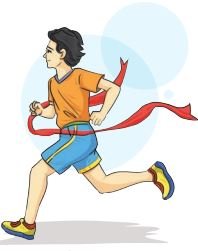
1. Locomotor Skills
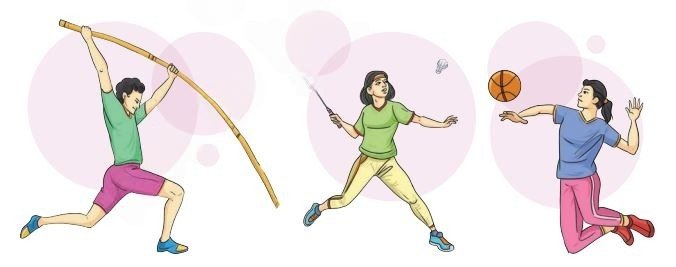
Locomotor skills, like walking, jumping, hopping, and skipping, help to build strength, speed, agility, and endurance. This movement is used in many games like Kabaddi, Kho-Kho, etc.
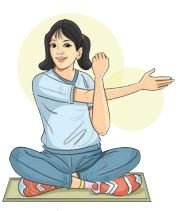
2. Non‑locomotor Skills
Non‑locomotor Skills are the movements without changing place, like bending, stretching, twisting, balancing, etc. These skills help to build stability, flexibility, body control, etc. These skills are used in yoga postures like Tāḍāsana, Vṛikṣhāsana, etc.
3. Manipulative Skills
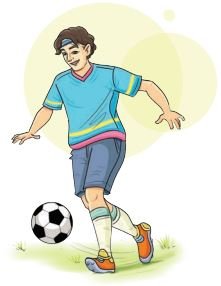
Manipulative skills help to understand how to control objects, like throwing, catching, kicking, striking, dribbling, etc. This skill helps to build hand-eye coordination, timing, focus, and judgement and is used in many games like cricket, football, volleyball, and Gillī‑Daṇḍā.
Chapter 2: History and Culture of Physical Education in India
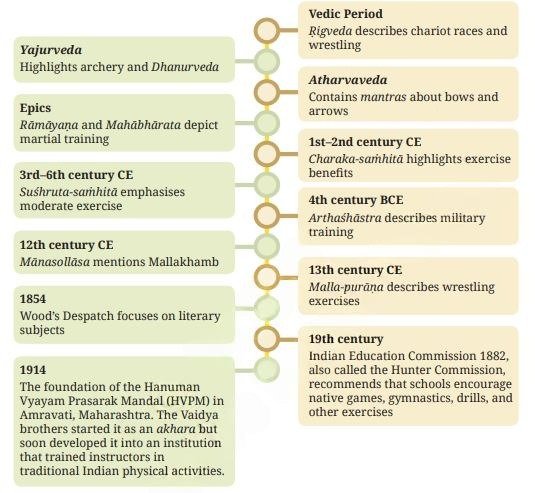
In ancient India, education was always holistic. It was not only about reading and writing. Students were trained to make both the body and mind strong. That is why exercise, games, martial arts, and yoga were important parts of daily life. We can find proof of this in the Vedas, epics, Ayurveda, and even in archaeological findings.
Evolution of Physical Education in Indian Culture
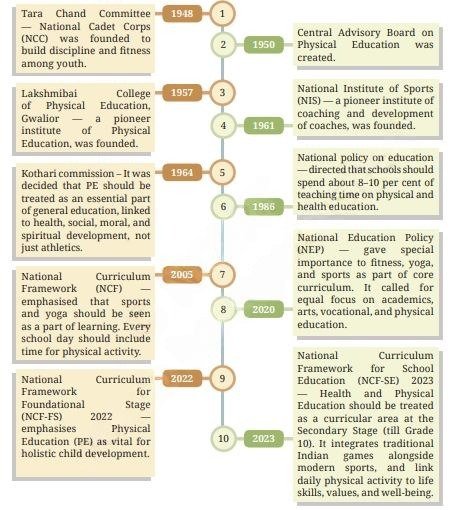
From Independent India to Present
In old India, physical activity was part of daily life. People stayed fit by walking, running, swimming, farming, hunting and martial training. Games help to make healthy life, discipline, teamwork, cleanliness, strength and learning life skills.
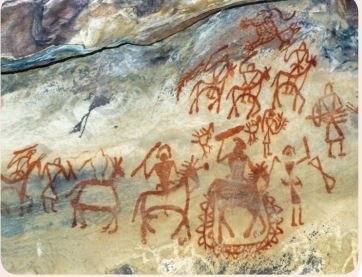
The physical activity evidence is seen in Bhimbetka rock paintings showing hunting and teamwork. In the Sindhu Sarasvati civilisation, daily work like farming, building and water management helps the people to become active. The Great Bath of Mohenjo‑Daro shows the value of cleanliness and community effort.
During the Epic period, the training became part of education. The Ramayana and Mahabharat students learn archery, weapon use, horse riding and disciple in gurukulas.
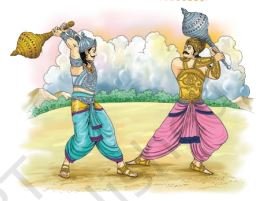
In the Classical period, physical activity was linked to health and state duties. The Arthashastra explained discipline and fitness for rulers and soldiers.
Ancient texts called exercise ‘vyayama’. Āchārya Charaka said regular exercise makes the body light, strong, stable, and hard-working. It improves digestion, pain tolerance, and balance of doṣhas. Exercise was advised in moderation, not excess.
Medieval Physical Culture
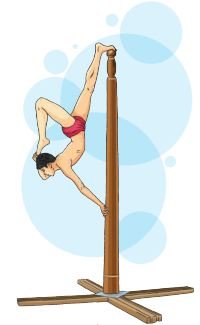
In medieval India, wrestling was very popular. The Malla‑purāṇa (13th century) described 16 types of wrestling exercises for strength and stamina. The Mānasollāsa mentioned Mallakhamb, where athletes did acrobatics on a wooden pole to build balance and flexibility.
Later on, wrestling became a community sport. People go to the training schools, which are known as akhāḍās, where the learners learn push-ups (daṇḍs), squats (baiṭhaks), and weight lifting.
In the late medieval period, physical activity was linked to military training. The Āʾīn‑i‑Akbarī record is there that the Akbar encouraged wrestling, archery, horse riding, and hunting. Stories of Shivaji Maharaj and Rajput warriors show that endurance, agility, and weapon training were needed for war and defense.
In Europe, the idea of physical education started in the 18th–19th centuries. Teachers like GutsMuths, Jahn, and Ling promoted gymnastics for health and discipline. In America, Charles Beck introduced gymnastics in schools in 1825. By the mid‑1800s, games and drills became part of daily school life.
Colonial India
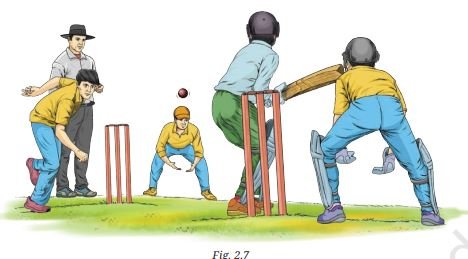
When the British started schools in India, they focused on literary subjects and ignored physical education. British sports like cricket, hockey, and football entered schools, while traditional games stayed outside.
In 1914, the Hanuman Vyayam Prasarak Mandal was founded sports school in Amravati. In 1920, Harry Buck started the YMCA College of Physical Education in Madras, the first professional institute. More colleges opened in the 1930s.
The Sargent Report of 1944 made physical education compulsory in schools. In 1946, the All India Physical Education Conference brought educators together. These steps made physical education an important part of Indian schooling.
Chapter 3: Careers in Physical Education
Careers in Physical Education in India are growing fast, with opportunities in teaching, coaching, fitness, sports science, and management.
Area/Category: Therapeutic Modality
| Role | Description | Qualification |
|---|---|---|
| Physiotherapist | Helps with injury treatment and recovery | BPT + specialisation |
| Sports Nutritionist | Plans diet for performance and recovery | B.Sc./M.Sc. Nutrition |
| Sports Psychologist | Improves mental strength and focus | Degree in Sports Psychology |
| Sports Biomechanist | Analyses movement and technique | Degree in Biomechanics |
| Exercise/Sports Physiologist | Studies body response to training | Degree in Exercise Physiology |
Area/Category: Teaching and Coaching
| Role | Description | Qualification |
|---|---|---|
| School PE Teacher | Guides students in fitness, games, yoga, and healthy habits | NCTE-approved PE programme |
| College/ University PE Teacher | Teaches sports science subjects and trains future professionals | NCTE-approved qualification |
| Sports Coach | Trains athletes and teams | B.P.Ed/M.P.Ed as well as coaching certificates |
Area/Category: Fitness and Wellness Industry
| Role | Description | Qualification |
|---|---|---|
| Fitness Trainer | Guides gym workouts and design fitness plans | Certificate/ Diploma |
| Yoga Practices | Teaches yoga and meditation | Diploma/ Certificate in Yoga |
| Aerobics/ Zumba/Pilates Instructor | Leads group fitness classes | Short-term certification |
Area/Category: Emerging Careers
| Role | Description | Qualification |
|---|---|---|
| Esports Coach/ Fitness Expert | Trains gamers’ fitness and reflexes | Gaming + fitness knowledge |
| Adventure Sports Guide | Leads trekking, rafting, climbing | Training from adventure institutes |
| Sports Technologist | Develops wearables and tech in training | Technology + Sports Science |
| Para-Sports Trainer | Trains differentlyabled athletes | PE + adaptive sports certification |
Area/Category: Sports Management and Media
| Role | Description | Qualification |
|---|---|---|
| Sports Event Manager | Organises tournaments and events | Degree/Diploma in Sports Management |
| Sports Administrator | Manages sports bodies and policies | Degree/Diploma in Sports Management |
| Sports Journalist/ Commentator | Reports and comments on sports | Journalism/Media Management degree or diploma |
| Sports Data Analyst | Analyses performance data | Statistics/CS/Sports Science |
| Sports Engineer | Develops sports equipment and technology | Engineering + specialisation |
Fitness and its Components
The fitness helps the body to work well, stay healthy, and do daily activities without getting tired. A fit student can jump, run, lift, play, and focus better in school. Fitness is not about strength; it is about the ability to make the body move smoothly and stay active.
There are two main types of fitness:
- Health‑related fitness keeps the body healthy and strong.
- Skill‑related fitness helps in sports, games, and quick movements.
Health-related fitness components help maintain good health, prevent diseases, and support everyday activities. They are important for all students, whether they play sports or not.
- Cardiovascular Endurance: This means the heart and lungs can give oxygen to the body during activity. A student with good endurance can run, swim, or cycle for a long time without getting tired.
- Muscular Strength: This is the power of muscles to lift, push, or carry weight. It is needed for activities like push-ups, yoga postures, or carrying books.
- Muscular Endurance: This means muscles can keep working for a long time without getting tired. Examples are sit-ups, cycling, or holding a yoga pose for many seconds.
- Flexibility: This is the ability of joints to bend and move easily. Flexible students can stretch, bend, or dance without difficulty.
- Body Composition: This is the balance of fat, muscle, and bone in the body. A healthy balance helps prevent diseases. Good diet and regular exercise keep body composition healthy.
These components help students perform better in games and sports. They support speed, coordination, and quick movement.
- Speed: Speed means moving from one place to another quickly. Example: running a short race, relay, or catching a bus in daily life.
- Agility: Agility means changing direction fast while keeping balance. Example: dodging in Kho‑Kho, moving side to side in badminton, or walking through a crowded market.
- Balance: Balance means keeping the body steady whether still or moving. Example: standing in a moving bus, climbing stairs safely, or holding a yoga pose.
- Coordination: Coordination means using different body parts smoothly together. Example: catching a ball (hand‑eye), kicking a football (foot‑eye), or daily tasks like writing, cooking, and driving.
- Power: Power is strength plus speed. It helps in strong, quick movements like jumping in volleyball, throwing a javelin, or lifting a school bag quickly.
- Reaction Time: Reaction time means how fast you respond to a signal. Example: starting to run when the whistle blows, stopping a bicycle quickly, or avoiding a falling object.
Disclaimer: The content that is present on our website is based on the NCERT Class 9 Physical Education textbook and is provided for educational purposes only. All the content and images have been taken from Physical Education and Well Being Class 9 NCERT Textbook and CBSE Support material. Images and content shown above are the property of individual organizations and are used here for reference purposes only. To make it easy to understand, some of the content and images are generated by AI and cross-checked by the teachers.