
← Back to Class 9 Social Science MCQs
Explore Life on Earth Class 9 NCERT Solutions to understand the important concepts of the NCERT Social Science chapter in simple and easy language. These solutions cover topics such as biomes, ecosystems, biodiversity, forest conservation, forest-dwelling communities, and the protection of natural resources. Students can use these question answers to understand the chapter, revise key concepts, and prepare effectively for their examinations.
Life on Earth Class 9 NCERT Solutions
Q. How do physiography and climate shape life on Earth?
Answer: Physiography and climate determine the type of plants, animals, and human activities in a region. Different landforms and climatic conditions create different biomes such as forests, grasslands, deserts, and tundra. These environments support different forms of life.
Q. How are humans and other life forms interconnected?
Answer: Humans, plants, animals, and microorganisms depend on one another for survival. Biomes provide food, water, shelter, and resources for living beings. Humans use natural resources, while animals help in pollination and seed dispersal, and microorganisms recycle nutrients. Thus, all life forms are interconnected and help maintain ecological balance.
Q. What is the importance of preserving various life forms, and how can we contribute to their conservation?
Answer: Preserving various life forms is important for maintaining biodiversity, ecological balance, and healthy ecosystems. Different species support human life by providing food, medicine, and other resources. We can contribute to conservation by protecting forests, reducing pollution, using resources responsibly, conserving wildlife, and supporting sustainable practices.
Look at the world map in Fig. 2.2 and answer the following questions.
Q. Which type of biome is found in smaller, separate regions, and why?
Answer: The tropical rainforest biome is found in smaller, separate regions. This is because it develops only in areas with high temperature and heavy rainfall throughout the year, which are limited to certain parts of the world.
Q. Which continent has the least number of biomes? What could be the reason for this?
Answer: Antarctica has the least number of biomes. This is because it has an extremely cold climate, is covered with ice, and does not support much plant and animal life.
Q. Why are there areas that do not have any specific biomes?
Answer: Some areas do not have a specific biome because of extreme climatic conditions, such as permanent ice cover, very high mountains, or regions with conditions that do not support typical plant and animal life. Therefore, no distinct biome develops there.
Q. What types of activities do you think people in desert regions generally undertake to sustain their households and livelihood?
Answer: People in desert regions generally depend on animal rearing, agriculture, handicrafts, trade, and tourism for their livelihood. They rear animals such as camels, goats, and sheep. They also grow crops in areas where water is available.
Q. With the help of your teacher, explore how do people address issues related to the availability of water.
Answer: People in desert regions address water shortage by collecting and storing rainwater, using wells and tanks, and using water carefully. They also adopt water conservation methods to make the best use of the limited water available.
Q. Compare the physical features of the Rajasthan camel (Fig. 2.7a) and the Nubra Valley (Ladakh) camel (Fig. 2.7b).
Answer: The Rajasthan camel has a single hump and a short, thin coat of fur. The Nubra Valley camel has two humps and a thick, dense coat of fur. The Nubra Valley camel is larger and better adapted to cold desert conditions.
Q. Considering the climatic conditions, why do you think the Nubra Valley camel might have a different fur density than the Rajasthan camel?
Answer: The Nubra Valley in Ladakh has a very cold climate, so the camel has a thick and dense fur coat to protect it from the cold. Rajasthan has a hot desert climate, so the camel has less fur to help it stay cool. Thus, the difference in fur density is an adaptation to their different climates.
Q. Explore your local environment. This could be your village, city, town, or residential area. Observe how people, plants, and animals build structures and interact. Complete the table with your findings.
| Component type | Examples observed | Interaction with humans |
|---|---|---|
| Trees/Vegetation/Plants | ||
| Insects | ||
| Animals | ||
| Non-living things |
Answer:
| Component type | Examples observed | Interaction with humans |
|---|---|---|
| Trees/Vegetation/Plants | Neem tree, Mango tree, Tulsi plant, Grass | Provide shade, fruits, oxygen, and medicinal uses |
| Insects | Butterflies, Bees, Ants | Help in pollination, honey production, and decomposition |
| Animals | Dogs, Cats, Cows, Sparrows | Provide companionship, milk, and help maintain ecological balance |
| Non-living things | Water, Soil, Roads, Buildings | Support daily life, farming, transportation, and shelter |
Q. Mark the following regions at appropriate levels on Fig. 2.10.
Answer:
| Region | Appropriate Level in Fig. |
|---|---|
| Andaman & Nicobar Islands | Tropical Rainforest (Hot and Wet) |
| Keralam | Tropical Rainforest (Hot and Wet) |
| Lakshadweep | Tropical Rainforest (Hot and Wet) |
| Meghalaya | Tropical Rainforest (Hot and Wet) |
| Chhattisgarh | Tropical Seasonal Forest |
| Odisha | Tropical Seasonal Forest |
| Ladakh | Tundra/Cold Desert (Cold and Dry) |
Q. Where will you place your home?
Answer: Place your home according to its local climate and vegetation. For example, if your home is in Maharashtra, it can be placed in the Tropical Seasonal Forest region.
Q. There is no arrow on the third side of the triangle. What would happen if we drew an arrow? Would it point upwards or downwards?
Answer: The third side represents the change from dry to wet conditions. If an arrow is drawn, it would point upwards, showing an increase in rainfall and moisture. As we move upward, vegetation becomes denser and biomes change from deserts and grasslands to forests.
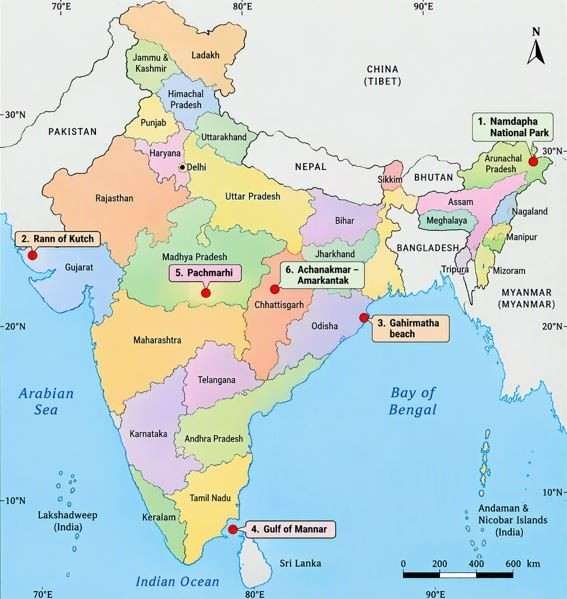
Q. Mark and name the following regions on the map in Figure. Also gather more information about these biodiversity regions from your teacher or other sources and discuss their features with your peers.
- Namdapha National Park
- Rann of Kutch
- Gahirmatha beach
- Gulf of Mannar
- Pachmarhi
- Achanakmar–Amarkantak
Answer:
Q. Can you explain how GI tagging of the forest products mentioned above connects geography, cultural traditions, local governance, and rural economy?
Answer: GI tagging connects a product to a specific geographical region. The quality and uniqueness of products such as Ramban Sulai Honey, Kandhamal Haldi, and Khasi Mandarin depend on the local climate, soil, and forest ecosystem. GI tags help preserve traditional knowledge and cultural practices, support local communities, and increase the market value of products. This strengthens the rural economy and promotes regional identity.
Q. Can you name some GI-tagged forest products from your state or union territory?
Answer: Maharashtra
- Warli Painting
- Sindhudurg and Ratnagiri Kokum
- Mahabaleshwar Strawberry
Note: Students should write GI-tagged products from their own State/UT.
Q.1. Why does India have diverse biomes? How does the local geography connect to the diversity?
Answer: India has diverse biomes because it has different landforms, climates, temperatures, and rainfall patterns. Mountains, plains, deserts, forests, and coastal regions create different environmental conditions. These geographical differences support various types of plants and animals.
Q.2. Make a list of economically valuable native plants in your region and comment on their abundance.
Answer: Maharashtra
| Plant | Economic Importance | Abundance |
|---|---|---|
| Mango | Fruit and trade | Abundant |
| Neem | Medicinal | uses Common |
| Bamboo | Construction and handicrafts | Common |
| Teak | Timber | Moderate |
| Tamarind | Food and trade | Common |
These plants support local livelihoods and contribute to the economy.
Q.3. Prepare a map of your state or Union Territory showing national parks and sanctuaries.
Answer (Maharashtra):
- Tadoba-Andhari Tiger Reserve
- Sanjay Gandhi National Park
- Navegaon National Park
- Gugamal National Park
- Chandoli National Park
- Bhimashankar Wildlife Sanctuary
(Students can mark these locations on a map of Maharashtra.)
Q.4. Study the impact of forest fires on people dependent on forests. Try to include the causes, losses, and preventive measures.
Answer:
Causes:
- High temperatures and dry conditions
- Human negligence
- Climate change
Losses:
- Destruction of forests and wildlife
- Loss of livelihoods
- Damage to homes and resources
- Air pollution
Preventive Measures:
- Create awareness among people
- Avoid careless use of fire
- Monitor forests regularly
- Take quick action when fires start
Q.5. Why are forests often called the ‘lungs of the Earth’?
Answer: Forests are called the “lungs of the Earth” because they help maintain oxygen levels and absorb carbon dioxide. They play an important role in balancing the Earth’s climate and supporting life.
Q.6. If large forest areas continue to be destroyed, what do you think would be its long-term effect on the global climate?
Answer: Continuous destruction of forests can increase carbon dioxide in the atmosphere and lead to global warming. It can disturb rainfall patterns, reduce biodiversity, and worsen climate change.
Q.7. Discuss some traditional forest conservation methods with your grandparents or an elderly person.
Answer: Traditional methods of forest conservation include protecting sacred groves, planting trees, avoiding unnecessary cutting of trees, and following community rules for using forest resources. Many communities also worship forest deities and conserve forests as part of their culture.
Q.8. How do forest dwellers contribute to the protection and conservation of forests?
Answer: Forest dwellers protect forests through sustainable use of resources and traditional knowledge. They help prevent forest fires, protect wildlife, participate in community forest management, and conserve biodiversity. They also play an important role in afforestation and eco-restoration.
Q.9. What is a forest fire? Prepare a plan for prevention and mitigation of forest fires.
Answer: A forest fire is an uncontrolled fire that spreads through forest vegetation and causes damage to forests, wildlife, and human settlements.
Plan for Prevention and Mitigation:
- Create awareness about forest fire risks.
- Avoid burning dry leaves and waste near forests.
- Monitor forests regularly during dry seasons.
- Report fire incidents immediately.
- Maintain fire lines and emergency response teams.
- Promote community participation in forest protection.
- Use modern technology to detect fires early.
Disclaimer: The content that is present on our website is based on the NCERT Class 9 Social Science textbook and is provided for educational purposes only. All the content and images have been taken from Social Science Class 9 NCERT Textbook and CBSE Support material. Images and content shown above are the property of individual organizations and are used here for reference purposes only. To make it easy to understand, some of the content and images are generated by AI and cross-checked by the teachers.