
Exploring Algebraic Identities Class 9 Notes helps students understand important algebraic identities in a simple and easy-to-learn way. These notes explain the meaning and use of algebraic identities with clear examples and step-by-step methods. Students can use them to learn how identities help in expanding expressions, simplifying calculations, and factorising algebraic expressions.
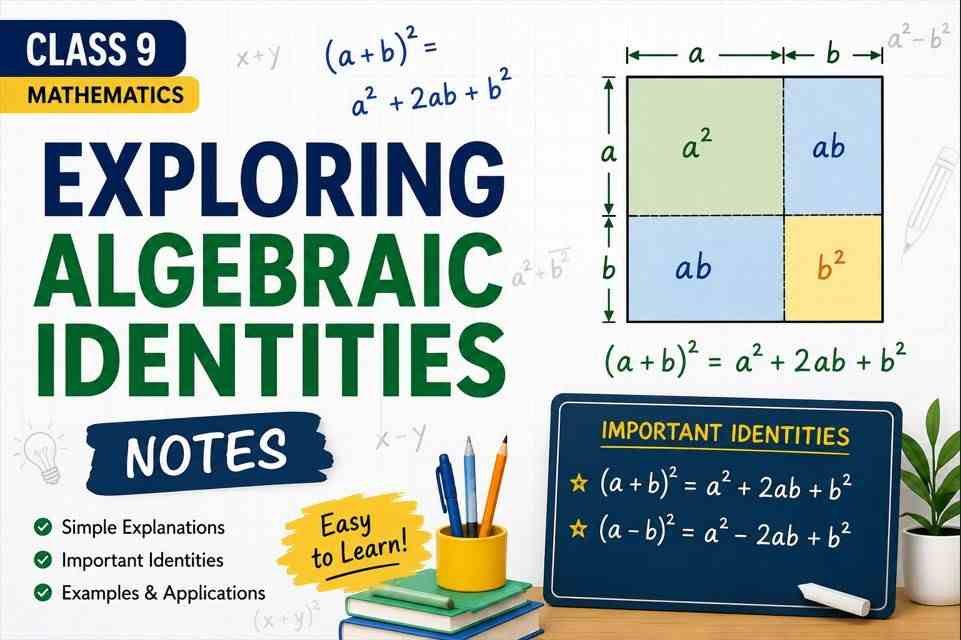
Exploring Algebraic Identities Class 9 Notes
An algebraic identity is a mathematical statement that is true for all permissible values of its variables. In this chapter, we will explore important identities and understand how they can be used for expansion, factorisation, and simplifying calculations.
Example 1: Three Consecutive Square Numbers.
Look at these three numbers: 1, 4, and 9.
These numbers are the square numbers because—
- 1 = 1 × 1
- 4 = 2 × 2
- 9 = 3 × 3
Now do the following:
Step 1: Add the first and the last number.
- 1 + 9 = 10
Step 2: Take the middle number, 4, and multiply it by 2.
- 4 × 2 = 8
Step 3: Subtract 8 from 10.
- 10 − 8 = 2
So, the answer is 2.
Example 2: Now take another three square numbers.
9, 16, 25
Again:
- 9 + 25 = 34
- 16 × 2 = 32
- 34 − 32 = 2
The answer is again 2.
Let’s try one more:
25, 36, 49
- 25 + 49 = 74
- 36 × 2 = 72
- 74 − 72 = 2
Again, the answer is 2!
What do we notice?
Whenever you are taking any three consecutive square numbers, then the answer is always 2. In this chapter we will try to find the reason and help to understand how algebraic identities work.
Visualising Identities
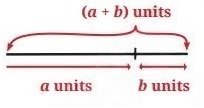
Consider two line segments of lengths a and b units, respectively, and make a longer line segment of length (a + b) units as shown in the figure.
Now draw a square of side (a+b) units and partition it into smaller squares and rectangles as shown in the figure.
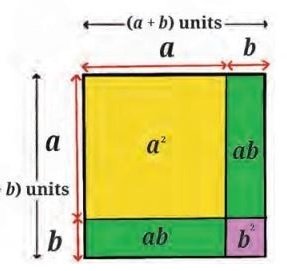
Inside this big square:
- One smaller square has area a2.
- Another smaller square has area b2.
- Two rectangles each have area ab.
So, the total area of the big square is (a + b)2 = a2 + 2ab + b2
This shows the identity visually using squares and rectangles.
Checking with Negative Numbers
- Let a = -2, b = -3.
- (a + b)2 = (-5)2 = 25
- Also, a2 + 2ab + b2 = 4 + 12 + 9 = 25.
It shows that the identity works even when numbers are negative.
Checking with Rational Numbers
\[ a = -\tfrac{2}{3}, \quad b = \tfrac{3}{4} \]\[ (a+b)^2 = \left(-\tfrac{2}{3} + \tfrac{3}{4}\right)^2 = \left(\tfrac{1}{12}\right)^2 = \tfrac{1}{144} \]\[ a^2 + 2ab + b^2 = \tfrac{4}{9} – \tfrac{1}{2} + \tfrac{9}{16} = \tfrac{1}{144} \]Identity vs Equation
- An equation is true only for some values. Example: x2 – 1 = 24 is true only when x = 5 or x = – 5.
- An identity is true for all values. Example (x + y)2 = x2 + 2xy + y2 always word, no matter what x and y are.
Comparing (a + b)2 and a2 + b2
- Take a = 10, b = 2:
- (a + b)2 = 144, while a2 + b2 = 104.
- So, (a+b)2 is grater because of the extra 2ab term.
Using the Identity
- Algebraic Expansion: (5x + 2y)2 = 25x2 + 10xy + 4y2
- Numerical Calculation Shortcut: To calculate 432: (40 + 3)2 = 1600 + 240 + 9 = 1849.
This identity is powerful because it works for all numbers and helps in both geometry and quick calculations.
Factorisation of Algebraic Expressions Using Identities
Factorisation of Algebraic Expressions Using Identities
We know –
- (a + b)2 = a2 + 2ab + b2
and
- (a – b)2 = a2 – 2ab + b2
These are special patterns. If an expression looks like this, we can write it in a shorter “factorised” form.
Example 1:
Expression x2 + 4x + 4
Notice –
- x2 = (x)2
- 4 = (2)2
- 4x = 2.x.2
So, it matches the pattern a2 + 2ab + b2 with a = x, b = 2.
Therefore:
- x2 + 4x + 4 = (x + 2)2
So, factor is (x + 2).
Example 2:
Expression 36x2 + 12x + 1
Notice:
- 36x2 = (6x)2
- 1 = (1)2
- 12x = 2.(6x).1
So, it matches the pattern with a = 6x, b = 1.
Therefore:
- 36x2 + 12x + 1 = (6x + 1)2
So, factor is (6x + 1)
Example 3:
Expression 50p2 + 60pq + 18q2
Take out the common factor 2 –
- = 2(25p2 + 30pq + 9q2)
Notice,
- 25p2 = (5p)2
- 9q2 = (3q)2
- 30pq = 2.(5p).(3q)
So, it matches the pattern with a = 5p, b = 3q.
Therefore –
- = 2(5p + 3q)2
So, factor is (5p + 3q).
Example 4: Using subtraction identity
Expression 292
We can write 29 = (30 – 1)
So,
- 292 = (30 – 1)2 = 302 – 2.30.1 + 12
- = 900 – 60 + 1 = 841
This shows how (a – b)2 identity helps in quick calculation.
Why This Works
- Identities are always true for all numbers.
- They give us a shortcut to factorise expressions.
- They also help in fast calculations without long multiplication.
More Identities
Square of a Sum of Three Numbers
Let’s expand.
- (a + b + c)2
- Think of it as (a + (b + c))2
- = a2 + 2a(b + c) + (b + c)2
- = a2 + 2ab + 2ac + b2 + 2bc + c2
- (a + b + c)2 = a2 + b2 + c2 + 2ab + 2bc + 2ca
Example with Numbers
Let’s calculate 1192 using this identity
119 can be written
- 100 + 10 + 9
- (100 + 10 + 9)2 = 1002 + 102 + 92 + 2(100)(10) + 2(100)(9) + 2(10)(9)
- =10000 + 100 + 81 + 2000 + 1800 + 180
- =14161
So, the identity works perfectly and gives us a shortcut for big numbers.
Factorisation Using Algebra Tiles
Consider a rectangle with side lengths x + 3 and x + 4 units.
The area of the rectangle is
- ( x + 3)( x + 4)
Using the distributive property,
- (x + 3)(x + 4) x2 + 7x + 12
The algebra tiles help us visualise this product:
- One x2 -tile represents x2.
- Three x-tiles represent 3x.
- Four x-tiles represent 4x.
- Twelve unit tiles represent 12.
Therefore, the total are is x2 + 3x + 4x + 12 = x2 + 7x + 12
The same arrangement also shows the reverse process –
- x2 + 7x + 12 = (x + 3) (x + 4)
So, the algebra tiles helps us to understand both expansion and factorisation.
Example with 2x + 3 and 3x + 1
The area is –
- (2x + 3)(3x + 1)
Using the distributive property –
- (2x + 3)(3x + 1) = 2x(3x) + 2x(1) + 3(3x) + 3(1)
- = 6x2 + 2x + 9x + 3
- = 6x2 + 11x + 3
Therefore,
- (px + a)(qx + b) = ( ______ )x2 + ( _____)x + ______
The blanks are
- pq, pb + aq, ab
- For p = 2, a = 3, q = 3, b = 1
- pq = 6
- pb + aq = 2(1) + 3(3) = 11
ab = 3(1) = 3
Hence,
- (2x + 3)(3x + 1) = 6x2 + 11x + 3
Factorisation Without Using Algebra Tiles
We want to factor expressions like x2 + 7x + 12
Instead of using tiles, we “split” the middle term by finding two numbers a and b, such that –
- a + b = coefficient of x
- ab = constant term
Then we can write –
- x2 + (a + b)x + ab = (x + a)(x + b)
Example of factor x2 + 7x + 12
We need numbers a, b such that a + b = 7 and ab = 12
- The pair is a = 3, b = 4
So,
- x2 + 7x + 12 = (x + 3)(x + 4)
Example factor x2 + 11x + 30
We need number a, b such that a + b = 11 and ab = 30
Check the factor of 30
- 2 + 15 = 17 (not 11)
- 3 + 10 = 13 (not 11)
- 5 + 6 = 11
So,
- x2 + 11x + 30 = (x + 5)(x + 6)
Example factor x2 – 5x + 6
We need numbers a, b such that a + b = -5 and ab = 6
check pairs
- -2 + -3 = -5
- (-2)(-3) = 6
So,
- x2 – 5x + 6 = (x – 2)(x – 3)
Why this works?
Because the quadratic expression x2 + (a + b)x + ab always expands back to (x + a)(x + b). So factorisation is just the reverse of expansion.
Finding New Identities
The Cube Identity
We already know that –
- (a + b)2 = a2 + 2ab + b2
For the cube
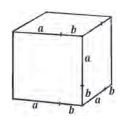
- (a + b)3 = a3 + 3a2b + 3ab2 + b3
This comes from the multiplying (a + b)(a2 + 2ab + b2)
Geometrically, imagine a cube of side (a + b). It can be split into –
- One cube of volume a3
- Once cube of volume b3
- Three cuboids of valume a2b
- Three cuboids of valume ab2
So, the total valume is –
- a3 + 3a2b + 3ab2 + b3
Cube with negative sign
If we replace b with -b
- (a – b)3 = a3 – 3a2b + 3ab2 – b3
You can notice the signs alternate positive, negative, positive, negative
Applications
- Example: Expression p3 + 6p2q + 12pq2 + 8q3
- This matches (p + 2q)3
- So, the cube side is p + 2q
- Example: Expression 8n3 – 60n2m + 150nm2 – 125m3
- This matches (2n – 5m)3
- So, here a = 2n, b = 5m
New identities from multiplication
- (x – y)(x2 + xy + y2) = x3 – y3 this is the difference of cubes identity.
- (x + y)(x2 – xy + y2) = x3 + y3 this is the sum of cubes identity.
- (x + y + z)(x2 + y2 + z2 – xy – xz – yz) = x3 + y3 + z3 – 3xyz this is a poweful identity for three variables
Example using the three variable identity
Given,
- x + y + z = 10
- xyz = 25
- x2 + y2 + z2 = 38
Identity
- (x + y + z)(x2 + y2 + z2 – xy – xz – yz) = x3 + y3 + z3 – 3xyz
- use (x + y + z)2 = x2 + y2 + z2 + 2(xy + xz + yz)
- 100 = 38 + 2(xy + xz + yz)
- xy + xz + yz = 31
Substitute
- x3 + y3 + z3 = 455 – 10(31) = 145
The sum of the cubes is 145
Simplifying Rational Expressions
Let us see how we can simplify some rational algebraic expressions using factorisation.
Example:
\[ \frac{x^2 – 7x + 12}{5x^2 + 5x – 100} \]Factor numerator
We need two numbers whose sum = –7 and product = 12.
They are –3 and –4.
So:
- x2 – 7x + 12 = (x – 3)(x – 4)
Factor the denominator.
Take out common factor 5 –
- 5x2 + 5x – 100 = 5(x2 + x – 20)
Now split, we need two numbers whose sum = 1 and product = -20.
They are 5 and -4
So,
- = 5(x – 4)(x + 5)
Cancel common factor
\[ \frac{(x-3)(x-4)}{5(x-4)(x+5)} = \frac{x-3}{5(x+5)} \]Final simplified form
\[ \frac{x-3}{5(x+5)} \]Example: Saira’s Rectangle
Pieces –
- One square of side x: area x2
- 8 rectangles of area x: total 8x
- 15 unit sqares: total 15
So, total area = x2 + 8x + 15
Factor:
We need two numbers whose sum = 8 and product = 15
They are 3 and 5
So,
x2 + 8x + 15 = (x + 3)(x + 5)
rectangle dimensions: length = x + 5, breadth = x + 3
Example pool problem
Length = x, breadth = x – 4
Area = x(x – 4) = 96
So,
x2 – 4x – 96 = 0
Factor:
We need two numbers whose product = -96 and sum = -4
They are -12 and 8
So,
- x2 – 4x – 96 = (x – 12)(x + 8)
Solutions: x = 12 or x = -8
Since length cannot be negative, x = 12
breadth = 12 – 4 = 8
Pool dimensions: length = 12 m and breadth = 8 m.
Disclaimer: The content that is present on our website is based on the NCERT Class 9 Mathematics textbook and is provided for educational purposes only. All the content and images have been taken from Mathematics Class 9 NCERT Textbook and CBSE Support material. Images and content shown above are the property of individual organizations and are used here for reference purposes only. To make it easy to understand, some of the content and images are generated by AI and cross-checked by the teachers.