
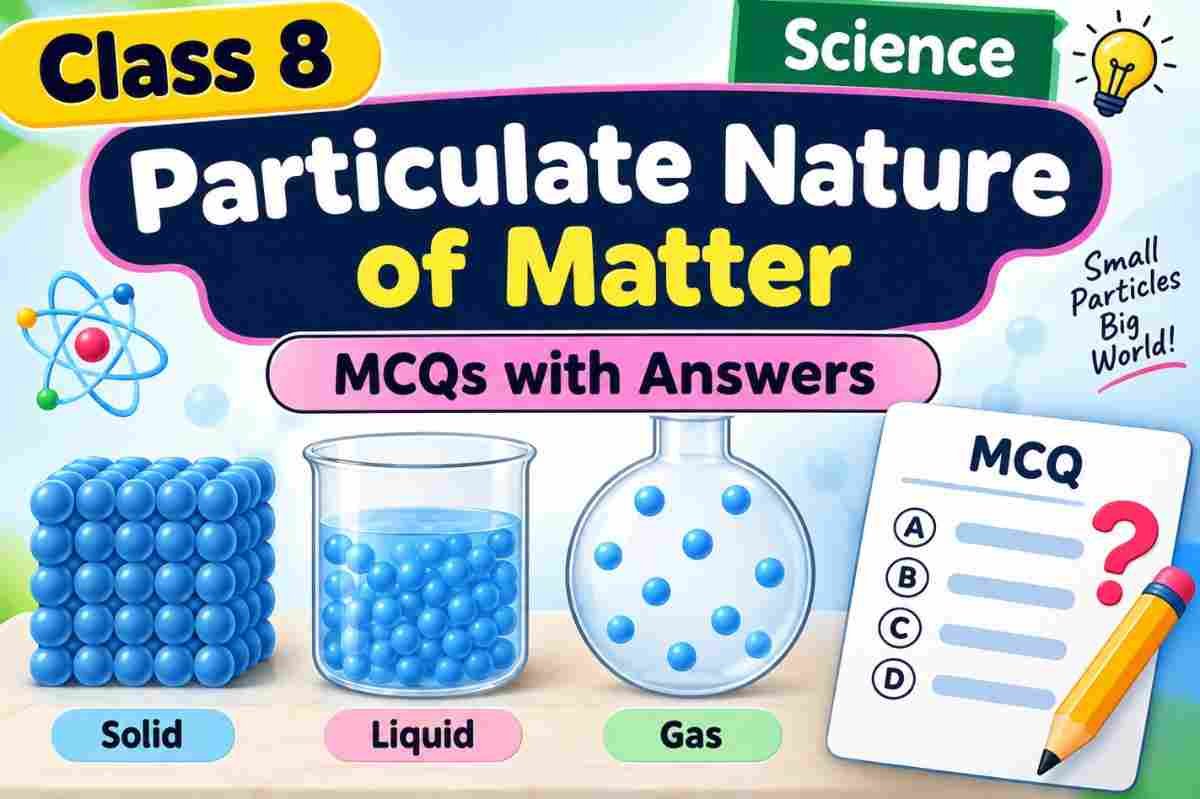
Particulate Nature of Matter Class 8 MCQs help students understand that matter is made up of very small particles. These questions cover important concepts such as the arrangement, movement, and properties of particles in solids, liquids, and gases. Practising these MCQs can help Class 8 students revise the chapter quickly and prepare for school exams.
Particulate Nature of Matter Class 8 MCQ
Conceptual Recall MCQs
Q. Constituent particles are:
a) The largest visible pieces of matter
b) The smallest building blocks of matter
c) Only found in liquids
d) Only found in gases
Answer: b) The smallest building blocks of matter
Explanation: Every substance is made of very tiny particles called constituent particles.
Q. Grinding chalk into powder is:
a) A chemical change
b) A physical change
c) A biological change
d) A nuclear change
Answer: b) A physical change
Explanation: Grinding does not make a new substance; only size changes.
Q. Which factor mainly decides the physical state of matter?
a) Colour of particles
b) Size of particles
c) Strength of interparticle forces
d) Shape of particles
Answer: c) Strength of interparticle forces
Explanation: Strong forces → solid, weak forces → gas.
Q. Liquids have:
a) Fixed shape but no fixed volume
b) No fixed shape but fixed volume
c) Fixed shape and fixed volume
d) No fixed shape and no fixed volume
Answer: b) No fixed shape but fixed volume
Explanation: Liquids take the shape of the container but keep the same volume.
Q. Gases differ from liquids because:
a) Gases have fixed volume
b) Gases occupy the entire available space
c) Gases have stronger forces than liquids
d) Gases cannot flow
Answer: b) Gases occupy the entire available space
Explanation: Gases spread freely and fill the whole container.
Q. Which state of matter has the least interparticle spacing?
a) Solid
b) Liquid
c) Gas
d) Plasma
Answer: a) Solid
Explanation: In solids, particles are tightly packed with very little space.
Q. Why is water practically incompressible compared to air?
a) Water particles are heavier
b) Water particles are already close together
c) Water particles are larger
d) Water particles are lighter
Answer: b) Water particles are already close together
Explanation: Liquids have very little space between particles, so pressure cannot reduce volume much.
Q. In solids, particles:
a) Move freely in all directions
b) Vibrate in fixed positions
c) Slide past each other
d) Have maximum spacing
Answer: b) Vibrate in fixed positions
Explanation: In solids, particles are tightly packed and only vibrate.
Q. Which state of matter has maximum interparticle spacing?
a) Solid
b) Liquid
c) Gas
d) Plasma
Answer: c) Gas
Explanation: Gas particles are far apart and move freely.
Application-Based MCQs
Q. When sugar dissolves in water, why can’t we see sugar particles?
a) They vanish completely
b) They break into constituent particles and fit into interparticle spaces
c) They change into water particles
d) They evaporate
Answer: b) They break into constituent particles and fit into interparticle spaces
Explanation: Sugar particles are too small to see; they occupy spaces between water particles.
Q. A student adds salt to water and stirs. The water tastes salty but no salt grains are visible. This shows:
a) Salt particles are destroyed
b) Salt particles are mixed with water particles
c) Salt particles are converted into water
d) Salt particles float on top
Answer: b) Salt particles are mixed with water particles
Explanation: Dissolving spreads particles into water without destroying them.
Q. Ice melts at 0°C while iron melts at 1538°C. What does this show?
a) Iron has weaker interparticle forces than ice
b) Iron has stronger interparticle forces than ice
c) Ice particles are larger than iron particles
d) Ice particles are heavier than iron particles
Answer: b) Iron has stronger interparticle forces than ice
Explanation: Higher melting point = stronger forces.
Q. Sugar dissolves in water but sand does not. Why?
a) Sugar particles fit into interparticle spaces of water
b) Sand particles are heavier
c) Sand particles vanish in water
d) Sugar particles change into water molecules
Answer: a) Sugar particles fit into interparticle spaces of water
Explanation: Soluble solids like sugar occupy spaces between water particles; insoluble solids like sand cannot.
Q. A student pours 200 mL water into three containers of different shapes. The water level remains the same. What does this show?
a) Liquids have fixed shape
b) Liquids have fixed volume
c) Liquids cannot flow
d) Liquids change into gas
Answer: b) Liquids have fixed volume
Explanation: Water volume stays constant, proving liquids have definite volume.
Q. Smoke spreads from one gas jar to another when the plate is removed. This shows:
a) Gases have fixed shape
b) Gases have fixed volume
c) Gases spread freely and occupy available space
d) Gases are heavier than solids
Answer: c) Gases spread freely and occupy available space
Explanation: Gas particles move freely in all directions.
Q. In the syringe experiment, air volume decreases when plunger is pushed. What does this show?
a) Gas particles have no space
b) Gas particles have large spaces that can be reduced
c) Gas particles are heavier than liquids
d) Gas particles are fixed in position
Answer: b) Gas particles have large spaces that can be reduced
Explanation: Gases have large interparticle spacing, so they can be compressed.
Q. Potassium permanganate spreads faster in hot water than in cold water because:
a) Hot water particles move faster
b) Cold water particles vanish
c) Hot water particles are heavier
d) Cold water particles are larger
Answer: a) Hot water particles move faster
Explanation: Heat increases particle motion, so diffusion is faster.
Q. Burning incense stick spreads fragrance across the room. This shows:
a) Air particles are fixed
b) Air particles move constantly and help spread fragrance
c) Fragrance particles vanish
d) Fragrance particles are heavier than air
Answer: b) Air particles move constantly and help spread fragrance
Explanation: Air particles collide with fragrance particles and spread them.
Assertion–Reason MCQs
Q. Assertion (A): Matter is made up of extremely small particles.
Reason (R): These particles can be seen easily with an ordinary microscope.
a) Both A and R are true, and R is the correct explanation of A
b) Both A and R are true, but R is not the correct explanation of A
c) A is true, R is false
d) A is false, R is true
Answer: c) A is true, R is false
Explanation: Matter is made of tiny particles, but they cannot be seen with an ordinary microscope.
Q. Assertion (A): Solids have a definite shape and volume.
Reason (R): Their particles are free to move past each other.
a) Both A and R are true, R explains A
b) Both A and R are true, R does not explain A
c) A true, R false
d) A false, R true
Answer: c) A is true, R is false
Explanation: Solids have definite shape because particles are fixed, not free.
Q. Assertion (A): Solids are incompressible.
Reason (R): Their particles are tightly packed with very little space.
a) Both A and R are true, R explains A
b) Both A and R are true, R does not explain A
c) A true, R false
d) A false, R true
Answer: a) Both A and R are true, R explains A
Explanation: Solids cannot be compressed because particles are already close together.
Q. Assertion (A): In gases, particles move freely in all directions.
Reason (R): Interparticle attractions in gases are negligible.
a) Both A and R are true, R explains A
b) Both A and R are true, R does not explain A
c) A true, R false
d) A false, R true
Answer: a) Both A and R are true, R explains A
Explanation: Negligible forces allow gas particles to move freely.
Q. Assertion (A): Liquids can be displaced when you move your finger through them.
Reason (R): Interparticle forces in liquids are weaker than in solids.
a) Both A and R are true, R explains A
b) Both A and R are true, R does not explain A
c) A true, R false
d) A false, R true
Answer: a) Both A and R are true, R explains A
Explanation: Liquids allow displacement because their forces are weaker than solids.
Case/Experiment-Based MCQ
Q. A teacher performs an activity:
- Breaks chalk into small pieces
- Grinds it into powder
- Shows powder under magnifying glass
- Observation: Each grain is still chalk.
Question: What does this activity prove?
a) Chalk changes into a new substance when ground
b) Chalk remains the same substance; only particle size changes
c) Chalk particles vanish after grinding
d) Chalk particles become sugar particles
Answer: b) Chalk remains the same substance; only particle size changes
Explanation: Grinding chalk is a physical change; it proves matter is made of smaller particles.
Q. A student hammers an iron nail and a piece of wood. Both break but do not flow. What does this prove?
a) Solids have weak forces
b) Solids have definite shape and strong particle attractions
c) Solids can easily change into liquids
d) Solids are made of gases
Answer: b) Solids have definite shape and strong particle attractions
Explanation: Hammering shows solids resist flow due to strong forces.
Q. A student observes that spilled water disappears after some time even at room temperature. What process does this show?
a) Boiling
b) Melting
c) Evaporation
d) Condensation
Answer: c) Evaporation
Explanation: Water changes slowly into vapour at all temperatures due to evaporation.
Q. A student adds sugar to water. The water level first rises, then decreases slightly after sugar dissolves. What does this prove?
a) Water particles vanish after mixing
b) Sugar particles occupy spaces between water particles
c) Sugar particles change into water molecules
d) Sugar particles float on top
Answer: b) Sugar particles occupy spaces between water particles
Explanation: The decrease in level shows water has interparticle spaces that sugar particles fill.
Q. A student drops potassium permanganate grains in three tumblers: hot water, room-temperature water, and ice-cold water. The spreading is fastest in hot water. What does this prove?
a) Heat reduces particle motion
b) Heat increases particle motion
c) Heat destroys particles
d) Heat changes water into gas
Answer: b) Heat increases particle motion
Explanation: Higher temperature increases kinetic energy, so diffusion is faster.
Diagram/Visual-Based MCQ
Q. Look at the diagram of sugar dissolving in water.
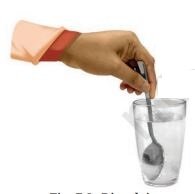
Question: What does the diagram show?
a) Sugar particles float on water
b) Sugar particles occupy spaces between water particles
c) Sugar particles change into water molecules
d) Sugar particles disappear completely
Answer: b) Sugar particles occupy spaces between water particles
Explanation: Sugar particles fit into interparticle spaces, making the solution sweet.
Q. In the figure, particles of a solid vibrate more when heated. What happens at the melting point?
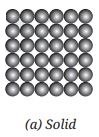
a) Particles stop vibrating
b) Particles leave fixed positions and move freely
c) Particles disappear
d) Particles change into gas directly
Answer: b) Particles leave fixed positions and move freely
Explanation: At melting point, vibrations break attractions → solid becomes liquid.
Q. In the figure, smoke spreads from Jar A to Jar B. What property of gases does this prove?
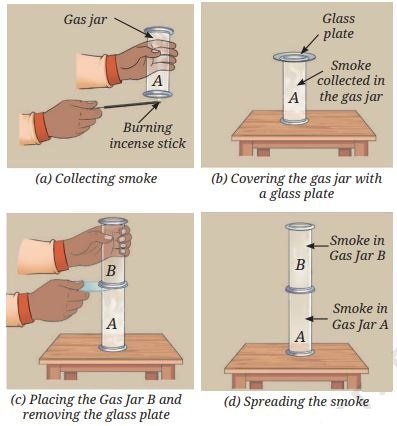
a) Gases have fixed volume
b) Gases occupy entire available space
c) Gases cannot move freely
d) Gases are heavier than liquids
Answer: b) Gases occupy entire available space
Explanation: Smoke fills Jar B, showing gases spread to occupy all space.
Q. In the figure, which state shows particles far apart with negligible forces?
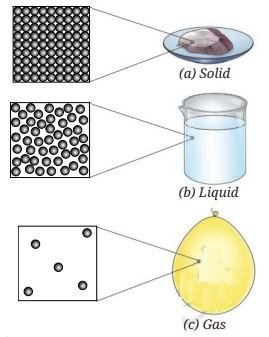
a) Solid
b) Liquid
c) Gas
d) Plasma
Answer: c) Gas
Explanation: Gas particles are far apart, move freely, and have negligible attractions.
Q. In the figure, which state shows particles vibrating only in fixed positions?
a) Solid
b) Liquid
c) Gas
d) Plasma
Answer: a) Solid
Explanation: Solids have maximum attraction, minimum spacing, and only vibrational motion.
Disclaimer: The content that is present on our website is based on the NCERT Class 8 Science textbook and is provided for educational purposes only. All the content and images have been taken from Science Class 8 NCERT Textbook. Images and content shown above are the property of individual organizations and are used here for reference purposes only. To make it easy to understand, some of the content and images are generated by AI and cross-checked by the teachers.