
Test your understanding of Nature of Elements, Compounds and Mixtures Class 8 with these MCQs. This quiz covers important concepts such as elements, compounds, mixtures, their properties, and differences. These questions are useful for Class 8 Science revision, practice, and exam preparation.
Nature of Elements Compounds and Mixtures Class 8 MCQ
Conceptual Recall
Q. Which of the following is a uniform mixture?
a) Sprout salad
b) Poha
c) Sugar dissolved in water
d) Vegetable soup
Answer: c) Sugar dissolved in water
Q. In science, a pure substance is one that:
a) Contains adulterants
b) Has only one type of particles
c) Is always edible
d) Cannot be used in experiments
Answer: b) Has only one type of particles
Q. Elements are made up of:
a) Different types of atoms
b) Identical atoms
c) Molecules of compounds
d) Mixtures of substances
Answer: b) Identical atoms
Q. Which of the following is NOT an element?
a) Gold
b) Silver
c) Water
d) Carbon
Answer: c) Water
Q. Water is a compound because:
a) It can be separated by physical methods
b) It contains hydrogen and oxygen chemically combined
c) It is a mixture of gases
d) It is always impure
Answer: b) It contains hydrogen and oxygen chemically combined
Q. The ratio of hydrogen to oxygen atoms in water is:
a) 1:1
b) 2:1
c) 1:2
d) 3:1
Answer: b) 2:1
Q. The air we breathe is:
a) A compound
b) An element
c) A mixture
d) A pure substance
Answer: c) A mixture
Q. Water is classified as:
a) An element
b) A compound
c) A mixture
d) A metalloid
Answer: b) A compound
Q. Native minerals are:
a) Pure elements
b) Compounds
c) Mixtures
d) Alloys
Answer: a) Pure elements
Q. Which of the following is a compound mineral?
a) Gold
b) Silver
c) Quartz
d) Carbon
Answer: c) Quartz
Application-Based
Q. Stainless steel is used for making utensils because:
a) It is a pure substance
b) It is an alloy with uniform properties
c) It reacts easily with food
d) It is a non-uniform mixture
Answer: b) It is an alloy with uniform properties
Q. Which of the following is a pure substance according to science?
a) Milk
b) Packed fruit juice
c) Sugar
d) Soil
Answer: c) Sugar
Q. Two atoms of hydrogen combine to form:
a) One atom of hydrogen
b) One molecule of hydrogen
c) One molecule of oxygen
d) One molecule of water
Answer: b) One molecule of hydrogen
Q. Which of the following is a metalloid?
a) Oxygen
b) Silicon
c) Gold
d) Sulfur
Answer: b) Silicon
Q. Sodium chloride is formed by:
a) Sodium + Oxygen
b) Sodium + Chlorine
c) Sodium + Carbon
d) Sodium + Sulfur
Answer: b) Sodium + Chlorine
Q. On heating sugar, the products formed are:
a) Carbon and water
b) Hydrogen and oxygen
c) Sodium and chlorine
d) Iron and sulfur
Answer: a) Carbon and water
Q. Stainless steel is preferred over pure iron for construction because:
a) It is lighter
b) It is stronger and more durable
c) It is a pure substance
d) It is a non‑metal
Answer: b) It is stronger and more durable
Q. Fertilisers are made using compounds to:
a) Reduce soil fertility
b) Increase crop production
c) Stop plant growth
d) Replace water
Answer: b) Increase crop production
Q. Cement is made from:
a) Talc and mica
b) Calcite, quartz, alumina, and iron oxide
c) Gold and silver
d) Pyroxene and olivine
Answer: b) Calcite, quartz, alumina, and iron oxide
Q. Talcum powder is obtained from:
a) Quartz
b) Talc
c) Calcite
d) Mica
Answer: b) Talc
Assertion–Reason
Q. Assertion (A): Air is a mixture.
Reason (R): Its components like nitrogen, oxygen, and carbon dioxide can be separated by physical methods.
a) Both A and R are true, and R is the correct explanation of A
b) Both A and R are true, but R is not the correct explanation of A
c) A is true, but R is false
d) A is false, but R is true
Answer: a) Both A and R are true, and R is the correct explanation of A
Q. Assertion (A): Water is a pure substance.
Reason (R): It consists of only H₂O particles.
a) Both A and R are true, and R is the correct explanation of A
b) Both A and R are true, but R is not the correct explanation of A
c) A is true, but R is false
d) A is false, but R is true
Answer: a) Both A and R are true, and R is the correct explanation of A
Q. Assertion (A): Mercury is a liquid at room temperature.
Reason (R): Mercury is a non‑metal.
a) Both A and R are true, and R is the correct explanation of A
b) Both A and R are true, but R is not the correct explanation of A
c) A is true, but R is false
d) A is false, but R is true
Answer: c) A is true, but R is false
Q. Assertion (A): Properties of compounds are different from their constituent elements.
Reason (R): Elements in compounds are chemically combined in fixed ratios.
a) Both A and R are true, and R is the correct explanation of A
b) Both A and R are true, but R is not the correct explanation of A
c) A is true, but R is false
d) A is false, but R is true
Answer: a) Both A and R are true, and R is the correct explanation of A
Q. Assertion (A): Chemists study how elements combine to form compounds.
Reason (R): This helps in inventing medicines and vaccines.
a) Both A and R are true, and R is the correct explanation of A
b) Both A and R are true, but R is not the correct explanation of A
c) A is true, but R is false
d) A is false, but R is true
Answer: a) Both A and R are true, and R is the correct explanation of A
Q. Assertion (A): Most rocks are mixtures of minerals.
Reason (R): Minerals are the building blocks of matter.
a) Both A and R are true, and R is the correct explanation of A
b) Both A and R are true, but R is not the correct explanation of A
c) A is true, but R is false
d) A is false, but R is true
Answer: b) Both A and R are true, but R is not the correct explanation of A
Case/Experiment-Based
Q. During an experiment, a student adds calcium oxide to water. The solution formed is filtered and kept in a petri dish. After some time, the solution turns milky.
What does this observation prove?
a) Presence of oxygen in air
b) Presence of nitrogen in air
c) Presence of carbon dioxide in air
d) Presence of dust particles in air
Answer: c) Presence of carbon dioxide in air
Q. In the activity, electricity is passed through water with a few drops of sulphuric acid. Two gases are collected in test tubes. Which gases are formed?
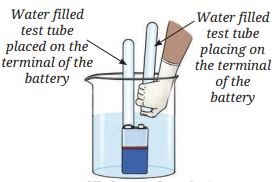
a) Hydrogen and Oxygen
b) Carbon dioxide and Oxygen
c) Nitrogen and Hydrogen
d) Oxygen and Carbon monoxide
Answer: a) Hydrogen and Oxygen
Q. In the activity, electricity passed through water produced hydrogen and oxygen. What does this prove?
a) Water is an element
b) Water is a compound made of elements
c) Hydrogen and oxygen are compounds
d) Hydrogen and oxygen are mixtures
Answer: b) Water is a compound made of elements
Q. In the activity, Sample A (iron + sulfur mixture) and Sample B (iron sulfide compound) were tested. Which observation is correct?
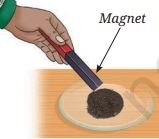
a) Sample A is attracted by a magnet, Sample B is not
b) Both Sample A and Sample B are attracted by a magnet
c) Sample A and Sample B show identical properties
d) Sample B can be separated into iron and sulfur easily
Answer: a) Sample A is attracted by a magnet, Sample B is not
Q. A material scientist develops a new alloy for bridges. Which statement is correct?
a) The alloy is a compound
b) The alloy is a mixture of metals
c) The alloy is a pure element
d) The alloy is a non‑metal
Answer: b) The alloy is a mixture of metals
Q. A student observes a rock under a magnifying glass and finds particles of quartz and mica. What does this show?
a) The rock is a pure substance
b) The rock is a mixture of minerals
c) The rock is an element
d) The rock is a compound
Answer: b) The rock is a mixture of minerals
Diagram/Visual-Based
Q. Utensils made of stainless steel, brass, and bronze are shown. Which statement is correct?
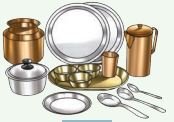
a) All are pure substances
b) All are alloys (mixtures of metals)
c) Brass is made of copper and tin
d) Bronze is made of copper and zinc
Answer: b) All are alloys (mixtures of metals)
Q. In the diagram showing gas testing, which observation indicates the presence of hydrogen gas?
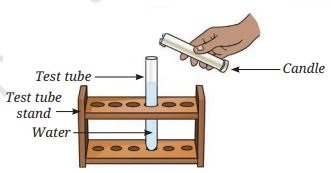
a) Candle flame glows brighter
b) Candle flame goes off
c) A pop sound is heard
d) Gas turns lime water milky
Answer: c) A pop sound is heard
Q. In the diagram showing molecules:
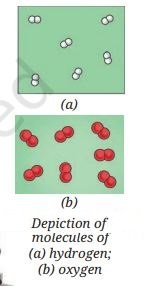
Two atoms of hydrogen combine → ______
Two atoms of oxygen combine → ______
a) H₂ molecule, O₂ molecule
b) H₂O molecule, O₂ molecule
c) H₂ molecule, H₂O molecule
d) O₂ molecule, H₂O molecule
Answer: a) H₂ molecule, O₂ molecule
Q. Graphene aerogel is shown in the figure. Which property makes it useful for cleaning oil spills?
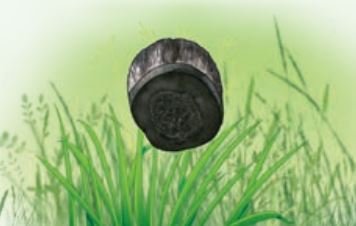
a) It is heavy and dense
b) It is highly porous and absorbent
c) It is a compound of hydrogen and oxygen
d) It is a mixture of gases
Answer: b) It is highly porous and absorbent
Q. In the diagram showing minerals (quartz, calcite, mica, pyroxene, olivine, talc), which mineral is used to make talcum powder?

a) Quartz
b) Calcite
c) Talc
d) Olivine
Answer: c) Talc
Disclaimer: The content that is present on our website is based on the NCERT Class 8 Science textbook and is provided for educational purposes only. All the content and images have been taken from Science Class 8 NCERT Textbook. Images and content shown above are the property of individual organizations and are used here for reference purposes only. To make it easy to understand, some of the content and images are generated by AI and cross-checked by the teachers.