
Practice Keeping Time with the Skies Class 8 MCQs to strengthen your understanding of how the Sun, Moon, stars, and sky observations help us measure and keep track of time. These questions are useful for Class 8 Science revision, school exams, and quick chapter practice.
Keeping Time with the Skies Class 8 MCQ
Conceptual Recall MCQ
Q. The day when the moon is not visible at all is called:
A. Full Moon (Purnima)
B. New Moon (Amavasya)
C. Half Moon
D. Crescent Moon
Answer: B. New Moon (Amavasya)
Q. On a full moon day, when the sun rises in the east, the moon is:
A. Rising in the East
B. Setting in the West
C. Overhead at sunrise
D. Not visible at all
Answer: B. Setting in the West
Q3. When the ball is held opposite to the lamp (position A), the illuminated portion facing Earth is:
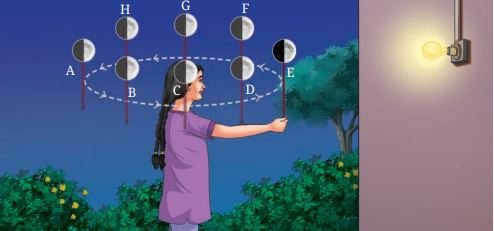
A. Not visible (New Moon)
B. Fully visible (Full Moon)
C. Half visible (quarter moon)
D. Crescent visible
Answer: B. Fully visible (Full Moon)
Q4. The average time taken by the Sun to return to its highest position in the sky is called:
A. Sidereal day
B. Mean solar day
C. Lunar day
D. Tropical year
Answer: B. Mean solar day
Q5. In the Indian National Calendar, the year begins on:
A. 1 January
B. 21 March
C. 22 March
D. 15 April
Answer: C. 22 March
Q6. Most artificial satellites orbit Earth at about:
A. 80 km above the surface
B. 800 km above the surface
C. 8,000 km above the surface
D. 80,000 km above the surface
Answer: B. 800 km above the surface
Application-Based MCQ
Q. If a student observes the Moon for 30 days and notes that the bright portion first decreases and then increases, what conclusion can be drawn?
A. The Moon is changing its shape.
B. The Moon is revolving around Earth.
C. The Sun is revolving around the Moon.
D. The Earth is revolving around the Moon.
Answer: B. The Moon is revolving around Earth.
Q. A student checks the newspaper and finds that the Moon rises at 14:23 on 7 April and at 15:17 on 8 April. What can be concluded?
A. The Moon rises at the same time every day.
B. The Moon rises about 50 minutes later each day.
C. The Sun controls the Moon’s rise time.
D. The Moon rises only at night.
Answer: B. The Moon rises about 50 minutes later each day.
Q. In the ball‑and‑torch activity, if the student sees only a curved bright edge on the ball, what does this represent?
A. Lunar eclipse
B. Crescent phase of the Moon
C. Waxing gibbous phase
D. Full Moon phase
Answer: B. Crescent phase of the Moon
Q. A student notices that February has 29 days in 2028. What does this indicate?
A. It is a lunar year.
B. It is a leap year in the Gregorian calendar.
C. It is a sidereal year.
D. It is a tropical year.
Answer: B. It is a leap year in the Gregorian calendar.
Q. In a leap year, the Indian National Calendar adds an extra day to:
A. Vaisakha
B. Chaitra
C. Jyestha
D. Phalguna
Answer: B. Chaitra
Q. If a city wants to plan roads and monitor land use, which ISRO satellite series would be most useful?
A. AstroSat
B. Cartosat
C. Aditya L1
D. Mangalyaan
Answer: B. Cartosat
Assertion–Reason MCQ
Q. Assertion (A): The Moon looks different every night.
Reason (R): The Earth blocks sunlight from reaching the Moon every day.
A. Both A and R are true, and R is the correct explanation of A.
B. Both A and R are true, but R is not the correct explanation of A.
C. A is true, but R is false.
D. A is false, but R is true.
Answer: C. A is true, but R is false.
Reason: Phases are due to revolution of the Moon, not daily eclipses.
Q. Assertion (A): The Moon can sometimes be seen during the daytime.
Reason (R): The Moon reflects sunlight and its rise time changes daily.
A. Both A and R are true, and R is the correct explanation of A.
B. Both A and R are true, but R is not the correct explanation of A.
C. A is true, but R is false.
D. A is false, but R is true.
Answer: A. Both A and R are true, and R is the correct explanation of A.
Q. Assertion (A): Phases of the Moon occur because Earth’s shadow falls on the Moon.
Reason (R): The Earth blocks sunlight from reaching the Moon every day.
A. Both A and R are true, and R is the correct explanation of A.
B. Both A and R are true, but R is not the correct explanation of A.
C. A is true, but R is false.
D. A is false, but R is true.
Answer: D. A is false, but R is true.
Phases are due to Moon’s revolution, not Earth’s shadow. Earth’s shadow causes eclipses.
Q. Assertion (A): In a lunar calendar, seasons do not remain fixed to the same months every year.
Reason (R): A lunar year is shorter than a solar year.
A. Both A and R are true, and R is the correct explanation of A.
B. Both A and R are true, but R is not the correct explanation of A.
C. A is true, but R is false.
D. A is false, but R is true.
Answer: A. Both A and R are true, and R is the correct explanation of A.
Q. Assertion (A): Festivals like Diwali and Eid fall on different Gregorian dates each year.
Reason (R): They are based on lunar or luni‑solar calendars.
A. Both A and R are true, and R is the correct explanation of A.
B. Both A and R are true, but R is not the correct explanation of A.
C. A is true, but R is false.
D. A is false, but R is true.
Answer: A. Both A and R are true, and R is the correct explanation of A.
Q. Assertion (A): Artificial satellites can be seen moving as points of light in the night sky.
Reason (R): They reflect sunlight while orbiting Earth.
A. Both A and R are true, and R is the correct explanation of A.
B. Both A and R are true, but R is not the correct explanation of A.
C. A is true, but R is false.
D. A is false, but R is true.
Answer: A. Both A and R are true, and R is the correct explanation of A.
Case/Experiment-Based MCQ
Q. Meera recorded the Moon’s appearance for 10 days after a full Moon. She noticed that the bright portion kept decreasing each day.
What is the correct inference?
A. The Moon is in waxing phase.
B. The Moon is in waning phase.
C. The Moon is in new Moon phase.
D. The Moon is in crescent phase only.
Answer: B. The Moon is in waning phase.
Q. Meera observed the Moon at sunrise for 5 days after full Moon. She noticed the bright portion kept decreasing and the Moon appeared closer to the Sun each morning.
Which phase was the Moon in?
A. Waxing phase
B. Waning phase
C. New Moon phase
D. Gibbous phase
Answer: B. Waning phase
Q. A student performs Activity with a ball and torch. At position E, the ball’s side facing Earth is completely dark.
Which real Moon phase does this represent?
A. Full Moon
B. New Moon
C. First Quarter
D. Gibbous Moon
Answer: B. New Moon
Q. In Activity, a student fixed a stick and marked the shadow tip every minute. She found the shortest shadow at 12:20 p.m. on 22 March and again at 12:20 p.m. on 23 March.
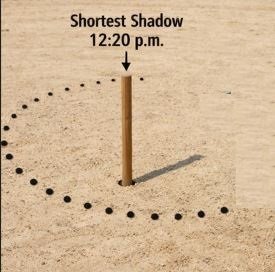
What conclusion can be drawn?
A. The solar day is exactly 23 hours.
B. The solar day is nearly 24 hours.
C. The solar day is equal to a lunar month.
D. The solar day is equal to a sidereal year.
Answer: B. The solar day is nearly 24 hours.
Q. A student notices that Holi was celebrated on 6 March in 2025 and on 25 March in 2026. What does this show?
A. Holi is based on solar calendars.
B. Holi is based on lunar phases, so its Gregorian date shifts.
C. Holi always falls on the same date.
D. Holi is linked to leap years only.
Answer: B. Holi is based on lunar phases, so its Gregorian date shifts.
Q. A student observes a fast‑moving point of light just after sunset. It does not twinkle like a star. Using a mobile app, she confirms it is a satellite.
Which property helped her identify it correctly?
A. It was stationary in the sky.
B. It moved quickly across the sky.
C. It was brighter than the Moon.
D. It changed shape like the Moon.
Answer: B. It moved quickly across the sky.
Diagram/Visual-Based MCQ
Q. Look at the diagram showing the Moon’s phases. If the Moon appears as a half circle after the new Moon, what is this phase called?

A. First Quarter
B. Last Quarter
C. Full Moon
D. Crescent Moon
Answer: A. First Quarter
Q. Look at a diagram showing the Sun, Earth, and Moon. If the Moon is overhead at sunrise and appears as a half circle, what phase is this?
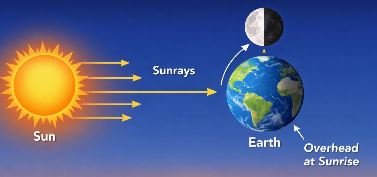
A. First Quarter
B. Last Quarter
C. Full Moon
D. Crescent Moon
Answer: B. Last Quarter
Q. Refer to Figure. At positions B and H, more than half of the illuminated portion of the Moon is visible. This phase is called:
A. Crescent
B. Gibbous
C. New Moon
D. Quarter Moon
Answer: B. Gibbous
Q. Refer to Fig. 11.8. Which natural cycle defines a month?
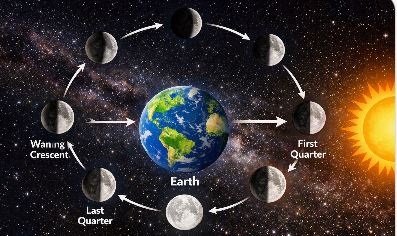
A. Earth’s rotation on its axis
B. Earth’s revolution around the Sun
C. Moon’s revolution around the Earth
D. Sun’s apparent northward movement
Answer: C. Moon’s revolution around the Earth
Q. Refer to the calendar. Festivals like Makar Sankranti and Pongal occur almost on the same Gregorian date every year because:
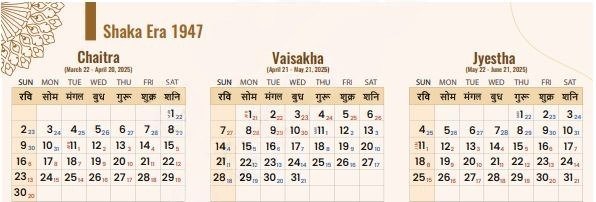
A. They follow lunar calendars.
B. They follow solar sidereal calendars.
C. They depend on leap years.
D. They are fixed by government order.
Answer: B. They follow solar sidereal calendars.
Q. A lot of artificial satellites are being sent up in space by many countries. After their useful life, any of them and their rocket parts become space junk or space debris. What happens to small debris when it falls towards Earth?
A. It collides with satellites.
B. It burns up in the atmosphere.
C. It creates new satellites.
D. It causes lunar eclipses.
Answer: B. It burns up in the atmosphere
Disclaimer: The content that is present on our website is based on the NCERT Class 8 Science textbook and is provided for educational purposes only. All the content and images have been taken from Science Class 8 NCERT Textbook. Images and content shown above are the property of individual organizations and are used here for reference purposes only. To make it easy to understand, some of the content and images are generated by AI and cross-checked by the teachers.