
Electric Charges and Fields is an important chapter in Class 12 Physics. Practising MCQs helps students understand the fundamental concepts of electrostatics and prepare for board examinations. These multiple-choice questions cover important topics such as electric charge, conductors and insulators, Coulomb’s law, the principle of superposition, electric fields, electric field lines, electric dipoles, electric flux and Gauss’s law. Attempt these questions to test your conceptual understanding and improve your exam preparation.

Electric Charges and Fields Class 12 MCQ
Conceptual Understanding MCQ
Q. A student observes that two glass rods rubbed with silk repel each other, while a glass rod and the silk cloth attract each other. Which conclusion can be drawn from this observation?
(a) Charges are produced only on glass rods.
(b) Like charges repel and unlike charges attract.
(c) All charged bodies attract each other.
(d) Silk cannot acquire charge.
Answer: (b) Like charges repel and unlike charges attract
Q. When a glass rod rubbed with silk is brought into contact with the same silk cloth, they no longer attract each other. The most appropriate conclusion is that
(a) all charges are destroyed during contact.
(b) the glass rod loses its mass during contact.
(c) unlike charges neutralise each other’s effect.
(d) the silk becomes positively charged.
Answer: (c) unlike charges neutralise each other’s effect
Q. While discussing charging by friction, a student says that new electric charges are created during rubbing. According to NCERT, which statement is correct?
(a) New charges are created on both objects.
(b) Positive charges are created whereas negative charges are destroyed.
(c) Charge is transferred from one body to another; no new charge is created.
(d) Only negative charges are created during rubbing.
Answer: (c) Charge is transferred from one body to another; no new charge is created
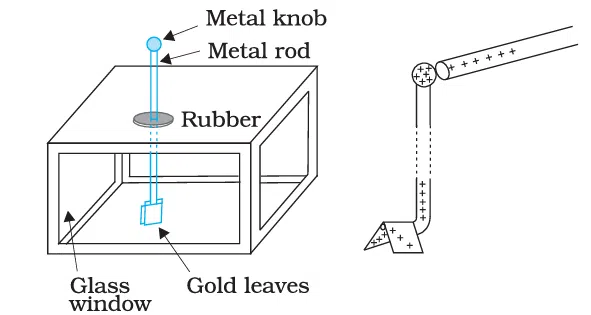
Q. The gold-leaf electroscope is primarily used to
(a) measure electric current flowing in a conductor.
(b) detect the presence of electric charge on a body.
(c) determine resistance of charged objects.
(d) measure the speed of charged particles.
Answer: (b) detect the presence of electric charge on a body
Q. A system contains five point charges: +2 C, –3 C, +5 C, –1 C and +4 C. A student claims that the total charge of the system should be obtained by adding only the magnitudes of the charges. Which of the following correctly evaluates the student’s claim?
(a) The claim is because charge is always positive.
(b) The claim is inbecause charge is a vector quantity.
(c) The claim is inbecause charges are added algebraically with proper signs.
(d) The claim is because negative charges cancel automatically.
Answer: (c) The claim is inbecause charges are added algebraically with proper signs.
Q. A body possesses a charge of –4.8 × 10⁻¹⁹ C. The excess charge on the body corresponds to
(a) 2 extra electrons
(b) 3 extra electrons
(c) 4 extra electrons
(d) 5 extra electrons
Answer: (b) 3 extra electrons
Q. A student states that a charge of 2.5e can exist on an isolated body because charge is a continuous quantity. According to the principle of quantisation of charge, which statement is correct?
(a) The student’s statement is correct.
(b) The charge can exist only if the body is very small.
(c) The charge cannot exist because charge must be an integral multiple of e.
(d) The charge can exist only in conductors.
Answer: (c) The charge cannot exist because charge must be an integral multiple of e.
Q. At the macroscopic level, charge appears to vary continuously even though it is quantised. The most appropriate reason is that
(a) electrons lose their identity at large scales.
(b) elementary charge is extremely small compared to everyday charges.
(c) quantisation of charge fails at large scales.
(d) protons and electrons combine at large scales.
Answer: (b) elementary charge is extremely small compared to everyday charges.
Q. Two identical conducting spheres carry charges +8 μC and 0 μC respectively. They are brought into contact and then separated. The charge on each sphere after separation will be
(a) +2 μC
(b) +4 μC
(c) +6 μC
(d) +8 μC
Answer: (b) +4 μC
Q. Three point charges are placed in space. A student wants to calculate the net force acting on one of the charges. Which principle should be used to determine the resultant electrostatic force?
(a) Conservation of charge
(b) Quantisation of charge
(c) Principle of superposition
(d) Gauss’s law
Answer: (c) Principle of superposition
Q. A point charge Q creates an electric field around itself. Even when no other charge is present nearby, the electric field
(a) exists only along one direction
(b) exists throughout the surrounding space
(c) exists only if a test charge is present
(d) exists only at finite distances
Answer: (b) exists throughout the surrounding space
Q. A charge of +2 μC placed at a point experiences a force of 0.4 N in an electric field. The magnitude of the electric field at that point is
(a) 1 × 10⁵ N/C
(b) 2 × 10⁵ N/C
(c) 2 × 10⁴ N/C
(d) 4 × 10⁵ N/C
Answer: (b) 2 × 10⁵ N/C
Q. A student draws electric field lines around a positive point charge and notices that the lines are crowded near the charge and become farther apart as the distance increases. What does this observation indicate?
(a) The charge decreases with distance.
(b) The electric field becomes stronger with distance.
(c) The electric field becomes weaker with distance.
(d) The electric field remains constant everywhere.
Answer: (c) The electric field becomes weaker with distance.
Q. Electric field lines never form closed loops in electrostatics because
(a) charges are quantised.
(b) electric field is conservative.
(c) charge is conserved.
(d) electric field is a scalar quantity.
Answer: (b) Electric field is conservative.
Q. An electric dipole consists of two equal and opposite charges separated by a small distance. Which statement is correct?
(a) The net charge and electric field of a dipole are both zero.
(b) The net charge is zero, but the electric field is not zero.
(c) The net charge is positive and the field is zero.
(d) The net charge is negative and the field is non-zero.
Answer: (b) The net charge is zero, but the electric field is not zero.
Q. Two charges +4 μC and –4 μC are separated by a distance of 4 cm. The magnitude of the electric dipole moment is
(a) 8 × 10⁻⁸ C m
(b) 1.6 × 10⁻⁷ C m
(c) 3.2 × 10⁻⁷ C m
(d) 6.4 × 10⁻⁷ C m
Answer: (c) 3.2 × 10⁻⁷ C m
Q. In Example 1.9, the electric field at a distant point on the axis of a dipole is approximately equal to 2.6 × 10⁵ N/C. The approximation works well because
(a) the charges are extremely large.
(b) the point lies very close to the dipole.
(c) the observation point is much farther from the dipole than the separation between the charges.
(d) the dipole has zero net charge.
Answer: (c) The observation point is much farther from the dipole than the separation between the charges.
Q. While studying a charged metallic conductor, a student finds it difficult to specify the position of every microscopic, charged particle on its surface. Instead, the charge is described in terms of charge per unit area. This quantity is known as ________.
(a) linear charge density
(b) volume charge density
(c) surface charge density
(d) electric flux density
Answer: (c) surface charge density
Q. A closed surface encloses no net charge. Which of the following can be concluded with certainty?
(a) Electric field is zero everywhere on the surface.
(b) Electric potential is zero everywhere.
(c) Net electric flux through the surface is zero.
(d) No charges exist near the surface.
Answer: (c) Net electric flux through the surface is zero.
Q. A student uses a cylindrical Gaussian surface to determine the electric field due to an infinitely long uniformly charged wire. Why is a cylindrical surface considered the most suitable Gaussian surface in this case?
(a) The electric field is constant everywhere in space.
(b) The electric field is radial and has the same magnitude at all points equidistant from the wire.
(c) The wire has a cylindrical shape.
(d) The charge enclosed is always zero.
Answer: (b) The electric field is radial and has the same magnitude at all points equidistant from the wire.
Q. According to NCERT, the electric field due to an infinite plane sheet carrying uniform positive surface charge density σ is _______.
(a) directly proportional to distance from the sheet.
(b) inversely proportional to distance from the sheet.
(c) inversely proportional to the square of distance from the sheet.
(d) independent of distance from the sheet.
Answer: (d) independent of distance from the sheet.
Q. If the surface charge density of an infinite plane sheet is doubled, the magnitude of the electric field produced by it becomes
(a) half
(b) unchanged
(c) double
(d) four times
Answer: (c) double
Q. A uniformly charged thin spherical shell carries a net positive charge. A small positive test charge is placed anywhere inside the shell. According to Gauss’s law, the electric field experienced by the test charge will be
(a) maximum at the centre.
(b) directed towards the shell.
(c) zero everywhere inside the shell.
(d) inversely proportional to distance from the centre.
Answer: (c) zero everywhere inside the shell.
Application-Based MCQ
Q. A body is electrically neutral. It becomes positively charged after a process of charging. Which of the following has most likely happened?
(a) The body has gained protons.
(b) The body has gained neutrons.
(c) The body has lost some electrons.
(d) Positive charges have been created inside the body.
Answer: (c) The body has lost some electrons
Q. A nylon comb becomes charged when rubbed through dry hair, but a metal spoon normally does not become charged when rubbed in the same manner. This is because _______.
(a) metals cannot acquire charge.
(b) charge on the spoon leaks through the body to the Earth.
(c) nylon contains more electrons than metal.
(d) friction acts only on nylon.
Answer: (b) charge on the spoon leaks through the body to the Earth
Q. A student wants to charge a metallic rod by rubbing it with a cloth. The rod is provided with a wooden handle. Why does the rod show signs of charging only when it is held through the wooden handle?
(a) Wood increases friction between the rod and cloth.
(b) Wood supplies extra electrons to the rod.
(c) Wood prevents charge from leaking through the student’s body to the ground.
(d) Wood creates positive charge inside the rod.
Answer: (c) Wood prevents charge from leaking through the student’s body to the ground
Q. During charging by friction, a glass rod loses electrons and becomes positively charged. Which statement correctly explains this process?
(a) Positive charges are created on the glass rod.
(b) Negative charges are destroyed from the glass rod.
(c) Electrons are transferred from the glass rod to the other body.
(d) Protons move from the glass rod to the silk cloth.
Answer: (c) Electrons are transferred from the glass rod to the other body.
Q. Two point charges are separated by a distance r in vacuum. If both charges are doubled while the distance remains unchanged, the electrostatic force between them becomes
(a) Two times
(b) Four times
(c) Eight times
(d) Sixteen times
Answer: (b) Four times
Q. Two point charges interact with a force F. If the separation between them is reduced to half while keeping the charges unchanged, the new force becomes
(a) F/4
(b) F/2
(c) 2F
(d) 4F
Answer: (d) 4F
Q. Coulomb compared electrostatic forces by repeatedly sharing charge between identical conducting spheres. This experimental method was mainly based on the assumption that
(a) charge is a vector quantity.
(b) identical conductors share charge equally when brought into contact.
(c) all conductors possess the same resistance.
(d) force does not depend on distance.
Answer: (b) identical conductors share charge equally when brought into contact.
Q. In a system containing several stationary charges, the force exerted by charge q₂ on charge q₁ is found using Coulomb’s law. If additional charges are placed nearby, which statement is correct?
(a) The force due to q₂ on q₁ changes because of the additional charges.
(b) The force due to q₂ on q₁ remains unchanged; only the net force changes.
(c) The force due to q₂ on q₁ becomes zero.
(d) Coulomb’s law is no longer applicable.
Answer: (b) The force due to q₂ on q₁ remains unchanged; only the net force changes.
Q. In Example 1.5, if the resultant force on the charge placed at the centroid were not zero, rotating the entire arrangement through 60° would change the direction of the force. This argument is primarily based on
(a) conservation of charge
(b) symmetry of the charge configuration
(c) quantisation of charge
(d) inverse-square law only
Answer: (b) symmetry of the charge configuration
Q. A positive test charge is placed near a positive source charge. The direction of the electric field at the location of the test charge is
(a) towards the source charge
(b) opposite to the force on the test charge
(c) perpendicular to the force on the test charge
(d) in the same direction as the force on the test charge
Answer: (d) in the same direction as the force on the test charge
Q. Unlike free fall under gravity, the time taken by charged particles to move through a given distance in a uniform electric field depends on
(a) their mass
(b) the speed of light only
(c) the direction of Earth’s magnetic field
(d) atmospheric pressure
Answer: (a) their mass
Q. A student claims that increasing the number of electric field lines drawn around a charge increases the strength of the electric field. Which statement is correct?
(a) The claim is because more field lines always mean stronger fields.
(b) The claim is only for positive charges.
(c) The claim is inbecause the number of lines is arbitrary; only their relative density matters.
(d) The claim is inbecause field lines cannot be drawn freely.
Answer: (c) The claim is inbecause the number of lines is arbitrary; only their relative density matters.
Q. A uniform electric field of magnitude 400 N/C passes through a flat surface of area 0.5 m². The area vector is parallel to the electric field. The electric flux through the surface is
(a) 0 N m²/C
(b) 100 N m²/C
(c) 200 N m²/C
(d) 400 N m²/C
Answer: (c) 200 N m²/C
Q. At the microscopic level, charge distribution is discontinuous because
(a) charge continuously changes with time
(b) charges exist as discrete particles separated by space
(c) electric fields are discontinuous
(d) matter contains only positive charges
Answer: (b) charges exist as discrete particles separated by space
Q. A closed spherical surface encloses a charge +q at its centre. If the radius of the sphere is doubled, the total electric flux through the surface will
(a) become twice its original value
(b) become four times its original value
(c) become half its original value
(d) remain unchanged
Answer: (d) remain unchanged
Q. A Gaussian surface encloses a positive charge. Another charge is placed outside the surface. Which statement is correct?
(a) The electric field inside the surface changes, but the enclosed charge remains unchanged.
(b) The electric flux through the surface increases.
(c) The electric flux through the surface decreases.
(d) The enclosed charge doubles.
Answer: (a) The electric field inside the surface changes, but the enclosed charge remains unchanged.
Q. A student chooses a Gaussian surface that passes through a discrete point charge while applying Gauss’s law. Why is this choice not recommended?
(a) The electric field at the location of a point charge is not well defined.
(b) Gauss’s law becomes invalid.
(c) Electric flux becomes negative.
(d) The enclosed charge becomes zero.
Answer: (a) The electric field at the location of a point charge is not well defined.
Q. A physicist discovers that the electrostatic force between charges no longer follows the inverse-square law. Which major result discussed in this section would also fail?
(a) Conservation of charge
(b) Quantisation of charge
(c) Gauss’s law in its present form
(d) Principle of superposition
Answer: (c) Gauss’s law in its present form
Q. The electric field due to an infinitely long straight wire carrying positive linear charge density λ is found to vary as
(a) 1/r²
(b) 1/r³
(c) 1/r
(d) independent of r
Answer: (c) 1/r
Q. An experiment shows that the electric field inside a uniformly charged spherical shell is not zero. Which fundamental conclusion would be affected?
(a) Conservation of charge
(b) Quantisation of charge
(c) The inverse-square dependence in Coulomb’s law
(d) Principle of superposition
Answer: (c) The inverse-square dependence in Coulomb’s law
Q. A body possesses a charge of +4.8 × 10⁻¹⁹ C. The body has
(a) gained 3 electrons
(b) lost 3 electrons
(c) lost 2 electrons
(d) gained 2 electrons
Answer: (b) lost 3 electrons
Assertion–Reason MCQ
Q. Assertion (A): A charged conductor distributes its charge over its entire surface.
Reason (R): Free electrons in a conductor can move easily throughout the material.
(a) Both A and R are true and R is the explanation of A.
(b) Both A and R are true but R is not the explanation of A.
(c) A is true but R is false.
(d) A is false but R is true.
Answer: (a) Both A and R are true and R is the explanation of A.
Q. Assertion (A): The total charge of an isolated system remains constant even if charges get redistributed among different bodies.
Reason (R): Electric charge can neither be created nor destroyed in an isolated system.
(a) Both A and R are true and R is the explanation of A.
(b) Both A and R are true but R is not the explanation of A.
(c) A is true but R is false.
(d) A is false but R is true.
Answer: (a) Both A and R are true and R is the explanation of A.
Q. Assertion (A): Coulomb’s law is consistent with Newton’s Third Law of Motion.
Reason (R): The electrostatic forces between two charges are equal in magnitude and opposite in direction.
(a) Both A and R are true and R is the explanation of A.
(b) Both A and R are true but R is not the explanation of A.
(c) A is true but R is false.
(d) A is false but R is true.
Answer: (a) Both A and R are true and R is the explanation of A.
Q. Assertion (A): The electric field due to a source charge is independent of the test charge used to measure it.
Reason (R): The force on the test charge is proportional to the magnitude of the test charge.
(a) Both A and R are true and R is the explanation of A.
(b) Both A and R are true but R is not the explanation of A.
(c) A is true but R is false.
(d) A is false but R is true.
Answer: (a) Both A and R are true and R is the explanation of A.
Q. Assertion (A): Two electric field lines can never intersect each other.
Reason (R): At any point in space, the electric field has a unique direction.
(a) Both A and R are true and R is the explanation of A.
(b) Both A and R are true but R is not the explanation of A.
(c) A is true but R is false.
(d) A is false but R is true.
Answer: (a) Both A and R are true and R is the explanation of A.
Q. Assertion (A): The electric field due to a dipole decreases more rapidly with distance than the field due to a single point charge.
Reason (R): At large distances, the dipole field varies as 1/r³ whereas the field due to a point charge varies as 1/r².
(a) Both A and R are true and R is the explanation of A.
(b) Both A and R are true but R is not the explanation of A.
(c) A is true but R is false.
(d) A is false but R is true.
Answer: (a) Both A and R are true and R is the explanation of A.
Q. Assertion (A): Gauss’s law can be applied to a closed surface of any shape.
Reason (R): The electric flux through a closed surface depends only on the total charge enclosed by the surface.
(a) Both A and R are true and R is the explanation of A.
(b) Both A and R are true but R is not the explanation of A.
(c) A is true but R is false.
(d) A is false but R is true.
Answer: (a) Both A and R are true and R is the explanation of A.
Q. Assertion (A): The electric field due to an infinitely long positively charged wire is directed radially outward.
Reason (R): Every point at the same perpendicular distance from the wire is equivalent because of cylindrical symmetry.
(a) Both A and R are true and R is the explanation of A.
(b) Both A and R are true but R is not the explanation of A.
(c) A is true but R is false.
(d) A is false but R is true.
Answer: (a) Both A and R are true and R is the explanation of A.
Q. Assertion (A): The electric field inside a uniformly charged thin spherical shell is zero.
Reason (R): Any Gaussian surface drawn completely inside the shell encloses no charge.
(a) Both A and R are true and R is the explanation of A.
(b) Both A and R are true but R is not the explanation of A.
(c) A is true but R is false.
(d) A is false but R is true.
Answer: (a) Both A and R are true and R is the explanation of A.
Case Study-Based MCQ
Case Study: A student performs an experiment using a glass rod and a silk cloth. After rubbing, the rod attracts paper bits. Another similarly charged glass rod is brought near it, and the rods repel each other. The rod is then touched to the silk cloth used for rubbing, after which it no longer attracts paper bits.
Q. Which statement best explains all the observations made in the experiment?
(a) Rubbing creates only one type of charge.
(b) Charged bodies always attract each other.
(c) Two types of electric charges exist, and opposite charges neutralise each other when brought together.
(d) Paper bits become permanently charged.
Answer: (c) Two types of electric charges exist, and opposite charges neutralise each other when brought together
Case Study: A student investigates Coulomb’s law using two identical charged conducting spheres. The spheres are initially separated by a distance r and exert a force F on each other. Each sphere is then touched with an identical uncharged conducting sphere so that the charge on each original sphere becomes half. The separation between the original charged spheres is then reduced to r/2.
Q. According to Coulomb’s law, the new electrostatic force between the original spheres will be
(a) F/4
(b) F/2
(c) F
(d) 4F
Answer: (c) F
Case Study: A scientist studies two charged particles separated by a large distance. One particle is accelerated. The effect of this motion is not observed instantaneously by the other particle. Instead, the information travels through space and reaches the second particle after a finite interval of time.
Q. Which concept best explains this time delay between cause and effect?
(a) Quantisation of charge
(b) Additivity of charge
(c) Electromagnetic field carrying information through space
(d) Conservation of charge
Answer: (c) Electromagnetic field carrying information through space
Case Study: A charged comb is brought close to small pieces of paper. The paper pieces move towards the comb even though they were initially neutral. According to NCERT, the electric field of the comb induces a dipole moment in the paper. Since the field around the comb is non-uniform, a net force acts on the induced dipole.
Q. Which statement best explains why the paper pieces move towards the comb?
(a) The paper gains a permanent negative charge.
(b) The comb transfers electrons directly to the paper.
(c) The non-uniform electric field induces a dipole and exerts a net attractive force.
(d) The paper becomes a conductor when brought near the comb.
Answer: (c) The non-uniform electric field induces a dipole and exerts a net attractive force.
Case Study: A student investigates Gauss’s law using different closed surfaces. First, a charge is placed inside a spherical surface. The sphere is then replaced by a cube and later by an irregular closed surface. In every case, the same charge remains enclosed within the surface.
Q. According to Gauss’s law, the total electric flux through each closed surface will be
(a) different because the shapes are different
(b) proportional to the surface area
(c) inversely proportional to the volume enclosed
(d) the same because the enclosed charge is unchanged
Answer: (d) the same because the enclosed charge is unchanged
Case Study: A physicist compares the electric field produced by three different charge distributions: an infinitely long charged wire, an infinite plane sheet, and a uniformly charged spherical shell. In each case, Gauss’s law is applied using a Gaussian surface that matches the symmetry of the charge distribution.
Q. Which statement correctly compares the variation of electric field with distance?
(a) For all three charge distributions, electric field varies as 1/r².
(b) For the wire, electric field varies as 1/r; for the plane sheet it remains constant; and for the spherical shell it varies as 1/r² outside the shell.
(c) For the wire and plane sheet, electric field remains constant.
(d) For all three charge distributions, electric field remains constant.
Answer: (b) For the wire, electric field varies as 1/r; for the plane sheet it remains constant; and for the spherical shell it varies as 1/r² outside the shell.
Figure-Based MCQ
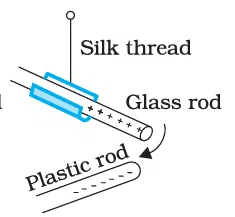
Q. Refer to Figure. A plastic rod rubbed with cat’s fur attracts a glass rod rubbed with silk. This observation directly supports which statement?
(a) Like charges attract one another.
(b) Unlike charges repel one another.
(c) Unlike charges attract one another.
(d) Neutral bodies repel charged bodies.
Answer: (c) Unlike charges attract one another
Q. Refer to Figure, (Gold-Leaf Electroscope). When a charged object touches the metal knob, the gold leaves diverge because _______.
(a) the leaves become magnetised.
(b) both leaves acquire similar charges.
(c) the leaves gain mass.
(d) the leaves become electrically neutral.
Answer: (b) both leaves acquire similar charges
Q. If 10⁹ electrons move out of a body every second, approximately how much time is required to accumulate a charge of 1 C?
(a) 20 years
(b) 50 years
(c) 100 years
(d) 200 years
Answer: (d) 200 years
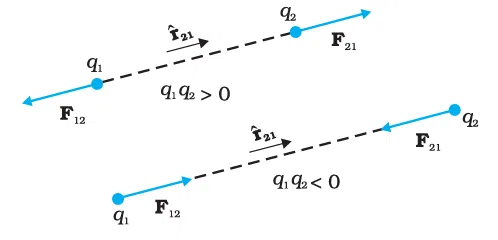
Q. Refer to Figure. Two point charges carry opposite signs. According to the vector form of Coulomb’s law, the force acting between them is ______.
(a) always repulsive
(b) always attractive
(c) zero
(d) perpendicular to the line joining the charges
Answer: (b) always attractive
Q. When the cup of water contains enormous positive and negative charges. Why then is the cup electrically neutral?
(a) Water contains only positive charge.
(b) Water contains only negative charge.
(c) The total positive and negative charges are equal in magnitude.
(d) Charges cannot exist in water.
Answer: (c) The total positive and negative charges are equal in magnitude.
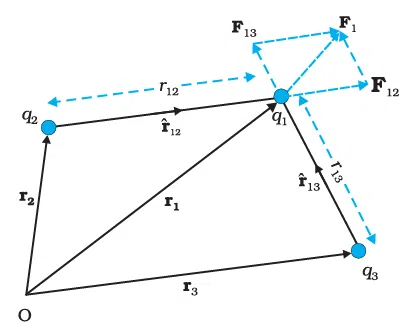
Q. Refer to Figure. The force acting on charge q₁ due to charges q₂ and q₃ is obtained by
(a) adding the magnitudes of F₁₂ and F₁₃
(b) subtracting the smaller force from the larger one
(c) vector addition of F₁₂ and F₁₃
(d) multiplying F₁₂ and F₁₃
Answer: (c) vector addition of F₁₂ and F₁₃
Q. The three identical charges are placed at the vertices of an equilateral triangle and a charge Q is placed at the centroid. The net electrostatic force on Q is
(a) directed towards one vertex
(b) directed away from all vertices
(c) equal to the force due to one charge
(d) zero
Answer: (d) zero
Q. Refer to Figure. The electric field due to a positive point charge is represented as radial lines directed outward from the charge. This representation indicates that
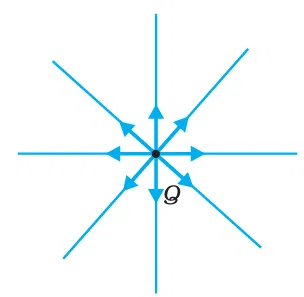
(a) a positive test charge would be attracted towards the source charge
(b) a positive test charge would experience no force
(c) a positive test charge would be repelled away from the source charge
(d) the electric field has circular symmetry
Answer: (c) a positive test charge would be repelled away from the source charge
Q. Refer to Figure. A negative point charge produces an electric field that is directed
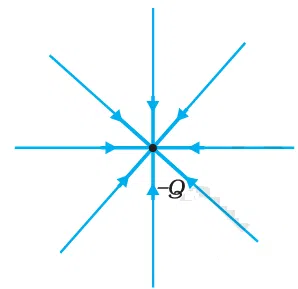
(a) radially inward towards the charge
(b) radially outward from the charge
(c) tangential to circular paths around the charge
(d) perpendicular to the radius vector
Answer: (a) radially inward towards the charge
Q. An electron and a proton fall through the same distance in equal electric fields. The electron reaches the destination much sooner because
(a) the electron carries more charge
(b) the electric field acts only on electrons
(c) the electron has a much smaller mass than the proton
(d) the proton experiences no electric force
Answer: (c) the electron has a much smaller mass than the proton
Q. The two equal and opposite charges are placed symmetrically about point A. The electric fields due to the two charges at A are in the same direction. As a result,
(a) the net electric field at A is zero
(b) the fields cancel each other
(c) the net electric field is obtained by adding their magnitudes
(d) the direction of the net field cannot be determined
Answer: (c) the net electric field is obtained by adding their magnitudes
Q. Refer to Figure. The arrows on the electric field lines around a positive point charge point radially outward because
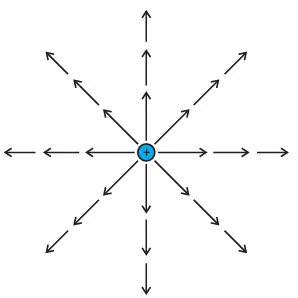
(a) a positive test charge would be attracted towards the source charge.
(b) a positive test charge would move away from the source charge.
(c) the electric field is zero near the charge.
(d) the direction of the field is arbitrary.
Answer: (b) A positive test charge would move away from the source charge.
Q. Refer to Figure. Two equal area elements are placed at points R and S. The density of field lines is greater at R than at S. Therefore,
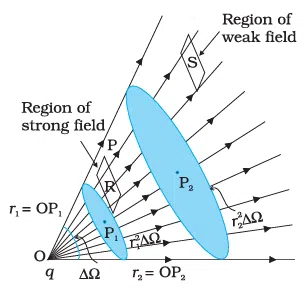
(a) the electric field at R is weaker than at S.
(b) the electric field at S is zero.
(c) the electric field at R is stronger than at S.
(d) the electric field is the same at R and S.
Answer: (c) The electric field at R is stronger than at S.
Q. Refer to Figure. When the angle between the electric field E and the area vector becomes 90°, the electric flux through the surface becomes
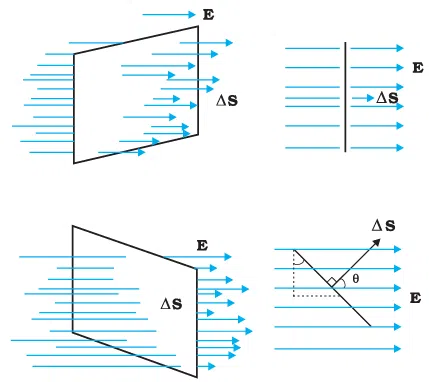
(a) maximum
(b) half of the maximum value
(c) double the maximum value
(d) zero
Answer: (d) Zero
Q. Refer to Figure. For a point located far away on the axis of a dipole, the electric field is directed
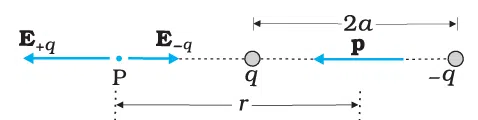
(a) opposite to the dipole moment vector
(b) along the dipole moment vector
(c) perpendicular to the dipole axis
(d) towards the centre of the dipole
Answer: (b) Along the dipole moment vector
Q. Refer to Figure. For a point located far away on the equatorial plane of a dipole, the electric field is directed
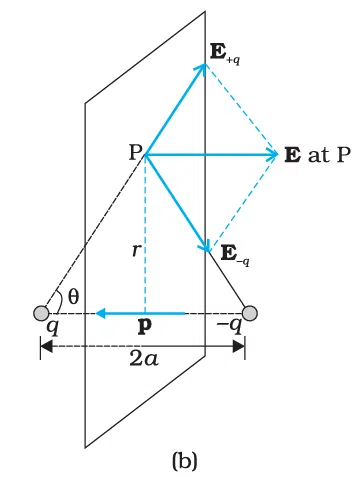
(a) along the dipole moment vector
(b) perpendicular to the dipole axis
(c) opposite to the dipole moment vector
(d) away from both charges
Answer: (c) Opposite to the dipole moment vector
Q. Refer to Figure. A long uniformly charged wire carries charge Q distributed over a length l. The quantity λ = ΔQ/Δl represents
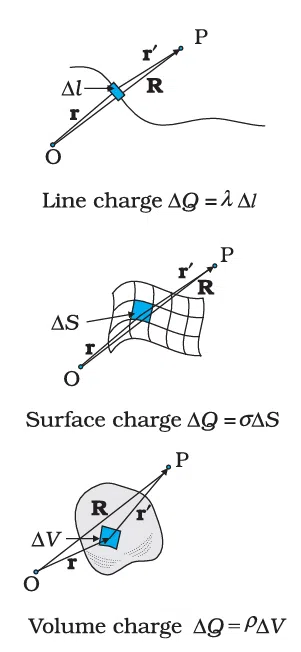
(a) surface charge density
(b) electric flux density
(c) volume charge density
(d) linear charge density
Answer: (d) linear charge density
Q. Refer to Figure. A point charge is placed at the centre of a spherical Gaussian surface. The total electric flux through the sphere depends on
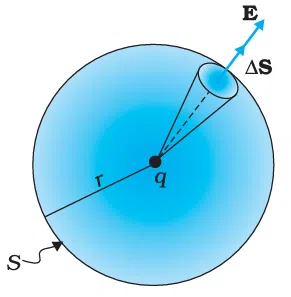
(a) only the charge enclosed
(b) only the radius of the sphere
(c) the area of the sphere
(d) both radius and charge
Answer: (a) only the charge enclosed
Q. Refer to Figure. A closed cylindrical surface is placed in a uniform electric field parallel to its axis. The electric flux through the curved surface is zero because
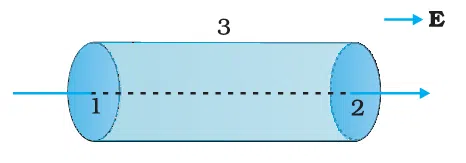
(a) the electric field inside the cylinder is zero
(b) the curved surface encloses no charge
(c) the electric field is perpendicular to the outward normal at every point
(d) the cylinder is symmetrical
Answer: (c) the electric field is perpendicular to the outward normal at every point
Q. A cylindrical Gaussian surface is placed symmetrically about the origin where the electric field points outward from the centre on both sides. The net outward flux through the cylinder is
(a) zero
(b) 1.57 N m²/C
(c) 3.14 N m²/C
(d) 6.28 N m²/C
Answer: (c) 3.14 N m²/C
Q. Refer to Figure. While applying Gauss’s law to an infinitely long uniformly charged wire, the flux through the two circular end faces of the cylindrical Gaussian surface is zero because
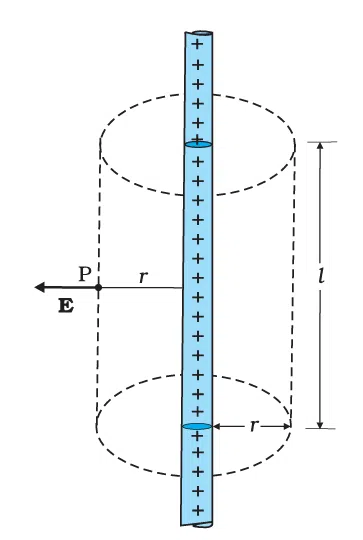
(a) the electric field is zero at the ends.
(b) the enclosed charge is zero.
(c) the electric field is parallel to the surface normals of the end faces.
(d) the electric field is perpendicular to the surface normals of the end faces.
Answer: (d) the electric field is perpendicular to the surface normals of the end faces.
Q. Refer to Figure. While applying Gauss’s law to an infinite plane sheet of charge, only two faces of the Gaussian surface contribute to the electric flux because
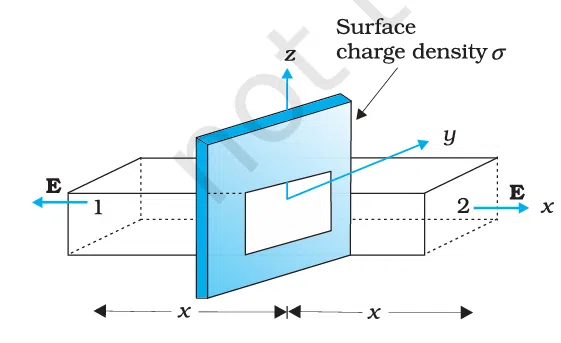
(a) charge is present only on those faces.
(b) electric field lines are parallel to the remaining faces.
(c) electric field is zero on the remaining faces.
(d) the Gaussian surface is open.
Answer: (b) electric field lines are parallel to the remaining faces.
Q. Refer to Figure. A point is located outside a uniformly charged thin spherical shell. The electric field at that point is the same as if
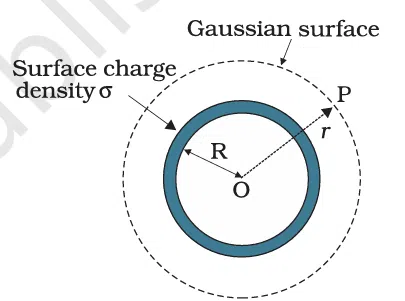
(a) the charge were uniformly distributed throughout the volume.
(b) the entire charge of the shell were concentrated at its centre.
(c) the charge were concentrated on the nearest point of the shell.
(d) the shell carried no charge.
Answer: (b) the entire charge of the shell were concentrated at its centre.
Q. An atom is modeled as a positively charged nucleus surrounded by a uniformly distributed negative charge cloud. For points outside the atom (r > R), the electric field is
(a) proportional to 1/r²
(b) proportional to r
(c) constant
(d) zero
Answer: (d) zero
Q. Refer to Figure. A Gaussian surface of radius r is drawn completely inside a uniformly charged thin spherical shell of radius R. The charge enclosed by the Gaussian surface is
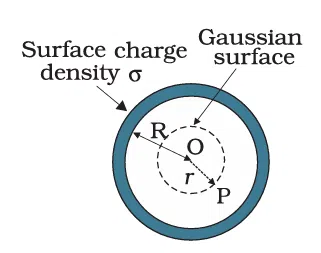
(a) equal to the total charge of the shell.
(b) proportional to r².
(c) zero.
(d) proportional to r³.
Answer: (c) zero.
Disclaimer: The content that is present on our website is based on the NCERT Class 12 Physics textbook and is provided for educational purposes only. All the content and images have been taken from Physics Class 12 NCERT Textbook and CBSE Support material. Images and content shown above are the property of individual organizations and are used here for reference purposes only. To make it easy to understand, some of the content and images are generated by AI and cross-checked by the teachers.