
The Colonial Era in India Class 8 MCQ with Answers provides students with useful multiple-choice questions based on the important events, developments, and changes during the colonial period in India. These questions cover key historical topics and help Class 8 students test their understanding, revise important concepts, and prepare effectively for school examinations.
The Colonial Era in India Class 8 MCQ with Answers
Conceptual Recall
Q. Who arrived at Calicut in 1498, marking the beginning of European colonial expansion in India?
a) Christopher Columbus
b) Vasco da Gama
c) Ferdinand Magellan
d) Bartholomew Diaz
Answer: b) Vasco da Gama
Q. Vasco da Gama arrived at Kappad (near Kozhikode) in which year?
a) 1492
b) 1498
c) 1510
d) 1560
Answer: b) 1498
Q. Which city became the capital of Portuguese India in 1510?
a) Calicut
b) Goa
c) Madras
d) Bombay
Answer: b) Goa
Q. The Dutch East India Company established trading posts in which of the following places?
a) Goa, Calicut, Bombay
b) Surat, Bharuch, Cochin, Nagapattinam, Masulipatnam
c) Pondicherry, Madras, Calcutta
d) Lahore, Delhi, Agra
Answer: b) Surat, Bharuch, Cochin, Nagapattinam, Masulipatnam
Q. Who decisively defeated the Dutch at the Battle of Colachel in 1741?
a) Aurangzeb
b) Dupleix
c) King Marthanda Varma of Travancore
d) Shivaji
Answer: c) King Marthanda Varma of Travancore
Q. Who granted the East India Company its royal charter?
a) Queen Victoria
b) Queen Elizabeth I
c) King George III
d) Queen Mary
Answer: b) Queen Elizabeth I
Q. Which battle in 1757 marked the beginning of British political dominance in India?
a) Battle of Buxar
b) Battle of Panipat
c) Battle of Plassey
d) Battle of Colachel
Answer: c) Battle of Plassey
Q. The Bengal famine of 1770–72 killed nearly:
a) 1 million people
b) 5 million people
c) 10 million people
d) 20 million people
Answer: c) 10 million people
Q. Who described Bengal as “the paradise of the earth”?
a) Robert Clive
b) Lord Lytton
c) Dadabhai Naoroji
d) William Digby
Answer: a) Robert Clive
Q. Which Governor-General observed in 1834 that “the bones of the cotton weavers are bleaching the plains of India”?
a) Robert Clive
b) William Bentinck
c) Charles Metcalfe
d) Lord Lytton
Answer: b) William Bentinck
Q. Who described Indian village communities as “little republics” that survived dynasties and revolutions?
a) Charles Metcalfe
b) Dadabhai Naoroji
c) Thomas Macaulay
d) Romesh Chunder Dutt
Answer: a) Charles Metcalfe
Q. What was the primary purpose of the railway network built in colonial India?
a) To promote tourism
b) To move raw materials to ports and distribute British goods
c) To connect Indian villages for local trade
d) To encourage temple visits
Answer: b) To move raw materials to ports and distribute British goods
Q. Who funded the construction of railways and telegraph networks in India?
a) British taxpayers
b) Indian tax revenue
c) Mughal emperors
d) European traders
Answer: b) Indian tax revenue
Q. Who led the Santhal Rebellion of 1855–56?
a) Nana Saheb and Tantia Tope
b) Sidhu and Kanhu Murmu
c) Mangal Pandey and Bahadur Shah Zafar
d) Rani Abbakka I and II
Answer: b) Sidhu and Kanhu Murmu
Q. Which revolt was directed against European planters forcing peasants to grow indigo?
a) Kol Uprising
b) Indigo Revolt
c) Vellore Mutiny
d) Santhal Rebellion
Answer: b) Indigo Revolt
Q. Who assisted Rani Lakshmibai in her military campaigns during the 1857 rebellion?
a) Nana Saheb
b) Tatia (Tantia) Tope
c) Bahadur Shah Zafar
d) Sidhu Murmu
Answer: b) Tatia (Tantia) Tope
Q. Who issued a counter-proclamation warning Indians not to trust Queen Victoria’s assurances in 1858?
a) Rani Lakshmibai
b) Begum Hazrat Mahal
c) Dadabhai Naoroji
d) William Bentinck
Answer: b) Begum Hazrat Mahal
Application-Based
Q. If European powers had not sought new trade routes, what might have been different?
a) Colonisation would have slowed down.
b) Mughal rule would have ended earlier.
c) Christianity would not exist.
d) India would have remained isolated.
Answer: a) Colonisation would have slowed down.
Q. If the Portuguese had not introduced the cartaz system, what might have been different?
a) Indian ships could freely trade in the Arabian Sea.
b) The Mughal Empire would collapse earlier.
c) Vasco da Gama would not reach India.
d) Hindu temples would not be rebuilt.
Answer: a) Indian ships could freely trade in the Arabian Sea.
Q. Rani Abbakka I’s resistance against the Portuguese shows:
a) Importance of alliances in defending local kingdoms.
b) Dependence on European naval power.
c) Decline of Indian trade networks.
d) Mughal support for Portuguese rule.
Answer: a) Importance of alliances in defending local kingdoms.
Q. If the Dutch had not been defeated at Colachel, what might have happened?
a) They could have maintained stronger control in Kerala.
b) The French would have captured Pondicherry earlier.
c) The Portuguese would have regained Goa.
d) The British would have lost Bengal.
Answer: a) They could have maintained stronger control in Kerala.
Q. Dupleix’s training of Indian soldiers in European techniques shows:
a) Early use of disciplined sepoy armies in India.
b) Decline of Mughal cavalry.
c) End of French trade in India.
d) Portuguese monopoly of spice trade.
Answer: a) Early use of disciplined sepoy armies in India.
Q. If Mir Jafar had not betrayed Siraj-ud-daulah at Plassey, what might have been the outcome?
a) The Nawab of Bengal could have defeated the British.
b) The French would have captured Calcutta.
c) The Doctrine of Lapse would not exist.
d) The Mughal Empire would collapse earlier.
Answer: a) The Nawab of Bengal could have defeated the British.
Q. The Doctrine of Lapse disregarded which Indian tradition?
a) Worship of Jagannath
b) Adoption as a means of succession
c) Use of Persian in diplomacy
d) Guerrilla warfare
Answer: b) Adoption as a means of succession
Q. If the British had controlled food prices during the Great Famine (1876–78), what might have been different?
a) Fewer deaths due to starvation.
b) More temples destroyed.
c) Mughal Empire revival.
d) End of railways in India.
Answer: a) Fewer deaths due to starvation.
Q. The export of one million tonnes of rice during famine shows:
a) British prioritised profit over Indian lives.
b) Farmers were given relief.
c) India had surplus food.
d) Famines were natural disasters only.
Answer: a) British prioritised profit over Indian lives.
Q. If Britain had not imposed heavy duties on Indian textiles, what might have been different?
a) India’s textile industry could have continued flourishing.
b) Mughal rule would have revived.
c) Farmers would stop agriculture.
d) English education would not spread.
Answer: a) India’s textile industry could have continued flourishing.
Q. Macaulay’s Minute on Education aimed to:
a) Create Indians “English in taste, opinions, morals, and intellect.”
b) Revive Sanskrit and Arabic learning.
c) Promote village schools.
d) Encourage traditional crafts.
Answer: a) Create Indians “English in taste, opinions, morals, and intellect.”
Q. If the railways had been designed to follow India’s existing trade patterns, what might have been different?
a) Indian industries could have benefited more.
b) British goods would not reach villages.
c) Mughal rule would revive.
d) Famines would not occur.
Answer: a) Indian industries could have benefited more.
Q. The phrase “jewel in the crown of the British Empire” shows:
a) India’s immense value to Britain in wealth and resources.
b) India’s independence from Britain.
c) Decline of Indian agriculture.
d) Mughal dominance in Bengal.
Answer: a) India’s immense value to Britain in wealth and resources.
Q. If the British had not restricted tribal access to forests, what might have been different?
a) Tribal communities could have continued their traditional way of life.
b) Indigo planters would have lost profits.
c) Sepoys would not rebel in 1857.
d) Mughal rule would revive.
Answer: a) Tribal communities could have continued their traditional way of life.
Q. Why did peasants in Bengal refuse to grow indigo?
a) It was sacred to Hindus.
b) They were poorly paid and trapped in debt slavery.
c) Indigo destroyed soil fertility.
d) Indigo was banned by the Mughal emperor.
Answer: b) They were poorly paid and trapped in debt slavery.
Q. If cultural artefacts had not been stolen and sent to Europe, what might have been different?
a) India would have retained more of its heritage.
b) European museums would lack Indian art.
c) Indian culture might have been less appreciated abroad.
d) All of the above.
Answer: d) All of the above
Q. The British documentation of India’s monuments and ethnic groups shows:
a) A mix of genuine scholarship and colonial motives.
b) Complete respect for Indian traditions.
c) Decline of archaeology in India.
d) Mughal revival.
Answer: a) A mix of genuine scholarship and colonial motives.
Assertion–Reason
Q. Assertion (A): Colonisers claimed they had a “civilising mission.”
Reason (R): They wanted to genuinely improve the lives of colonised people.
a) Both A and R are true, and R is the correct explanation of A.
b) Both A and R are true, but R is not the correct explanation of A.
c) A is true, but R is false.
d) A is false, but R is true.
Answer: c) A is true, but R is false.
Q. Assertion (A): The Portuguese monopolised the spice trade for nearly a century.
Reason (R): They used naval dominance and the cartaz system to control ships in the Arabian Sea.
a) Both A and R are true, and R is the correct explanation of A.
b) Both A and R are true, but R is not the correct explanation of A.
c) A is true, but R is false.
d) A is false, but R is true.
Answer: a) Both A and R are true, and R is the correct explanation of A.
Q. Assertion (A): The French colonial ambitions were checked during the Carnatic Wars.
Reason (R): The British defeated the French and reduced their territory to Pondicherry and a few enclaves.
a) Both A and R are true, and R is the correct explanation of A.
b) Both A and R are true, but R is not the correct explanation of A.
c) A is true, but R is false.
d) A is false, but R is true.
Answer: a) Both A and R are true, and R is the correct explanation of A.
Q. Assertion (A): The subsidiary alliance system appeared to preserve the sovereignty of princely states.
Reason (R): In reality, it transferred real power to the British while burdening rulers with the costs of their own subjugation.
a) Both A and R are true, and R is the correct explanation of A.
b) Both A and R are true, but R is not the correct explanation of A.
c) A is true, but R is false.
d) A is false, but R is true.
Answer: a) Both A and R are true, and R is the correct explanation of A.
Q. Assertion (A): Lord Lytton refused to interfere with food prices during the Great Famine.
Reason (R): He believed in the British policy of “free market.”
a) Both A and R are true, and R is the correct explanation of A.
b) Both A and R are true, but R is not the correct explanation of A.
c) A is true, but R is false.
d) A is false, but R is true.
Answer: a) Both A and R are true, and R is the correct explanation of A.
Q. Assertion (A): English education created a class of Indians who staffed colonial administration.
Reason (R): It was cheaper to employ Indians than British officials.
a) Both A and R are true, and R is the correct explanation of A.
b) Both A and R are true, but R is not the correct explanation of A.
c) A is true, but R is false.
d) A is false, but R is true.
Answer: a) Both A and R are true, and R is the correct explanation of A.
Q. Assertion (A): Indians funded their own subjugation under British rule.
Reason (R): Indian tax revenue was used to finance colonial administration, military, and officials’ lifestyles.
a) Both A and R are true, and R is the correct explanation of A.
b) Both A and R are true, but R is not the correct explanation of A.
c) A is true, but R is false.
d) A is false, but R is true.
Answer: a) Both A and R are true, and R is the correct explanation of A.
Q. Assertion (A): The Great Rebellion of 1857 began with sepoy discontent.
Reason (R): Rumours spread that rifle cartridges were greased with cow and pig fat, offending both Hindu and Muslim sepoys.
a) Both A and R are true, and R is the correct explanation of A.
b) Both A and R are true, but R is not the correct explanation of A.
c) A is true, but R is false.
d) A is false, but R is true.
Answer: a) Both A and R are true, and R is the correct explanation of A.
Q. Assertion (A): The spread of Sanskrit studies in Europe influenced philosophers and writers.
Reason (R): European scholars saw Indian texts as a “discovery of a new continent.”
a) Both A and R are true, and R is the correct explanation of A.
b) Both A and R are true, but R is not the correct explanation of A.
c) A is true, but R is false.
d) A is false, but R is true.
Answer: a) Both A and R are true, and R is the correct explanation of A.
Case Study
Q. Read the passage:
“Colonialism brought rapid growth of economies and technologies, but the benefits were mostly for the colonisers, while colonised people suffered hardships.”
a) What does this show about colonialism?
i) It was equally beneficial for all.
ii) It exploited colonised regions.
iii) It ended slavery.
iv) It promoted democracy.
Answer: ii) It exploited colonised regions.
Q. Read the passage:
“In Goa, the Portuguese established the Inquisition in 1560, which persecuted Hindus, Muslims, Jews, and Christian converts suspected of practising their original faith. It was abolished only in 1812.”
a) What does this show about Portuguese rule?
i) It was marked by religious persecution.
ii) It promoted cultural harmony.
iii) It ended slavery in India.
iv) It encouraged temple building.
Answer: i) It was marked by religious persecution.
b) When was the Goa Inquisition abolished?
i) 1560
ii) 1600
iii) 1812
iv) 1857
Answer: iii) 1812
Q. Read the passage:
“Dupleix, Governor-General of French India (1742–1754), pioneered strategies like indirect rule through puppet rulers and training sepoys. Despite initial successes, the French lost ground to the British during the Carnatic Wars.”
a) What does this passage highlight about Dupleix?
i) He introduced strategies later adopted by the British.
ii) He avoided military involvement.
iii) He focused only on trade.
iv) He rebuilt temples in Pondicherry.
Answer: i) He introduced strategies later adopted by the British.
b) Which war checked French ambitions in India?
i) Battle of Plassey
ii) Carnatic Wars
iii) Battle of Colachel
iv) Anglo–Maratha Wars
Answer: ii) Carnatic Wars
Q. Read the passage:
“In 1757, Robert Clive conspired with Mir Jafar, leading to the British victory at Plassey. This marked the transformation of the East India Company from traders to rulers.”
a) Who was the Nawab of Bengal during the Battle of Plassey?
i) Mir Jafar
ii) Siraj-ud-daulah
iii) Aurangzeb
iv) Shah Alam II
Answer: ii) Siraj-ud-daulah
b) What does this incident show about British strategy?
i) Use of divide-and-rule and political manipulation
ii) Dependence only on military strength
iii) Focus on cultural revival
iv) Avoidance of Indian politics
Answer: i) Use of divide-and-rule and political manipulation
Q. Read the passage:
“Dadabhai Naoroji, in his book Poverty and Un-British Rule in India (1901), compiled evidence of wealth drained from India. Later, Romesh Chunder Dutt and modern economist Utsa Patnaik estimated trillions of dollars were extracted from India.”
a) What does this passage highlight?
i) Economic exploitation under colonial rule
ii) British investment in Indian industries
iii) Mughal decline in Bengal
iv) Indian surplus wealth
Answer: i) Economic exploitation under colonial rule
b) According to Utsa Patnaik, how much wealth was drained from India between 1765–1938 (in today’s value)?
i) 45 billion USD
ii) 450 billion USD
iii) 45 trillion USD
iv) 4.5 trillion USD
Answer: iii) 45 trillion USD
Q. Read the passage:
“In 1835, Thomas Macaulay argued that a single shelf of a good European library was worth the whole native literature of India and Arabia. His policy led to the decline of traditional schools and the rise of English-educated elites.”
a) What does this passage show about Macaulay’s views?
i) He believed European knowledge was superior.
ii) He promoted Indian village schools.
iii) He supported Persian literature.
iv) He revived Sanskrit learning.
Answer: i) He believed European knowledge was superior.
b) What was the long-term impact of Macaulay’s policy?
i) Division between English-educated elites and the masses.
ii) Revival of Indian crafts.
iii) End of British rule.
iv) Expansion of Mughal power.
Answer: i) Division between English-educated elites and the masses.
Q. Read the passage:
“After the famine of 1770, groups of sannyasis and fakirs attacked British treasuries and tax collectors. The British called them bandits and eventually defeated them. This rebellion later inspired Bankim Chandra Chattopadhyay’s novel Anandamath, which contained the song ‘Vande Mātaram’.”
a) What inspired the Sannyasi-Fakir rebellion?
i) Harsh British taxation policies after famine
ii) Mughal expansion in Bengal
iii) Portuguese naval dominance
iv) Decline of village schools
Answer: i) Harsh British taxation policies after famine
b) Which novel was inspired by this rebellion?
i) Devendra Kuravanji
ii) Anandamath
iii) Poverty and Un-British Rule
iv) Economic History of India
Answer: ii) Anandamath
c) Which song from Anandamath became India’s national song?
i) Jana Gana Mana
ii) Vande Mātaram
iii) Sare Jahan Se Achha
iv) Raghupati Raghav Raja Ram
Answer: ii) Vande Mātaram
Q. Read the passage:
“In 1857, sepoys in Meerut killed their British officers and marched to Delhi, proclaiming Bahadur Shah Zafar as their leader. The revolt spread across northern and central India, capturing Kanpur, Lucknow, and Jhansi. The British response was brutal, with mass executions and destruction of villages.”
a) Who was proclaimed leader by the sepoys in Delhi?
i) Nana Saheb
ii) Bahadur Shah Zafar
iii) Tantia Tope
iv) Rani Lakshmibai
Answer: ii) Bahadur Shah Zafar
b) What does this passage show about the rebellion?
i) It spread widely across northern and central India.
ii) It was limited to Bengal only.
iii) It was peaceful and non-violent.
iv) It was supported by the British.
Answer: i) It spread widely across northern and central India.
Q. Read the passage:
“In 1785, Charles Wilkins published the first English translation of the Bhagavad Gītā. This spread Indian philosophy to Europe and later the United States, influencing thinkers and artists.”
a) Which text was translated by Charles Wilkins?
i) Rigveda
ii) Bhagavad Gītā
iii) Upanishads
iv) Ramayana
Answer: ii) Bhagavad Gītā
b) What does this translation signify?
i) Cultural influence flowing from India to Europe
ii) Decline of Sanskrit studies
iii) Mughal expansion
iv) British military dominance
Answer: i) Cultural influence flowing from India to Europe
Diagram/Visual-Based
Q. Refer to Figure (cartoon of British magnate straddling Africa with telegraph wire). What does the telegraph wire symbolise?
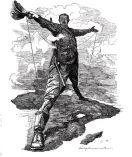
a) Spread of instant communication aiding colonial control
b) Decline of European trade
c) Resistance movements in Africa
d) Religious conversion
Answer: a) Spread of instant communication aiding colonial control
Q. Refer to Figure (plaque in Kozhikode). What does this plaque commemorate?

a) Arrival of Vasco da Gama in 1498
b) Coronation of Shivaji in 1674
c) Battle of Panipat in 1761
d) Treaty of Purandar in 1665
Answer: a) Arrival of Vasco da Gama in 1498
Q. Refer to Figure (Clive leading troops at Plassey). What does this painting symbolise?
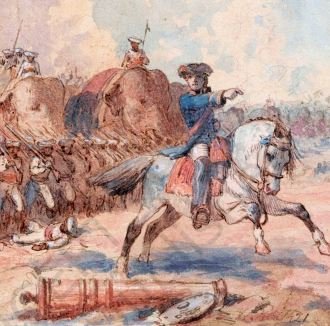
a) British victory through betrayal and manipulation
b) French dominance in Bengal
c) Mughal expansion in the Deccan
d) Portuguese monopoly of spice trade
Answer: a) British victory through betrayal and manipulation
Q. Refer to Figure (grain bags on Madras beach during famine). What does this image symbolise?
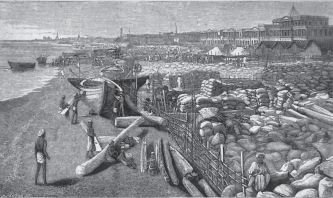
a) Export of grain while Indians starved
b) Relief distribution to famine victims
c) Arrival of Vasco da Gama
d) Construction of famine relief camps
Answer: a) Export of grain while Indians starved
Q. Refer to Figure (“The East offering its riches to Britannia”). What does Britannia’s higher position in the painting symbolise?
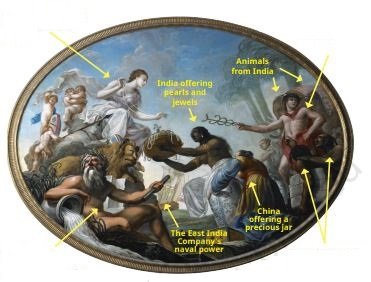
a) Superiority of Britain over colonies
b) Equality between Britain and India
c) Decline of European trade
d) Mughal dominance in Bengal
Answer: a) Superiority of Britain over colonies
Q. Refer to Figure (map of British Indian Empire, 1909). What do the black lines represent?
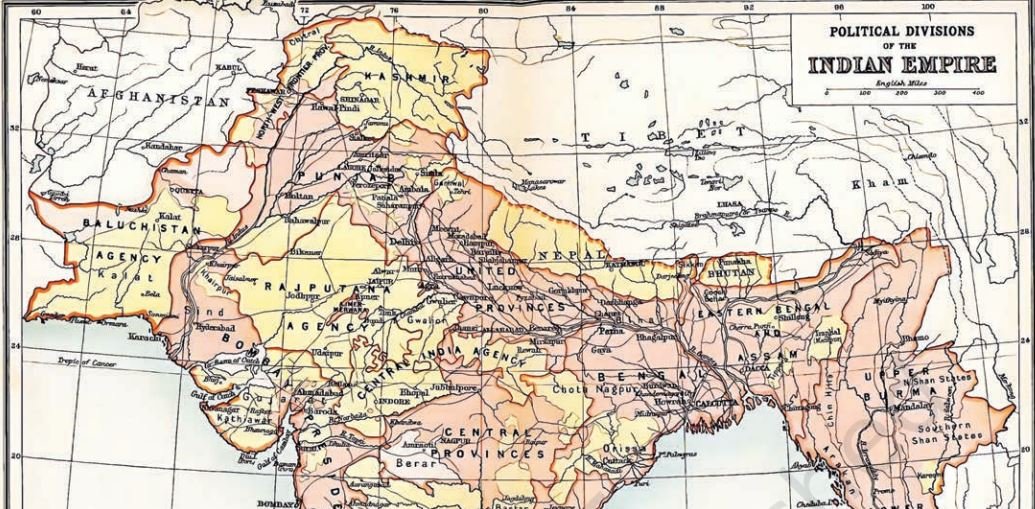
a) Boundaries of princely states
b) Railway lines built under British rule
c) Rivers of India
d) Trade routes of Mughal Empire
Answer: b) Railway lines built under British rule
Q. Refer to Figure (sketch of Santhal rebels vs sepoys). What does this image symbolise?
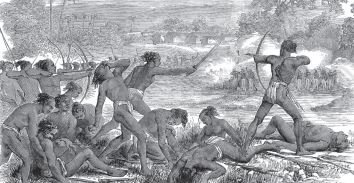
a) Unequal confrontation between tribal rebels and British forces
b) Victory of Santhals over sepoys
c) Indigo planters’ defeat
d) Mughal expansion in Bengal
Answer: a) Unequal confrontation between tribal rebels and British forces
Q. Refer to Figure (portrait of Rani Lakshmibai). What does this image symbolise?
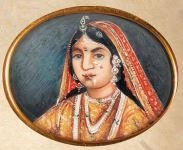
a) Her bravery and leadership in resisting British annexation
b) Her alliance with Queen Victoria
c) Her role in rebuilding temples
d) Her contribution to Sanskrit translations
Answer: a) Her bravery and leadership in resisting British annexation
Disclaimer: The content that is present on our website is based on the NCERT Class 8 Social Science textbook and is provided for educational purposes only. All the content and images have been taken from Socail Science Class 8 NCERT Textbook. Images and content shown above are the property of individual organizations and are used here for reference purposes only. To make it easy to understand, some of the content and images are generated by AI and cross-checked by the teachers.