
The Rise of Marathas Class 8 MCQ with Answers helps students revise the important events, personalities, administration, and contributions related to the rise of the Marathas. These multiple-choice questions are based on the Class 8 Social Science syllabus and are useful for quick revision, practice, and exam preparation. Each MCQ includes the correct answer to help students check their understanding.
The Rise of Marathas Class 8 MCQ with Answers
Conceptual Recall
Q. The Marathas are native to which region of India?
a) Deccan Plateau
b) Indo‑Gangetic Plain
c) Malabar Coast
d) Thar Desert
Answer: a) Deccan Plateau
Q. Who among the following saints translated the Bhagavad Gita into Marathi?
a) Sant Tukaram
b) Sant Dnyaneshwar
c) Sant Ramdas
d) Sant Namdev
Answer: b) Sant Dnyaneshwar
Q. In which year was Chhatrapati Shivaji born?
a) 1627
b) 1630
c) 1646
d) 1657
Answer: b) 1630
Q. Who was Afzal Khan?
a) Mughal nobleman
b) Bijapur general
c) Rajput ruler
d) Portuguese trader
Answer: b) Bijapur general
Q. Who succeeded Chhatrapati Shivaji as ruler?
a) Rajaram
b) Sambhaji
c) Tarabai
d) Shahu
Answer: b) Sambhaji
Q. Which Mughal emperor failed to subdue the Marathas despite long campaigns in the Deccan?
a) Akbar
b) Jahangir
c) Aurangzeb
d) Shah Jahan
Answer: c) Aurangzeb
Q. What was the aṣhṭa pradhāna manḍala?
a) Council of eight ministers assisting Shivaji
b) Eight forts built by Shivaji
c) Eight naval ships of the Marathas
d) Eight provinces under Maratha rule
Answer: a) Council of eight ministers assisting Shivaji
Q. Which tax was 25% of revenue collected from provinces not directly under Maratha rule?
a) Sardeshmukhi
b) Chauth
c) Jizya
d) Lagaan
Answer: b) Chauth
Q. What was the main local body delivering justice in the Maratha judicial system?
a) Kotwāl
b) Panchāyat
c) Nyāyādhīsh
d) Peshwa
Answer: b) Panchāyat
Q. Who rebuilt the Kashi Vishwanath temple in Varanasi?
a) Tarabai
b) Ahilyabai Holkar
c) Jijabai
d) Nana Phadnavis
Answer: b) Ahilyabai Holkar
Q. Who conquered the Thanjavur region in the late 17th century?
a) Sambhaji
b) Rajaram
c) Ekoji
d) Tarabai
Answer: c) Ekoji
Q. Which Maratha ruler established the Dhanwantari Mahal, a centre for medicine?
a) Shivaji
b) Shahu Maharaj
c) Serfoji II
d) Mahadji Shinde
Answer: c) Serfoji II
Application-Based
Q. If Chhatrapati Shivaji had not escaped from Agra in 1666, what could have been the possible impact on Maratha power?
a) Marathas would have immediately defeated the Mughals.
b) Maratha expansion might have slowed down.
c) Marathas would have shifted their capital to Delhi.
d) Bhakti saints would have stopped writing poetry.
Answer: b) Maratha expansion might have slowed down.
Q. The founding of the Maratha navy in 1657 shows:
a) Importance of sea trade and coastal defense.
b) Decline of Mughal power in Delhi.
c) Spread of Bhakti movement in Maharashtra.
d) End of Yadava dynasty rule.
Answer: a) Importance of sea trade and coastal defense.
Q. Shivaji used guerrilla warfare against larger armies. If you were a Mughal commander facing this tactic, which geographical feature would be most dangerous for you?
a) Open plains
b) Thick forests and mountains
c) Desert regions
d) Coastal ports
Answer: b) Thick forests and mountains
Q. The sacking of Surat by Shivaji showed:
a) His disregard for religion
b) His ability to strike at Mughal prestige
c) His alliance with the Dutch
d) His defeat at Purandar
Answer: b) His ability to strike at Mughal prestige
Q. If Rajaram had not fled to Gingee, what might have been the impact?
a) Mughal–Maratha conflict would not spread to South India.
b) Aurangzeb would have abandoned the Deccan.
c) The Marathas would have allied with the British earlier.
d) Tarabai would not have ruled.
Answer: a) Mughal–Maratha conflict would not spread to South India.
Q. The rise of the Peshwas shows:
a) Decline of Mughal power.
b) Shift from centralised to decentralised Maratha administration.
c) End of Maratha expansion.
d) Beginning of British rule.
Answer: b) Shift from centralised to decentralised Maratha administration.
Q. Shivaji abolished hereditary posts and paid salaries directly from the treasury. What was the main benefit of this system?
a) It reduced corruption and prevented officials from becoming too powerful.
b) It increased the number of forts.
c) It allowed the Mughals to control Maratha officials.
d) It stopped the collection of taxes.
Answer: a) It reduced corruption and prevented officials from becoming too powerful.
Q. Why did Shivaji issue instructions not to cut mango and jackfruit trees?
a) They were sacred trees.
b) They took years to mature and were cared for by people like their children.
c) They were useless for naval construction.
d) They were reserved for Mughal officials.
Answer: b) They took years to mature and were cared for by people like their children.
Q. If Shivaji had not promoted the Marathi language through Rājya-Vyavahāra-Koṣha, what might have been the result?
a) Persian words would continue to dominate Maratha diplomacy.
b) Sanskrit would have replaced Marathi completely.
c) Trade networks would collapse.
d) Women leaders would not emerge.
Answer: a) Persian words would continue to dominate Maratha diplomacy.
Q. Ahilyabai Holkar’s rebuilding of temples across India shows:
a) Her devotion and cultural revival efforts.
b) Her alliance with Aurangzeb.
c) Her focus only on military expansion.
d) Her opposition to weaving industries.
Answer: a) Her devotion and cultural revival efforts.
Q. If Serfoji II had not started a printing press, what might have been the impact?
a) India’s first native press would not exist.
b) Carnatic music would not develop.
c) The Marathas would lose Thanjavur.
d) The Mughal Empire would expand.
Answer: a) India’s first native press would not exist.
Q. The Thanjavur Marathas’ patronage of arts shows:
a) Their role in creating a syncretic culture.
b) Their focus only on military expansion.
c) Their alliance with Aurangzeb.
d) Their decline in administration.
Answer: a) Their role in creating a syncretic culture.
Assertion–Reason
Q. Assertion (A): The Bhakti saints helped strengthen the cultural foundation of Maharashtra.
Reason (R): They composed devotional songs in local languages, making spiritual ideas accessible to common people.
a) Both A and R are true, and R is the correct explanation of A.
b) Both A and R are true, but R is not the correct explanation of A.
c) A is true, but R is false.
d) A is false, but R is true.
Answer: a) Both A and R are true, and R is the correct explanation of A.
Q. Assertion (A): Shivaji established a navy to secure coastal resources.
Reason (R): Neither the Bijapur Sultanate nor the Mughal Empire had a strong naval force.
a) Both A and R are true, and R is the correct explanation of A.
b) Both A and R are true, but R is not the correct explanation of A.
c) A is true, but R is false.
d) A is false, but R is true.
Answer: a) Both A and R are true, and R is the correct explanation of A.
Q. Assertion (A): The Marathas briefly controlled Lahore, Attock, and Peshawar.
Reason (R): Their northward expansion brought them into conflict with the Afghans.
a) Both A and R are true, and R is the correct explanation of A.
b) Both A and R are true, but R is not the correct explanation of A.
c) A is true, but R is false.
d) A is false, but R is true.
Answer: a) Both A and R are true, and R is the correct explanation of A.
Q. Assertion (A): Shivaji gave pensions to widows of soldiers and offered military posts to their sons.
Reason (R): He wanted to ensure loyalty and welfare of soldiers’ families.
a) Both A and R are true, and R is the correct explanation of A.
b) Both A and R are true, but R is not the correct explanation of A.
c) A is true, but R is false.
d) A is false, but R is true.
Answer: a) Both A and R are true, and R is the correct explanation of A.
Q. Assertion (A): Tarabai organised large Maratha armies to invade Mughal territories in the north.
Reason (R): She realised that Aurangzeb’s presence in the Deccan left north India unprotected.
a) Both A and R are true, and R is the correct explanation of A.
b) Both A and R are true, but R is not the correct explanation of A.
c) A is true, but R is false.
d) A is false, but R is true.
Answer: a) Both A and R are true, and R is the correct explanation of A.
Q. Assertion (A): Serfoji II contributed to the development of Carnatic music and Bharatanatyam.
Reason (R): He patronised musicians and promoted cultural innovation in Thanjavur.
a) Both A and R are true, and R is the correct explanation of A.
b) Both A and R are true, but R is not the correct explanation of A.
c) A is true, but R is false.
d) A is false, but R is true.
Answer: a) Both A and R are true, and R is the correct explanation of A.
Case Study
Q. Read the following passage and answer:
“In 1761, the Marathas faced a major defeat in the Battle of Panipat against Ahmad Shah Abdali. Despite this setback, they regained control over Delhi in 1775 and fought three Anglo‑Maratha wars against the British. By 1818, however, the Maratha power came to an end.”
a) Which battle marked the decline of Maratha supremacy?
i) Battle of Panipat
ii) Battle of Plassey
iii) Battle of Buxar
iv) Battle of Talikota
Answer: i) Battle of Panipat
b) The end of Maratha power came after which war?
i) First Anglo‑Maratha War
ii) Second Anglo‑Maratha War
iii) Third Anglo‑Maratha War
iv) Mughal‑Maratha War
Answer: iii) Third Anglo‑Maratha War
c) What does this case study show about the Marathas?
i) They were strong but faced repeated challenges.
ii) They never fought against the British.
iii) They only focused on Bhakti literature.
iv) They ruled peacefully without wars.
Answer: i) They were strong but faced repeated challenges.
Q. Read the passage:
“In 1666, Shivaji was imprisoned at Agra by Aurangzeb. He escaped by hiding in baskets of fruits and sweets along with his son Sambhaji. Aurangzeb could never capture him again.”
a) Which Mughal emperor imprisoned Shivaji?
i) Akbar
ii) Jahangir
iii) Aurangzeb
iv) Shah Jahan
Answer: iii) Aurangzeb
b) What does this incident show about Shivaji?
i) His bravery and clever strategy
ii) His dependence on foreign powers
iii) His lack of planning
iv) His defeat in battle
Answer: i) His bravery and clever strategy
Q. Read the passage:
“In 1761, the Marathas suffered a disastrous defeat at Panipat. Yet under Peshwa Madhavrao I and Mahadji Shinde, they recovered and recaptured Delhi in 1771. Delhi remained under their control until the British captured it three decades later.”
a) Which battle marked a major setback for the Marathas?
i) Battle of Talikota
ii) Battle of Panipat
iii) Battle of Plassey
iv) Battle of Buxar
Answer: ii) Battle of Panipat
b) Who recaptured Delhi for the Marathas in 1771?
i) Tarabai
ii) Sambhaji
iii) Mahadji Shinde
iv) Nana Phadnavis
Answer: iii) Mahadji Shinde
c) What does this case show about the Marathas?
i) They quickly recovered from defeats.
ii) They never fought the British.
iii) They only ruled Maharashtra.
iv) They abandoned Delhi permanently.
Answer: i) They quickly recovered from defeats.
Q. Read the passage:
“Kanhoji Angre guided the Marathas to victory in many naval battles despite their ships being less advanced than European ones. Europeans forced Indians to buy trade passes (cartaz), but the Marathas challenged this practice and demanded passes from Europeans themselves.”
a) Who was Kanhoji Angre?
i) Mughal general
ii) Maratha naval commander
iii) Portuguese trader
iv) Rajput ruler
Answer: ii) Maratha naval commander
b) What does this case show about Maratha naval policy?
i) They accepted European dominance.
ii) They challenged European control over trade.
iii) They avoided naval battles.
iv) They relied only on forts.
Answer: ii) They challenged European control over trade.
Q. Read the passage:
“Shivaji’s seal carried a Sanskrit inscription: ‘This seal of Chhatrapati Shivaji, the son of Shahji, waxing like the new moon, revered by the world, reigns for the welfare of the people.’”
a) What does the use of Sanskrit in Shivaji’s seal signify?
i) Cultural revival and assertion of identity
ii) Dependence on Persian diplomacy
iii) Decline of Maratha power
iv) Alliance with Europeans
Answer: i) Cultural revival and assertion of identity
b) What value of Shivaji is reflected in the phrase “reigns for the welfare of the people”?
i) His concern for subjects
ii) His focus only on military power
iii) His disregard for culture
iv) His alliance with the Mughals
Answer: i) His concern for subjects
Q. Read the passage:
“Serfoji II inscribed the history of the Bhonsle family on the walls of the Brihadishwara temple at Thanjavur, one of the largest single inscriptions in India.”
a) What does this inscription signify?
i) Preservation of history for posterity
ii) Decline of Maratha culture
iii) Mughal dominance in Thanjavur
iv) European naval supremacy
Answer: i) Preservation of history for posterity
b) Which temple wall carries this inscription?
i) Somnath temple
ii) Brihadishwara temple
iii) Kashi Vishwanath temple
iv) Jagannath temple
Answer: ii) Brihadishwara temple
Diagram/Visual-Based
Q. Refer to the timeline below:
| 1630 | Birth of Chhatrapati Shivaji |
| 1646 | Beginning of Shivaji’s rule |
| 1657 | Founding of Maratha navy |
| 1674 | Shivaji’s coronation at Raigad |
| 1680 | Death of Shivaji |
Which event shows the formal recognition of Shivaji as king?
a) 1630 – Birth of Shivaji
b) 1646 – Beginning of rule
c) 1657 – Founding of navy
d) 1674 – Coronation at Raigad
Answer: d) 1674 – Coronation at Raigad
Q. Refer to the map of Shivaji’s kingdom. Which southern region did Shivaji conquer during his dakṣiṇa-digvijaya?
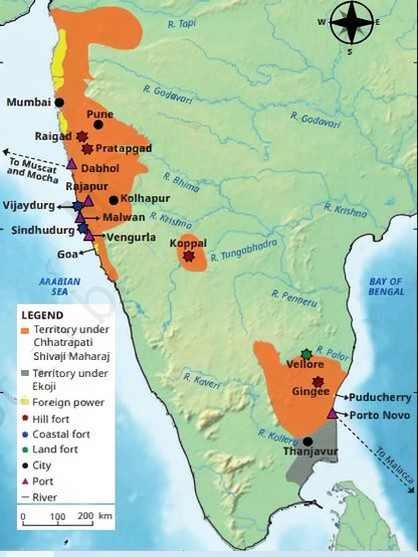
a) Punjab
b) Northern Tamil Nadu and parts of Karnataka
c) Gujarat
d) Bengal
Answer: b) Northern Tamil Nadu and parts of Karnataka
Q. Refer to Figure (mural of British officer surrendering). What does this image symbolise?
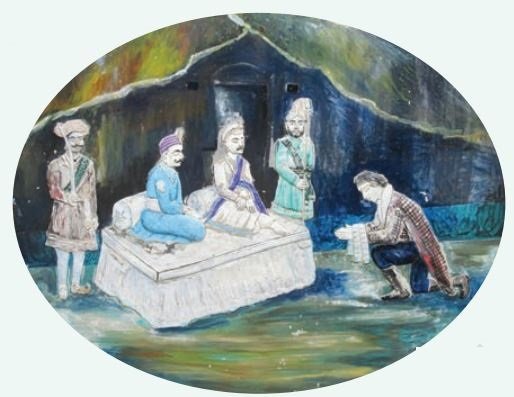
a) Mughal victory over Marathas
b) Maratha success in the First Anglo–Maratha War
c) Rajaram’s flight to Gingee
d) Aurangzeb’s defeat in the Deccan
Answer: b) Maratha success in the First Anglo–Maratha War
Q. In the Maratha Kingdom. Who was responsible for land revenue?
a) Amatya
b) Sachiv
c) Nyayadhish
d) Sumant
Answer: b) Sachiv
Q. Refer to Figure (postage stamp of Ahilyabai Holkar). What does this stamp commemorate?
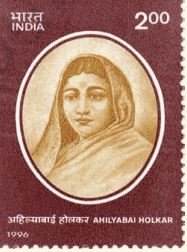
a) Her role in the Anglo–Maratha wars
b) Her rebuilding of temples and cultural contributions
c) Her alliance with Tarabai
d) Her naval victories against Europeans
Answer: b) Her rebuilding of temples and cultural contributions
Q. Refer to Figure (Thanjavur painting). What is the unique feature of this art style?
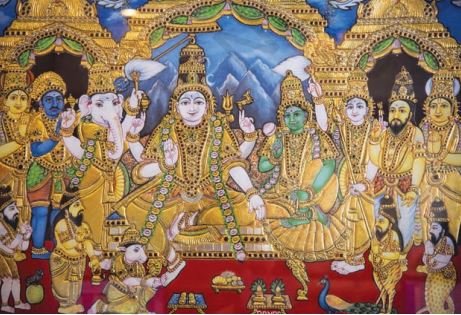
a) Use of stone carvings
b) Delicate gold foil work giving radiant appearance
c) Persian calligraphy
d) European oil painting technique
Answer: b) Delicate gold foil work giving radiant appearance
Disclaimer: The content that is present on our website is based on the NCERT Class 8 Social Science textbook and is provided for educational purposes only. All the content and images have been taken from Socail Science Class 8 NCERT Textbook. Images and content shown above are the property of individual organizations and are used here for reference purposes only. To make it easy to understand, some of the content and images are generated by AI and cross-checked by the teachers.