
← Back to Class 10 Study Material
Chemical Reactions and Equations Class 10 MCQ covers important concepts from the chapter, including types of chemical reactions, balancing chemical equations, oxidation and reduction, corrosion, and rancidity. These multiple-choice questions are useful for CBSE Class 10 exam preparation and quick revision.
Chemical Reactions and Equations Class 10 MCQ
Conceptual Recall
Q. Which of the following is not an indicator of a chemical reaction?
a) Change in state
b) Change in colour
c) Evolution of a gas
d) Dissolving salt in water
Answer: d) Dissolving salt in water
Q. Which law is followed while balancing a chemical equation?
a) Law of constant proportion
b) Law of conservation of mass
c) Law of multiple proportion
d) Law of definite proportion
Answer: b) Law of conservation of mass
Q. Which of the following is a combination reaction?
a) CaO + H₂O → Ca(OH)₂
b) Zn + H₂SO₄ → ZnSO₄ + H₂
c) 2KClO₃ → 2KCl + 3O₂
d) AgNO₃ + NaCl → AgCl + NaNO₃
Answer: a) CaO + H₂O → Ca(OH)₂
Q. Which of the following is a decomposition reaction?
a) CaO + H₂O → Ca(OH)₂
b) 2AgCl → 2Ag + Cl₂
c) CH₄ + 2O₂ → CO₂ + 2H₂O
d) H₂ + Cl₂ → 2HCl
Answer: b) 2AgCl → 2Ag + Cl₂
Q. In the reaction: Fe + CuSO₄ → FeSO₄ + Cu
Iron displaces copper because:
a) Iron is less reactive than copper
b) Iron is more reactive than copper
c) Copper is more reactive than iron
d) Both are equally reactive
Answer: b) Iron is more reactive than copper
Q. The reddish-brown coating on iron articles is called:
a) Tarnish
b) Rust
c) Patina
d) Scale
Answer: b) Rust
Application-Based
Q. A student burns a magnesium ribbon in air. Which observation correctly explains the reaction?
a) Magnesium ribbon turns black
b) A dazzling white flame is seen and white powder forms
c) A colourless gas is released
d) Temperature of ribbon decreases
Answer: b) A dazzling white flame is seen and white powder forms
Q. The skeletal equation for burning magnesium is: Mg + O₂ → MgO
Which is the correct balanced equation?
a) Mg + O₂ → MgO₂
b) 2Mg + O₂ → 2MgO
c) Mg + O₂ → 2MgO
d) 2Mg + O → Mg₂O
Answer: b) 2Mg + O₂ → 2MgO
Q. Whitewashing walls involves formation of a thin shiny layer after 2–3 days. Which compound is responsible for this shiny finish?
a) Ca(OH)₂
b) CaO
c) CaCO₃
d) CO₂
Answer: c) CaCO₃
Q. When ferrous sulphate crystals are heated, they lose water and turn from green to brown. Which products are formed?
a) Fe₂O₃, SO₂, SO₃
b) FeO, SO₂, O₂
c) Fe₂O₃, H₂O, CO₂
d) FeSO₄, SO₂, SO₃
Answer: a) Fe₂O₃, SO₂, SO₃
Q. When sodium sulphate solution is mixed with barium chloride solution, a white precipitate is formed. The precipitate is:
a) NaCl
b) BaSO₄
c) Na₂SO₄
d) BaCl₂
Answer: b) BaSO₄
Q. Chips manufacturers flush bags with nitrogen gas because:
a) Nitrogen adds flavour
b) Nitrogen prevents oxidation of oils
c) Nitrogen makes chips crispy
d) Nitrogen acts as preservative by killing bacteria
Answer: b) Nitrogen prevents oxidation of oils
Assertion–Reason
Q. Assertion (A): Burning of magnesium ribbon produces magnesium oxide.
Reason (R): Magnesium reacts with nitrogen in air to form magnesium nitride.
a) Both A and R are true, and R is the correct explanation of A
b) Both A and R are true, but R is not the correct explanation of A
c) A is true, R is false
d) A is false, R is true
Answer: c) A is true, R is false
Q. Assertion (A): In a balanced chemical equation, the number of atoms of each element is equal on both sides.
Reason (R): Balancing is done to satisfy the law of conservation of mass.
a) Both A and R are true, and R is the correct explanation of A
b) Both A and R are true, but R is not the correct explanation of A
c) A is true, R is false
d) A is false, R is true
Answer: a) Both A and R are true, and R is the correct explanation of A
Q. Assertion (A): Respiration is an exothermic process.
Reason (R): Glucose combines with oxygen to release energy.
a) Both A and R are true, and R is the correct explanation of A
b) Both A and R are true, but R is not the correct explanation of A
c) A is true, R is false
d) A is false, R is true
Answer: a) Both A and R are true, and R is the correct explanation of A
Q. Assertion (A): Electrolysis of water produces hydrogen and oxygen gases.
Reason (R): The volume of hydrogen collected is double the volume of oxygen.
a) Both A and R are true, and R is the correct explanation of A
b) Both A and R are true, but R is not the correct explanation of A
c) A is true, R is false
d) A is false, R is true
Answer: a) Both A and R are true, and R is the correct explanation of A
Q. Assertion (A): In the reaction CuO + H₂ → Cu + H₂O, copper oxide is reduced.
Reason (R): Reduction means loss of oxygen.
a) Both A and R are true, and R is the correct explanation of A
b) Both A and R are true, but R is not the correct explanation of A
c) A is true, R is false
d) A is false, R is true
Answer: a) Both A and R are true, and R is the correct explanation of A
Q. Assertion (A): Silver articles turn black after some time.
Reason (R): Silver reacts with sulphur compounds in air to form silver sulphide.
a) Both A and R are true, and R is the correct explanation of A
b) Both A and R are true, but R is not the correct explanation of A
c) A is true, R is false
d) A is false, R is true
Answer: a) Both A and R are true, and R is the correct explanation of A
Case Study Based
Q. A student adds dilute HCl to zinc granules in a test tube. He observes brisk effervescence and the test tube becomes warm. Based on this experiment, answer:
i) The gas evolved is:
a) Oxygen
b) Hydrogen
c) Carbon dioxide
d) Nitrogen
Answers: b) Hydrogen
ii) The rise in temperature indicates:
a) Endothermic reaction
b) Exothermic reaction
c) Neutralisation reaction
d) Physical change
Answers: b) Exothermic reaction
Q. A student tries to balance the equation: Fe + H₂O → Fe₃O₄ + H₂
He follows the hit-and-trial method. After balancing, the equation becomes:
3Fe + 4H₂O → Fe₃O₄ + 4H₂
Based on this case study, answer:
i) Which element was balanced first?
a) Hydrogen
b) Oxygen
c) Iron
d) Sulphur
Answers: b) Oxygen
ii) What does the symbol (g) in H₂O(g) indicate?
a) Water is liquid
b) Water is solid
c) Water is steam
d) Water is aqueous solution
Answers: c) Water is steam
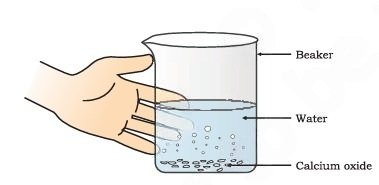
Q. A student adds water to quicklime (CaO) in a beaker. He feels the beaker turning hot.
i) The reaction is:
a) Endothermic
b) Exothermic
c) Neutralisation
d) Physical change
Answers: b) Exothermic
ii) The product formed is:
a) CaCO₃
b) Ca(OH)₂
c) CaCl₂
d) CaSO₄
Answers: b) Ca(OH)₂
Q. A student places silver chloride in sunlight. After some time, the white crystals turn grey.
i) Which type of decomposition is this?
a) Thermal
b) Electrolytic
c) Photolytic
d) Exothermic
Answers: c) Photolytic
ii) Which products are formed?
a) Ag and Cl₂
b) AgCl and O₂
c) Ag₂O and Cl₂
d) Ag and O₂
Answers: a) Ag and Cl₂
Q. A student dips iron nails in copper sulphate solution. After 20 minutes, the nails turn brownish and the solution’s blue colour fades.
i) Which type of reaction is this?
a) Combination
b) Decomposition
c) Displacement
d) Double displacement
Answers: c) Displacement
ii) Which new compound is formed in solution?
a) FeCl₂
b) FeSO₄
c) CuSO₄
d) Fe₂O₃
Answers: b) FeSO₄
Q4. A student leaves fried food uncovered for two days. The food develops a foul smell and taste.
i) The process responsible is:
a) Fermentation
b) Rancidity
c) Corrosion
d) Putrefaction
Answers: b) Rancidity
ii) Which method can prevent this?
a) Keeping food in sunlight
b) Adding antioxidants
c) Adding acids
d) Washing with water
Answers: b) Adding antioxidants
Diagram/Visual-Based
Q. Burning of magnesium ribbon in air produces a white powder collected in the watch glass. This powder is:
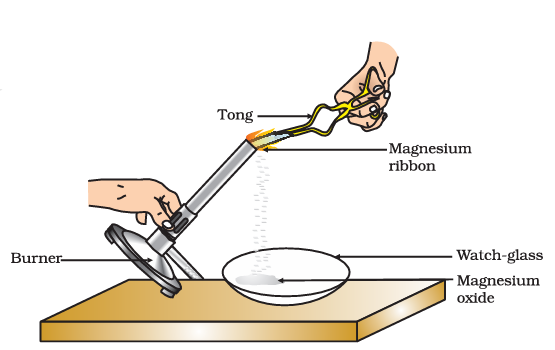
a) Magnesium chloride
b) Magnesium oxide
c) Magnesium hydroxide
d) Magnesium carbonate
Answer: b) Magnesium oxide
Q. In a chemical equation, the symbols (s), (l), (g), (aq) represent:
a) Solid, liquid, gas, aqueous solution
b) Solution, liquid, gas, solid
c) Salt, liquid, glucose, aqueous solution
d) Solid, liquid, glucose, acid
Answer: a) Solid, liquid, gas, aqueous solution
Q. Burning of coal is shown as an example of combination reaction. The product formed is:
a) CO
b) CO₂
c) H₂O
d) CH₄
Answer: b) CO₂
Q. Heating of lead nitrate produces brown fumes. These fumes are of:
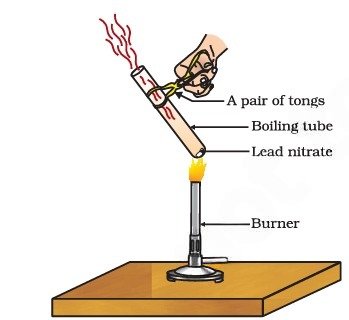
a) SO₂
b) NO₂
c) CO₂
d) Cl₂
Answer: b) NO₂
Q. Heating copper powder forms a black coating. This black substance is:
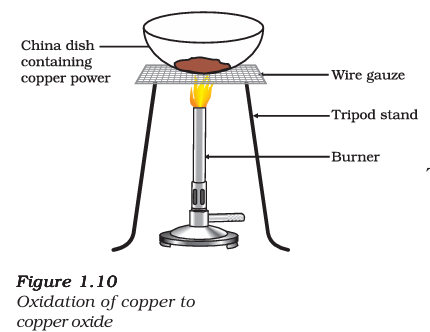
a) CuCl₂
b) CuO
c) Cu₂O
d) CuSO₄
Answer: b) CuO
Q. The green coating observed on copper articles is due to formation of:
a) Copper sulphate
b) Copper carbonate
c) Copper oxide
d) Copper chloride
Answer: b) Copper carbonate
Disclaimer: The content that is present on our website is based on the NCERT Class 10 Science textbook and is provided for educational purposes only. All the content and images have been taken from Science Class 10 NCERT Textbook. Images and content shown above are the property of individual organizations and are used here for reference purposes only. To make it easy to understand, some of the content and images are generated by AI and cross-checked by the teachers.