
← Back to Class 10 Study Material
Acids, Bases and Salts Class 10 MCQ covers important concepts such as properties of acids and bases, indicators, pH scale, chemical reactions, salts, and their uses. These multiple-choice questions are useful for CBSE Class 10 exam preparation and quick revision.
Acids Bases and Salts Class 10 MCQ
Conceptual Recall MCQs
Q. Which of the following substances can act as a natural acid‑base indicator?
a) Common salt
b) Red cabbage leaves
c) Sugar solution
d) Distilled water
Answer: b) Red cabbage leaves
Q. Which property of bases is used when soap makes a turmeric stain reddish‑brown?
a) Bases are sour in taste
b) Bases turn red litmus blue
c) Bases change turmeric colour
d) Bases produce hydrogen gas
Answer: c) Bases change turmeric colour
Q. The reaction between an acid and a base to form salt and water is called:
a) Combination reaction
b) Neutralisation reaction
c) Decomposition reaction
d) Double displacement reaction
Answer: b) Neutralisation reaction
Q. Which ion is common to all acids in aqueous solution?
a) OH⁻
b) Cl⁻
c) H⁺
d) Na⁺
Answer: c) H⁺
Q. Dry HCl gas does not change the colour of litmus paper because:
a) It has no hydrogen atoms
b) It does not produce H⁺ ions without water
c) It is a weak acid
d) It is neutral in nature
Answer: b) It does not produce H⁺ ions without water
Q. Bases soluble in water are called:
a) Acids
b) Alkalis
c) Salts
d) Neutral substances
Answer: b) Alkalis
Q. Tooth decay starts when the pH of the mouth falls below:
a) 7.0
b) 6.0
c) 5.5
d) 4.0
Answer: c) 5.5
Q. Which acid is present in bee sting and nettle sting?
a) Acetic acid
b) Citric acid
c) Methanoic acid
d) Oxalic acid
Answer: c) Methanoic acid
Q. Which of the following salts is neutral in nature (pH ≈ 7)?
a) Sodium chloride
b) Sodium acetate
c) Sodium carbonate
d) Ammonium chloride
Answer: a) Sodium chloride
Q. Rock salt is formed due to:
a) Reaction of NaCl with lime
b) Drying up of ancient seas
c) Reaction of NaCl with CO₂
d) Neutralisation of NaOH with HCl
Answer: b) Drying up of ancient seas
Q. The blue colour of copper sulphate crystals is due to:
a) Copper metal
b) Water of crystallisation
c) Oxygen gas
d) Sulphur atoms
Answer: b) Water of crystallisation
Q. The chemical formula of gypsum is:
a) CaSO₄·½H₂O
b) CaSO₄·2H₂O
c) CaSO₄·5H₂O
d) CaSO₄·10H₂O
Answer: b) CaSO₄·2H₂O
Application‑Based MCQs
Q. A student suffering from acidity after overeating should be given:
a) Lemon juice
b) Vinegar
c) Baking soda solution
d) Orange juice
Answer: c) Baking soda solution
Q. When zinc reacts with dilute sulphuric acid, bubbles are formed in soap solution because:
a) Oxygen gas is released
b) Hydrogen gas is released
c) Carbon dioxide gas is released
d) Nitrogen gas is released
Answer: b) Hydrogen gas is released
Q. Copper oxide reacts with dilute HCl to form a blue‑green solution. The colour is due to:
a) Copper sulphate
b) Copper nitrate
c) Copper chloride
d) Copper carbonate
Answer: c) Copper chloride
Q. Why should curd not be kept in copper vessels?
a) Copper reacts with lactic acid to form toxic salts
b) Copper absorbs water from curd
c) Copper turns curd sour
d) Copper makes curd alkaline
Answer: a) Copper reacts with lactic acid to form toxic salts
Q. While diluting concentrated sulphuric acid, it is recommended to add acid slowly to water because:
a) Water is heavier than acid
b) The process is highly exothermic
c) Acid evaporates quickly
d) Water reacts violently with acid
Answer: b) The process is highly exothermic
Q. A student adds NaOH pellets to water. The beaker becomes warm. This shows the process is:
a) Endothermic
b) Exothermic
c) Neutralisation
d) Decomposition
Answer: b) Exothermic
Q. A farmer finds that his soil has very low pH. Which action will help?
a) Adding lime (Ca(OH)₂)
b) Adding more water
c) Adding dilute HCl
d) Adding sugar solution
Answer: a) Adding lime (Ca(OH)₂)
Q. During indigestion, excess HCl is produced in the stomach. Which remedy is most effective?
a) Lemon juice
b) Baking soda solution
c) Vinegar
d) Orange juice
Answer: b) Baking soda solution
Q. Which salt is used in soda‑acid fire extinguishers?
a) Sodium carbonate
b) Sodium hydrogencarbonate
c) Sodium chloride
d) Calcium carbonate
Answer: b) Sodium hydrogencarbonate
Q. Washing soda is used for removing permanent hardness of water because:
a) It reacts with Ca²⁺ and Mg²⁺ ions to form insoluble carbonates
b) It increases acidity of water
c) It neutralises dissolved gases
d) It absorbs water vapour
Answer: a) It reacts with Ca²⁺ and Mg²⁺ ions to form insoluble carbonates
Q. When copper sulphate crystals are heated, they turn white because:
a) Copper is oxidised
b) Water of crystallisation is removed
c) Sulphur burns away
d) Oxygen escapes
Answer: b) Water of crystallisation is removed
Q. Plaster of Paris is used for supporting fractured bones because:
a) It is acidic in nature
b) It sets into a hard solid when mixed with water
c) It is neutral in nature
d) It is soluble in water
Answer: b) It sets into a hard solid when mixed with water
Assertion–Reason MCQs
Q. Assertion (A): Acids react with metals to form salt and hydrogen gas.
Reason (R): Metals displace hydrogen from acids.
a) Both A and R are true, R explains A
b) Both A and R are true, R does not explain A
c) A is true, R is false
d) A is false, R is true
Answer: a) Both A and R are true, R explains A
Q. Assertion (A): Lime water turns milky when carbon dioxide is passed through it.
Reason (R): Calcium carbonate is formed which is insoluble in water.
a) Both A and R are true, R explains A
b) Both A and R are true, R does not explain A
c) A is true, R is false
d) A is false, R is true
Answer: a) Both A and R are true, R explains A
Q. Assertion (A): Non‑metallic oxides are acidic in nature.
Reason (R): They react with bases to form salt and water.
a) Both A and R are true, R explains A
b) Both A and R are true, R does not explain A
c) A is true, R is false
d) A is false, R is true
Answer: a) Both A and R are true, R explains A
Q. Assertion (A): Glucose solution does not conduct electricity.
Reason (R): Glucose does not produce ions in water.
a) Both A and R are true, R explains A
b) Both A and R are true, R does not explain A
c) A is true, R is false
d) A is false, R is true
Answer: a) Both A and R are true, R explains A
Q. Assertion (A): An aqueous solution of HCl conducts electricity.
Reason (R): HCl produces H⁺ ions in water which carry current.
a) Both A and R are true, R explains A
b) Both A and R are true, R does not explain A
c) A is true, R is false
d) A is false, R is true
Answer: a) Both A and R are true, R explains A
Q. Assertion (A): Strong acids produce more H⁺ ions in solution.
Reason (R): Strength of an acid depends on concentration of OH⁻ ions.
a) Both A and R are true, R explains A
b) Both A and R are true, R does not explain A
c) A is true, R is false
d) A is false, R is true
Answer: c) A is true, R is false
Q. Assertion (A): Acid rain makes survival of aquatic life difficult.
Reason (R): Acid rain lowers the pH of river water.
a) Both A and R are true, R explains A
b) Both A and R are true, R does not explain A
c) A is true, R is false
d) A is false, R is true
Answer: a) Both A and R are true, R explains A
Q. Assertion (A): Toothpastes are generally basic in nature.
Reason (R): They neutralise acids produced by bacteria in the mouth.
a) Both A and R are true, R explains A
b) Both A and R are true, R does not explain A
c) A is true, R is false
d) A is false, R is true
Answer: a) Both A and R are true, R explains A
Q. Assertion (A): Salts of strong acid and strong base are neutral.
Reason (R): They completely ionise in water and do not hydrolyse.
a) Both A and R are true, R explains A
b) Both A and R are true, R does not explain A
c) A is true, R is false
d) A is false, R is true
Answer: a) Both A and R are true, R explains A
Q. Assertion (A): Bleaching powder is used to disinfect drinking water.
Reason (R): It releases chlorine which kills germs.
a) Both A and R are true, R explains A
b) Both A and R are true, R does not explain A
c) A is true, R is false
d) A is false, R is true
Answer: a) Both A and R are true, R explains A
Q. Assertion (A): Plaster of Paris is calcium sulphate hemihydrate.
Reason (R): It is formed by heating gypsum at 373 K.
a) Both A and R are true, R explains A
b) Both A and R are true, R does not explain A
c) A is true, R is false
d) A is false, R is true
Answer: a) Both A and R are true, R explains A
Q. Assertion (A): The blue colour of copper sulphate crystals reappears when water is added after heating.
Reason (R): Water of crystallisation is restored.
a) Both A and R are true, R explains A
b) Both A and R are true, R does not explain A
c) A is true, R is false
d) A is false, R is true
Answer: a) Both A and R are true, R explains A
Case Based MCQ
Q. In onion cloth strips are treated with dilute HCl and NaOH. The odour disappears with base but remains with acid. Which conclusion can be drawn?
a) Onion acts as an olfactory indicator
b) Onion is a natural dye
c) Onion is a neutral substance
d) Onion is a strong acid
Answer: a) Onion acts as an olfactory indicator
Q. In phenolphthalein turns pink in NaOH solution. On adding HCl drop by drop, the colour disappears. What does this show?
a) Acid neutralises base
b) Base neutralises acid
c) Phenolphthalein is a natural indicator
d) NaOH is neutral
Answer: a) Acid neutralises base
Q. The HCl gas is tested with dry and wet blue litmus paper. Colour change occurs only with wet litmus. This proves:
a) HCl is neutral in dry state
b) HCl shows acidic character only in presence of water
c) HCl is a weak acid
d) HCl does not contain hydrogen
Answer: b) HCl shows acidic character only in presence of water
Q. A student collects soil samples from different regions and tests pH using universal indicator. He finds one soil sample has pH 4.5. Which conclusion is correct?
a) Soil is highly alkaline, good for wheat
b) Soil is acidic, not suitable for most crops
c) Soil is neutral, suitable for all crops
d) Soil is basic, suitable for rice
Answer: b) Soil is acidic, not suitable for most crops
Q. In the chlor‑alkali process, brine is electrolysed. Which set of products is obtained?
a) NaOH, Cl₂, H₂
b) NaCl, O₂, H₂
c) NaOH, CO₂, Cl₂
d) NaCl, H₂O, O₂
Answer: a) NaOH, Cl₂, H₂
Q. The water droplets appear inside the boiling tube when copper sulphate crystals are heated. These droplets come from:
a) Moisture in air
b) Water of crystallisation in copper sulphate
c) Condensation of oxygen
d) Reaction of copper with sulphur
Answer: b) Water of crystallisation in copper sulphate
Diagram/Visual‑Based MCQ
Q. Refer to Figure (Passing CO₂ through lime water). What is observed when excess CO₂ is passed?
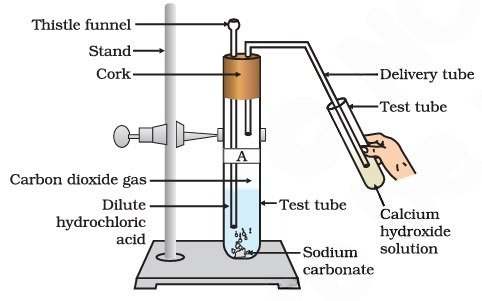
a) Lime water turns milky due to CaCO₃
b) Milky solution disappears due to Ca(HCO₃)₂ formation
c) Lime water turns red due to acid formation
d) Lime water remains unchanged
Answer: b) Milky solution disappears due to Ca(HCO₃)₂ formation
Q. Refer to Figure (Acid solution in water conducts electricity). The bulb glows only in acid solution because:
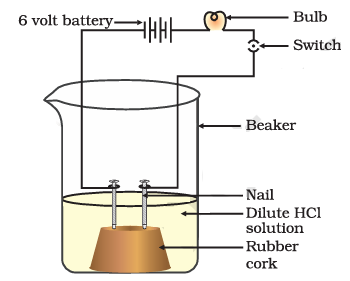
a) Acids release OH⁻ ions
b) Acids release H⁺ ions which carry current
c) Acids are sour in taste
d) Acids are neutral substances
Answer: b) Acids release H⁺ ions which carry current
Q. Refer to Figure. Which solution has pH less than 7?
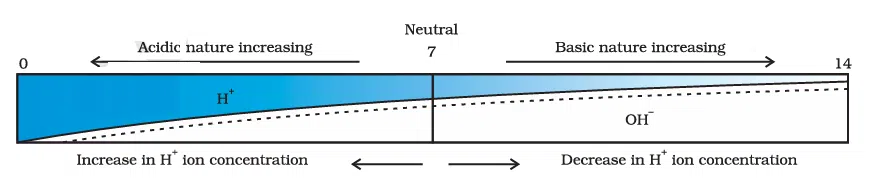
a) Tap water
b) Lemon juice
c) 1M NaOH
d) Saliva before meal
Answer: b) Lemon juice
Q. Refer to Figure. Which of the following substances has pH greater than 7?
a) Lemon juice
b) Tomato juice
c) Milk of magnesia
d) Coffee
Answer: c) Milk of magnesia
Q. Refer to Figure. Which product formed at the cathode during electrolysis of brine?
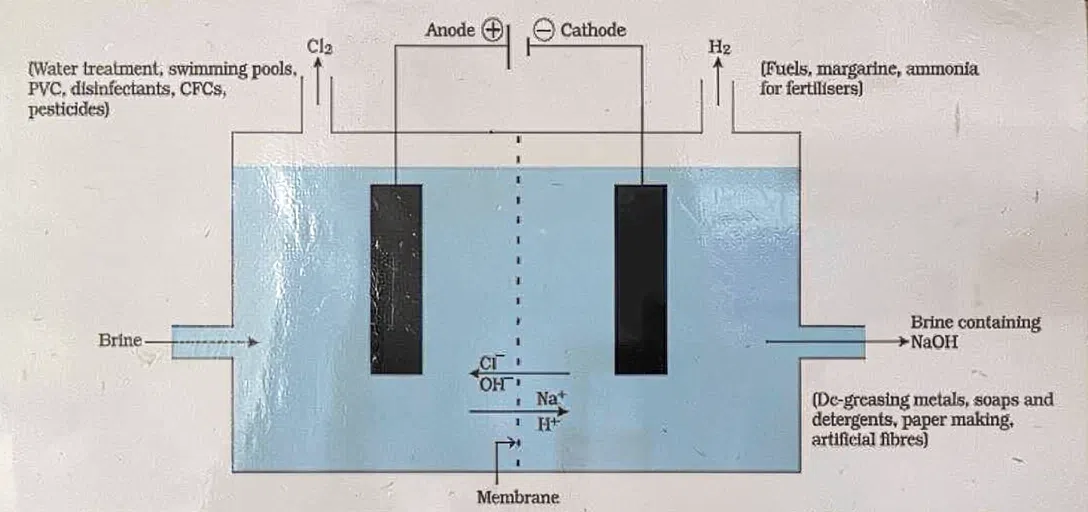
a) Chlorine gas
b) Hydrogen gas
c) Sodium hydroxide
d) Oxygen gas
Answer: b) Hydrogen gas
Q. Refer to Figure, What change is observed when hydrated copper sulphate is heated?
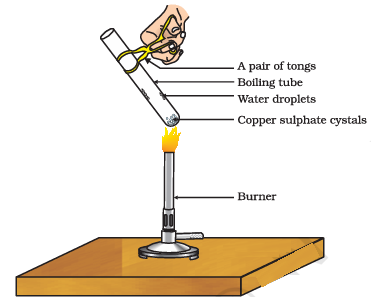
a) Blue crystals turn white
b) White crystals turn blue
c) Blue crystals turn green
d) Blue crystals remain unchanged
Answer: a) Blue crystals turn white
Disclaimer: The content that is present on our website is based on the NCERT Class 10 Science textbook and is provided for educational purposes only. All the content and images have been taken from Science Class 10 NCERT Textbook. Images and content shown above are the property of individual organizations and are used here for reference purposes only. To make it easy to understand, some of the content and images are generated by AI and cross-checked by the teachers.