
← Back to Class 10 Study Material
Metals and Non-Metals Class 10 MCQ covers important concepts such as physical and chemical properties, reactivity series, ionic compounds, extraction of metals, corrosion, and alloys. These MCQs are useful for CBSE Class 10 exam preparation and quick revision.
Metals and Non Metals Class 10 MCQ
Conceptual Recall
Q. The shining surface of metals in their pure state is called:
a) Ductility
b) Malleability
c) Metallic lustre
d) Sonority
Answer: c) Metallic lustre
Q. Which of the following metals is the most ductile?
a) Copper
b) Aluminium
c) Gold
d) Silver
Answer: c) Gold
Q. Which pair of metals is the best conductor of heat?
a) Silver and Copper
b) Lead and Mercury
c) Iron and Zinc
d) Aluminium and Magnesium
Answer: a) Silver and Copper
Q. Which of the following is the only liquid non‑metal at room temperature?
a) Iodine
b) Bromine
c) Mercury
d) Sulphur
Answer: b) Bromine
Q. Diamond and graphite are allotropes of:
a) Sulphur
b) Carbon
c) Iodine
d) Oxygen
Answer: b) Carbon
Q. Which non‑metal is lustrous?
a) Sulphur
b) Carbon
c) Iodine
d) Hydrogen
Answer: c) Iodine
Q. Which of the following metals is kept immersed in kerosene oil to prevent accidental fires?
a) Magnesium
b) Sodium
c) Aluminium
d) Copper
Answer: b) Sodium
Q. Which oxide is amphoteric in nature?
a) Copper(II) oxide
b) Sodium oxide
c) Aluminium oxide
d) Calcium oxide
Answer: c) Aluminium oxide
Q. Which of the following metals does not react with oxygen even at high temperature?
a) Iron
b) Silver
c) Copper
d) Zinc
Answer: b) Silver
Q. Metals react with dilute acids to form:
a) Salt + Hydrogen gas
b) Salt + Oxygen gas
c) Salt + Nitrogen gas
d) Salt + Carbon dioxide
Answer: a) Salt + Hydrogen gas
Q. Which metal does not react with dilute HCl?
a) Magnesium
b) Aluminium
c) Copper
d) Zinc
Answer: c) Copper
Q. Hydrogen gas is not evolved when metals react with nitric acid because:
a) Nitric acid is weak
b) Nitric acid is a strong oxidising agent
c) Nitric acid is amphoteric
d) Nitric acid reacts only with non‑metals
Answer: b) Nitric acid is a strong oxidising agent
Q. Sodium loses one electron to form:
a) Sodium anion (Na–)
b) Sodium cation (Na+)
c) Sodium molecule (Na2)
d) Sodium radical
Answer: b) Sodium cation (Na+)
Q. Which of the following is the hardest natural substance?
a) Graphite
b) Diamond
c) Iodine
d) Sulphur
Answer: b) Diamond
Q. Ionic compounds generally exist as:
a) Molecules
b) Aggregates of ions in crystal lattice
c) Free atoms
d) Covalent bonds
Answer: b) Aggregates of ions in crystal lattice
Q. The naturally occurring substances in the earth’s crust that contain metals are called:
a) Ores
b) Minerals
c) Gangue
d) Alloys
Answer: b) Minerals
Q. Which of the following metals is found in the free state in nature?
a) Sodium
b) Calcium
c) Gold
d) Aluminium
Answer: c) Gold
Q. The impurities such as soil and sand present in ores are called:
a) Flux
b) Gangue
c) Slag
d) Alloy
Answer: b) Gangue
Q. The process of converting sulphide ores into oxides by heating in excess air is called:
a) Calcination
b) Roasting
c) Electrolysis
d) Refining
Answer: b) Roasting
Q. The process of converting carbonate ores into oxides by heating in limited air is called:
a) Calcination
b) Roasting
c) Smelting
d) Electrolysis
Answer: a) Calcination
Q. Which reaction is used to join railway tracks?
a) Roasting of zinc sulphide
b) Calcination of zinc carbonate
c) Thermit reaction (Fe₂O₃ + Al)
d) Electrolytic refining of copper
Answer: c) Thermit reaction (Fe₂O₃ + Al)
Q. The green coating formed on copper is:
a) Copper sulphide
b) Basic copper carbonate
c) Copper oxide
d) Copper chloride
Answer: b) Basic copper carbonate
Q. Silver articles turn black due to formation of:
a) Silver oxide
b) Silver chloride
c) Silver sulphide
d) Silver carbonate
Answer: c) Silver sulphide
Q. Rusting of iron produces:
a) Iron sulphide
b) Iron carbonate
c) Hydrated iron oxide
d) Iron chloride
Answer: c) Hydrated iron oxide
Application-Based
Q. Sodium can be easily cut with a knife because:
a) It is highly ductile
b) It is very soft compared to other metals
c) It has high melting point
d) It is a poor conductor of electricity
Answer: b) It is very soft compared to other metals
Q. School bells are made of metals mainly due to their property of:
a) Lustre
b) Sonority
c) Ductility
d) Malleability
Answer: b) Sonority
Q. Graphite is used in making electrodes because:
a) It is lustrous
b) It is a conductor of electricity
c) It is malleable
d) It is ductile
Answer: b) It is a conductor of electricity
Q. Diamond is used in cutting tools mainly due to:
a) High melting point
b) Hardness
c) Conductivity
d) Sonority
Answer: b) Hardness
Q. Calcium starts floating on water during reaction because:
a) It is lighter than water
b) Hydrogen bubbles stick to its surface
c) It forms soluble hydroxide
d) It reacts violently with water
Answer: b) Hydrogen bubbles stick to its surface
Q. Anodising of aluminium is done to:
a) Remove oxide layer
b) Make aluminium more ductile
c) Form a thick protective oxide layer
d) Increase sonority
Answer: c) Form a thick protective oxide layer
Q. Aqua regia can dissolve gold because:
a) It contains only HCl
b) It contains only HNO3
c) It is a mixture of concentrated HCl and HNO3 in 3:1 ratio
d) It is a mixture of H2SO4 and HCl
Answer: c) It is a mixture of concentrated HCl and HNO3 in 3:1 ratio
Q. When zinc is added to iron(II) sulphate solution:
a) No reaction occurs
b) Zinc displaces iron from the solution
c) Iron displaces zinc from the solution
d) Hydrogen gas is evolved
Answer: b) Zinc displaces iron from the solution
Q. Sodium chloride conducts electricity only in molten state because:
a) It has metallic lustre
b) Ions are free to move in molten state
c) It reacts with oxygen
d) It is amphoteric
Answer: b) Ions are free to move in molten state
Q. Ionic compounds are soluble in water but not in petrol because:
a) Water is a polar solvent
b) Petrol is a polar solvent
c) Petrol reacts with salts
d) Water has low boiling point
Answer: a) Water is a polar solvent
Q. Mercury can be obtained from cinnabar (HgS) by:
a) Electrolysis of molten HgS
b) Heating in air followed by reduction of HgO
c) Dissolving in water
d) Reaction with acids
Answer: b) Heating in air followed by reduction of HgO
Q. Copper can be obtained from Cu₂S ore by:
a) Electrolysis of copper sulphide
b) Heating in air to form Cu₂O and then reduction
c) Dissolving in kerosene
d) Reaction with dilute HCl
Answer: b) Heating in air to form Cu₂O and then reduction
Q. Zinc oxide can be reduced to zinc metal by:
a) Heating with carbon
b) Electrolysis of molten ZnO
c) Heating with oxygen
d) Reaction with acids
Answer: a) Heating with carbon
Q. Aluminium powder is used in displacement reactions because:
a) It is less reactive than iron
b) It is highly reactive and displaces other metals
c) It reacts only with acids
d) It forms alloys easily
Answer: b) It is highly reactive and displaces other metals
Q. Iron nails rust only in test tube A (Activity 3.14) because:
a) Only air is present
b) Only water is present
c) Both air and water are present
d) Neither air nor water is present
Answer: c) Both air and water are present
Q. Galvanisation protects iron even if zinc coating is broken because:
a) Zinc is less reactive than iron
b) Zinc is more reactive than iron and corrodes first
c) Zinc forms alloys with iron
d) Zinc is amphoteric
Answer: b) Zinc is more reactive than iron and corrodes first
Assertion–Reason
Q. Assertion (A): Gold and silver are the most malleable metals.
Reason (R): They can be beaten into thin sheets without breaking.
a) Both A and R are true, and R is the correct explanation of A
b) Both A and R are true, but R is not the correct explanation of A
c) A is true, but R is false
d) A is false, but R is true
Answer: a) Both A and R are true, and R is the correct explanation of A
Q. Assertion (A): Copper wires are used in household wiring.
Reason (R): Copper is a good conductor of electricity and ductile.
a) Both A and R are true, and R is the correct explanation of A
b) Both A and R are true, but R is not the correct explanation of A
c) A is true, but R is false
d) A is false, but R is true
Answer: a) Both A and R are true, and R is the correct explanation of A
Q. Assertion (A): Sulphur dioxide dissolves in water to form an acidic solution.
Reason (R): Non‑metals generally form acidic oxides.
a) Both A and R are true, and R is the correct explanation of A
b) Both A and R are true, but R is not the correct explanation of A
c) A is true, but R is false
d) A is false, but R is true
Answer: a) Both A and R are true, and R is the correct explanation of A
Q. Assertion (A): Magnesium oxide solution turns red litmus blue.
Reason (R): Metal oxides are generally basic in nature.
a) Both A and R are true, and R is the correct explanation of A
b) Both A and R are true, but R is not the correct explanation of A
c) A is true, but R is false
d) A is false, but R is true
Answer: a) Both A and R are true, and R is the correct explanation of A
Q. Assertion (A): Sodium reacts violently with cold water.
Reason (R): The reaction is highly exothermic and hydrogen catches fire.
a) Both A and R are true, and R is the correct explanation of A
b) Both A and R are true, but R is not the correct explanation of A
c) A is true, but R is false
d) A is false, but R is true
Answer: a) Both A and R are true, and R is the correct explanation of A
Q. Assertion (A): Aluminium does not react with cold or hot water.
Reason (R): A protective oxide layer prevents further reaction.
a) Both A and R are true, and R is the correct explanation of A
b) Both A and R are true, but R is not the correct explanation of A
c) A is true, but R is false
d) A is false, but R is true
Answer: a) Both A and R are true, and R is the correct explanation of A
Q. Assertion (A): Magnesium reacts vigorously with dilute HCl.
Reason (R): Magnesium is more reactive than zinc and iron.
a) Both A and R are true, and R is the correct explanation of A
b) Both A and R are true, but R is not the correct explanation of A
c) A is true, but R is false
d) A is false, but R is true
Answer: a) Both A and R are true, and R is the correct explanation of A
Q. Assertion (A): Copper cannot displace iron from iron sulphate solution.
Reason (R): Copper is less reactive than iron.
a) Both A and R are true, and R is the correct explanation of A
b) Both A and R are true, but R is not the correct explanation of A
c) A is true, but R is false
d) A is false, but R is true
Answer: a) Both A and R are true, and R is the correct explanation of A
Q. Assertion (A): Ionic compounds have high melting and boiling points.
Reason (R): Strong electrostatic forces of attraction exist between oppositely charged ions.
a) Both A and R are true, and R is the correct explanation of A
b) Both A and R are true, but R is not the correct explanation of A
c) A is true, but R is false
d) A is false, but R is true
Answer: a) Both A and R are true, and R is the correct explanation of A
Q. Assertion (A): Solid NaCl does not conduct electricity.
Reason (R): In solid state, ions are not free to move.
a) Both A and R are true, and R is the correct explanation of A
b) Both A and R are true, but R is not the correct explanation of A
c) A is true, but R is false
d) A is false, but R is true
Answer: a) Both A and R are true, and R is the correct explanation of A
Q. Assertion (A): Metals at the top of the activity series are never found in free state.
Reason (R): They are highly reactive and always exist as compounds.
a) Both A and R are true, and R is the correct explanation of A
b) Both A and R are true, but R is not the correct explanation of A
c) A is true, but R is false
d) A is false, but R is true
Answer: a) Both A and R are true, and R is the correct explanation of A
Q. Assertion (A): Oxygen is the most common element combined with metals in ores.
Reason (R): Oxygen is highly reactive and abundant in the earth’s crust.
a) Both A and R are true, and R is the correct explanation of A
b) Both A and R are true, but R is not the correct explanation of A
c) A is true, but R is false
d) A is false, but R is true
Answer: a) Both A and R are true, and R is the correct explanation of A
Q. Assertion (A): Metals high in the activity series cannot be reduced by carbon.
Reason (R): These metals have more affinity for oxygen than carbon.
a) Both A and R are true, and R is the correct explanation of A
b) Both A and R are true, but R is not the correct explanation of A
c) A is true, but R is false
d) A is false, but R is true
Answer: a) Both A and R are true, and R is the correct explanation of A
Q. Assertion (A): In electrolytic refining, pure metal is deposited at the cathode.
Reason (R): Metal ions from the electrolyte gain electrons at the cathode.
a) Both A and R are true, and R is the correct explanation of A
b) Both A and R are true, but R is not the correct explanation of A
c) A is true, but R is false
d) A is false, but R is true
Answer: a) Both A and R are true, and R is the correct explanation of A
Q. Assertion (A): Stainless steel does not rust.
Reason (R): It contains iron mixed with nickel and chromium.
a) Both A and R are true, and R is the correct explanation of A
b) Both A and R are true, but R is not the correct explanation of A
c) A is true, but R is false
d) A is false, but R is true
Answer: a) Both A and R are true, and R is the correct explanation of A
Q. Assertion (A): Pure gold is not suitable for making ornaments.
Reason (R): Pure gold is very soft and is alloyed with copper or silver to make it hard.
a) Both A and R are true, and R is the correct explanation of A
b) Both A and R are true, but R is not the correct explanation of A
c) A is true, but R is false
d) A is false, but R is true
Answer: a) Both A and R are true, and R is the correct explanation of A
Case/Experiment-Based
Q. In the textbook activity, a pin fixed with wax on a copper wire falls after heating. What does this prove?
a) Copper has metallic lustre
b) Copper is malleable
c) Copper is a good conductor of heat
d) Copper is ductile
Answer: c) Copper is a good conductor of heat
Q. In the textbook activity, sulphur powder was burnt and fumes collected in a test tube. The solution formed after adding water turned blue litmus red. This shows that:
a) Sulphur forms a basic oxide
b) Sulphur forms an acidic oxide
c) Sulphur is malleable
d) Sulphur is ductile
Answer: b) Sulphur forms an acidic oxide
Q. In the textbook activity, magnesium did not react with cold water but reacted with hot water to form hydrogen gas. What does this indicate?
a) Magnesium is more reactive than sodium
b) Magnesium reacts only with acids
c) Magnesium is less reactive than calcium
d) Magnesium does not form hydroxide
Answer: c) Magnesium is less reactive than calcium
Q. In the textbook activity, bubbles formed fastest with magnesium and the thermometer showed the highest rise. This indicates:
a) Magnesium is the least reactive metal
b) Magnesium is the most reactive among Mg, Al, Zn, Fe
c) Copper is more reactive than magnesium
d) Aluminium is more reactive than magnesium
Answer: b) Magnesium is the most reactive among Mg, Al, Zn, Fe
Q. In the textbook activity, salt samples were tested for solubility. Which observation is correct?
a) NaCl dissolves in petrol but not in water
b) NaCl dissolves in water but not in petrol
c) NaCl dissolves in both water and petrol
d) NaCl dissolves only in kerosene
Answer: b) NaCl dissolves in water but not in petrol
Q. A student heated cinnabar (HgS) in air. First, a red solid HgO was formed, which on further heating gave silvery mercury. This shows:
a) Mercury can be extracted by electrolysis
b) Mercury oxide decomposes on heating to give mercury
c) Mercury reacts with acids to form salts
d) Mercury is amphoteric
Answer: b) Mercury oxide decomposes on heating to give mercury
Q. A student heated manganese dioxide with aluminium powder. Molten manganese was formed with large heat evolution. This shows:
a) Aluminium is oxidised and MnO₂ is reduced
b) Aluminium is reduced and MnO₂ is oxidised
c) Both are oxidised
d) Both are reduced
Answer: a) Aluminium is oxidised and MnO₂ is reduced
Q. A student placed iron nails in three test tubes:
- Tube A: water + air → nails rusted
- Tube B: boiled water + oil → no rust
- Tube C: dry air + CaCl₂ → no rust
This shows that rusting requires:
a) Only water
b) Only air
c) Both air and water
d) Neither air nor water
Answer: c) Both air and water
Diagram/Visual-Based
Q. In the circuit shown in Figure, the bulb glows when a metal strip is placed between A and B. This indicates:
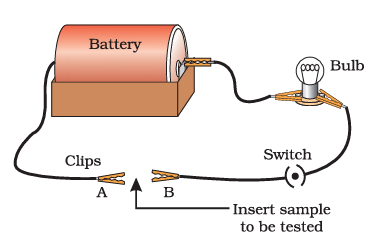
a) Metals are malleable
b) Metals are ductile
c) Metals conduct electricity
d) Metals are sonorous
Answer: c) Metals conduct electricity
Q. In the circuit of Figure, when carbon (graphite) is placed between A and B, the bulb glows. This indicates:
a) Graphite is ductile
b) Graphite conducts electricity
c) Graphite is malleable
d) Graphite is sonorous
Answer: b) Graphite conducts electricity
Q. In Figure, steam is passed over heated iron. The products formed are:
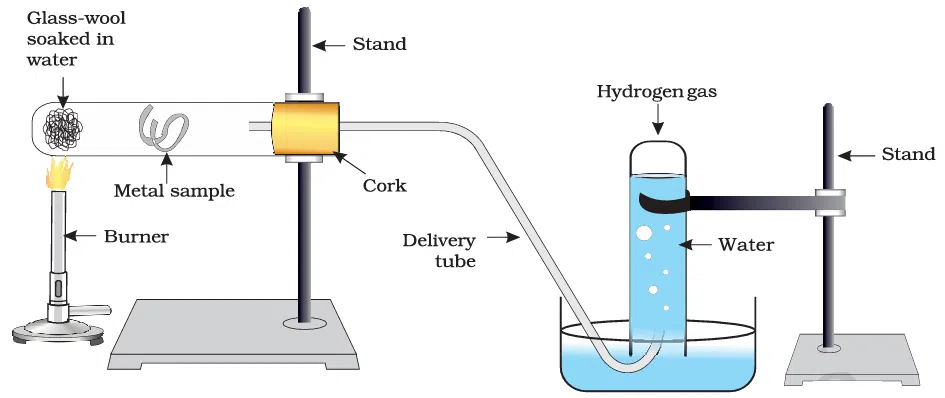
a) Fe2O3 and H2
b) Fe3O4 and H2
c) FeO and H2
d) Fe(OH)2 and H2
Answer: b) Fe3O4 and H2
Q. In Figure, an iron nail placed in copper sulphate solution gets coated with reddish‑brown copper. This shows:
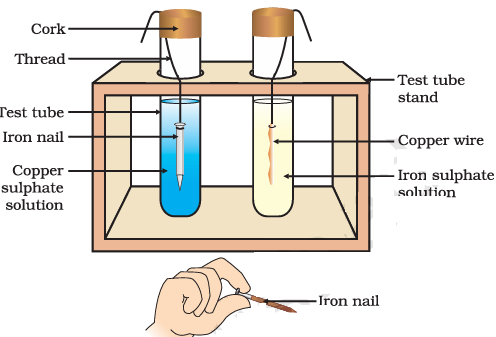
a) Copper is more reactive than iron
b) Iron is more reactive than copper
c) Both metals are equally reactive
d) No displacement reaction occurs
Answer: b) Iron is more reactive than copper
Q. In Figure, electrodes are placed in salt solution and bulb glows. This shows:
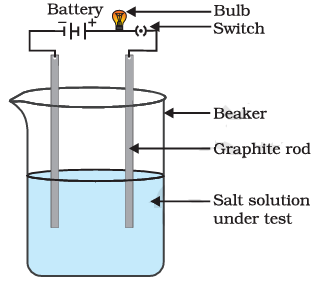
a) Ionic compounds are malleable
b) Ionic compounds conduct electricity in solution
c) Ionic compounds are ductile
d) Ionic compounds are sonorous
Answer: b) Ionic compounds conduct electricity in solution
Q. In Figure (Activity series and metallurgy), metals like K, Na, Ca are extracted mainly by:
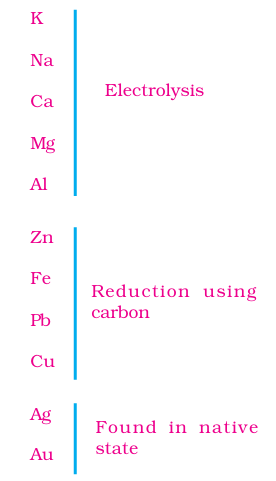
a) Heating alone
b) Reduction with carbon
c) Electrolysis of molten salts
d) Roasting in air
Answer: c) Electrolysis of molten salts
Q. In Fig. 3.12 (Electrolytic refining of copper), the anode is:
a) Pure copper strip
b) Impure copper block
c) Graphite rod
d) Aluminium strip
Answer: b) Impure copper block
Q. The iron pillar near Qutub Minar has not rusted for 1600 years. This shows:
a) Iron is always rust‑proof
b) Ancient Indian metallurgy developed rust‑resistant processes
c) Iron reacts only with sulphur
d) Iron is alloyed with copper
Answer: b) Ancient Indian metallurgy developed rust‑resistant processes
Disclaimer: The content that is present on our website is based on the NCERT Class 10 Science textbook and is provided for educational purposes only. All the content and images have been taken from Science Class 10 NCERT Textbook. Images and content shown above are the property of individual organizations and are used here for reference purposes only. To make it easy to understand, some of the content and images are generated by AI and cross-checked by the teachers.