
← Back to Class 10 Study Material
Practise Electricity Class 10 MCQs to revise important concepts and prepare for the CBSE Science examination. These MCQs help students check their understanding, improve accuracy, and practise exam-oriented questions. Regular practice can help students identify difficult topics and build confidence for the Class 10 Science Board Examination.
Electricity Class 10 MCQ
Conceptual Recall
Q. The rate of flow of electric charge through a conductor is called:
a) Electric potential
b) Electric current
c) Resistance
d) Voltage
Answer: b) Electric current
Q. A continuous and closed path through which electric current flows is called:
a) Electric field
b) Electric flux
c) Electric circuit
d) Electric source
Answer: c) Electric circuit
Q. The resistance of a conductor is directly proportional to its:
a) Area of cross-section
b) Length
c) Current
d) Potential difference
Answer: b) Length
Q. The resistance of a conductor is inversely proportional to its:
a) Length
b) Resistivity
c) Area of cross-section
d) Temperature
Answer: c) Area of cross-section
Q. Resistors are said to be connected in series when they are connected:
a) Side by side between two common points
b) End to end in a single path
c) In different circuits
d) Across a battery separately
Answer: b) End to end in a single path
Q. In a series combination of resistors, the current:
a) Is different through each resistor
b) Is maximum in the first resistor
c) Is the same through all resistors
d) Depends on the resistance only
Answer: c) Is the same through all resistors
Q. In a parallel combination of resistors, the potential difference across each resistor is:
a) Different
b) Zero
c) Equal
d) Infinite
Answer: c) Equal
Q. For resistors connected in parallel, the reciprocal of the equivalent resistance is equal to:
a) Sum of the resistances
b) Difference of the resistances
c) Product of the resistances
d) Sum of the reciprocals of the resistances
Answer: d) Sum of the reciprocals of the resistances
Q. The production of heat in a conductor when electric current passes through it is known as:
a) Magnetic effect of current
b) Chemical effect of current
c) Heating effect of current
d) Induction effect
Answer: c) Heating effect of current
Q. Joule’s law of heating is given by:
a) H = V/I
b) H = I²Rt
c) H = IR
d) H = V/R
Answer: b) H = I²Rt
Q. If the resistance of the resistor increases while current remains constant, the heat produced will:
a) Increase
b) Decrease
c) Become zero
d) Remain unchanged
Answer: a) Increase
Q. Electric power is the rate of:
a) Flow of charge
b) Consumption of electrical energy
c) Increase of resistance
d) Production of current
Answer: b) Consumption of electrical energy
Q. The SI unit of electric power is:
a) Joule
b) Kilowatt-hour
c) Watt
d) Ampere
Answer: c) Watt
Application-Based
Q. In a torch, the bulb glows only when the switch is ON because the switch:
a) Increases the voltage of the cell
b) Produces electric charge
c) Converts electricity into light
d) Completes the electric circuit
Answer: d) Completes the electric circuit
Q. When the switch of an electric circuit is turned OFF, the bulb stops glowing because:
a) The cell becomes dead immediately
b) The circuit gets broken and current stops flowing
c) The bulb absorbs all the charge
d) Electrons stop existing in the wire
Answer: b) The circuit gets broken and current stops flowing
Q. A charge of 120 C flows through a conductor in 60 s. The current in the conductor is:
a) 0.5 A
b) 1 A
c) 2 A
d) 4 A
Answer: c) 2 A
Q. A nichrome wire is replaced by another wire of the same material and thickness but double the length. The resistance of the new wire will be:
a) Half
b) Double
c) One-fourth
d) Unchanged
Answer: b) Double
Q. Two wires have the same length and are made of the same material. The thicker wire will have:
a) Higher resistance
b) Infinite resistance
c) Lower resistance
d) Equal resistance
Answer: c) Lower resistance
Q. Why is nichrome commonly used in electric heating devices?
a) It has very low resistivity
b) It melts easily
c) It oxidises rapidly at high temperature
d) It has high resistivity and does not oxidise readily
Answer: d) It has high resistivity and does not oxidise readily
Q. Three resistors of 2 Ω, 3 Ω and 5 Ω are connected in series. Their equivalent resistance is:
a) 10 Ω
b) 5 Ω
c) 3 Ω
d) 30 Ω
Answer: a) 10 Ω
Q. An electric circuit contains two resistors of 4 Ω and 6 Ω connected in series. The total resistance of the circuit will be:
a) 2 Ω
b) 10 Ω
c) 24 Ω
d) 5 Ω
Answer: b) 10 Ω
Q. A current of 0.5 A flows through a series circuit containing a 4 Ω resistor. The potential difference across the resistor is:
a) 8 V
b) 4 V
c) 2 V
d) 0.5 V
Answer: c) 2 V
Q. Three resistors of 2 Ω, 3 Ω and 6 Ω are connected in parallel. Their equivalent resistance is:
a) 1 Ω
b) 11 Ω
c) 6 Ω
d) 18 Ω
Answer: a) 1 Ω
Q. Two resistors of 4 Ω and 6 Ω are connected in parallel. The equivalent resistance will be:
a) 10 Ω
b) 2.4 Ω
c) 24 Ω
d) 1.0 Ω
Answer: b) 2.4 Ω
Q. In a parallel circuit, the total current is:
a) Equal to the current through any one resistor
b) Less than the smallest branch current
c) Equal to the sum of currents through all branches
d) Always constant at 1 A
Answer: c) Equal to the sum of currents through all branches
Q. An electric heater and a battery form a purely resistive circuit. In such a circuit, the electrical energy supplied by the source is converted entirely into:
a) Light energy
b) Sound energy
c) Mechanical energy
d) Heat energy
Answer: d) Heat energy
Q. If the current through a resistor is doubled, the heat produced in the same time will become:
a) Double
b) Four times
c) Half
d) One-fourth
Answer: b) Four times
Q. Why is tungsten used for making the filament of an electric bulb?
a) It has very low melting point
b) It is a poor conductor
c) It has a very high melting point
d) It does not get heated
Answer: c) It has a very high melting point
Q. An electric bulb operates at 220 V and draws a current of 0.5 A. Its power is:
a) 110 W
b) 220 W
c) 440 W
d) 55 W
Answer: a) 110 W
Q. A device has a power rating of 1000 W. This is equal to:
a) 0.1 kW
b) 1 kW
c) 10 kW
d) 100 kW
Answer: b) 1 kW
Q. Which of the following is the commercial unit of electrical energy?
a) Joule
b) Watt
c) Kilowatt-hour (kWh)
d) Volt
Answer: c) Kilowatt-hour (kWh)
Assertion–Reason
Q. Assertion (A): In metallic conductors, electric current is due to the movement of electrons.
Reason (R): Electrons constitute the flow of charges in metallic wires.
a) Both A and R are true, and R is the correct explanation of A
b) Both A and R are true, but R is not the correct explanation of A
c) A is true, but R is false
d) A is false, but R is true
Answer: a) Both A and R are true, and R is the correct explanation of A
Q. Assertion (A): An ammeter is connected in series in an electric circuit.
Reason (R): An ammeter measures the current flowing through the circuit.
a) Both A and R are true, and R is the correct explanation of A
b) Both A and R are true, but R is not the correct explanation of A
c) A is true, but R is false
d) A is false, but R is true
Answer: a) Both A and R are true, and R is the correct explanation of A
Q. Assertion (A): The resistance of a conductor depends on its length.
Reason (R): A longer wire offers greater opposition to the flow of charges.
a) Both A and R are true, and R is the correct explanation of A
b) Both A and R are true, but R is not the correct explanation of A
c) A is true, but R is false
d) A is false, but R is true
Answer: a) Both A and R are true, and R is the correct explanation of A
Q. Assertion (A): Copper is widely used for electrical transmission lines.
Reason (R): Copper has low resistivity and is a good conductor of electricity.
a) Both A and R are true, and R is the correct explanation of A
b) Both A and R are true, but R is not the correct explanation of A
c) A is true, but R is false
d) A is false, but R is true
Answer: a) Both A and R are true, and R is the correct explanation of A
Q. Assertion (A): The equivalent resistance of resistors connected in series is greater than any individual resistance.
Reason (R): The equivalent resistance in series is equal to the sum of individual resistances.
a) Both A and R are true, and R is the correct explanation of A
b) Both A and R are true, but R is not the correct explanation of A
c) A is true, but R is false
d) A is false, but R is true
Answer: a) Both A and R are true, and R is the correct explanation of A
Q. Assertion (A): The potential difference across a series combination is equal to the sum of potential differences across individual resistors.
Reason (R): Current remains the same through all resistors connected in series.
a) Both A and R are true, and R is the correct explanation of A
b) Both A and R are true, but R is not the correct explanation of A
c) A is true, but R is false
d) A is false, but R is true
Answer: a) Both A and R are true, but R is not the correct explanation of A
Q. Assertion (A): The equivalent resistance of resistors connected in parallel is less than the smallest individual resistance.
Reason (R): Parallel combination provides multiple paths for the flow of current.
a) Both A and R are true, and R is the correct explanation of A
b) Both A and R are true, but R is not the correct explanation of A
c) A is true, but R is false
d) A is false, but R is true
Answer: a) Both A and R are true, and R is the correct explanation of A
Q. Assertion (A): Electrical appliances in homes are connected in parallel.
Reason (R): Different appliances require different currents and can operate independently.
a) Both A and R are true, and R is the correct explanation of A
b) Both A and R are true, but R is not the correct explanation of A
c) A is true, but R is false
d) A is false, but R is true
Answer: a) Both A and R are true, and R is the correct explanation of A
Q. Assertion (A): The heat produced in a resistor is directly proportional to the square of the current passing through it.
Reason (R): According to Joule’s law, H = I²Rt.
a) Both A and R are true, and R is the correct explanation of A
b) Both A and R are true, but R is not the correct explanation of A
c) A is true, but R is false
d) A is false, but R is true
Answer: a) Both A and R are true, and R is the correct explanation of A
Q. Assertion (A): A fuse is connected in series with an electrical appliance.
Reason (R): A fuse protects the circuit by melting when excessive current flows.
a) Both A and R are true, and R is the correct explanation of A
b) Both A and R are true, but R is not the correct explanation of A
c) A is true, but R is false
d) A is false, but R is true
Answer: a) Both A and R are true, and R is the correct explanation of A
Q. Assertion (A): Electric power can be expressed as P = VI.
Reason (R): Electric power is the rate at which electrical energy is consumed.
a) Both A and R are true, and R is the correct explanation of A
b) Both A and R are true, but R is not the correct explanation of A
c) A is true, but R is false
d) A is false, but R is true
Answer: a) Both A and R are true, and R is the correct explanation of A
Q. Assertion (A): One kilowatt-hour is a unit of energy.
Reason (R): One kilowatt-hour equals 3.6 × 10⁶ joules.
a) Both A and R are true, and R is the correct explanation of A
b) Both A and R are true, but R is not the correct explanation of A
c) A is true, but R is false
d) A is false, but R is true
Answer: a) Both A and R are true, and R is the correct explanation of A
Case Study-Based
Case Study: A student connects a cell, a bulb, an ammeter and a plug key to form a closed circuit. When the plug key is inserted, the bulb starts glowing and the ammeter shows a reading. When the plug key is removed, the bulb goes off and the ammeter reading becomes zero.
Q. The bulb glows when the plug key is inserted because:
a) The circuit becomes closed
b) The bulb becomes hotter
c) The resistance becomes zero
d) The ammeter creates current
Answer: a) The circuit becomes closed
Q. Which instrument in the circuit measures electric current?
a) Cell
b) Bulb
c) Plug key
d) Ammeter
Answer: d) Ammeter
Case Study: A student connects a cell, a bulb, an ammeter and a plug key to form a closed circuit. When the plug key is inserted, the bulb starts glowing and the ammeter shows a reading. When the plug key is removed, the bulb goes off and the ammeter reading becomes zero.
Q. The bulb glows when the plug key is inserted because:
a) The circuit becomes closed
b) The bulb becomes hotter
c) The resistance becomes zero
d) The ammeter creates current
Answer: a) The circuit becomes closed
Q. Which instrument in the circuit measures electric current?
a) Cell
b) Bulb
c) Plug key
d) Ammeter
Answer: d) Ammeter
Case Study: A student performs an experiment using different wires in the same electric circuit. He observes that doubling the length of a nichrome wire decreases the current. He also finds that a thicker wire of the same material allows more current to flow. When he replaces the nichrome wire with a copper wire of the same length and thickness, the current increases further.
Q. Which factor is responsible for the increase in current when a thicker wire is used?
a) Increased resistance
b) Increased resistivity
c) Increased area of cross-section
d) Increased length
Answer: c) Increased area of cross-section
Q. The higher current observed in the copper wire is mainly because copper has:
a) Higher resistivity than nichrome
b) Lower resistivity than nichrome
c) Greater length
d) Smaller area
Answer: b) Lower resistivity than nichrome
Case Study: A student connects three resistors of resistances R₁, R₂ and R₃ in series with a battery. He observes that the ammeter shows the same reading at different positions in the circuit. He also measures the potential difference across each resistor and finds that the total potential difference across the combination equals the sum of the individual potential differences.
Q. The observation that the ammeter shows the same reading everywhere indicates that:
a) Potential difference is constant
b) Resistance is zero
c) Current is the same throughout the series circuit
d) Voltage increases across each resistor
Answer: c) Current is the same throughout the series circuit
Q. For the series combination, the equivalent resistance is given by:
a) R = R₁R₂R₃
b) R = R₁ + R₂ + R₃
c) R = (R₁ + R₂ + R₃)⁻¹
d) R = R₁/R₂/R₃
Answer: b) R = R₁ + R₂ + R₃
Case Study: A student connects three resistors R₁, R₂ and R₃ in parallel across a battery. Using an ammeter, he measures the current through each branch and finds them to be I₁, I₂ and I₃. He also measures the total current supplied by the battery.
Q. According to the observations, the total current in the circuit is:
a) I₁ × I₂ × I₃
b) I₁ + I₂ + I₃
c) I₁/I₂/I₃
d) Equal to I₁ only
Answer: b) I₁ + I₂ + I₃
Q. The voltage across each resistor in the parallel combination is:
a) Different for each resistor
b) Equal to the battery voltage
c) Zero
d) Half of the battery voltage
Answer: b) Equal to the battery voltage
Case Study: An electric iron is connected to a 220 V supply. As electric current flows through its heating element, the element becomes hot and transfers heat to the clothes. The heating element is made of a material that can withstand high temperatures without burning quickly.
Q. The heating of the electric iron is due to:
a) Chemical effect of current
b) Heating effect of current
c) Magnetic effect of current
d) Electroplating
Answer: b) Heating effect of current
Q. The material commonly used for heating elements is nichrome because it:
a) Has high resistivity and does not oxidise readily
b) Has zero resistance
c) Has a very low melting point
d) Conducts heat poorly
Answer: a) Has high resistivity and does not oxidise readily
Case Study: A refrigerator rated 400 W operates for 8 hours every day. It is used continuously for 30 days. Electrical energy consumption is measured in kilowatt-hours (kWh), which is the commercial unit of energy.
Q. The power rating of 400 W means the refrigerator consumes energy at a rate of:
a) 400 joules per second
b) 400 joules per hour
c) 400 coulombs per second
d) 400 volts per second
Answer: a) 400 joules per second
Q. The unit used by electricity boards to calculate electricity bills is:
a) Joule
b) Watt
c) Ampere
d) Kilowatt-hour
Answer: d) Kilowatt-hour
Diagram/Visual-Based
Q. Refer to Figure. In the circuit shown, conventional current flows:
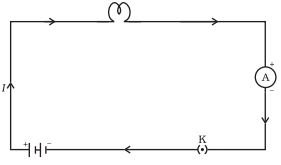
a) From the negative terminal to the positive terminal of the cell
b) From the positive terminal to the negative terminal of the cell through the circuit
c) In both directions simultaneously
d) Only through the bulb
Answer: b) From the positive terminal to the negative terminal of the cell through the circuit
Q. Refer to Figure. Which component is connected in series to measure the current flowing in the circuit?
a) Cell
b) Plug key
c) Ammeter
d) Connecting wire
Answer: c) Ammeter
Q. Refer to Figure. Which observation from the experiment shows that resistance depends on the length of the conductor?
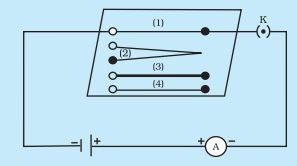
a) Using a thicker wire changes the current
b) Replacing nichrome with copper changes the current
c) Doubling the wire length changes the ammeter reading
d) Removing the plug key stops the current
Answer: c) Doubling the wire length changes the ammeter reading
Q. Refer to Figure. If the ammeter is moved to another position in the same series circuit, the reading will:
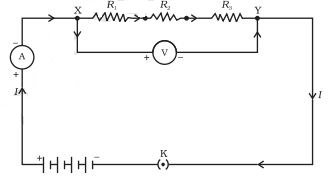
a) Increase
b) Decrease
c) Become zero
d) Remain unchanged
Answer: d) Remain unchanged
Q. Refer to Figure. The activity shown is mainly used to verify that:
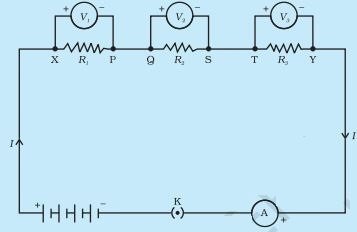
a) Current changes in a series circuit
b) Voltage is same across all resistors
c) Total potential difference equals the sum of individual potential differences
d) Resistance decreases in series combination
Answer: c) Total potential difference equals the sum of individual potential differences
Q. Refer to Figure. What is the main purpose of connecting the voltmeter across the parallel combination?
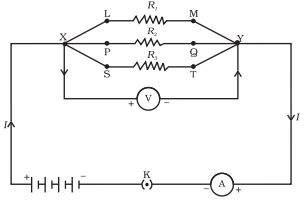
a) To measure current
b) To measure resistance directly
c) To measure potential difference across the combination
d) To increase current
Answer: c) To measure potential difference across the combination
Q. Refer to Figure. Why is the ammeter connected in series with each branch one at a time?
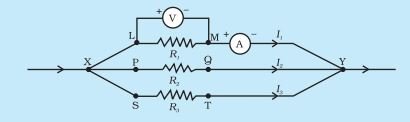
a) To measure the current in that branch
b) To measure voltage
c) To increase resistance
d) To decrease battery voltage
Answer: a) To measure the current in that branch
Q. In a circuit containing a resistor, if the potential difference remains constant and the current doubles, the electric power (P = VI) will:
a) Become half
b) Remain unchanged
c) Double
d) Become four times
Answer: c) Double
Q. According to the formula P = V²/R, if the voltage across a resistor is doubled while resistance remains constant, the power becomes:
a) Twice
b) Four times
c) Half
d) One-fourth
Answer: b) Four times
Disclaimer: The content that is present on our website is based on the NCERT Class 10 Science textbook and is provided for educational purposes only. All the content and images have been taken from Science Class 10 NCERT Textbook. Images and content shown above are the property of individual organizations and are used here for reference purposes only. To make it easy to understand, some of the content and images are generated by AI and cross-checked by the teachers.