
← Back to Class 9 Kaushal Vikas
Introduction to Agricultural Practices Class 9 Notes provide easy-to-understand explanations of the basic concepts of agriculture and farming practices. These notes cover important topics such as agricultural activities, crop production, soil preparation, sowing, irrigation, crop protection, harvesting and storage. Prepared according to the Kaushal Vikas (Skill Education) curriculum, these notes will help Class 9 students understand agricultural practices, learn essential concepts and prepare effectively for their examinations.
Introduction to Agricultural Practices Class 9 Notes
What is agriculture?
Agriculture means growing crops and raising animals for food, clothing, and other useful products. Examples:
- Growing rice, wheat, maize, vegetables, and fruits.
- Raising cows, goats, hens, and fish.
What is a crop calendar?
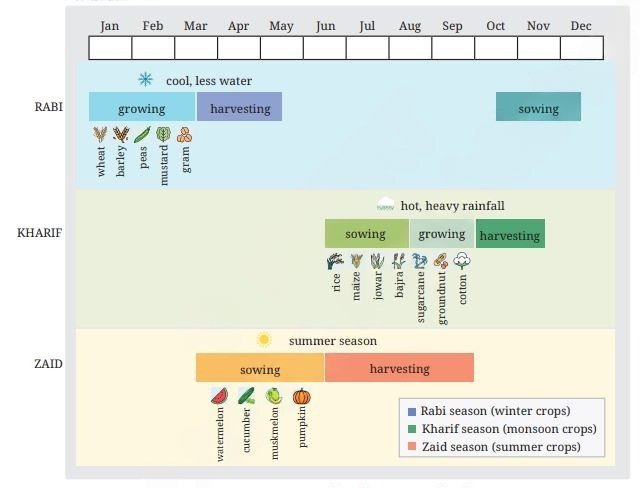
A crop calendar is a timetable that shows:
- When to sow seeds
- When to grow crops
- When to harvest crops
It helps farmers plan their work according to weather conditions like rainfall or soil conditions. For example,
Rabi Crops (Winter Crops)
- Sown: October-November
- Harvested: March-April
- Need cool weather and less water
Examples:
- Wheat
- Barley
- Peas
- Mustard
- Gram
Kharif Crops (Monsoon Crops)
- Sown: June-July
- Harvested: September-October
- Need hot weather and good rainfall
Examples:
- Rice
- Maize
- Jowar
- Bajra
- Cotton
- Groundnut
- Sugarcane
Zaid Crops (Summer Crops)
- Grown between Rabi and Kharif seasons
- Need warm weather
Examples:
- Watermelon
- Cucumber
- Muskmelon
- Pumpkin
Agriculture and India
India is One of the oldest agricultural civilisations. India is a leading producer of vegetables and fruits, milk, eggs, and fish.
According to the Economic Survey 2024-25, Indian agriculture contributes about 16% to India’s GDP, and about 46.1% of the workforce is employed in agriculture. The learning of agriculture helps students:
- Understand nature better.
- Learn how plants and animals grow.
- Develop practical life skills.
- Explore job and business opportunities.
Nowadays modern technologies are used in farming, like drones, robotics, biotechnology and artificial intelligence. These technologies help farmers:
- Increase production
- Save time
- Use resources wisely
What is Kṛiṣhi-parāśhara
Kṛiṣhi-parāśhara is an ancient Indian text that explains:
- Soil preparation
- Crop selection
- Irrigation methods
- Seasonal planning
- Pest control
It promotes:
- Natural farming methods
- Environmental protection
- Sustainable agriculture
What is a value chain?
A value chain is the journey of an agricultural product from the farm to the consumer. At every step, some work is done on the product, so its value and price increase.
Why Do Vegetables Cost More in Supermarkets?
Vegetables sold in supermarkets are often 300-400% more expensive than those sold directly in a mandi. This happens because extra costs are added at different stages.
Examples:
- Transportation
- Storage
- Packaging
- Processing
- Shop profit
How Does Value Increase?
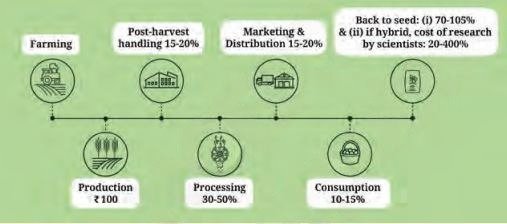
- Farm Production: The farmer grows the crop.
- Post-Harvest Handling: After harvesting, crops need cleaning, sorting, packing and storage. This adds 15-20% to the cost.
- Processing: Some products are processed before selling, like wheat to flour and oilseeds to cooking oil. This adds 30-50% more value.
- Transportation: Products are transported from farm to warehouse or market. Transport costs also increase the price.
- Storage: Products may be stored in warehouses or in cold storage. The storage costs increase the final price.
- Retail Sale: Shopkeepers and supermarkets add their profit before selling to customers. Therefore, consumers pay a higher price.
Agro-climatic relationship
What is an agro-climatic relationship?
‘Agro-climatic relationship’ means the connection between agriculture and climate. Climate affects:
- Crop growth
- Crop production
- Livestock rearing
Farmers choose crops according to the climate of their region. India has different climates, so different crops are grown in different places. For example:
| Region | Main Crops |
|---|---|
| Punjab & Haryana | Wheat |
| West Bengal | Rice |
| Maharashtra | Cotton, Sugarcane |
| Madhya Pradesh | Soyabean |
| Rajasthan | Millets (Bajra) |
| Himachal Pradesh & Kashmir | Fruits |
Role of IMD (India Meteorological Department)
The India Meteorological Department (IMD):
- Records weather information.
- Gives weather forecasts.
- Provides Agrotechnological Advisory Services (AAS).
- Helps farmers plan farming activities.
IMD forecasts weather information through SMS alerts, All India Radio, Doordarshan, community radio, mobile apps, Kisan Portal and Krishi Vikas Kendra (KVK). Apps like Bharat-VISTAAR, developed by the Government of India.
This weather information helps farmers to –
- Decide when to sow seeds
- Decide when to irrigate fields
- Protect crops from heavy rain, floods, or drought
- Plan harvesting
- Reduce crop losses
Animals are also affected by climate. In Ladakh, animals like the yak, goat, horse, and double-humped camel can be affected by extreme weather conditions.
Important Meteorological Parameters
A. Duration of Summer and Winter
For Ladakh:
- Farming season is very short.
- Crops can be grown mainly from May to September.
Any sudden weather change can harm crops.
B. Precipitation (Rainfall and Snowfall)
Rainfall and snowfall provide water for crops.
Effects:
Heavy rainfall:
- Floods may occur.
- Crops can be damaged.
Low rainfall:
- Water shortage occurs.
- Crop production decreases.
C. Temperature
In Ladakh:
- Day temperature: 20°C to 30°C
- Night temperature: 0°C to 5°C
This temperature is suitable for farming.
D. Humidity
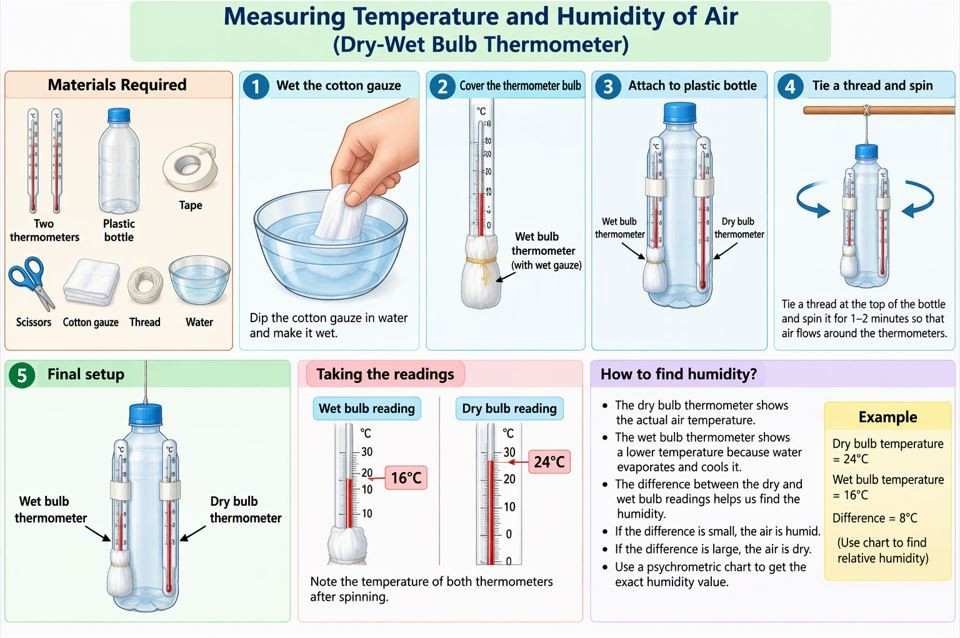
Humidity means the amount of water vapour in the air.
In Ladakh:
- Humidity is about 70–74% during May to September.
Low humidity causes:
- Faster water loss from plants.
- Dry soil.
E. Wind Direction and Speed
Strong winds can:
- Damage crops.
- Cause soil erosion.
- Reduce crop yield.
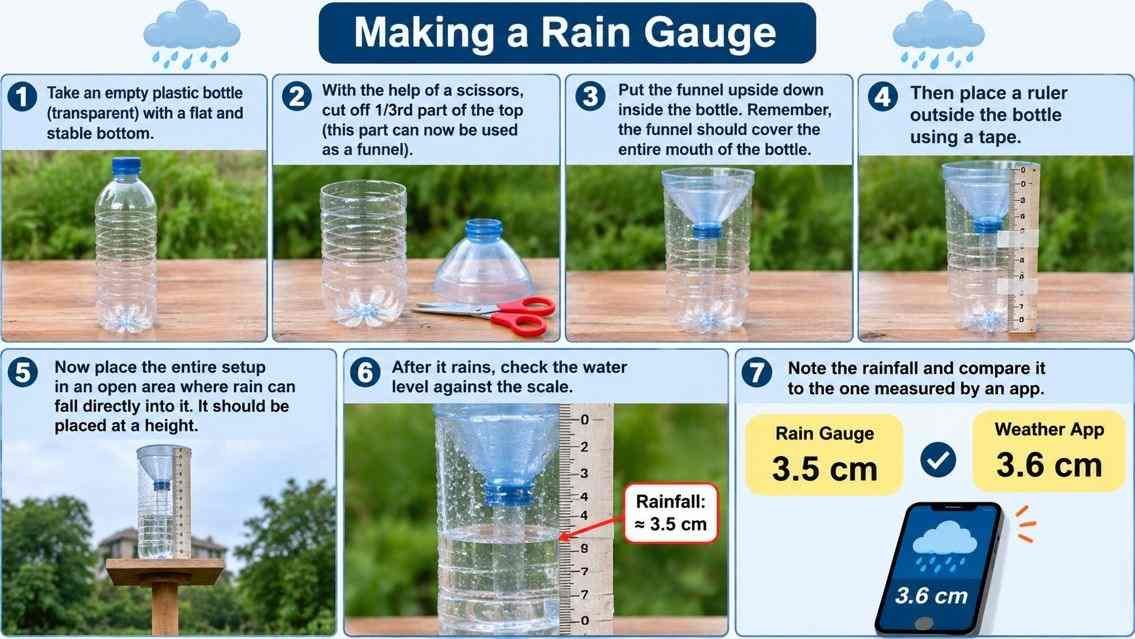
Make your own meteorological lab.
Making a rain gauge. The rain gauge helps to measure rainfall. The materials required –
- Plastic bottle
- Scissors
- Funnel
- Ruler
- Tape
Measuring temperature and humidity of air
Identifying the direction of the wind

What is soil testing?
Soil testing means checking the health and quality of soil. It helps farmers know:
- Whether the soil is good for plants.
- Which nutrients are present.
- What improvements are needed.
Healthy soil helps plants grow better and gives more yield.
Why is Soil Testing Important?
- Maintains soil fertility
- Helps plants grow healthy
- Improves crop production
- Identifies problems in soil
Types of Soil Properties Checked
There are three types of soil properties which we have to check –
- Physical Properties: These tell us about the structure of soil. For example, soil texture and water-holding capacity.
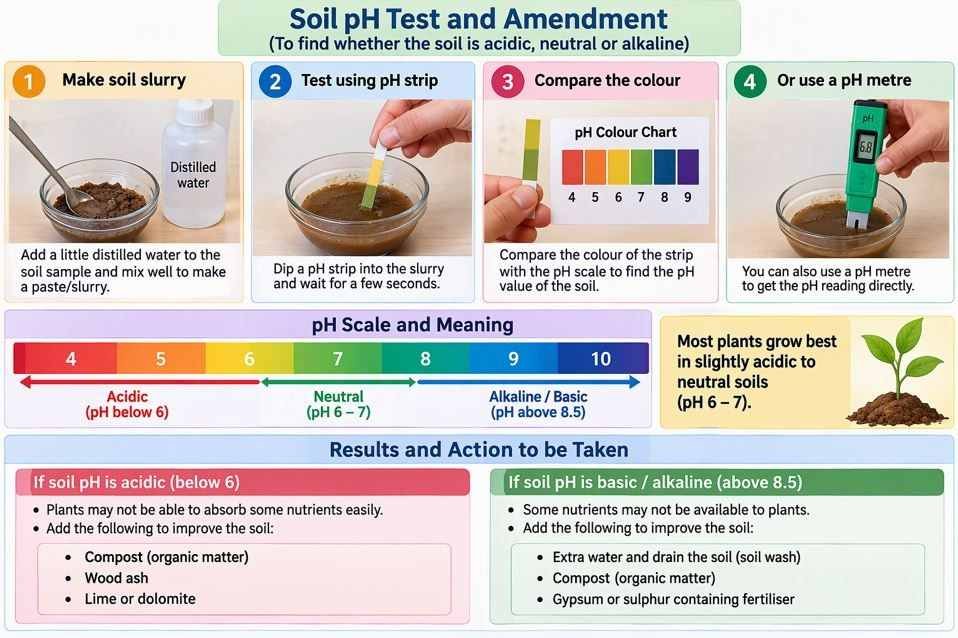
- Chemical Properties: These tell us about chemicals and nutrients in soil. For example, pH value, nutrient content and organic matter.
- Biological Properties: These tell us about living organisms in soil. For example, microbes, earthworms and beneficial bacteria
Soil Sample Collection
To get correct results, soil must be collected carefully.
Steps
- Collect soil from different places in the field.
- Avoid areas under trees.
- Avoid places where fertilisers are stored.
- Remove stones, leaves, and waste materials.
- Dry the soil in sunlight.
- Crush large lumps.
- Sieve the soil to get fine particles.
- Label the sample properly.
Write:
- Date of collection
- Place
- Previous crop grown
Field Soil Collection Method
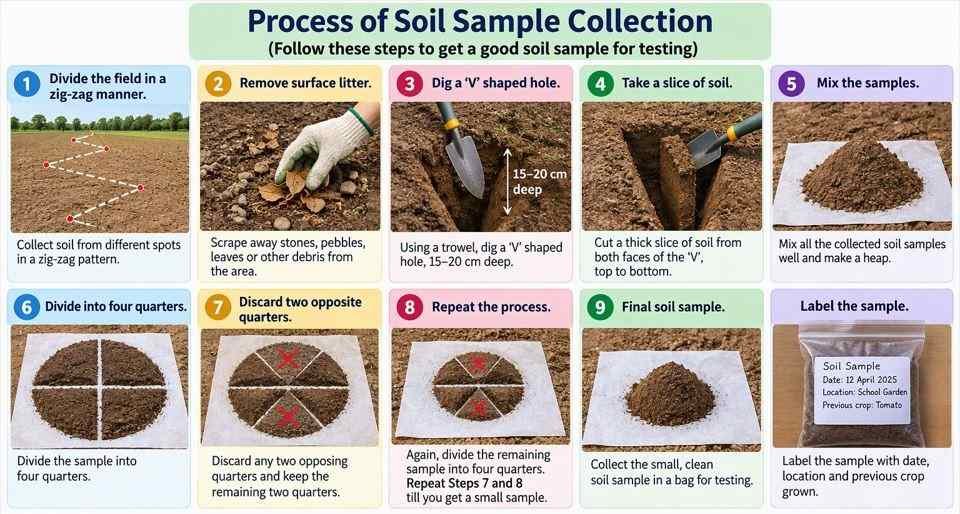
- Step 1: Walk through the field in a zig-zag pattern.
- Step 2: Remove stones, leaves, and other waste.
- Step 3: Dig a V-shaped hole about 15–20 cm deep.
- Step 4: Take soil from both sides of the hole.
- Step 5: Mix all soil samples together.
- Step 6: Make a heap and divide it into four parts.
- Step 7: Throw away two opposite parts.
- Step 8: Mix the remaining two parts.
- Step 9: Repeat until a small sample remains. This sample is used for testing.
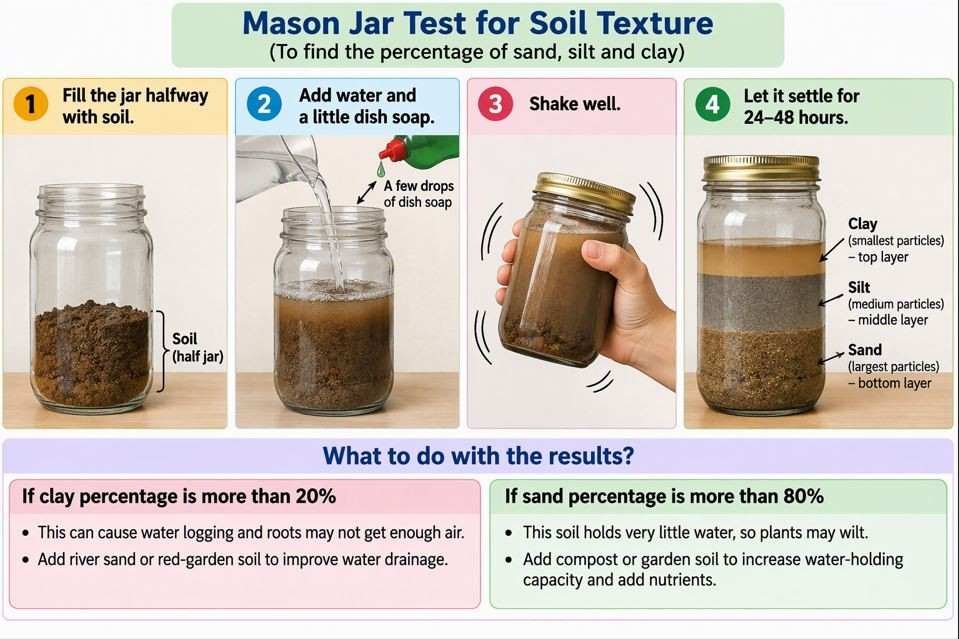
Testing soil for its clay and sand percentage (mason jar test)
pH test and amendment
Seed selection
What is Seed Selection?
Seed selection means choosing healthy and good-quality seeds for sowing. Good seeds produce:
- Healthy plants
- Better crop yield
- Strong growth
Poor-quality seeds produce:
- Weak plants
- Low yield
- More diseases
Even if the soil is very fertile, weak seeds cannot produce a good crop.
Germination Test
A germination test helps us know:
- How many seeds will sprout.
- Whether seeds are healthy or not.
Importance of Germination Test
- Helps farmers know how many seeds to sow.
- Reduces wastage of seeds.
- Improves crop production.
Seed Treatment
Before sowing, seeds are treated to:
- Increase germination.
- Protect seeds from insects.
- Protect seeds from diseases.
Seed selection using the floating method
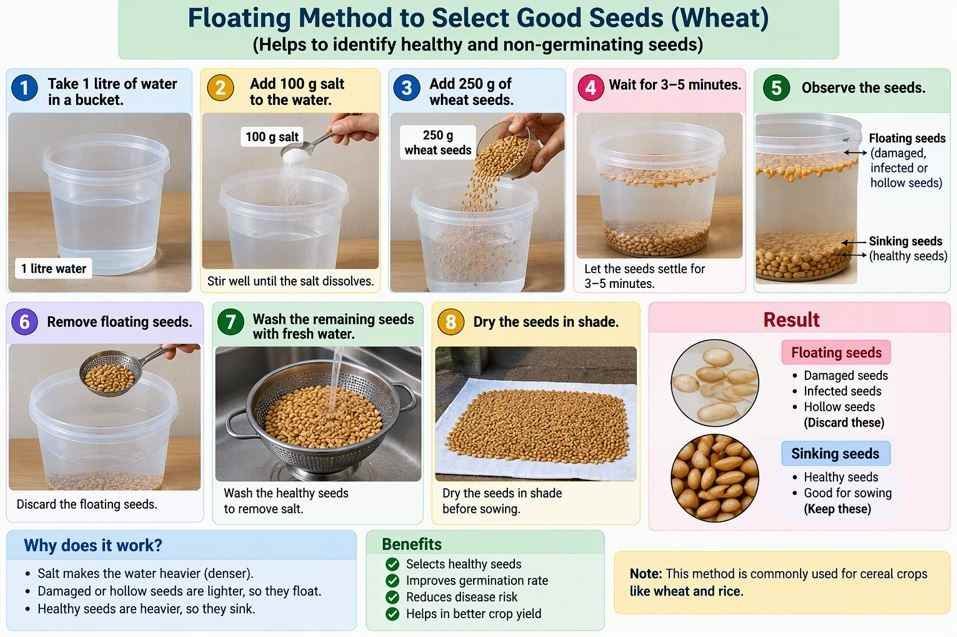
What is Seed Dormancy?
Seed dormancy is a natural condition in which the seed is alive but it does not germinate. This helps seeds survive during unfavourable conditions.
Why is Dormancy Useful?
It prevents seeds from growing when:
- Water is not available.
- Temperature is not suitable.
- Conditions are not favourable.
- Breaking Dormancy
Sometimes seeds need treatment before germination. For example, rice seeds can be soaked in warm water for a few hours. This helps seeds germinate faster.
Preparing organic fertilisers and pesticides
Organic Fertilisers
Organic fertilisers are natural materials that improve soil fertility. For example, vermicompost is made by cow dung, agricultural waste or due to earthworms. The organic fertiliser helps to improve soil fertility; it helps to add nutrients and helps to improve soil structure.
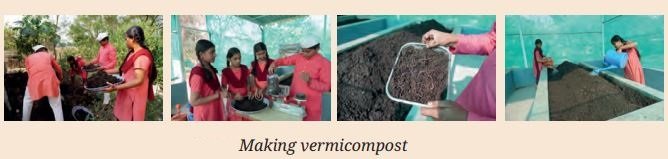
Organic Pesticide (Daśhaparṇī Arka)
Daśhaparṇī Arka is a natural pesticide. It is made by –
- Neem leaves
- Karanj leaves
- Papaya leaves
- Tulsi leaves
- Hibiscus leaves
- Cow dung
- Cow urine
- Water
and other plant materials.
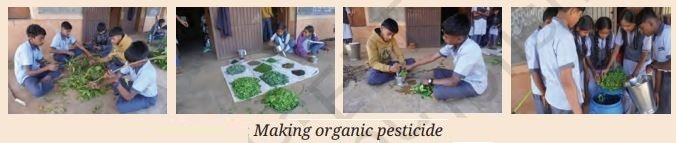
The benefits of organic pesticides are that they are eco-friendly, help to control pests, are safe for plants and reduce chemical use.
Selection of vocation
What are agricultural vocations?
Agricultural vocations are jobs related to farming and agriculture. For example,
- Rooftop gardening
- Precision farming
- Mushroom cultivation
- Aquaponics
- Pisciculture (fish farming)
- Backyard poultry
- Organic farming
- Choosing a Vocation
Before selecting any agricultural work, ask:
- Can it be completed within 3 months?
- Is enough space available?
- Is an expert available to guide?
- Are resources available?
- Can real hands-on work be done?
Disclaimer: The content that is present on our website is based on the NCERT Class 9 Kaushal Vikas textbook and is provided for educational purposes only. All the content and images have been taken from Kaushal Vikas Class 9 NCERT Textbook and CBSE Support material. Images and content shown above are the property of individual organizations and are used here for reference purposes only. To make it easy to understand, some of the content and images are generated by AI and cross-checked by the teachers.