
← Back to Class 10 Study Material
Practise Magnetic Effects of Electric Current Class 10 MCQs to revise important concepts and prepare for the CBSE Science examination. These MCQs are designed to help students check their understanding, improve accuracy, and become familiar with exam-oriented questions. Regular practice can help students identify weak areas and build confidence for the Class 10 Science Board Examination.

Magnetic Effects of Electric Current Class 10 MCQ
Conceptual Recall
Q. The region surrounding a magnet where its magnetic force can be experienced is called:
a) Electric field
b) Magnetic field
c) Magnetic domain
d) Magnetic circuit
Answer: b) Magnetic field
Q. A compass needle is actually a:
a) Current-carrying conductor
b) Soft iron strip
c) Small bar magnet
d) Solenoid
Answer: c) Small bar magnet
Q. A coil of many circular turns of insulated copper wire wound closely in the shape of a cylinder is called a:
a) Resistor
b) Solenoid
c) Galvanometer
d) Fuse
Answer: b) Solenoid
Q. The magnetic field inside a long current-carrying solenoid is:
a) Zero everywhere
b) Non-uniform
c) Uniform
d) Circular only
Answer: c) Uniform
Q. In domestic electric wiring, the wire with red insulation is generally called the:
a) Neutral wire
b) Earth wire
c) Live wire
d) Fuse wire
Answer: c) Live wire
Q. The potential difference between the live wire and neutral wire in Indian households is:
a) 110 V
b) 220 V
c) 440 V
d) 12 V
Answer: b) 220 V
Application-Based
Q. When current is passed through a straight conductor placed near a compass needle, the needle gets deflected. This shows that:
a) Current produces heat only
b) Current produces a magnetic effect
c) Magnetic field destroys current
d) Compass needle becomes electrically charged
Answer: b) Current produces a magnetic effect
Q. Iron filings sprinkled around a bar magnet arrange themselves in a definite pattern because:
a) They become electrically charged
b) They experience magnetic force due to the magnet
c) Gravity acts differently on them
d) They are attracted towards the paper
Answer: b) They experience magnetic force due to the magnet
Q. The direction of the magnetic field at a point is taken as the direction in which:
a) A south pole moves
b) Current flows
c) The north pole of a compass needle points
d) Electrons move
Answer: c) The north pole of a compass needle points
Q. A soft iron rod is placed inside a current-carrying solenoid. The rod becomes magnetised and behaves as an:
a) Permanent magnet
b) Insulator
c) Ammeter
d) Electromagnet
Answer: d) Electromagnet
Q. In a current-carrying solenoid, one end behaves as a north pole and the other as a south pole. This shows that the magnetic field around a solenoid is similar to that of a:
a) Current-carrying straight wire
b) Circular loop only
c) Bar magnet
d) Compass needle only
Answer: c) Bar magnet
Q. A current-carrying conductor placed perpendicular to a magnetic field experiences the:
a) Maximum force
b) Minimum force
c) Zero force
d) Same force in all directions
Answer: a) Maximum force
Q. Why is the metallic body of appliances such as electric iron and refrigerator connected to the earth wire?
a) To increase current flow
b) To reduce electricity consumption
c) To increase voltage
d) To protect the user from electric shock
Answer: d) To protect the user from electric shock
Q. A home appliance develops leakage current to its metallic body. The earth wire helps by:
a) Increasing the appliance power
b) Providing a low-resistance path for current to flow to the ground
c) Increasing the resistance of the circuit
d) Stopping current in the live wire
Answer: b) Providing a low-resistance path for current to flow to the ground
Q. Which of the following appliances is normally connected to the 15 A circuit in a house?
a) Electric bulb
b) Ceiling fan
c) Geyser
d) LED lamp
Answer: c) Geyser
Assertion–Reason
Q. Assertion (A): Magnetic field lines emerge from the north pole and enter the south pole of a magnet.
Reason (R): Outside a magnet, the magnetic field is directed from north pole to south pole.
a) Both A and R are true, and R is the correct explanation of A
b) Both A and R are true, but R is not the correct explanation of A
c) A is true, but R is false
d) A is false, but R is true
Answer: a) Both A and R are true, and R is the correct explanation of A
Q. Assertion (A): No two magnetic field lines can intersect each other.
Reason (R): At the point of intersection, the magnetic field would have two directions, which is not possible.
a) Both A and R are true, and R is the correct explanation of A
b) Both A and R are true, but R is not the correct explanation of A
c) A is true, but R is false
d) A is false, but R is true
Answer: a) Both A and R are true, and R is the correct explanation of A
Q. Assertion (A): Magnetic field lines emerge from the north pole and enter the south pole of a magnet.
Reason (R): Outside a magnet, the magnetic field is directed from north pole to south pole.
a) Both A and R are true, and R is the correct explanation of A
b) Both A and R are true, but R is not the correct explanation of A
c) A is true, but R is false
d) A is false, but R is true
Answer: a) Both A and R are true, and R is the correct explanation of A
Q. Assertion (A): No two magnetic field lines can intersect each other.
Reason (R): At the point of intersection, the magnetic field would have two directions, which is not possible.
a) Both A and R are true, and R is the correct explanation of A
b) Both A and R are true, but R is not the correct explanation of A
c) A is true, but R is false
d) A is false, but R is true
Answer: a) Both A and R are true, and R is the correct explanation of A
Q. Assertion (A): The magnetic field lines inside a solenoid are parallel straight lines.
Reason (R): The magnetic field inside a solenoid is uniform.
a) Both A and R are true, and R is the correct explanation of A
b) Both A and R are true, but R is not the correct explanation of A
c) A is true, but R is false
d) A is false, but R is true
Answer: a) Both A and R are true, and R is the correct explanation of A
Q. Assertion (A): The direction of force on a current-carrying conductor changes when the direction of current is reversed.
Reason (R): The direction of force depends on both the current and the magnetic field.
a) Both A and R are true, and R is the correct explanation of A
b) Both A and R are true, but R is not the correct explanation of A
c) A is true, but R is false
d) A is false, but R is true
Answer: a) Both A and R are true, and R is the correct explanation of A
Q. Assertion (A): Household electrical appliances are connected in parallel.
Reason (R): Each appliance receives the same potential difference and can operate independently.
a) Both A and R are true, and R is the correct explanation of A
b) Both A and R are true, but R is not the correct explanation of A
c) A is true, but R is false
d) A is false, but R is true
Answer: a) Both A and R are true, and R is the correct explanation of A
Q. Assertion (A): A fuse is connected in series in a domestic circuit.
Reason (R): It protects appliances by breaking the circuit when excessive current flows.
a) Both A and R are true, and R is the correct explanation of A
b) Both A and R are true, but R is not the correct explanation of A
c) A is true, but R is false
d) A is false, but R is true
Answer: a) Both A and R are true, and R is the correct explanation of A
Case Study-Based
Case Study: A student places a bar magnet under a sheet of paper and sprinkles iron filings around it. After gently tapping the sheet, the iron filings arrange themselves in curved patterns. The student also observes that the filings are more crowded near the ends of the magnet.
Q. The curved patterns formed by iron filings represent:
a) Electric field lines
b) Magnetic field lines
c) Paths of electrons
d) Gravitational lines
Answer: b) Magnetic field lines
Q. The crowding of iron filings near the poles indicates that the magnetic field is:
a) Weaker near the poles
b) Absent near the poles
c) Uniform everywhere
d) Stronger near the poles
Answer: d) Stronger near the poles
Case Study: A student places an aluminium rod between the poles of a strong horseshoe magnet and passes electric current through it. He observes that the rod gets displaced. When the direction of current is reversed, the rod moves in the opposite direction. He also notices that reversing the magnetic field reverses the direction of motion.
Q. The displacement of the rod shows that a magnetic field exerts a:
a) Voltage
b) Resistance
c) Force on a current-carrying conductor
d) Charge on the conductor
Answer: c) Force on a current-carrying conductor
Q. The direction of force on the conductor depends on:
a) Resistance only
b) Current only
c) Magnetic field only
d) Both current and magnetic field
Answer: d) Both current and magnetic field
Case Study: A family switches on several high-power appliances using the same socket. After a short time, the fuse melts and the supply to the appliances stops. The electrician explains that too much current was drawn from the circuit.
Q. The situation described above is an example of:
a) Earthing
b) Overloading
c) Electromagnetic induction
d) Magnetic shielding
Answer: b) Overloading
Q. The fuse melts because of:
a) Cooling effect of current
b) Magnetic effect of current
c) Joule heating due to excessive current
d) Chemical reaction in the wire
Answer: c) Joule heating due to excessive current
Diagram/Visual-Based
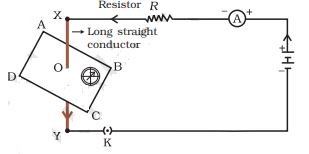
Q. Refer to Figure. What observation confirms the magnetic effect of electric current?
a) Heating of the wire
b) Glowing of the bulb
c) Deflection of the compass needle
d) Increase in resistance
Answer: c) Deflection of the compass needle
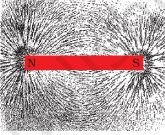
Q. Refer to Figure. Why are the magnetic field lines shown as closed curves?
a) Field lines start and end at the north pole
b) Field lines start and end at the south pole
c) Outside and inside the magnet, field lines form a continuous closed path
d) Iron filings form circular loops automatically
Answer: c) Outside and inside the magnet, field lines form a continuous closed path
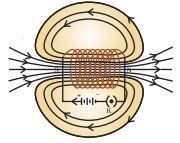
Q. Refer to Figure. Which statement correctly describes the magnetic field inside a current-carrying solenoid?
a) It is circular and non-uniform
b) It is strongest only at the ends
c) It consists of parallel field lines indicating a uniform field
d) It does not exist inside the solenoid
Answer: c) It consists of parallel field lines indicating a uniform field
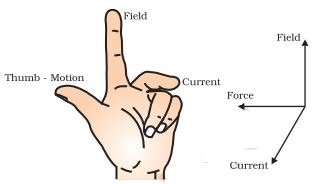
Q. Refer to Figure. According to Fleming’s Left-Hand Rule, if the forefinger represents the magnetic field and the middle finger represents the current, then the thumb represents:
a) Resistance
b) Motion or force on the conductor
c) Voltage
d) Magnetic pole
Answer: b) Motion or force on the conductor
Q. Refer to Figure. Why are domestic appliances connected in parallel with the live and neutral wires?
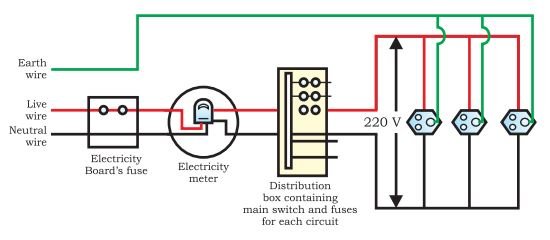
a) To ensure that all appliances receive the same potential difference
b) To increase the total resistance of the circuit
c) To make current the same through all appliances
d) To reduce the voltage supplied to each appliance
Answer: a) To ensure that all appliances receive the same potential difference
Q. Refer to Figure. Which wire is connected to the metallic body of appliances as a safety measure?
a) Live wire
b) Neutral wire
c) Fuse wire
d) Earth wire
Answer: d) Earth wire
Disclaimer: The content that is present on our website is based on the NCERT Class 10 Science textbook and is provided for educational purposes only. All the content and images have been taken from Science Class 10 NCERT Textbook. Images and content shown above are the property of individual organizations and are used here for reference purposes only. To make it easy to understand, some of the content and images are generated by AI and cross-checked by the teachers.