
← Back to Class 9 Social Science MCQs
Explore Governance and Public Policy Class 9 NCERT Solutions to understand the important concepts of this Social Science chapter in simple and easy language. These solutions cover public policy, good governance, policy coordination, the role of government, and the participation of different stakeholders in policymaking. Students can also learn about Khelo Bharat Niti 2025 and understand how central, state, and local governments work together to implement policies effectively. These question answers will help students revise key concepts and prepare for their examinations.
Governance and Public Policy Class 9 NCERT Solutions
Q. What is governance, and how have its meaning and practice evolved over time?
Answer: Governance is the process of making, implementing, and monitoring decisions for the welfare of people. It involves the government, citizens, media, civil society, and private organisations working together. In India, the idea of governance evolved from ancient institutions like the Sabhā and Samiti, and concepts such as Rājadharma and Rām Rājya, to the modern democratic system based on the Constitution. Today, governance focuses on transparency, accountability, participation, and public welfare.
Q. What is public policy? How does it affect our day-to-day lives, and what makes it ‘public’?
Answer: Public policy is a course of action adopted by the government to solve public problems, meet people’s needs, and promote the welfare of society. It affects our daily lives through services such as education, healthcare, transport, clean drinking water, sanitation, and public safety. A policy is called public because it is made for the benefit of all people, implemented by public institutions, and often funded by public money collected through taxes.
Q. What are the various stages of policy-making and policy implementation?
Answer: The stages of the policy process are:
- Policy Desirability (Problem Identification) – Identifying public needs and problems.
- Policy Formulation – Consulting stakeholders and preparing the policy.
- Policy Adoption – Approving laws, rules, and regulations.
- Policy Implementation – Putting the policy into action.
- Policy Monitoring – Tracking progress and identifying problems.
- Policy Evaluation – Assessing results and making improvements.
These stages help ensure that policies achieve their objectives effectively.
Q. Who are the major contributors to policy-making and implementation?
Answer: The major contributors are:
- Citizens – Identify issues, give suggestions, and provide feedback.
- Elected Representatives (MPs, MLAs, Local Representatives) – Raise public issues and make laws.
- Government Officials, Departments, and Ministries – Prepare and implement policies.
- Civil Society Organisations, NGOs, Experts, Researchers, and Media – Create awareness and suggest solutions.
- Private Sector – Provides innovation, expertise, and resources.
- International Organisations – Offer technical support and international experience.
All these groups work together to make and implement public policies.
Q. What role do citizens play in shaping public policy and strengthening good governance?
Answer: Citizens play an important role by identifying problems, expressing concerns, giving suggestions, participating in consultations, providing feedback, voting in elections, following laws, and taking part in community activities. Their participation helps improve public policies and makes governance more transparent, accountable, and responsive to people’s needs. Active citizen participation strengthens democracy and promotes good governance.
Q.1. As a student, what role can you play in the successful implementation of Khelo Bharat Niti 2025?
Answer: As a student, I can actively participate in sports and physical activities. I can encourage my classmates to take part in sports, maintain sports facilities properly, and support a healthy lifestyle. I can also help identify and promote local sports talent.
Q.2. Your school is designated as the ‘state’s sports ambassador’. What actions should it take to fulfil its role as sports ambassador?
Answer: The school should organise regular sports events and competitions. It should encourage all students, including girls and specially abled students, to participate in sports. The school should provide training, identify talented players, create awareness about fitness, and promote a sporting culture among students.
Q.3. What actions should it take to fulfil its role as sports ambassador?
Answer: The school should:
- Organise sports tournaments and training camps.
- Encourage maximum student participation in sports.
- Promote physical fitness and healthy habits.
- Support talented athletes with proper coaching.
- Create awareness about the benefits of sports.
- Work with local sports institutions and coaches.
Q.4. Which ministries of the government can contribute towards the success of Khelo Bharat Niti 2025? How?
Answer:
- Ministry of Youth Affairs and Sports: Provides sports policies, funding, and training programmes.
- Ministry of Education: Promotes sports activities in schools and colleges.
- Ministry of Health and Family Welfare: Supports fitness, nutrition, and healthcare for sportspersons.
- Ministry of Science and Technology: Encourages research for better sports equipment and training methods.
- Ministry of Information and Broadcasting: Creates awareness and promotes sports through media.
Together, these ministries help develop sports infrastructure, encourage participation, and support athletes across the country.
Q. “Good governance is the responsibility of the government alone.” Do you agree with this statement? Give reasons to support your answer.
Answer: No, I do not agree with this statement. Good governance is a shared responsibility of the government, citizens, media, civil society organisations, and the private sector. The government makes laws and policies, but citizens participate in public life, the media raises awareness, and other organisations help implement and monitor programmes. Therefore, good governance is achieved when all work together.
Q. Do you think students can contribute to good governance? Write a short note describing any five ways in which students can become more responsible and active citizens.
Answer: Yes, students can contribute to good governance.
Five ways students can become responsible and active citizens are:
- Following rules and laws responsibly.
- Participating in community and school activities.
- Keeping public places clean and promoting cleanliness.
- Creating awareness about social and environmental issues.
- Giving useful suggestions and feedback on public services.
By doing these activities, students can help strengthen democracy and good governance.
Q. Choose any one public policy and prepare a chart.
Answer:
Swachh Bharat Mission
| Aspect | Details |
|---|---|
| Problem it | Poor sanitation, open defecation, and unclean surroundings |
| Major stakeholders involved | Government, local bodies, citizens, schools, NGOs, and media |
| How different actors coordinate | Government provides funds and guidelines, local bodies implement projects, NGOs create awareness, and citizens participate in cleanliness drives |
| Role of citizens | Maintain cleanliness, segregate waste, use toilets, and support sanitation programmes |
Q. What is governance?
Answer: Governance is the process of decision-making, implementation, and monitoring for the welfare of people.
Q. How is governance different from government?
Answer: Government refers to institutions that exercise political authority, while governance refers to the process through which decisions are made, implemented, and monitored.
Q. What is meant by public policy?
Answer: Public policy is a course of action adopted by the government to solve public problems, meet people’s needs, and promote public welfare.
Q. Name any four principles of good governance.
Answer:
- Transparency
- Accountability
- Participation
- Rule of Law
Q. Compare Government and Governance.
Answer:
| Government | Governance |
|---|---|
| Refers to institutions that exercise political authority | Refers to the process of decision-making and implementation |
| Includes Legislature, Executive, and Judiciary | Includes government, citizens, media, civil society, and private organisations |
| Focuses on who governs | Focuses on how governing is carried out |
Q. Compare Policy and Public Policy.
Answer:
| Policy | Public Policy |
|---|---|
| Applies to a specific organisation or group | Applies to society as a whole |
| May be made by schools, companies, clubs, or families | Made by the government |
| Benefits a limited group of people | Benefits the public |
| Example: School mobile phone policy | Example: Swachh Bharat Mission, Ayushman Bharat |
Q. Imagine you have been appointed to advise the district administration on improving governance. You have proposed six points (given below), but the administration decides to prioritise only three areas for improvement. Which three would you recommend as priority areas, and which one out of the three do you feel is the most important?
- Improve drinking water facilities in schools.
- Improve sanitation and public toilets in schools and market areas.
- Provide tricycles for orthopaedically challenged students.
- Install open-area swings and open-air gym in public parks.
- Ensure the vaccination of stray dogs to prevent rabies.
- Ensure distribution of iron and folic acid tablets for female students in schools.
Answer: I would recommend the following three priority areas:
- Improve drinking water facilities in schools.
- Improve sanitation and public toilets in schools and market areas.
- Ensure distribution of iron and folic acid tablets for female students in schools.
Most Important: Improve drinking water facilities in schools.
- Reason: Safe drinking water is a basic necessity for health and well-being. It helps prevent diseases and supports students’ learning and development. Along with sanitation and proper nutrition, it contributes to a healthier and more productive society.
Explanation:
- Drinking water facilities ensure good health and reduce water-borne diseases.
- Sanitation and public toilets improve hygiene and cleanliness in schools and public places.
- Iron and folic acid tablets help improve the health of female students and prevent anaemia.
These three areas directly support public health, education, and overall welfare, which are important goals of good governance.
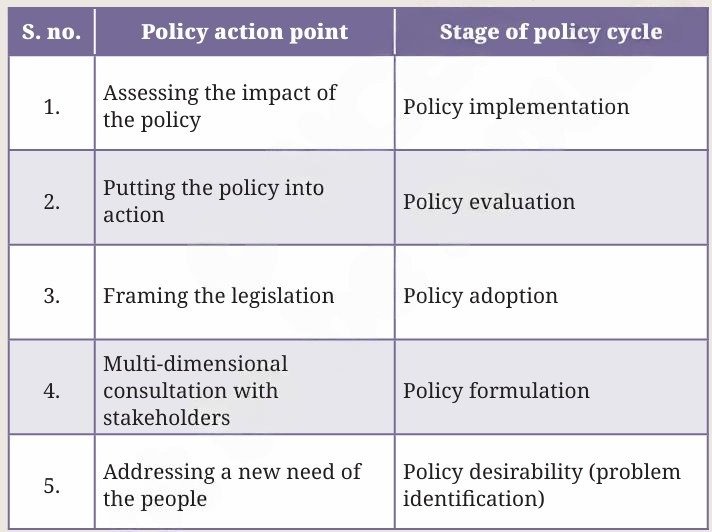
Q. Match the policy action point to its corresponding stage in the policy cycle.
Answer:
- Assessing the impact of the policy → Policy Evaluation
- Putting the policy into action → Policy Implementation
- Framing the legislation → Policy Adoption
- Multi-dimensional consultation with stakeholders → Policy Formulation
- Addressing a new need of the people → Policy Desirability (Problem Identification)
Q. Read the following case and answer the given questions.
Case: The government launches a programme to plant one lakh trees in a city. Funds are allocated, but only a few saplings survive because they are not watered or protected.
Q. Which stage of the policy cycle appears to be weak?
Answer: The Policy Implementation stage appears to be weak because the saplings were planted but not properly watered and protected.
Q. Which organisations should coordinate to improve the programme?
Answer: The local government authorities, municipal corporation, forest department, schools, NGOs, and citizen groups should coordinate to improve the programme.
Q. Suggest two measures that could improve the outcome.
Answer:
- Arrange regular watering and maintenance of the saplings.
- Protect the saplings using tree guards and involve local communities in their care.
Q.9. Read each statement carefully. Do you agree or disagree? Give reasons for your answer.
(a) A good public policy can fail if it is not implemented properly.
Answer: I agree. A good policy can fail if it is not implemented properly. Even if funds and plans are available, the policy will not achieve its goals without proper execution, monitoring, and coordination.
(b) Citizen participation sometimes makes decision-making slower, but it can improve governance.
Answer: I agree. Citizen participation may take more time because different opinions are considered. However, it improves governance by making policies more responsive, transparent, and suitable for people’s needs.
(c) Technology alone cannot ensure good governance.
Answer: I agree. Technology can make services faster and more accessible, but good governance also requires accountability, transparency, citizen participation, effective institutions, and responsible officials.
Q. Design a public policy. You are a member of your school’s student representative body. Identify one issue, for example, plastic waste, water wastage, road safety, energy conservation, or littering in public places. Prepare a simple policy proposal that includes the following aspects of policymaking:
Answer:
Policy Proposal: Save Water Policy
Issue Selected: Water Wastage
1. Reason for Selecting the Issue
Answer: Water is being wasted in schools through leaking taps and careless use. Saving water is important because it is an essential natural resource.
2. Proposed Solution
Answer:
- Repair leaking taps immediately.
- Install water-saving taps.
- Conduct awareness programmes on water conservation.
- Display posters encouraging students to save water.
3. Who Should Implement It?
Answer:
- School management
- Teachers
- Student representatives
- Maintenance staff
4. How Will Students Participate?
Answer:
- Use water carefully.
- Report leaking taps.
- Participate in awareness campaigns.
- Encourage classmates to conserve water.
5. How Will You Know Whether the Policy Has Succeeded?
Answer:
- Reduction in water wastage.
- Fewer leaking taps in the school.
- Greater student awareness about water conservation.
- Lower water consumption compared to previous months.
Disclaimer: The content that is present on our website is based on the NCERT Class 9 Social Science textbook and is provided for educational purposes only. All the content and images have been taken from Social Science Class 9 NCERT Textbook and CBSE Support material. Images and content shown above are the property of individual organizations and are used here for reference purposes only. To make it easy to understand, some of the content and images are generated by AI and cross-checked by the teachers.