
← Back to Class 9 Social Science MCQs
Managing Your Personal Finances, Class 9 students learn how to manage money wisely and make informed financial decisions. The chapter explains the five pillars of personal finance: income, budgeting, saving, investing, and protection. It also covers common investment options such as fixed deposits, bonds, stocks, and mutual funds, along with insurance, borrowing, risk and return, and income tax. These NCERT Solutions provide clear and easy-to-understand answers to help students understand the concepts and prepare for examinations.

Managing your Personal Finances Class 9 NCERT Solutions
Q. What is personal finance and why is it important?
Answer: Personal finance is the planning and management of a person’s money. It is important because it helps people spend wisely, save money, and achieve future goals.
Q. What are the pillars of personal finance?
Answer: The five pillars of personal finance are:
- Income
- Budgeting
- Saving
- Investing
- Protection and Risk Management
Q. What are some common savings and investment options?
Answer: Common options include:
- Fixed Deposits (FDs)
- Public Provident Fund (PPF)
- Bonds
- Stocks (Shares)
- Mutual Funds
Q. How can you protect your savings and assets?
Answer: You can protect your savings and assets through:
- Health insurance
- Life insurance
- General insurance
- Responsible borrowing and debt management
Q. What is income tax?
Answer: Income tax is a direct tax paid by individuals on the income they earn in a financial year. It helps the government provide public services such as schools, hospitals, and roads.
Q. Sai’s taxable income is ₹3,80,000 in a financial year. How much income tax does he have to pay according to the above tax slabs?
Answer: Sai’s taxable income is ₹3,80,000, which falls under the Nil tax slab (up to ₹4,00,000). Therefore, he has to pay ₹0 as income tax.
Q. Ask your parents, relative or a person in your neighbourhood if they file personal income tax returns. Make a small report on the procedure to file an income tax return. You may refer to the following website: https://incometaxindia.gov.in/Pages/tax-services/file-income-tax-return.aspx
Answer: Procedure for Filing an Income Tax Return (ITR)
- Visit the Income Tax e-Filing Portal.
- Log in using the PAN number and password.
- Select the relevant Assessment Year and ITR form.
- Enter details of income, such as salary, business income, interest, etc.
- Provide information about deductions and tax paid.
- Check all details carefully and calculate the tax payable or refund due.
- Submit the Income Tax Return online.
- Verify the return electronically using Aadhaar OTP, net banking, or other available methods.
- After successful verification, an acknowledgement receipt is generated for future reference.
Filing an income tax return is an important responsibility of citizens. It helps the government collect revenue for public services such as roads, hospitals, schools, and national development. Filing returns on time also ensures transparency and compliance with tax laws.
Q. Why is managing money wisely important for all individuals irrespective of their income?
Answer: Managing money wisely is important because it helps people meet their needs, save for the future, handle emergencies, and achieve financial goals. It ensures financial security regardless of income.
Q. How can budgeting help people balance their present needs with their future financial goals? Give examples.
Answer: Budgeting helps people plan their income and expenses. It controls unnecessary spending and allows money to be saved for future goals.
Examples:
- Saving every month for a school trip.
- Saving money to buy sports equipment after a few months.
- Setting aside money for higher education or emergencies.
Q. School Reopening Budget Activity: Your parents have given you ₹3,000 to prepare for the new school year. Make a list of the items you need, find out their prices (by visiting local stores, or asking a parent or teacher), and prepare a budget. Calculate the total cost and check whether it stays within ₹3,000.
- If your total is less than ₹3,000, you may add one additional item of your choice.
- If your total exceeds ₹3,000, decide which item(s) you can postpone or avoid buying to stay within your budget.
Use the budget template provided and ensure that all expenses are accurately calculated.
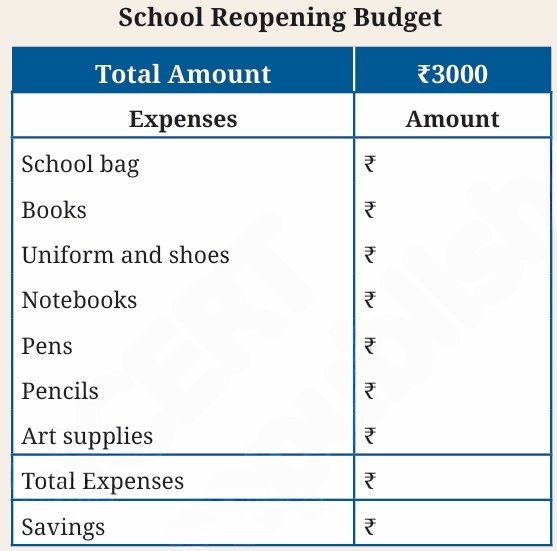
Answer: Total Amount: ₹3,000
| Expenses | Amount (₹) |
|---|---|
| School bag | 800 |
| Books | 700 |
| Uniform and shoes | 900 |
| Notebooks | 250 |
| Pens | 100 |
| Pencils | 50 |
| Art supplies | 100 |
| Total Expenses | 2,900 |
| Savings | 100 |
The total expenses are ₹2,900, which is within the budget of ₹3,000. Therefore, the savings are ₹100.
Q. Why is saving alone often not enough to build wealth in the long run? How do investments help increase the value of money over time?
Answer: Saving alone is not enough to build wealth because inflation reduces the purchasing power of money over time. Investments help money grow by earning returns and benefiting from compounding. Therefore, investing helps increase wealth and protect the value of money in the long run.
Q. Investment Planning Activity: Suppose you received cash gifts worth ₹3000 on your last birthday and decided to save ₹1500. With the help of your teacher, calculate the returns you might have earned if you had invested this amount in different combinations of investments. For example, what returns would you have received if you had invested ₹500 in a fixed deposit, ₹800 in the stock market, and ₹200 in gold? Try other combinations and find information on the returns from different investment options using reliable sources, such as newspapers, magazines, or official websites. Based on your findings, prepare an investment plan explaining why you think each investment option is suitable or unsuitable.
Answer: Suppose I invested ₹1500 as follows:
| Investment Option | Amount Invested (₹) | Assumed Annual Return | Return Earned (₹) |
|---|---|---|---|
| Fixed Deposit (FD) | 500 | 7% | 35 |
| Stocks | 800 | 10% | 80 |
| Gold | 200 | 8% | 16 |
| Total | 1500 | 131 |
Total amount after one year = ₹1500 + ₹131 = ₹1631
Investment Plan:
- Fixed Deposit: Suitable because it is safe and gives assured returns.
- Stocks: Suitable for higher returns, but involves higher risk.
- Gold: Suitable because it helps protect wealth and can increase in value over time.
Q. How does inflation affect the value of money over time? Why should people consider inflation while making financial decisions?
Answer: Inflation is the increase in the prices of goods and services over time. As prices rise, the same amount of money can buy fewer goods and services.
People should consider inflation while making financial decisions because it reduces the purchasing power of money. Investing helps money grow and protects its value against inflation.
Q. Different investment options involve different levels of risk and return. Do you think taking higher risks is always the best way to earn higher returns? How should a person decide which investment option is most suitable for them?
Answer: No, taking higher risks is not always the best way to earn higher returns. Higher-risk investments can also result in losses.
A person should choose an investment based on:
- Financial goals
- Risk tolerance
- Time horizon
- Liquidity needs
The most suitable investment is one that matches the person’s needs and ability to take risk.
Q. Why do people buy insurance policies even though they may never face a major loss? How does insurance provide financial security?
Answer: People buy insurance policies to protect themselves against unexpected financial losses. Insurance provides financial security by covering expenses during emergencies such as illness, accidents, or property damage, helping families avoid financial difficulties and protect their savings.
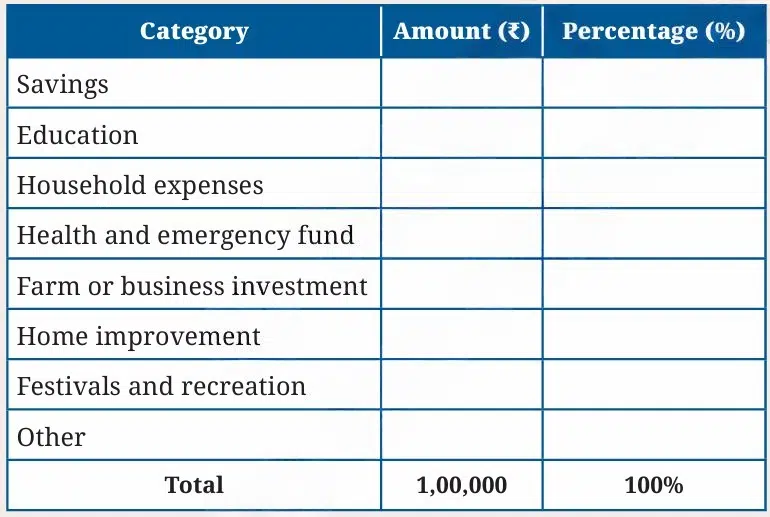
Q. Imagine your family receives ₹1,00,000 from farming, a small business, livestock sales, and savings. Help your family decide how to use the money wisely.
Step 1: Prepare a Budget
Allocate the ₹1,00,000 among the following categories:
Step 2: Needs vs Wants
Classify each expense as a need or a want and give a reason.
Examples:
- School fees
- New mobile phone
- Better seeds or livestock feed
- Festival celebrations
- Water storage tank
Step 3: Save for the Future
Suppose your family saves ₹30,000 at 8% compound interest per year. Using the formula A = P(1 + r)ⁿ, where A: Amount, P: Principal, r: Rate of compound interest, n: number of years, calculate:
- The amount after 5 years.
- The interest earned.
Step 4: Save First, Spend Later
- Many financial experts recommend:
- Expenses = Income – Savings
- If your family receives ₹1,00,000 and saves ₹20,000 first, only ₹80,000 is available for spending. This helps ensure that future needs and emergencies can be met.
Step 5: Reflect
- What percentage of the money did you save?
- Which expenses were needs and which were wants?
- How can savings improve a family’s financial security?
- How does compound interest help money grow?
Answer:
Step 1: Prepare a Budget
| Category | Amount (₹) | Percentage (%) |
|---|---|---|
| Savings | 20,000 | 20% |
| Education | 15,000 | 15% |
| Household Expenses | 25,000 | 25% |
| Health and Emergency Fund | 10,000 | 10% |
| Farm or Business Investment | 20,000 | 20% |
| Home Improvement | 5,000 | 5% |
| Festivals and Recreation | 3,000 | 3% |
| Other | 2,000 | 2% |
| Total | 1,00,000 | 100% |
Step 2: Needs vs Wants
| Expense | Need/Want | Reason |
|---|---|---|
| School fees | Need | Necessary for education. |
| New mobile phone | Want | Can be postponed if current phone works. |
| Better seeds or livestock feed | Need | Helps increase farm production and income. |
| Festival celebrations | Want | Important for enjoyment but not essential. |
| Water storage tank | Need | Required for storing water and daily use. |
Step 3: Save for the Future
Given:
- P = ₹30,000
- r = 8% = 0.08
- n = 5 years
Formula:
- A = P(1 + r)ⁿ
- A = 30,000 (1 + 0.08)⁵
- A = 30,000 × 1.4693
- A ≈ ₹44,079
- Amount after 5 years = ₹44,079
- Interest earned = ₹44,079 − ₹30,000 = ₹14,079
- Step 4: Save First, Spend Later
If the family receives ₹1,00,000 and saves ₹20,000 first:
- Expenses = Income − Savings
- Expenses = ₹1,00,000 − ₹20,000 = ₹80,000
So, only ₹80,000 is available for spending.
Step 5: Reflect
1. What percentage of the money did you save?
- Saved amount = ₹20,000
- Percentage saved = (20,000 ÷ 1,00,000) × 100
- = 20%
2. Which expenses were needs and which were wants?
- Needs: School fees, better seeds/livestock feed, water storage tank, household expenses, health fund.
- Wants: New mobile phone, festival celebrations, recreation.
3. How can savings improve a family’s financial security?
Savings help families handle emergencies, meet future needs, and achieve financial goals without borrowing money.
4. How does compound interest help money grow?
Compound interest helps money grow faster because interest is earned on both the original amount and the interest already earned. This increases savings over time.
Disclaimer: The content that is present on our website is based on the NCERT Class 9 Social Science textbook and is provided for educational purposes only. All the content and images have been taken from Social Science Class 9 NCERT Textbook and CBSE Support material. Images and content shown above are the property of individual organizations and are used here for reference purposes only. To make it easy to understand, some of the content and images are generated by AI and cross-checked by the teachers.