
Prepare for the CBSE Class 12 Physics board examination with these important MCQs on Electrostatic Potential and Capacitance. This collection covers important NCERT-based concepts, electrostatic potential, potential difference, equipotential surfaces, electric potential energy, capacitors, combinations of capacitors and energy stored in a capacitor.
Electrostatic Potential and Capacitance Class 12 MCQ
Conceptual Understanding
Q. A charge is moved from point R to point P in an electrostatic field by applying an external force equal and opposite to the electric force at every point. The work done by the external force is stored as
(a) kinetic energy of the charge
(b) magnetic potential energy
(c) electrostatic potential energy
(d) heat energy only
Answer: (c) electrostatic potential energy
Q. A student claims that the work done by an electrostatic force in moving a charge from one point to another depends on the path followed. Based on the conservative nature of electrostatic force, which statement is correct?
(a) The claim is for positive charges.
(b) The claim is for negative charges.
(c) The claim is only in a non-uniform field.
(d) The claim is inbecause the work depends only on the initial and final positions.
Answer: (d) The claim is inbecause the work depends only on the initial and final positions.
Q. Electrostatic potential at a point is defined as
(a) force experienced by a unit positive charge.
(b) electric field strength at that point.
(c) work done in bringing a unit positive charge from infinity to that point without acceleration.
(d) potential energy possessed by any charge at that point.
Answer: (c) work done in bringing a unit positive charge from infinity to that point without acceleration.
Q. The electrostatic potential at a point is 500 V. The work required to bring a charge of 2 μC from infinity to that point is
(a) 1 × 10⁻³ J
(b) 5 × 10⁻⁴ J
(c) 2 × 10⁻³ J
(d) 10⁻² J
Answer: (a) 1 × 10⁻³ J
Q. For convenience, electrostatic potential is usually taken to be zero at
(a) the origin
(b) the location of the source charge
(c) the Earth’s surface
(d) infinity
Answer: (d) infinity
Q. A student compares the electric potential due to a point charge and an electric dipole at large distances. Which statement correctly distinguishes the two?
(a) Both depend only on distance from the source.
(b) Potential due to a point charge depends on angle, whereas dipole potential does not.
(c) Potential due to a dipole depends on both distance and orientation, whereas potential due to a point charge depends only on distance.
(d) Both decrease as 1/r².
Answer: (c) Potential due to a dipole depends on both distance and orientation, whereas potential due to a point charge depends only on distance.
Q. A point is located on the axial line of a dipole on the side of the positive charge. The electric potential at that point is
(a) positive
(b) negative
(c) zero
(d) always infinite
Answer: (a) positive
Q. The electrostatic potential due to a system of charges at any point is calculated by
(a) vector addition of individual potentials
(b) multiplying individual potentials
(c) algebraic addition of individual potentials
(d) finding the average of individual potentials
Answer: (c) algebraic addition of individual potentials
Q. Two charges +4 μC and –4 μC are separated by a small distance. A point is situated on the equatorial line of the dipole. The electric potential at that point is
(a) positive
(b) negative
(c) zero
(d) cannot be determined
Answer: (c) zero
Q. A uniformly charged spherical shell carries charge q and radius R. A positive test charge is moved from the centre of the shell to a point on its inner surface. The work done by the electrostatic force is
(a) positive
(b) negative
(c) infinite
(d) zero
Answer: (d) zero
Q. The electric potential due to a point charge varies as (1/r), whereas the electric potential due to an electric dipole at large distances varies as (1/r^2). If the distance from an electric dipole is doubled while keeping the angle unchanged, the electric potential becomes:
(a) V/2
(b) V/4
(c) V/8
(d) 2V
Answer: (b) V/4
Q. A student observes that two points are located at the same distance from the centre of a dipole but have different potentials. Which statement best explains this observation?
(a) Dipole potential depends only on distance.
(b) Dipole potential depends on both distance and the angle with the dipole moment.
(c) Dipole potential depends only on charge magnitude.
(d) Dipole potential does not follow the superposition principle.
Answer: (b) Dipole potential depends on both distance and the angle with the dipole moment.
Q. Which of the following statements correctly compares the potential due to a point charge and a dipole at large distances?
(a) Both decrease as 1/r.
(b) Point charge potential decreases as 1/r² while dipole potential decreases as 1/r.
(c) Point charge potential decreases as 1/r while dipole potential decreases as 1/r².
(d) Both decrease as 1/r².
Answer: (c) Point charge potential decreases as 1/r while dipole potential decreases as 1/r².
Q. An equipotential surface is a surface on which
(a) electric field is constant.
(b) electric force is constant.
(c) electric potential has the same value at every point.
(d) electric flux is always zero.
Answer: (c) electric potential has the same value at every point.
Q. A system contains two unlike charges. The electrostatic potential energy of the system is negative because
(a) the electric field is zero.
(b) the charges attract each other, and energy must be supplied to separate them to infinity.
(c) unlike charges cannot possess potential energy.
(d) Coulomb’s law is not applicable.
Answer: (b) the charges attract each other, and energy must be supplied to separate them to infinity.
Q. A charge q is placed at a point where the external electrostatic potential is V. The potential energy of the charge due to the external field is given by
(a) q/V
(b) V/q
(c) qV
(d) q²V
Answer: (c) qV
Q. One electron volt (1 eV) is defined as
(a) the charge on an electron
(b) the potential difference across an electron
(c) the energy gained by an electron when accelerated through a potential difference of 1 volt
(d) the kinetic energy of an electron at rest
Answer: (c) the energy gained by an electron when accelerated through a potential difference of 1 volt
Q. The potential energy of an electric dipole of dipole moment p placed in a uniform electric field E at an angle θ is
(a) U = pE cosθ
(b) U = pE sinθ
(c) U = –pE cosθ
(d) U = –pE sinθ
Answer: (c) U = –pE cosθ
Q. The potential energy of a dipole in a uniform electric field is minimum when
(a) dipole is perpendicular to the field
(b) dipole is antiparallel to the field
(c) dipole is parallel to the field
(d) electric field is zero
Answer: (c) dipole is parallel to the field
Q. In electrostatic equilibrium, the electric field inside a conductor is
(a) maximum
(b) non-uniform
(c) constant
(d) zero
Answer: (d) zero
Q. A conductor is placed in electrostatic equilibrium. Which one of the following quantities remains constant throughout the conductor?
(a) Electric field
(b) Surface charge density
(c) Electric potential
(d) Electric flux
Answer: (c) Electric potential
Q. A sensitive electronic instrument is enclosed inside a hollow conducting box. Even when strong external electric fields are present, the instrument is unaffected. This phenomenon is known as
(a) electric induction
(b) electric coupling
(c) electrostatic shielding
(d) dielectric polarisation
Answer: (c) electrostatic shielding
Q. A dielectric slab is placed in a uniform external electric field. Unlike a conductor, the electric field inside the dielectric does not become zero because
(a) dielectrics possess free electrons that move randomly.
(b) charges in a dielectric cannot move freely throughout the substance.
(c) induced charges completely cancel the external field.
(d) dielectric materials have infinite conductivity.
Answer: (b) charges in a dielectric cannot move freely throughout the substance.
Q. Water (H₂O) and HCl are examples of polar molecules because
(a) they are electrically charged.
(b) they conduct electricity.
(c) the centres of positive and negative charges do not coincide.
(d) they have no dipole moment.
Answer: (c) the centres of positive and negative charges do not coincide.
Q. The dipole moment per unit volume of a dielectric is called
(a) capacitance
(b) electric susceptibility
(c) dielectric strength
(d) polarisation
Answer: (d) polarisation
Q. A capacitor stores energy by maintaining
(a) equal charges on both plates
(b) opposite charges on two conductors separated by an insulator
(c) current flow through an insulator
(d) zero potential difference
Answer: (b) opposite charges on two conductors separated by an insulator
Q. A capacitor with larger capacitance can store more charge because
(a) it develops a larger potential difference for a small charge.
(b) it can store a larger charge for the same potential difference.
(c) it removes electric fields completely.
(d) it behaves like a conductor.
Answer: (b) it can store a larger charge for the same potential difference.
Q. The dielectric constant K is given by
\(K = \frac{C}{C_0}\)where C is the capacitance with dielectric and C₀ is the capacitance without dielectric.
If inserting a dielectric increases the capacitance from 4 μF to 20 μF, the dielectric constant is
(a) 2
(b) 4
(c) 5
(d) 10
Answer: (c) 5
Q. If four capacitors of 10 μF each are connected. The equivalent capacitance of the entire arrangement is approximately
(a) 10 μF
(b) 13.3 μF
(c) 20 μF
(d) 40 μF
Answer: (b) 13.3 μF
Q. A capacitor is charged by transferring charge from one plate to the other. The work done by the external source in this process is stored as
(a) kinetic energy of charges
(b) magnetic energy
(c) electrostatic potential energy
(d) thermal energy only
Answer: (c) electrostatic potential energy
Q. The energy stored in a capacitor can be expressed as
\[U = \frac{1}{2}CV^2\]If the potential difference across the capacitor is doubled while the capacitance remains unchanged, the stored energy becomes
(a) 2U
(b) 4U
(c) U/2
(d) U
Answer: (b) 4U
Q. A capacitor stores an energy U when charged to a potential difference V. If the potential difference is reduced to V/2, the new stored energy becomes
(a) U
(b) U/2
(c) U/4
(d) 2U
Answer: (c) U/4
Q. According to NCERT, the energy stored in a capacitor can be viewed as being stored in
(a) the conducting plates only
(b) the electric field between the plates
(c) the battery connected to the capacitor
(d) the dielectric material only
Answer: (b) the electric field between the plates
Q. The energy density of an electric field is given by
\[u = \frac{1}{2}\varepsilon_0 E^2\]This expression suggests that energy density depends on
(a) E
(b) 1/E
(c) E²
(d) E\sqrt{E}E
Answer: (c) E²
Application-Based MCQ
Q. While defining electrostatic potential, the test charge used is taken to be very small because
(a) a large charge has no electric field.
(b) the test charge should not disturb the original charge configuration.
(c) only small charges can move in an electric field.
(d) the potential depends on the magnitude of the test charge.
Answer: (b) the test charge should not disturb the original charge configuration.
Q. Electrostatic potential energy is meaningful only up to an arbitrary additive constant because
(a) potential energy cannot be measured.
(b) only potential energy differences have physical significance.
(c) electric fields are always changing.
(d) electrostatic forces are non-conservative.
Answer: (b) only potential energy differences have physical significance.
Q. A positive point charge Q is placed at the origin. A unit positive test charge is slowly brought from infinity to a nearby point P. The work done by the external agent is
(a) negative because the charge is moving towards Q.
(b) zero because the displacement is radial.
(c) positive because the external agent works against the repulsive electric force.
(d) negative because potential at P is positive.
Answer: (c) positive because the external agent works against the repulsive electric force.
Q. The electrostatic potential at a distance \(r\) from a point charge \(Q\) is given by:(a) \(V = \frac{Q}{4\pi\varepsilon_0 r^2}\)
(b) \(V = \frac{Q}{4\pi\varepsilon_0 r}\)
(c) \(V = \frac{Q^2}{4\pi\varepsilon_0 r}\)
(d) \(V = \frac{Qr}{4\pi\varepsilon_0}\)
Answer: (b) \(V = \frac{Q}{4\pi\varepsilon_0 r}\)
Q. A point charge produces a potential of V at a distance r. At a distance 2r from the same charge, the potential will be
(a) 4V
(b) 2V
(c) V
(d) V/2
Answer: (d) V/2
Q. For a point located far from an electric dipole, the potential is given by
\[V = \frac{1}{4\pi\varepsilon_0}\frac{p\cos\theta}{r^2}\]According to this expression, if the distance from the dipole is doubled while θ remains unchanged, the potential becomes
(a) V/2
(b) V/4
(c) V/8
(d) 2V
Answer: (b) V/4
Q. At large distances, the potential due to an electric dipole varies as 1/r² whereas the potential due to a point charge varies as 1/r. Which conclusion follows?
(a) Dipole potential decreases faster with distance.
(b) Dipole potential decreases slower with distance.
(c) Both decrease at the same rate.
(d) Dipole potential remains constant.
Answer: (a) Dipole potential decreases faster with distance.
Q. A dipole has a dipole moment p. At a distant point on its axis, the potential is V. If the dipole moment is doubled without changing the position of the observation point, the new potential will be
(a) V/2
(b) V
(c) 2V
(d) 4V
Answer: (c) 2V
Q. According to the dipole potential formula,
\[V = \frac{1}{4\pi\varepsilon_0}\frac{p\cos\theta}{r^2}\]the potential will be maximum when
(a) θ = 90°
(b) θ = 60°
(c) θ = 45°
(d) θ = 0°
Answer: (d) θ = 0°
Q. Three charges are placed at different points in space. To calculate the electric potential at a given point, one should
(a) add the individual potentials algebraically.
(b) add the individual potentials vectorially.
(c) multiply all potentials.
(d) calculate only the largest potential.
Answer: (a) add the individual potentials algebraically.
Q. A dipole has dipole moment p. The potential at a point on its axis is V. If the dipole moment is doubled while the observation point remains unchanged, the new potential becomes
(a) V/2
(b) V
(c) 2V
(d) 4V
Answer: (c) 2V
Q. Two equipotential surfaces differ in potential by 20 V and are separated by a perpendicular distance of 4 cm. The magnitude of the electric field between them is
(a) 200 N/C
(b) 400 N/C
(c) 500 N/C
(d) 800 N/C
Answer: (c) 500 N/C
Q. Two positive point charges are brought from infinity and placed at a fixed distance apart. The electrostatic potential energy of the system is
(a) negative because the charges repel each other.
(b) zero because potential energy exists only in gravitational systems.
(c) positive because work must be done against the repulsive force.
(d) always negative irrespective of the nature of charges.
Answer: (c) positive because work must be done against the repulsive force.
Q. An electron is accelerated through a potential difference of 5 V. The energy gained by the electron is
(a) 5 J
(b) 5 eV
(c) 8 × 10⁻¹⁹ eV
(d) 1.6 × 10⁻¹⁹ J
Answer: (b) 5 eV
Q. A charge of 4 μC is placed at a point where the electric potential is 500 V. The potential energy of the charge is
(a) 2 × 10⁻³ J
(b) 4 × 10⁻³ J
(c) 8 × 10⁻³ J
(d) 1 × 10⁻³ J
Answer: (a) 2 × 10⁻³ J
Q. A dipole is initially aligned parallel to a uniform electric field. It is then rotated through 180°. The change in its potential energy is
(a) zero
(b) pE
(c) 2pE
(d) –2pE
Answer: (c) 2pE
Q. When the electric field direction was suddenly changed by 60°, the energy released by the polarised substance was
(a) 1 J
(b) 2 J
(c) 3 J
(d) 6 J
Answer: (c) 3 J
Q. The electric field just outside the surface of a charged conductor is related to surface charge density σ by
\[E = \frac{\sigma}{\varepsilon_0}\]If the surface charge density is doubled, the electric field just outside the conductor becomes
(a) E/2
(b) E
(c) 2E
(d) 4E
Answer: (c) 2E
Q. When a non-polar molecule such as O₂ is placed in an external electric field, it develops an induced dipole moment because
(a) electrons leave the molecule.
(b) positive and negative charges are displaced slightly in opposite directions.
(c) the molecule becomes ionised.
(d) permanent dipoles already exist inside the molecule.
Answer: (b) positive and negative charges are displaced slightly in opposite directions.
Q. For a linear isotropic dielectric,
\[P = \varepsilon_0 \chi_e E\]If the electric field strength is doubled, the polarisation P becomes
(a) P/2
(b) P
(c) 2P
(d) 4P
Answer: (c) 2P
Q. The capacitance of a capacitor is defined as
\[C = \frac{Q}{V}\]If both Q and V are doubled, the capacitance becomes
(a) C/2
(b) C
(c) 2C
(d) 4C
Answer: (b) C
Q. A capacitor has a capacitance of 5 μF. When connected to a potential difference of 200 V, the charge stored on the capacitor is
(a) 1 × 10⁻⁴ C
(b) 1 × 10⁻³ C
(c) 2 × 10⁻³ C
(d) 5 × 10⁻³ C
Answer: (b) 1 × 10⁻³ C
For a parallel plate capacitor,
\[C = \frac{\varepsilon_0 A}{d}\]Q. If the area of each plate is doubled while keeping the separation unchanged, the capacitance becomes
(a) C/2
(b) C
(c) 2C
(d) 4C
Answer: (c) 2C
Q. For the same capacitor, if the separation between the plates is doubled while keeping the area unchanged, the capacitance becomes
(a) 2C
(b) C
(c) C/2
(d) C/4
Answer: (c) C/2
Q. When a dielectric completely fills the region between the plates of a capacitor, the capacitance
(a) decreases
(b) remains unchanged
(c) increases by a factor equal to the dielectric constant
(d) becomes zero
Answer: (c) increases by a factor equal to the dielectric constant
Q. Three capacitors of capacitances 3 μF, 6 μF and 2 μF are connected in parallel. The equivalent capacitance is
(a) 1 μF
(b) 6 μF
(c) 9 μF
(d) 11 μF
Answer: (d) 11 μF
Q. Three capacitors of capacitances 3 μF, 6 μF and 2 μF are connected in series. The equivalent capacitance is
\[\frac{1}{C} = \frac{1}{3}+\frac{1}{6}+\frac{1}{2}\]Q. The equivalent capacitance is
(a) 1 μF
(b) 2 μF
(c) 3 μF
(d) 6 μF
Answer: (a) 1 μF
Q. A capacitor of capacitance 4 μF is connected across a 100 V battery. The energy stored in the capacitor is
(a) 0.01 J
(b) 0.02 J
(c) 0.04 J
(d) 0.08 J
Answer: (b) 0.02 J
Q. For a parallel plate capacitor,
where AdAdAd is the volume between the plates.
Q. If the electric field between the plates becomes twice its original value, the stored energy becomes
(a) twice
(b) four times
(c) half
(d) unchanged
Answer: (b) four times
Q. If the electric field in a region is doubled, the energy density of the field becomes
(a) u/2
(b) u
(c) 2u
(d) 4u
Answer: (d) 4u
Q. Two capacitors have equal capacitance. Capacitor A is charged to 100 V while capacitor B is charged to 200 V. The ratio of energies stored in A and B is
(a) 1 : 2
(b) 1 : 4
(c) 2 : 1
(d) 4 : 1
Answer: (b) 1 : 4
Assertion–Reason MCQ
Q. Assertion (A): Electrostatic force is a conservative force.
Reason (R): The work done by an electrostatic force between two points is independent of the path followed.
(a) Both A and R are true and R is the explanation of A.
(b) Both A and R are true but R is not the explanation of A.
(c) A is true but R is false.
(d) A is false but R is true.
Answer: (a) Both A and R are true and R is the explanation of A.
Q. Assertion (A): Electrostatic potential is a characteristic of the electric field and is independent of the test charge.
Reason (R): Both the work done and the force experienced are proportional to the magnitude of the test charge.
(a) Both A and R are true and R is the explanation of A.
(b) Both A and R are true but R is not the explanation of A.
(c) A is true but R is false.
(d) A is false but R is true.
Answer: (a) Both A and R are true and R is the explanation of A.
Q. Assertion (A): The electric potential on the equatorial plane of an electric dipole is zero.
Reason (R): The distances from the point to the positive and negative charges are equal, causing equal and opposite potential contributions.
(a) Both A and R are true and R is the explanation of A.
(b) Both A and R are true but R is not the explanation of A.
(c) A is true but R is false.
(d) A is false but R is true.
Answer: (a) Both A and R are true and R is the explanation of A.
Q. Assertion (A): Electric potential obeys the superposition principle.
Reason (R): Potential is a scalar quantity, so individual potentials can be added algebraically.
(a) Both A and R are true and R is the explanation of A.
(b) Both A and R are true but R is not the explanation of A.
(c) A is true but R is false.
(d) A is false but R is true.
Answer: (a) Both A and R are true and R is the explanation of A.
Q. Assertion (A): The electric potential on the equatorial plane of a dipole is zero.
Reason (R): The contributions to potential due to +q and –q have equal magnitude but opposite signs.
(a) Both A and R are true and R is the explanation of A.
(b) Both A and R are true but R is not the explanation of A.
(c) A is true but R is false.
(d) A is false but R is true.
Answer: (a) Both A and R are true and R is the explanation of A.
Q. Assertion (A): Electric field lines are always perpendicular to equipotential surfaces.
Reason (R): No work is required to move a charge along an equipotential surface.
(a) Both A and R are true and R is the explanation of A.
(b) Both A and R are true but R is not the explanation of A.
(c) A is true but R is false.
(d) A is false but R is true.
Answer: (a) Both A and R are true and R is the explanation of A.
Q. Assertion (A): The potential energy of a charge placed in an external electric field depends on the electric potential at that point.
Reason (R): Potential energy is equal to the product of the charge and the electric potential.
(a) Both A and R are true and R is the explanation of A.
(b) Both A and R are true but R is not the explanation of A.
(c) A is true but R is false.
(d) A is false but R is true.
Answer: (a) Both A and R are true and R is the explanation of A.
Q. Assertion (A): Excess charge on a conductor resides only on its outer surface.
Reason (R): The electric field inside a conductor in electrostatic equilibrium is zero.
(a) Both A and R are true and R is the explanation of A.
(b) Both A and R are true but R is not the explanation of A.
(c) A is true but R is false.
(d) A is false but R is true.
Answer: (a) Both A and R are true and R is the explanation of A.
Q. Assertion (A): The electric field inside an empty cavity of a conductor is zero.
Reason (R): External electric fields cannot penetrate into the cavity of a conductor in electrostatic equilibrium.
(a) Both A and R are true and R is the explanation of A.
(b) Both A and R are true but R is not the explanation of A.
(c) A is true but R is false.
(d) A is false but R is true.
Answer: (a) Both A and R are true and R is the explanation of A.
Q. Assertion (A): A dielectric develops a net dipole moment when placed in an external electric field.
Reason (R): The applied electric field polarises the dielectric molecules.
(a) Both A and R are true and R is the explanation of A.
(b) Both A and R are true but R is not the explanation of A.
(c) A is true but R is false.
(d) A is false but R is true.
Answer: (a) Both A and R are true and R is the explanation of A.
Q. Assertion (A): The electric field between the plates of an ideal parallel plate capacitor is uniform.
Reason (R): The plate separation is much smaller than the dimensions of the plates, so edge effects can be neglected.
(a) Both A and R are true and R is the explanation of A.
(b) Both A and R are true but R is not the explanation of A.
(c) A is true but R is false.
(d) A is false but R is true.
Answer: (a) Both A and R are true and R is the explanation of A.
Q. Assertion (A): Energy stored in a capacitor is proportional to the square of the potential difference across it.
Reason (R): The energy stored in a capacitor is given by
(a) Both A and R are true and R is the explanation of A.
(b) Both A and R are true but R is not the explanation of A.
(c) A is true but R is false.
(d) A is false but R is true.
Answer: (a) Both A and R are true and R is the explanation of A.
Q. Assertion (A): When a charged capacitor is connected to an identical uncharged capacitor, the final energy is less than the initial energy.
Reason (R): During charge redistribution, some energy is dissipated as heat and electromagnetic radiation.
(a) Both A and R are true and R is the explanation of A.
(b) Both A and R are true but R is not the explanation of A.
(c) A is true but R is false.
(d) A is false but R is true.
Answer: (a) Both A and R are true and R is the explanation of A.
Case Study Based MCQs
Q. Case Study: A student brings a small positive test charge from infinity towards a positive source charge. The charge is moved very slowly so that at every point the external force balances the electric force. The student repeats the process using different curved and straight paths but keeps the same initial and final positions.
Q. Which observation will remain unchanged for all paths?
(a) The displacement vector at every point.
(b) The direction of the electric force.
(c) The work done in moving the charge between the two positions.
(d) The magnitude of the electric field at every point.
Answer: (c) The work done in moving the charge between the two positions.
Q. Case Study: A capacitor is charged and then disconnected from the battery. The charge remains stored on the plates. A student argues that the energy is stored on the plates because the plates carry charge. Another student argues that the energy is stored in the electric field existing between the plates.
Q. Which of the following statement is correct?
(a) Energy is stored only on the positive plate.
(b) Energy is stored only on the negative plate.
(c) Energy is stored in the electric field between the plates.
(d) Energy is stored inside the battery.
Answer: (c) Energy is stored in the electric field between the plates.
Q. Case Study: A student is studying the potential due to different charge configurations. He notices that for a point charge, the potential depends only on distance. However, while studying a dipole, he finds that the potential at two points located at the same distance from the centre can be different.
Q. What is the main reason for this observation?
(a) Dipole potential depends on the angle between the position vector and dipole moment.
(b) Dipole moment changes with distance.
(c) Potential depends on mass distribution.
(d) Coulomb’s law is not applicable to dipoles.
Answer: (a) Dipole potential depends on the angle between the position vector and dipole moment.
Q. Case Study: A student moves a small positive test charge between two different points lying on the same equipotential surface. He notices that the electric potential remains unchanged throughout the motion.
Q. Which conclusion is most appropriate?
(a) Electric field is parallel to the equipotential surface.
(b) Work done in moving the charge between the two points is zero.
(c) Electric force becomes zero everywhere on the surface.
(d) Potential energy becomes infinite.
Answer: (b) Work done in moving the charge between the two points is zero.
Case Study: An aircraft accumulates static charge due to friction with air during flight. To avoid dangerous sparking during landing, special tyres with slight conductivity are used.
Q. The primary purpose of making the tyres slightly conducting is to
(a) increase mechanical strength.
(b) reduce friction with the runway.
(c) safely transfer accumulated charge to the Earth.
(d) increase the speed of the aircraft.
Answer: (c) safely transfer accumulated charge to the Earth.
Case Study: A student has two capacitors of capacitances 4 μF and 6 μF. He first connects them in series and then in parallel.
Q. Which statement is correct?
(a) Series combination gives greater capacitance than parallel combination.
(b) Parallel combination gives greater capacitance than series combination.
(c) Both combinations give the same capacitance.
(d) Series combination gives infinite capacitance.
Answer: (b) Parallel combination gives greater capacitance than series combination.
Figure Based MCQ
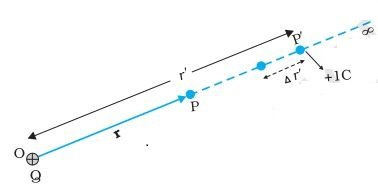
Q. Refer to Figure. A positive test charge is brought from infinity to point P near a positive charge Q. As the charge approaches P, the electrostatic potential at its location
(a) decreases and becomes negative.
(b) remains constant.
(c) increases and remains positive.
(d) becomes zero.
Answer: (c) increases and remains positive.
Q. The potential due to a charge of 4×10−74 \times 10^{-7}4×10⁻⁷ C at a distance of 9 cm was calculated. The value of this potential is
(a) 4×1024 \times 10^24×102 V
(b) 4×1034 \times 10^34×103 V
(c) 4×1044 \times 10^44×104 V
(d) 4×1054 \times 10^54×105 V
Answer: (c) 4×1044 \times 10^44×104 V
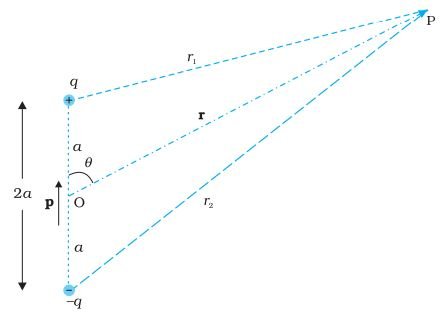
Q. Refer to Figure. A point lies on the equatorial plane of a dipole. The electric potential at that point is
(a) maximum positive
(b) maximum negative
(c) proportional to dipole moment
(d) zero
Answer: (d) zero
Q. The charges +3 × 10⁻⁸ C and –2 × 10⁻⁸ C are placed 15 cm apart. One point where the net electric potential becomes zero is located
(a) 3 cm from the positive charge
(b) 9 cm from the positive charge
(c) 15 cm from the positive charge
(d) 30 cm from the positive charge
Answer: (b) 9 cm from the positive charge
Q. The field-line diagrams. For a positive point charge, moving a small positive test charge from Q to P (towards the source charge) requires
(a) positive work by the external agent
(b) zero work by the external agent
(c) negative work by the external agent
(d) no force acts during the motion
Answer: (a) positive work by the external agent
Q. Refer to Figure. A point lies on the equatorial plane of an electric dipole. The electric potential at that point is
(a) maximum positive
(b) maximum negative
(c) zero
(d) dependent only on distance
Answer: (c) zero
Q. The charges +3 × 10⁻⁸ C and –2 × 10⁻⁸ C are placed 15 cm apart. One point where the net potential becomes zero is
(a) 3 cm from the positive charge
(b) 6 cm from the positive charge
(c) 9 cm from the positive charge
(d) 12 cm from the positive charge
Answer: (c) 9 cm from the positive charge
Q. The another point where the net potential becomes zero is located
(a) 30 cm from the positive charge
(b) 45 cm from the positive charge
(c) 60 cm from the positive charge
(d) 75 cm from the positive charge
Answer: (b) 45 cm from the positive charge
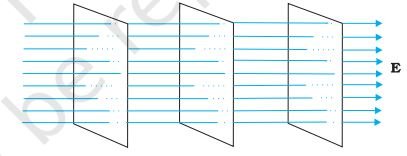
Q. Refer to Figure. For a uniform electric field directed along the x-axis, the equipotential surfaces are
(a) concentric spheres
(b) cylinders
(c) planes parallel to the y-z plane
(d) circles centred on the x-axis
Answer: (c) planes parallel to the y-z plane
Q. A charge q0q_0q0 is brought to the centre of a square whose corners contain charges +q, –q, +q and –q. The extra work required is
(a) positive
(b) negative
(c) dependent on q0q_0q0
(d) zero
Answer: (d) zero
Q. A small Gaussian surface (pill box) is partly inside and partly outside a charged conductor. The electric field inside the conductor contributes zero flux because
(a) no charge exists inside the conductor.
(b) electric field inside the conductor is zero.
(c) the Gaussian surface is very small.
(d) the surface charge is constant.
Answer: (b) electric field inside the conductor is zero.
Q. A bird can safely sit on a high-voltage transmission wire because
(a) birds are good insulators.
(b) current cannot flow through feathers.
(c) there is no significant potential difference across the bird’s body.
(d) the wire carries only alternating current.
Answer: (c) there is no significant potential difference across the bird’s body.
Q. The energy stored in the charged capacitor is
(a) 2.25×10−62.25\times10^{-6}2.25×10⁻⁶ J
(b) 4.5×10−64.5\times10^{-6}4.5×10⁻⁶ J
(c) 9×10−69\times10^{-6}9×10⁻⁶ J
(d) 1.8×10−51.8\times10^{-5}1.8×10⁻⁵ J
Answer: (b) 4.5×10−64.5\times10^{-6}4.5×10⁻⁶ J
Q. A 900 pF capacitor is charged to 100 V. The charge stored on the capacitor is
(a) 9×10−109\times10^{-10}9×10⁻¹⁰ C
(b) 9×10−99\times10^{-9}9×10⁻⁹ C
(c) 9×10−89\times10^{-8}9×10⁻⁸ C
(d) 9×10−79\times10^{-7}9×10⁻⁷ C
Answer: (c) 9×10−89\times10^{-8}9×10⁻⁸ C
Q. When the charged capacitor was connected to another identical uncharged capacitor, the final energy stored in the system became
(a) equal to the initial energy
(b) half of the initial energy
(c) one-fourth of the initial energy
(d) double the initial energy
Answer: (b) half of the initial energy
Disclaimer: The content that is present on our website is based on the NCERT Class 12 Physics textbook and is provided for educational purposes only. All the content and images have been taken from Physics Class 12 NCERT Textbook and CBSE Support material. Images and content shown above are the property of individual organizations and are used here for reference purposes only. To make it easy to understand, some of the content and images are generated by AI and cross-checked by the teachers.