
Electric Charges and Fields is the first chapter of CBSE Class 12 Physics. This chapter explains the basic concepts of electric charge, its properties, Coulomb’s law, electric fields, electric dipoles, electric flux and Gauss’s law. These notes cover all the important topics, definitions, formulas and derivations in simple language to help students understand the concepts and prepare effectively for their CBSE Class 12 Physics board examination.
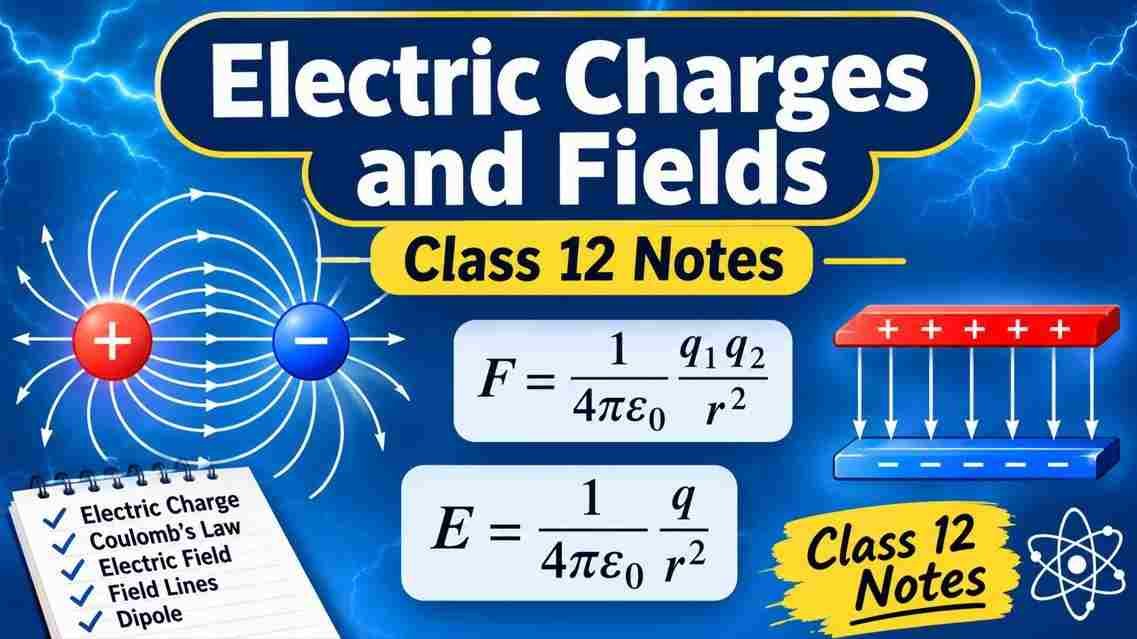
Electric Charges and Fields Class 12 Notes
Electric Charge
- Electric charge is a property of an object.
- Because of charge, objects can attract or repel each other.
- Some objects become charged when they are rubbed together.
- A charged object can attract small and light objects like paper bits, straw, and dust.
Example: A comb rubbed on dry hair can attract small pieces of paper.
Around 600 BC, a Greek scientist named Thales noticed that amber rubbed with wool could attract light objects. Amber is a yellowish natural material. The word electricity comes from the Greek word “Elektron”, which means amber.
Two Types of Charges
Scientists found that there are only two kinds of charges:
- Positive charge (+)
- Negative charge (-)
Remember:
- Positive + Positive → Repel
- Negative + Negative → Repel
- Positive + Negative → Attract
How Do Objects Get Charged?
All objects are made of tiny particles called atoms. Atoms contain electrons. When two objects are rubbed together, some electrons move from one object to another. This movement of electrons makes the objects charged.
What Happens When Opposite Charges Meet?
- Positive and negative charges cancel each other.
- After cancelling, the object becomes neutral again.
- This is why a charged glass rod loses its charge when it touches the silk used for rubbing.
Gold-Leaf Electroscope (Figure No. 1.2(a))
- It is a device used to check whether an object is charged or not.
- It has a metal knob and two thin gold leaves.
- When a charged object touches the knob, charge reaches the leaves.
- Both leaves get the same type of charge.
- The leaves move apart because similar charges repel.
CONDUCTORS AND INSULATORS
What are Conductors?
Conductors are materials that allow electric charge to move through them easily. In conductors, electrons can move freely. Because of this, electricity can pass through them easily.
Examples of Conductors
- Metals (copper, aluminium, iron)
- Human body
- Animal body
- Earth (ground)
Example: Electric wires are made of metals because metals are good conductors.
What are Insulators?
Insulators are materials that do not allow electric charge to move easily. In these materials, electrons cannot move freely. Therefore, electricity cannot pass through them easily.
Examples of Insulators
- Plastic
- Glass
- Wood
- Porcelain
- Nylon
- Rubber
Example: The plastic covering on electric wires protects us from electric shock.
What Happens When Charge Is Given to a Conductor?
If a conductor receives some charge, the charge spreads quickly over its entire surface. This happens because electrons can move freely inside the conductor.
Example: If a metal sphere is charged, the charge spreads over the whole sphere.
What Happens When Charge Is Given to an Insulator?
If an insulator receives some charge, the charge stays at the place where it is produced. The charge does not spread over the whole object because electrons cannot move freely.
Example: A plastic comb remains charged after rubbing.
Semiconductors
Some materials are neither good conductors nor good insulators. They allow electricity to pass only to some extent. These materials are called semiconductors.
Examples
- Silicon
- Germanium
Note: The conductivity of semiconductors lies between conductors and insulators.
BASIC PROPERTIES OF ELECTRIC CHARGE
Electric charge has three important properties:
- Additivity of Charges
- Conservation of Charge
- Quantisation of Charge
What is a point charge?
Sometimes the size of a charged object is very small compared to the distance between objects. In such cases, we treat the object as a point charge. We assume that all the charge is concentrated at one point.
Example: Tiny charged particles can be treated as point charges.
1. Additivity of Charges
Charges are added just like ordinary numbers.The total charge of a system is the algebraic sum of all charges present. While adding, positive and negative signs must be considered.
Formula
Total Charge = q₁ + q₂ + q₃ + …
Example
A system contains charges:
+1, +2, -3, +4, -5
Total charge = (+1) + (+2) + (-3) + (+4) + (-5)
Total charge = -1
2. Conservation of Charge
Charge can neither be created nor destroyed. Charge can only be transferred from one object to another. The total charge of an isolated system always remains constant.
Example
When a glass rod is rubbed with silk:
- A glass rod loses electrons.
- Silk gains electrons.
- The amount of charge lost by the rod is equal to the amount gained by the silk.
Therefore, the total charge remains unchanged.
3. Quantisation of Charge
Electric charge exists in fixed small units. A body cannot have any arbitrary amount of charge. The charge on a body is always a whole-number multiple of a basic unit called e.
Formula
q = ne
where,
- q = charge on the body
- n = integer (1, 2, 3, …)
- e = basic unit of charge
Value of Fundamental Charge
e = 1.6 × 10⁻¹⁹ C
where C stands for coulomb.
| Charge on Particles | Particle Charge |
|---|---|
| Electron | -e |
| Proton | +e |
SI Unit of Charge
The SI unit of electric charge is Coulomb (C).
Important Value
1 electron = 1.6 × 10⁻¹⁹ C
Smaller Units
- 1 mC (milli coulomb) = 10⁻³ C
- 1 μC (micro coulomb) = 10⁻⁶ C
COULOMB’S LAW
What Did Coulomb Study?
We know that charged objects can attract or repel each other. Scientists wanted to know:
- How much force acts between two charges?
- What factors affect this force?
A French scientist named Charles Augustin Coulomb performed experiments and gave a law to answer these questions. This law is called Coulomb’s Law.
Coulomb’s Law
Coulomb’s Law states that the force between two charged objects depends on:
- The amount of charge on the objects.
- The distance between the objects.
The force becomes stronger when the charges are larger. The force becomes weaker when the distance between the charges increases.
Understanding with an Example
Imagine two small positively charged balls.
- When the balls are placed near each other, they push each other away because like charges repel.
- If we increase the charge on the balls, the pushing force becomes stronger.
- If we move the balls farther apart, the pushing force becomes weaker.
This is exactly what Coulomb observed in his experiments.
Effect of Charge on Force
The force between two charges increases when the charges increase.
For example:
- Two charges of +1 C and +1 C produce a certain force.
- If the charges are increased to +2 C and +2 C, the force becomes much larger.
Therefore, larger charges produce a stronger force.
Effect of Distance on Force
The force between two charges decreases when the distance increases.
For example:
- If two charges are close to each other, they exert a strong force.
- If they are moved farther apart, the force becomes weaker.
This is why charged objects interact more strongly when they are near each other.
Nature of the Force
The force between charges can be of two types.
1. Repulsive Force: When both charges are of the same type, they repel each other. Examples:
- Positive and positive charges repel each other.
- Negative and negative charges repel each other.
Example: Two positively charged glass rods push each other away.
2. Attractive Force: When the charges are of opposite types, they attract each other. Examples:
- Positive and negative charges attract each other.
Example: A positively charged glass rod attracts a negatively charged plastic rod.
Mathematical Form of Coulomb’s Law
The force between two point charges is given by
$$F = \frac{k q_1 q_2}{r^2}$$where,
- F is the electrostatic force between the charges.
- q₁ and q₂ are the charges.
- r is the distance between the charges.
- k is a constant whose value is
You do not need to memorise the meaning of every symbol immediately. First understand the idea that more charge gives more force and more distance gives less force.
Important Observations from the Formula
When charge increases
- The force increases.
- This means heavily charged objects exert a stronger force on each other.
When distance increases
- The force decreases very quickly.
- If the distance is doubled, the force becomes four times smaller.
- If the distance is tripled, the force becomes nine times smaller.
- This is because the distance is squared in the formula.
Conditions for Coulomb’s Law
The charged bodies should be very small compared to the distance between them. Such small charged bodies are called point charges. The charges should be at rest.
Why Is Coulomb’s Law Important?
Coulomb’s Law helps us:
- Calculate the force between charges.
- Understand attraction and repulsion.
- Study electric fields and electrostatics.
FORCES BETWEEN MULTIPLE CHARGES
Coulomb’s law helps us find the force between two charges. But in reality, a charge is often surrounded by many other charges. For example, charge q1 may be surrounded by q2, q3 and q4. In such a situation, we need a method to find the total force acting on q1.
Principle of Superposition
The total force on a charge due to a number of charges is equal to the vector sum of the forces produced by each charge acting separately. This rule is called the Principle of Superposition.
Suppose three students are pushing a box.
- One student pushes towards the right.
- Another pushes towards the left.
- A third pushes forward.
The final movement of the box depends on the combined effect of all three pushes.
Similarly, when many charges are present, each charge exerts its own force. The total force is found by adding all these forces.
Very Important Point
While calculating the force due to one charge, the presence of other charges does not affect it.
For example:
- Force of q2 on q1 is calculated using Coulomb’s law.
- Force of q3 on q1 is also calculated using Coulomb’s law.
- These forces are then added to get the net force.
Formula
- F = F12 + F13 + F14 + ….
where,
- F12 = force on q1 due to q2
- F13 = force on q1 due to q3
and so on.
Important Points
- Electrostatic forces obey the principle of superposition.
- Net force is obtained by vector addition.
- Individual forces remain unaffected by other charges.
- Coulomb’s law and superposition principle form the basis of electrostatics.
Electric Field
Suppose a charge Q is placed in space. Now another charge q is placed nearby. According to Coulomb’s law, Q exerts a force on q.But a question arises:
How does Q exert force on q even though they are not touching each other?
To answer this question, scientists introduced the concept of electric field.
What Is Electric Field?
A charged body creates an invisible region around itself. Any other charge entering this region experiences an electric force.This region is called the electric field.
Think of a heater kept in a room. The heater does not touch you directly. Still, you feel warmth when you come near it. Similarly, a charge creates an effect in the space around it. This effect is called the electric field.
Definition: The electric field at a point is defined as the force experienced by a unit positive test charge placed at that point.
Electric Field Due to a Point Charge
If a charge Q produces an electric field at a distance r, then
$$E = \frac{1}{4\pi\varepsilon_0}\frac{Q}{r^2}$$Here
- E = electric field
- Q = source charge
- r = distance from the charge
- ε0 = permittivity of free space
Force on a Charge in an Electric Field
When a charge is placed in an electric field, it experiences a force. The force is given by
- F= qE
where
- F = force
- q = charge placed in the field
- E = electric field
Electric Field Intensity
From
- F=qE
we get
$$E = \frac{F}{q}$$This means electric field is equal to force per unit positive charge.
Source Charge and Test Charge
Source Charge
The charge which produces the electric field is called the source charge. It is usually represented by Q.
Test Charge
The small positive charge used to detect or measure the electric field is called the test charge. It is usually represented by q.
Why Is the Test Charge Kept Very Small?
If the test charge is large, it may change the position of the source charge. Therefore, a very small test charge is used so that the source charge remains undisturbed.
Electric Field Due to a Positive Charge
A positive charge repels a positive test charge. Therefore, the electric field is directed away from the positive charge.
Note: Electric field lines move outward from a positive charge.
Electric Field Due to a Negative Charge
A negative charge attracts a positive test charge. Therefore, the electric field is directed towards the negative charge.
Note: Electric field lines move inward towards a negative charge.
Characteristics of Electric Field
- Electric Field Is a Vector Quantity: It has both magnitude and direction.
- Electric Field Exists at Every Point Around a Charge: A charged body produces an electric field in all directions around it.
- Electric Field Depends on Distance: As the distance from the charge increases, the electric field decreases.
- Electric Field Is Independent of Test Charge:The value of electric field depends only on the source charge and distance.
It does not depend on the test charge used to measure it.
Important Point
- Electric Field Due to a System of Charges
- When many charges are present, each charge produces its own electric field.
- The total electric field at any point is obtained by adding all individual electric fields vectorially.
- This is again based on the Principle of Superposition.
SI Unit of Electric Field
The SI unit of electric field is
- N/C
(Newton per Coulomb)
ELECTRIC FIELD LINES
Why Do We Need Electric Field Lines?
We know that an electric field exists around a charged object. However, the electric field is invisible and cannot be seen directly. To show the electric field in a simple picture, scientists use electric field lines.
Electric field lines help us understand:
- The direction of the electric field.
- The strength of the electric field at different points.
What Are Electric Field Lines?
Electric field lines are imaginary lines drawn in an electric field such that the tangent at any point gives the direction of the electric field at that point.
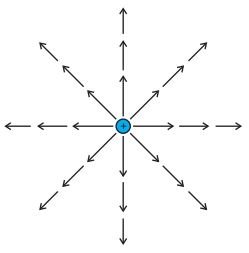
Imagine water flowing in a river. The direction in which the water flows shows the direction of motion. Similarly, electric field lines show the direction in which a positive test charge would move. Therefore, electric field lines help us visualize the electric field around a charge.
Electric Field Lines Around a Positive Charge
A positive charge repels a positive test charge. Therefore, the electric field lines move away from the positive charge. Field lines originate from a positive charge and spread outward in all directions.
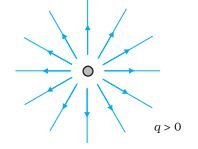
Electric Field Lines Around a Negative Charge
A negative charge attracts a positive test charge. Therefore, the electric field lines move towards the negative charge. Field lines end on a negative charge.

What Does the Closeness of Field Lines Show?
The distance between field lines tells us about the strength of the electric field.
- When Field Lines Are Close Together
- Electric field is strong.
- More field lines are present in the region.
- When Field Lines Are Far Apart
- Electric field is weak.
- Fewer field lines are present in the region.
Near a charge, field lines are crowded because the electric field is strong. Far from the charge, field lines are spread apart because the electric field becomes weaker.
Field Lines for Two Positive Charges
When two positive charges are placed near each other: Both charges repel each other. Their field lines move outward from both charges. The pattern shows repulsion between the charges.

Field Lines for a Positive and Negative Charge (Electric Dipole)
When a positive charge and a negative charge are placed near each other: Field lines start from the positive charge. Field lines end on the negative charge. The pattern shows attraction between the charges.

Properties of Electric Field Lines
These properties are very important for examinations.
- Field Lines Start from Positive Charge and End at Negative Charge: Electric field lines always originate from positive charges. They terminate on negative charges.
If only one charge is present, the field lines may extend to infinity. - Field Lines Show the Direction of Electric Field: At any point, the direction of the electric field is along the tangent to the field line.
- Two Electric Field Lines Never Cross Each Other: If two field lines crossed, there would be two directions of electric field at the same point. This is impossible because the electric field at a point has only one direction.
- Electric Field Lines Never Form Closed Loops: Electric field lines start from positive charges and end on negative charges. Therefore, they do not form closed loops.
- Field Lines Are Continuous Curves: In a region where there is no charge, electric field lines continue smoothly without any break.
- Closer Field Lines Represent Stronger Electric Field: Where field lines are crowded, the electric field is stronger. Where field lines are farther apart, the electric field is weaker.
ELECTRIC FLUX
What Is Electric Flux?
Electric flux tells us how much electric field passes through a surface. In simple words, it measures the number of electric field lines passing through a given surface.
Imagine rain is falling vertically. Now place a notebook in the rain.
- If the notebook is held flat, more raindrops fall on it.
- If the notebook is tilted, fewer raindrops fall on it.
Similarly, electric flux depends on how a surface is placed in an electric field.
Definition: Electric flux through a surface is a measure of the total electric field passing through that surface.
Factors Affecting Electric Flux
Electric flux depends on:
- Strength of Electric Field (E): Stronger electric field means more field lines pass through the surface. Therefore, electric flux increases.
- Area of Surface (A): Larger area allows more field lines to pass through it. Therefore, electric flux increases.
- Angle Between Electric Field and Surface: The orientation of the surface also affects electric flux. Formula of Electric Flux
where,
- ϕ = Electric Flux
- E = Electric Field
- A = Area of Surface
- θ = Angle between electric field and normal to the surface
Special Cases
Case 1: Surface Perpendicular to Electric Field
Angle: $$\theta = 0^\circ$$Electric Flux: $$\phi = EA$$
Flux is maximum. This is because maximum number of field lines pass through the surface.
Case 2: Surface Parallel to Electric Field
Angle: $$\theta = 90^\circ$$Electric Flux: $$\phi = 0$$
No field lines pass through the surface. Therefore, electric flux becomes zero.
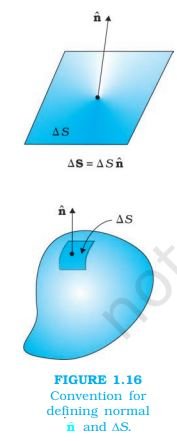
Area Vector
To describe the orientation of a surface, we use an area vector.
- The direction of the area vector is always perpendicular (normal) to the surface.
- For a closed surface, the area vector is directed outward.
SI Unit of Electric Flux
The SI unit of electric flux is:
$$\text{N m}^2/\text{C}$$(Newton metre² per Coulomb)
ELECTRIC DIPOLE
An electric dipole is a pair of equal and opposite charges separated by a small distance. If two charges +q and −q are separated by a distance 2a, they form an electric dipole. Imagine two charges:
- One positive charge (+q)
- One negative charge (−q)
placed a small distance apart. Such an arrangement is called an electric dipole.
Example
(-q) ——– (+q)
2a
Direction of an Electric Dipole
The direction of a dipole is always taken from the negative charge to the positive charge.
Note: Dipole direction : Negative → Positive
Centre of a Dipole
The midpoint between the positive and negative charges is called the centre of the dipole. Example –
(-q) —- O —- (+q)
O = Centre
Total Charge of an Electric Dipole
The dipole contains:
- Positive charge = +q
- Negative charge = −q
Therefore,
- Total charge = (+q) + (−q) = 0
Important Point
- Although the total charge is zero, the electric field of a dipole is not zero.
- This is because the two charges are separated by some distance.
Electric Field of an Electric Dipole
The electric field produced by a dipole is found using:
- Coulomb’s Law
- Principle of Superposition
For board exams, two positions are important:
- Point on the axial line
- Point on the equatorial line
What is Axial Position?
Any point lying on the line joining the two charges of the dipole is called an axial point.
P (-q) ——– (+q) (All points on this line are axial points.)
Electric Field at Axial Position
For a point far away from the dipole (r>>a),
$$E = \frac{1}{4\pi\varepsilon_0}\frac{2p}{r^3}$$where,
- E = electric field
- p = dipole moment
- r = distance from the centre of dipole
Direction of Electric Field
At an axial point, the electric field is in the same direction as the dipole moment.
Note:
- At axial position,
- Direction of electric field = Direction of dipole moment
Equatorial Position
What is Equatorial Position?
A point lying on the perpendicular bisector of the dipole is called an equatorial point.
               P
               |
               |
(-q)------O------(+q)
Here P is on the equatorial line.
Electric Field at Equatorial Position
For a point far away from the dipole (r>>a),
$$E = \frac{1}{4\pi\varepsilon_0}\frac{p}{r^3}$$Direction of Electric Field
At an equatorial point, the electric field is opposite to the direction of dipole moment.
Note: At equatorial position, Electric field is opposite to dipole moment.
Dipole Moment
The most important quantity related to a dipole is its dipole moment.
Definition: The dipole moment of an electric dipole is the product of either charge and the distance between the two charges.
Formula
$$p = q(2a)$$where,
- p = dipole moment
- q = magnitude of charge
- 2a = separation between charges
Direction of Dipole Moment
The dipole moment is directed from:
- Negative charge → Positive charge
SI Unit of Dipole Moment
- C m
(Coulomb metre)
Important Observation
The electric field of a single charge decreases as:
$$\frac{1}{r^2}$$But the electric field of a dipole decreases as:
$$\frac{1}{r^3}$$Important Point for exam
A dipole field decreases more rapidly than the field due to a single charge.
Physical Significance of Dipoles
- Many molecules contain positive and negative charges.
- Depending on their arrangement, molecules may or may not have a dipole moment.
Non-Polar Molecules
In some molecules, the centres of positive and negative charges coincide.Therefore, their dipole moment is zero.
Examples
- CO₂
- CH₄
These are called non-polar molecules.
Polar Molecules
In some molecules, the centres of positive and negative charges do not coincide. Therefore, such molecules have a permanent dipole moment. These are called polar molecules.
Example
- H₂O (Water molecule)
DIPOLE IN A UNIFORM EXTERNAL FIELD
What Happens When a Dipole Is Placed in an Electric Field?
Consider an electric dipole placed in a uniform electric field.
- The positive charge (+q) experiences a force in the direction of the electric field.
- The negative charge (−q) experiences a force in the opposite direction of the electric field.
Since these two forces are equal in magnitude and opposite in direction, the net force on the dipole is zero. However, the forces act at different points. Because of this, they produce a turning effect called torque.
Imagine you are trying to open a door. If you push the door near its edge, the door rotates. Similarly, the forces acting on the two charges of a dipole try to rotate the dipole. This turning effect is called torque.
Torque on an Electric Dipole
Definition: When an electric dipole is placed in a uniform electric field, it experiences a torque that tends to align the dipole with the electric field.
Formula of Torque
$$\tau = pE\sin\theta$$Vector form:
$$\vec{\tau} = \vec{p} \times \vec{E}$$where,
- τ = torque
- p = dipole moment
- E = electric field
- θ = angle between dipole moment and electric field
Direction of Torque
The torque acts in such a way that the dipole tries to align itself with the electric field. In simple words: The electric field tries to rotate the dipole until it points in the direction of the field.
When Is Torque Maximum?
Torque is maximum when
$$\theta = 90^\circ$$because
$$\sin 90^\circ = 1$$Therefore,
$$\tau_{\max} = pE$$When Is Torque Zero?
Case 1: Dipole Parallel to Electric Field
Angle: $$\theta = 0^\circ$$Torque: $$\tau = 0$$
In this position, the dipole is already aligned with the field.
Case 2: Dipole Antiparallel to Electric Field
Angle: $$\theta = 180^\circ$$Torque: $$\tau = 0$$
Again, torque becomes zero.
Dipole in a Non-Uniform Electric Field
What Is a Non-Uniform Electric Field?
A non-uniform electric field is a field whose strength changes from one point to another.
What Happens to the Dipole?
In a non-uniform electric field:
- The forces on the two charges are not equal.
- Therefore, they do not completely cancel each other.
As a result:
- A net force acts on the dipole.
- A torque may also act on the dipole.
The dipole always tends to move towards the region where the electric field is stronger.
Why Does a Charged Comb Attract Small Pieces of Paper?
When a charged comb is brought near a piece of paper: The paper is initially neutral. The electric field of the comb causes charges inside the paper to shift slightly. One side of the paper becomes slightly positive and the other side becomes slightly negative. This process is called polarisation.
The paper now behaves like a small dipole. Since the electric field near the comb is non-uniform, a net attractive force acts on the paper. As a result, the paper moves towards the comb.
Continuous Charge Distribution
Why Do We Need Continuous Charge Distribution?
So far, we have considered charges as separate point charges. However, in real life, charge is often spread over an object such as:
- A wire
- A metal sphere
- A conductor
- A charged sheet
In such cases, it is difficult to treat every charge separately. Therefore, we use the idea of continuous charge distribution.
What is Continuous Charge Distribution?
When charge is spread continuously over the length, surface, or volume of an object, it is called a continuous charge distribution.
Surface Charge Density
When charge is spread over a surface, we use surface charge density. Surface charge density is the charge per unit area of a surface. Formula
$$\sigma = \frac{Q}{A}$$where,
- σ = surface charge density
- Q = charge
- A = area
SI Unit
$$\text{C/m}^2$$Examples
- Charged metal plate
- Charged conductor surface
Linear Charge Density
When charge is distributed along a line or wire, we use linear charge density.
Definition: Linear charge density is the charge per unit length. Formula
$$\lambda = \frac{Q}{L}$$where,
- λ = linear charge density
- Q = charge
- L = length
SI Unit
C/m
Example
A long charged wire.
Volume Charge Density
When charge is distributed throughout a volume, we use volume charge density.
Definition: Volume charge density is the charge per unit volume. Formula
$$\rho = \frac{Q}{V}$$where,
- ρ = volume charge density
- Q = charge
- V = volume
SI Unit
$$\text{C/m}^3$$Example
A charged solid sphere.
GAUSS’S LAW
This is one of the most important topics in the chapter. Before learning the law, first understand the idea behind it.
Suppose a charge is placed inside a closed surface (like a sphere). The charge produces electric field lines in all directions. These field lines pass through the surface.
Gauss’s Law tells us that the total electric flux passing through a closed surface depends only on the charge enclosed inside the surface.
Gauss’s Law Definition: The total electric flux through any closed surface is equal to 1/ε₀ times the total charge enclosed by that surface. Formula
$$\phi = \frac{q}{\varepsilon_0}$$where,
- ϕ = Total electric flux
- q = Total charge enclosed inside the surface
- ε = Permittivity of free space
Imagine a balloon surrounding a charge. If the charge is inside the balloon, electric field lines pass through the balloon surface. More charge inside the balloon means more field lines crossing the surface. Therefore, electric flux depends on the enclosed charge.
What is a Gaussian Surface?
The imaginary closed surface chosen to apply Gauss’s Law is called a Gaussian Surface. Examples
- Sphere
- Cylinder
- Cube
The shape of the Gaussian surface can be anything.
Important Points of Gauss’s Law
Gauss’s Law is valid for every closed surface
The surface may be:
- Sphere
- Cylinder
- Cube
- Any irregular shape
The law remains true.
Only Enclosed Charge Matters
The flux depends only on the charge present inside the Gaussian surface. Charges outside the surface do not contribute to the net flux.
If No Charge is Enclosed
If no charge is present inside the closed surface,
q=0
Therefore,
ϕ=0
The total electric flux through the closed surface becomes zero.
Gaussian Surface Should Not Pass Through a Point Charge
While applying Gauss’s Law, the Gaussian surface should not pass through a discrete charge because the electric field becomes undefined at that point.
Why is Gauss’s Law Important?
Gauss’s Law helps us find electric fields easily for highly symmetric charge distributions. Without Gauss’s Law, many calculations become very difficult.
Applications of Gauss’s Law
- Electric field due to an infinitely long charged wire.
- Electric field due to an infinite plane sheet.
- Electric field due to a charged spherical shell.
Electric Field Due to an Infinitely Long Charged Wire
Situation
Consider a very long straight wire carrying uniform charge.
Let
λ
be the linear charge density.
Formula
$$E = \frac{\lambda}{2\pi\varepsilon_0 r}$$where,
- E = Electric field
- λ = Linear charge density
- r = Distance from wire
Important Observation
The electric field is:
- Radial in direction.
- Away from the wire if charge is positive.
- Towards the wire if charge is negative.
Electric Field Due to an Infinite Plane Sheet
Situation
Consider an infinite plane sheet having uniform surface charge density.
Let
σ
be the surface charge density.
Formula
$$E = \frac{\sigma}{2\varepsilon_0}$$Important Observation
The electric field is perpendicular to the sheet.
For a positively charged sheet:
- Electric field is directed away from the sheet.
For a negatively charged sheet:
- Electric field is directed towards the sheet.
Electric Field Due to a Uniformly Charged Thin Spherical Shell
Let:
- Radius of shell = R
- Total charge = q
Two cases are important.
Case 1: Outside the Shell (r > R)
Formula
$$E = \frac{1}{4\pi\varepsilon_0}\frac{q}{r^2}$$Important Observation
Outside the shell, the entire charge behaves as if it is concentrated at the centre.
Case 2: Inside the Shell (r < R)
Formula
E=0
Very Important Result
The electric field at every point inside a uniformly charged thin spherical shell is zero. This is one of the most important results obtained using Gauss’s Law.
Why is the Field Zero Inside?
The charges are distributed uniformly on the outer surface. The effects of charges from all directions cancel each other inside the shell.
Therefore,
E=0
Disclaimer: The content that is present on our website is based on the NCERT Class 12 Physics textbook and is provided for educational purposes only. All the content and images have been taken from Physics Class 12 NCERT Textbook and CBSE Support material. Images and content shown above are the property of individual organizations and are used here for reference purposes only. To make it easy to understand, some of the content and images are generated by AI and cross-checked by the teachers.