
Study Electrostatic Potential and Capacitance Class 12 Notes based on the CBSE NCERT Physics syllabus. These notes cover all the important concepts, definitions, formulas, derivations and numerical problems from the chapter. Topics include electric potential, potential difference, equipotential surfaces, potential energy of an electric dipole, conductors, dielectrics, capacitors, combinations of capacitors and energy stored in a capacitor. These easy-to-understand notes will help students strengthen their concepts, revise important formulas and prepare effectively for the CBSE Class 12 Physics board examination.
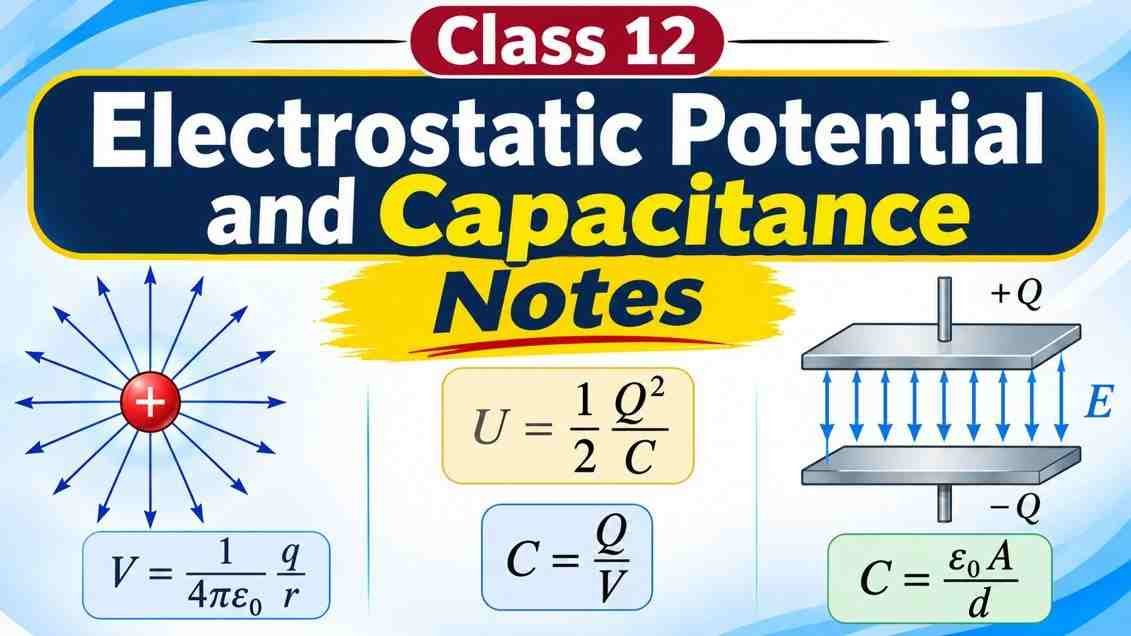
Electrostatic Potential and Capacitance Class 12 Notes
Electrostatic Potential Energy
Electrostatic potential energy is the energy stored in a charge due to its position in an electric field. Similar to gravitational potential energy, work must be done to move a charge against an electric force. This work gets stored as electrostatic potential energy.
The electrostatic force is a conservative force, which means that the work done depends only on the initial and final positions of the charge and not on the path followed. Because of this property, the concept of potential energy is meaningful in electrostatics.
When a charge qqq is moved from point RRR to point PPP against the electric force, an external force must be applied. This external force is equal and opposite to the electric force.
$$F_{\text{ext}} = -F_E$$The work done by the external force increases the potential energy of the charge. Therefore, the potential energy difference between two points is equal to the work done by the external force in moving the charge between those points.
$$\Delta U = U_P – U_R = W_{RP}$$Since electrostatic force is conservative, the work done in moving a charge from one point to another is independent of the path followed. It depends only on the initial and final positions.
The actual value of potential energy is not important. Only the difference in potential energy between two points has physical significance.
For convenience, the potential energy at infinity is taken as zero.
$$U_{\infty} = 0$$With this reference, the potential energy of a charge at any point is equal to the work done by an external force in bringing the charge from infinity to that point without acceleration.
$$U_P = W_{\infty P}$$Definition: The potential energy of a charge at a point in an electrostatic field is the work done by an external force in bringing the charge from infinity to that point without acceleration.
Important Points
- Electrostatic force is a conservative force.
- Work done by an electrostatic field is path independent.
- Work done against electric force is stored as potential energy.
- Only potential energy difference is physically significant.
- Potential energy at infinity is taken as zero.
Electrostatic Potential
Electrostatic potential is a property of an electric field. It tells us how much work is needed to bring a unit positive charge from infinity to a point without acceleration. Since work done is proportional to the charge, we divide the work by the charge to get a quantity that depends only on the electric field and not on the test charge.
The difference in potential between two points is equal to the work done per unit charge in moving a positive test charge from one point to another.
$$V_P – V_R = \frac{U_P – U_R}{q}$$Only the potential difference between two points has physical significance. The actual value of potential is not important. For convenience, the potential at infinity is taken as zero.
When the potential at infinity is zero, the electrostatic potential at a point is equal to the work done by an external force in bringing a unit positive charge from infinity to that point without acceleration.
Definition: Electrostatic potential at any point in an electric field is the work done in bringing a unit positive charge from infinity to that point without acceleration.
Formula
$$V = \frac{W}{q}$$For a unit positive charge,
V = W
Important Points
- Electrostatic potential is work done per unit positive charge.
- Potential is a scalar quantity.
- SI unit of potential is volt (V).
- Only potential difference is physically important.
- Potential at infinity is taken as zero.
- Work done by the electrostatic field is path independent.
Potential Due to a Point Charge
The electrostatic potential due to a point charge is the work done in bringing a unit positive charge from infinity to a point in the electric field of that charge without acceleration.
Consider a point charge Q. The potential at a point located at a distance r from the charge depends only on the value of the charge and its distance from the point. Since electrostatic force is conservative, the work done is independent of the path followed.
The electrostatic potential due to a point charge Q is given by
$$V = \frac{1}{4\pi\varepsilon_0}\frac{Q}{r}$$or
$$V = \frac{kQ}{r}$$where
Q = point charge
r = distance from the charge
The potential varies inversely with distance. Therefore, as the distance from the charge increases, the potential decreases.
$$V \propto \frac{1}{r}$$For a positive charge, the potential is positive.
$$Q > 0 \Rightarrow V > 0$$For a negative charge, the potential is negative.
$$Q < 0 \Rightarrow V < 0$$The potential at infinity is taken as zero.
$$V_{\infty} = 0$$Definition: The electrostatic potential at a point is the work done in bringing a unit positive charge from infinity to that point without acceleration.
Important Board Points
- Potential due to a point charge depends on Q and r.
- Potential is a scalar quantity.
- Potential varies as 1/r.
- Electric field varies as 1/r2.
- Positive charge produces positive potential.
- Negative charge produces negative potential.
- Potential at infinity is zero.
Potential Due to an Electric Dipole
An electric dipole consists of two equal and opposite charges separated by a small distance. The dipole is characterized by its dipole moment p, which is directed from the negative charge to the positive charge.
$$p = q(2a)$$The electric potential at a point due to an electric dipole is equal to the algebraic sum of the potentials produced by the two charges. Therefore, the principle of superposition is applicable to electric potential.
For a point far away from the dipole (r≫a), the potential is given by
$$V = \frac{1}{4\pi\varepsilon_0}\frac{p\cos\theta}{r^2}$$or
$$V = \frac{1}{4\pi\varepsilon_0}\frac{\vec{p} \cdot \hat{r}}{r^2}$$where:
- p = dipole moment
- r = distance from the centre of the dipole
- θ = angle between p and r
Unlike the potential due to a point charge, the potential due to a dipole depends on both the distance r and the angle θ. Therefore, two points at the same distance from the dipole may have different potentials.
On the axial line of the dipole (θ=0∘), the potential is maximum.
$$V = \frac{1}{4\pi\varepsilon_0}\frac{p}{r^2}$$On the equatorial line (θ=90∘), the potential is zero because cos90∘=0.
V=0
Difference Between Potential Due to a Point Charge and a Dipole
| Point Charge | Electric Dipole |
|---|---|
| Depends only on distance r | Depends on r and θ |
| Varies as 1/r | Varies as 1/r2 |
| Can be positive or negative depending on charge | Can be positive, negative, or zero depending on position |
Important Points
- Potential due to a dipole follows the superposition principle.
- Potential depends on both distance and angle.
- Potential is maximum on the axial line.
- Potential is zero on the equatorial line.
- Dipole potential decreases as 1/r2.
Potential Due to a System of Charges
A system of charges contains two or more charges placed at different positions. The electrostatic potential at any point due to such a system is found using the principle of superposition. According to this principle, the total potential at a point is the algebraic sum of the potentials due to all individual charges.
If charges q1,q2,q3,…,qn are placed at distances r1,r2,r3,…,rn from a point P, then the total potential at P is
$$V = V_1 + V_2 + V_3 + \cdots + V_n$$or
$$V = \frac{1}{4\pi\varepsilon_0}\left(\frac{q_1}{r_1}+\frac{q_2}{r_2}+\frac{q_3}{r_3}+\cdots+\frac{q_n}{r_n}\right)$$Since potential is a scalar quantity, we add potentials algebraically and do not use vector addition.
For a continuous charge distribution, the total potential is obtained by adding the potentials due to all small charge elements.
Potential Due to a Charged Spherical Shell
For a uniformly charged spherical shell of radius R and charge q:
Outside the Shell (r≥R)
The shell behaves like a point charge placed at its centre.
$$V = \frac{1}{4\pi\varepsilon_0}\frac{q}{r}$$On the Surface (r=R)
$$V = \frac{1}{4\pi\varepsilon_0}\frac{q}{R}$$Inside the Shell (r<R)
The electric field inside the shell is zero, so the potential remains constant and is equal to the potential at the surface.
$$V = \frac{1}{4\pi\varepsilon_0}\frac{q}{R}$$Definition: The potential at a point due to a system of charges is equal to the algebraic sum of the potentials due to the individual charges.
Important Points
- Potential obeys the superposition principle.
- Total potential = algebraic sum of individual potentials.
- Potential is a scalar quantity.
- For a spherical shell, potential is constant inside the shell.
- Electric field inside a charged spherical shell is zero.
- Outside the shell, it behaves like a point charge.
Equipotential Surfaces
An equipotential surface is a surface on which the electric potential is the same at every point. Since there is no potential difference between any two points on the surface, no work is done in moving a charge along an equipotential surface.
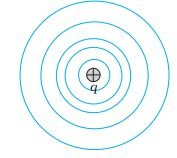
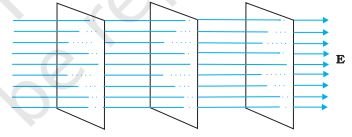
For a point charge, the equipotential surfaces are concentric spherical surfaces centred on the charge. For a uniform electric field, the equipotential surfaces are parallel planes perpendicular to the electric field.
A very important property of equipotential surfaces is that the electric field is always perpendicular (normal) to the equipotential surface. If the electric field had a component along the surface, work would be required to move a charge on the surface, which is not possible because all points on an equipotential surface have the same potential.
Definition: An equipotential surface is a surface with a constant value of electric potential at all points on the surface.
Important Properties of Equipotential Surfaces
- Electric potential is the same at every point.
- No work is done in moving a charge on an equipotential surface.
- Electric field is always perpendicular to the equipotential surface.
- Equipotential surfaces never intersect each other.
- Closer equipotential surfaces indicate a stronger electric field.
Examples
Point Charge
Equipotential surfaces are concentric spheres.
Equipotential surfaces are parallel planes.
Relation Between Electric Field and Potential
The electric field is related to the rate of change of potential. The electric field acts in the direction where the potential decreases most rapidly.
The magnitude of electric field is given by
$$E = -\frac{dV}{dl}$$where:
- E = electric field
- dV = small change in potential
- dl = small displacement normal to the equipotential surface
The negative sign shows that potential decreases in the direction of the electric field.
Important Conclusions
- Electric field is directed from higher potential to lower potential.
- Electric field is perpendicular to the equipotential surface.
- The magnitude of electric field is equal to the potential gradient.
Important Points
- No work is done along an equipotential surface.
- Electric field is always normal to an equipotential surface.
- For a point charge, equipotential surfaces are spherical.
- For a uniform electric field, equipotential surfaces are parallel planes.
- Electric field points in the direction of decreasing potential.
Potential Energy of a System of Charges
When two or more charges are placed together, the system stores electrostatic potential energy. This energy is equal to the work done by an external agency in bringing the charges from infinity to their given positions.
For two point charges q1 and q2 separated by a distance rrr, the potential energy of the system is
$$U = \frac{1}{4\pi\varepsilon_0}\frac{q_1q_2}{r}$$The potential energy depends on the values of the charges and the distance between them.
- If q1q2>0 (like charges), then potential energy is positive.
- If q1q2<0 (unlike charges), then potential energy is negative.
Positive potential energy means work must be done against the repulsive force to bring the charges together. Negative potential energy means the charges attract each other.
For a system of three charges, the total potential energy is equal to the sum of the potential energies of all possible pairs of charges.
$$U = \frac{1}{4\pi\varepsilon_0}\left(\frac{q_1q_2}{r_{12}}+\frac{q_1q_3}{r_{13}}+\frac{q_2q_3}{r_{23}}\right)$$Similarly, for a system containing many charges, the total electrostatic potential energy is the algebraic sum of the potential energies of all charge pairs.
Since electrostatic force is conservative, the potential energy depends only on the final arrangement of charges and not on the path followed while bringing them together.
Definition: The electrostatic potential energy of a system of charges is the work done by an external agency in assembling the charges from infinity to their specified positions.
Important Points
- Potential energy is stored when charges are brought together.
- Potential energy depends on charges and their separation.
- Like charges have positive potential energy.
- Unlike charges have negative potential energy.
- Potential energy is a scalar quantity.
- Total potential energy is the sum of the energies of all charge pairs.
- It is independent of the path used to assemble the charges.
Potential Energy in an External Field
When a charge is placed in an external electric field, it possesses potential energy due to its position in that field. The potential energy is equal to the work done in bringing the charge from infinity to that point.
If the electric potential at a point is V and a charge qqq is placed there, then its potential energy is
U=qV
where:
- U = potential energy
- q = charge
- V = electric potential at that point
Thus, potential energy depends on both the charge and the potential of the point.
Electron Volt (eV)
Electron volt is a unit of energy commonly used in atomic and nuclear physics.
Definition: One electron volt (1 eV) is the energy gained by an electron when it moves through a potential difference of 1 volt.
$$1\,\text{eV} = 1.6 \times 10^{-19}\,\text{J}$$Important Conversions
$$1\,\text{keV} = 10^3\,\text{eV}$$$$1\,\text{MeV} = 10^6\,\text{eV}$$$$1\,\text{GeV} = 10^9\,\text{eV}$$$$1\,\text{TeV} = 10^{12}\,\text{eV}$$Potential Energy of Two Charges in an External Field
If two charges q1 and q2 are placed at points having potentials V(r1) and V(r2), then the total potential energy consists of:
- Energy due to the external electric field.
- Mutual interaction energy between the two charges.
Therefore,
$$U = q_1V(r_1) + q_2V(r_2) + \frac{1}{4\pi\varepsilon_0}\frac{q_1q_2}{r_{12}}$$where r12 is the distance between the two charges.
Potential Energy of a Dipole in an External Electric Field
When an electric dipole is placed in a uniform electric field, it experiences a torque that tends to align the dipole with the field.
The potential energy of a dipole depends on the angle $\theta$ between the dipole moment $\vec{p}$ and the electric field $\vec{E}$.$$U = -pE\cos\theta$$or
$$U = -\vec{p} \cdot \vec{E}$$Special Cases
Dipole Parallel to Electric Field
$$\theta = 0^\circ$$U=-pE
Potential energy is minimum.
Dipole Perpendicular to Electric Field
$$\theta = 90^\circ$$U=0
Dipole Opposite to Electric Field
$$\theta = 180^\circ$$U=+pE
Potential energy is maximum.
Electrostatics of Conductors
A conductor is a material that contains free electrons which can move easily inside it. In metals, these free electrons move randomly in the absence of an electric field. When an external electric field is applied, the electrons rearrange themselves until electrostatic equilibrium is reached.
Electric Field Inside a Conductor
In electrostatic equilibrium, the electric field inside a conductor is always zero. If an electric field existed inside, the free electrons would continue to move, and the conductor would not remain in a static condition.
Electric Field at the Surface of a Conductor
At the surface of a charged conductor, the electric field is always perpendicular (normal) to the surface.
If the field had a component along the surface, free electrons would move along the surface, which is not possible in electrostatic equilibrium.
Excess Charge Resides on the Surface
In a charged conductor, all excess charge remains on the outer surface. There is no excess charge inside the conductor.
This is a direct consequence of Gauss’s law.
Potential of a Conductor
Since the electric field inside a conductor is zero, no work is required to move a charge from one point to another inside the conductor.
Therefore, the potential remains the same throughout the conductor and on its surface.
Electric Field Just Outside a Charged Conductor
The electric field just outside the surface of a charged conductor is
$$E = \frac{\sigma}{\varepsilon_0}$$where:
- σ = surface charge density
- ε0 = permittivity of free space
Vector form:
$$\vec{E} = \frac{\sigma}{\varepsilon_0}\hat{n}$$where $\hat{n}$ is the outward normal unit vector.Electrostatic Shielding
A conductor can protect its interior from external electric fields. If a cavity is present inside a conductor and no charge is placed inside the cavity, the electric field inside the cavity remains zero.
This phenomenon is called electrostatic shielding.
Definition: The phenomenon in which a conductor shields its interior from external electric fields is called electrostatic shielding.
Applications
- Protection of sensitive electronic instruments.
- Metal body of a car protects passengers from lightning.
- Important Board Points
- Electric field inside a conductor is zero.
- Excess charge resides only on the outer surface.
- Potential remains constant throughout a conductor.
- Electric field is normal to the conductor surface.
- A conductor is an equipotential body.
- Electrostatic shielding keeps the interior free from external electric fields.
Dielectrics and Polarisation
Dielectrics are non-conducting substances that do not have free charge carriers. Unlike conductors, charges cannot move freely inside a dielectric. When a dielectric is placed in an external electric field, it does not completely cancel the field. Instead, it reduces the field inside the material.
The external electric field causes the molecules of the dielectric to develop dipole moments or align their existing dipole moments. As a result, the dielectric becomes polarised.
Types of Molecules
Non-Polar Molecules
In non-polar molecules, the centres of positive and negative charges coincide. Therefore, these molecules do not have a permanent dipole moment.
Examples
- Oxygen (O2))
- Hydrogen (H2)
When an external electric field is applied, charges inside the molecule shift slightly, producing an induced dipole moment.
Polar Molecules
In polar molecules, the centres of positive and negative charges do not coincide. Therefore, these molecules have a permanent dipole moment.
Examples
- Water (H2O)
- Hydrogen Chloride (HCl)
In the absence of an electric field, the dipoles are randomly oriented. When an electric field is applied, the dipoles tend to align in the direction of the field.
Polarisation
The process by which a dielectric develops a net dipole moment in an external electric field is called polarisation.
Definition: The dipole moment per unit volume of a dielectric is called polarisation.
- It is represented by P.
- For a linear isotropic dielectric,
where:
- P = polarisation
- ε0 = permittivity of free space
- χe = electric susceptibility
- E = electric field
Effect of Polarisation
When a dielectric is polarised, induced charges appear on its opposite surfaces.
- Positive bound charges appear on one surface.
- Negative bound charges appear on the opposite surface.
These induced charges produce an electric field opposite to the external electric field.
As a result, the electric field inside the dielectric decreases.
Difference Between Conductor and Dielectric
| Conductor | Dielectric |
|---|---|
| Has free electrons | No free electrons |
| Internal electric field becomes zero | Internal electric field decreases but is not zero |
| Charges move freely | Charges cannot move freely |
| Excess charge appears on surface | Polarisation produces bound charges |
Important Points
- Dielectrics are insulating materials.
- Polarisation occurs when a dielectric is placed in an electric field.
- Polar molecules have permanent dipole moments.
- Non-polar molecules develop induced dipole moments.
- Polarisation is dipole moment per unit volume.
- The induced field opposes the external field.
- Electric field inside a dielectric decreases but does not become zero.
Capacitors and Capacitance
A capacitor is a device made of two conductors separated by an insulating material called a dielectric. When the conductors are connected to a battery, equal and opposite charges (+Q and −Q) appear on them. The capacitor stores electric charge and electrical energy.
The potential difference V between the conductors is directly proportional to the charge Q stored on them. Therefore, the ratio of charge to potential difference remains constant for a given capacitor. This constant is called the capacitance of the capacitor.
Definition: The capacitance of a capacitor is defined as the ratio of the charge on either conductor to the potential difference between them.
Formula
$$C = \frac{Q}{V}$$where:
- C = capacitance
- Q = charge on the capacitor
- V = potential difference between the conductors
Capacitance depends on:
- Shape of the conductors
- Size of the conductors
- Separation between the conductors
- Nature of the dielectric medium
It does not depend on the charge stored or the potential difference applied.
SI Unit of Capacitance
The SI unit of capacitance is farad (F).
$$1\,\text{F} = 1\,\text{C}\,\text{V}^{-1}$$Common Sub-units
$$1\,\mu\text{F} = 10^{-6}\,\text{F}$$$$1\,\text{nF} = 10^{-9}\,\text{F}$$$$1\,\text{pF} = 10^{-12}\,\text{F}$$Importance of Large Capacitance
A capacitor with large capacitance can store a large amount of charge even at a small potential difference.
From
$$V = \frac{Q}{C}$$for a fixed charge Q
- Larger C → Smaller V
- Smaller C → Larger V
This helps prevent leakage of charge.
Dielectric Strength
Every insulating material can withstand only a limited electric field. If the electric field becomes too large, the insulator breaks down and starts conducting.
Definition: The maximum electric field that a dielectric can withstand without losing its insulating property is called dielectric strength.
For air,
$$3 \times 10^6\,\text{V m}^{-1}$$Important Points
- A capacitor consists of two conductors separated by an insulator.
- Charges on the conductors are equal and opposite.
- Capacitance is the charge stored per unit potential difference.
- Capacitance depends on geometry and dielectric medium.
- SI unit of capacitance is farad (F).
- Large capacitance allows more charge storage at lower voltage.
- Dielectric strength is the maximum electric field an insulator can withstand.
The Parallel Plate Capacitor
A parallel plate capacitor consists of two large parallel conducting plates separated by a small distance. The plates carry equal and opposite charges (+Q)(+Q)(+Q) and (−Q)(-Q)(−Q). The space between the plates may be vacuum, air, or a dielectric material.
Because the plate separation is very small compared to their size, the electric field between the plates is nearly uniform. The electric field is directed from the positive plate to the negative plate.
Electric Field Between the Plates
The electric field between the plates is
$$E = \frac{\sigma}{\varepsilon_0}$$Since
$$\sigma = \frac{Q}{A}$$therefore,
$$E = \frac{Q}{\varepsilon_0 A}$$where:
- Q = charge on each plate
- A = area of each plate
- ε0 = permittivity of free space
Potential Difference Between the Plates
For a uniform electric field,
V=Ed
Substituting the value of E,
$$V = \frac{Qd}{\varepsilon_0 A}$$where d is the separation between the plates.
Capacitance of a Parallel Plate Capacitor
Using
$$C = \frac{Q}{V}$$we get
$$C = \frac{\varepsilon_0 A}{d}$$Important Result
$$C = \frac{\varepsilon_0 A}{d}$$This is the most important formula for board examinations.
Dependence of Capacitance
From
$$C = \frac{\varepsilon_0 A}{d}$$we conclude:
If Area Increases
Capacitance increases.
$$C \propto A$$If Plate Separation Increases
Capacitance decreases.
$$C \propto \frac{1}{d}$$Fringing Effect
Near the edges of the plates, electric field lines bend outward. This effect is called fringing of the electric field.
For numericals, fringing is usually neglected because
$$d^2 \ll A$$and the field is assumed to be uniform.
Definition: The bending outward of electric field lines near the edges of a capacitor plate is called fringing of the field.
Important Points
- A parallel plate capacitor has two parallel conducting plates.
- Plates carry equal and opposite charges.
- Electric field between the plates is uniform.
- Electric field is directed from positive to negative plate.
- Capacitance depends on plate area and separation.
- Larger area gives larger capacitance.
- Greater separation gives smaller capacitance.
- Fringing occurs near the edges of the plates.
Effect of Dielectric on Capacitance
When a dielectric material is inserted between the plates of a capacitor, the dielectric becomes polarised. The induced charges on the dielectric produce an electric field opposite to the original electric field. As a result, the electric field and the potential difference between the plates decrease.
Since the charge on the plates remains unchanged, a decrease in potential difference causes the capacitance to increase. Therefore, a capacitor can store more charge when a dielectric is placed between its plates.
For a dielectric of dielectric constant KKK,
$$V = \frac{V_0}{K}$$where:
- V0 = potential difference without dielectric
- V = potential difference with dielectric
The capacitance becomes
$$C = \frac{\varepsilon A}{d}$$where
$$\varepsilon = K\varepsilon_0$$Substituting,
$$C = \frac{K\varepsilon_0 A}{d}$$Since
$$C_0 = \frac{\varepsilon_0 A}{d}$$therefore,
$$C = KC_0$$Dielectric Constant
Definition: The dielectric constant of a substance is the factor by which the capacitance increases when the dielectric is completely inserted between the plates of a capacitor.
Formula:
$$K = \frac{C}{C_0}$$where:
- C = capacitance with dielectric
- C0 = capacitance without dielectric
Also,
$$K = \frac{\varepsilon}{\varepsilon_0}$$where:
- ε = permittivity of medium
- ε0 = permittivity of free space
Permittivity of a Medium
The permittivity of a dielectric medium is
$$\varepsilon = K\varepsilon_0$$For vacuum,
K=1
and
$$\varepsilon = \varepsilon_0$$Effect of Dielectric on Capacitor
When dielectric is inserted:
- Electric field decreases
- Potential difference decreases
- Capacitance increases
- More charge can be stored
Important Board Points
- A dielectric reduces the electric field between capacitor plates.
- Potential difference decreases after inserting a dielectric.
- Capacitance increases by a factor K.
- Dielectric constant is always greater than 1.
Combination of Capacitors
Sometimes two or more capacitors are connected together to get the required capacitance. The equivalent capacitance depends on how the capacitors are connected. The two most important combinations are series combination and parallel combination.
Capacitors in Series
In a series combination, capacitors are connected one after another.
C₁ – C₂ – C₃
In a series combination:
- The charge on each capacitor is the same.
- Potential difference gets divided among the capacitors.
- Equivalent capacitance is less than the smallest capacitor.
Important Relations
Same charge on each capacitor:
Q_1=Q_2=Q_3=Q
Total potential difference:
V=V_1+V_2+V_3
Equivalent capacitance:
$$\frac{1}{C} = \frac{1}{C_1} + \frac{1}{C_2} + \frac{1}{C_3}$$For nnn capacitors,
$$\frac{1}{C} = \frac{1}{C_1} + \frac{1}{C_2} + \cdots + \frac{1}{C_n}$$Important Point
In a series combination, the charge on each capacitor remains the same.
Capacitors in Parallel
In a parallel combination, all positive plates are connected together and all negative plates are connected together.
         || C₁ ||
------||      ||------
         || C₂ ||
------||      ||------
         || C₃ ||
In a parallel combination:
- Potential difference across each capacitor is the same.
- Charge gets divided among the capacitors.
- Equivalent capacitance is greater than any individual capacitor.
Important Relations
Same potential difference:
$$V_1 = V_2 = V_3 = V$$Total charge:
$$Q = Q_1 + Q_2 + Q_3$$Equivalent capacitance:
$$C = C_1 + C_2 + C_3$$For nnn capacitors,
$$C = C_1 + C_2 + \cdots + C_n$$Important Point
In a parallel combination, the potential difference across each capacitor is the same.
Difference Between Series and Parallel Combination
| Series Combination | Parallel Combination |
|---|---|
| Charge is same on each capacitor | Potential difference is same on each capacitor |
| Voltage divides | Charge divides |
| Capacitance decreases | Capacitance increases |
| Equivalent capacitance is smaller than the smallest capacitor | Equivalent capacitance is larger than the largest capacitor |
Energy Stored in a Capacitor
When a capacitor is charged, work has to be done to transfer charge from one plate to the other. This work gets stored in the capacitor as electrostatic potential energy.
Definition: The work done in charging a capacitor is stored as electrostatic potential energy in the capacitor.
The energy stored in a capacitor is given by
$$U = \frac{1}{2}\frac{Q^2}{C}$$Using Q=CV, the energy can also be written as
$$U = \frac{1}{2}CV^2$$or
$$U = \frac{1}{2}QV$$All three formulas represent the same energy.
Energy Stored in the Electric Field
The energy stored in a capacitor is present in the electric field between its plates.
For a parallel plate capacitor,
$$U = \frac{1}{2}\varepsilon_0 E^2 (Ad)$$where:
- A = area of each plate
- d = separation between plates
- Ad = volume between the plates
- E = electric field
Energy Density
The energy stored per unit volume of an electric field is called energy density.
Definition: Energy density is the energy stored per unit volume of space.
It is given by
$$u = \frac{1}{2}\varepsilon_0 E^2$$where:
- u = energy density
- E = electric field
This relation is valid for any electric field.
Important Points
- Energy is stored when a capacitor is charged.
- Stored energy is electrostatic potential energy.
- Energy is stored in the electric field between the plates.
- Energy density means energy per unit volume.
- Energy stored is always positive.
Disclaimer: The content that is present on our website is based on the NCERT Class 12 Physics textbook and is provided for educational purposes only. All the content and images have been taken from Physics Class 12 NCERT Textbook and CBSE Support material. Images and content shown above are the property of individual organizations and are used here for reference purposes only. To make it easy to understand, some of the content and images are generated by AI and cross-checked by the teachers.