
← Back to Class 9 Kaushal Vikas
Learn about Rooftop Gardening Class 9 Notes with easy-to-understand explanations based on the Kaushal Vikas curriculum. These notes explain the concept of rooftop gardening, its importance, benefits, requirements, and different methods of growing plants on rooftops. They will help students understand how unused rooftop spaces can be converted into green gardens and used for growing vegetables, fruits, flowers, and other plants. These notes are useful for quick revision and exam preparation.
Rooftop Gardening Class 9 Notes
Rooftop gardening means growing plants on the roof of a house, school, or building. Instead of leaving rooftops empty, we can grow:
- Vegetables
- Fruits
- Flowers
- Herbs
Plants can be grown in:
- Pots
- Grow bags
- Containers
- Raised beds
This method is very useful in cities where there is less open land.
Benefits of Rooftop Gardening
- Fresh vegetables and fruits
- Better air quality
- Keeps buildings cool in summer
- Makes surroundings beautiful
- Reduces dependence on market vegetables
- Good use of empty rooftop space
Production from a Rooftop Garden
Even a small rooftop garden of 1 square metre can produce about 10 kg of vegetables in one year. Before starting a rooftop garden, some important decisions must be made.
- Which Plants Should Be Grown: Choose plants that can grow well in your area and are suitable for the local climate. For example, spinach, coriander, fenugreek, tomato, chilli, marigold, etc.
- Amount of Sunlight: Different plants need different amounts of sunlight. Choose a place that receives enough sunlight.
- Water Requirement: Select plants that need less water. This helps save water and reduces maintenance.
- Cost and Materials: Cost and materials is also important, like pots or containers, soil, compost and seeds. Choose materials according to your budget.
- Available Space: Measure the rooftop space and decide where to place pots and how many pots can fit safely
- Usefulness of Plants: Grow plants according to your need. For example, vegetables for the school midday meal, flowers for festivals and celebrations or herbs for home use.
Process chart
A process chart helps in planning the work. It shows which tasks are to be completed, the date of completion and the responsibility of each person.
Example Process Chart
| Task | Date | Responsibility |
|---|---|---|
| Layout of rooftop garden | Week 1 | Students |
| Soil testing and pot mixture preparation | Week 1 | Students and teacher |
| Germination test | Week 2 | Students |
| Sowing seeds | Week 2 | Students |
| Watering and weeding | Daily | Students |
| Pest protection | Weekly | Students |
| Monitoring plant growth | Weekly | Students |
| Adding nutrients | Every 15 days | Students |
| Harvesting | After 2–3 months | Students |
| Packaging and transport | Harvest time | Students |
Designing the layout
Before starting a rooftop garden, we must plan the layout carefully. A good layout helps plants grow healthy and makes gardening easier.
1. Space Between Pots
Leave enough space between pots and containers.
Why is it important?
- Easy watering
- Easy weeding
- Easy cleaning
- Easy movement while working
2. Sunlight Requirement
Most plants need sunlight to grow. Choose a part of the roof that gets 5–6 hours of direct sunlight every day.
Plants that need more sunlight
- Tomato
- Chilli
- Cucumber
- Brinjal
Place these plants in open sunny areas.
Plants that need less sunlight
- Coriander
- Mint
- Spinach
- Other leafy vegetables
Place these plants in partially shaded areas.
3. Weight and Safety
Pots, soil, and water are heavy. Too much weight can damage the roof.
Safety Tips
- Place large and heavy pots near roof beams.
- Avoid putting many heavy pots at one place.
- Check the roof’s weight-carrying capacity.
Why?
Roof beams are stronger and can support more weight.
4. Water Management
Excess water should not collect on the roof.
What should be done?
- Keep pots on trays.
- Use tiles or stands under pots.
- Ensure proper drainage.
Benefits
- Prevents waterlogging
- Protects the roof from seepage
- Increases roof life
5. Provision for Shade
Some plants cannot tolerate strong sunlight.
Shade can be provided by:
- Shade nets
- Bamboo screens
- Vertical trellises
Benefits
- Protects plants from heat
- Prevents leaf damage
- Maintains proper growth
6. Protection from Wind
Strong winds can:
- Damage plants
- Break stems
- Knock over pots
Protection Methods
- Place pots near walls
- Use bamboo supports
- Install wind barriers
- Observe wind direction before planning the garden
Selecting materials
After planning the rooftop garden, the next step is to collect the required materials. Choose materials carefully so that plants grow well and the roof remains safe.
| Materials | Options | Safety note |
|---|---|---|
| Pots/ containers | Terracotta pots (allow air and moisture to pass, preventing waterlogging around roots), plastic pots (lightweight), grow bags (flexible and easy to move), cement pots (limited use since heavy and retain heat), wooden containers (allow air to pass, preventing temperature fluctuations and waterlogging) and recycled material (for example, old buckets with holes drilled in bottom, old sinks) | Place heavy pots/containers only near beams or roof edges. Distribute weight evenly across the roof |
| Potting mixture | Soil, compost mixtures and cocopeat/ perlite/vermiculite | Avoid using only soil, as it retains excess water and increases the load on the roof |
| For watering | Watering cans, small sprinklers and hose pipe attached to taps, and trays/ saucers to prevent seepage | Always place trays/saucers under pots to collect extra water and prevent seepage |
| Shade and support structures | Shade net, bamboo screens and lightweight movable trellises | For providing shade and for climbers |
| Gloves | Always wear gloves while handling soil and organic matter | |
| Other components | Compost bin and storage area | Care to be taken to avoid infestation by rats and/or pests, and proper storage with lock arrangements |
Selecting tools for doing work
After collecting materials, the next step is to select the right tools for rooftop gardening. Tools make gardening easier, faster, and safer.
| Tools | Use | Safety note |
|---|---|---|
| Hand Trowel | Digging soil, sowing seeds, and transplanting seedlings | Do not leave sharp tools on the ground. Store safely after use. |
| Pruning Scissors | Cutting stems, removing dry leaves, and shaping plants | Handle carefully. Keep blades closed when not in use. |
| Watering Can / Spray Bottle | Watering plants gently, especially young seedlings | Avoid spilling water on the floor. Hold firmly while using. |
| Buckets / Trays | Carrying soil mixture and collecting extra water from pots | Do not overload. Lift small amounts to avoid strain. |
| Pots / Grow Bags / Grow Beds | Growing plants and raising seedlings Choose containers that are easy to carry. | Avoid very heavy pots. |
| Nursery Trays | Growing seeds before transplanting | Keep trays in a safe place to avoid damage to young seedlings. |
Making Bill of Materials
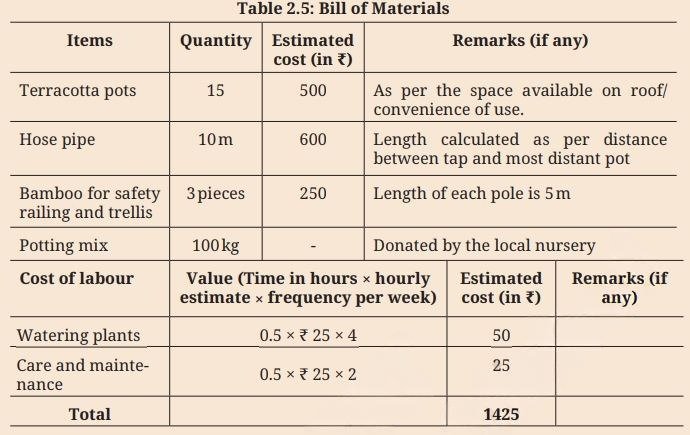
What is a Bill of Materials (BoM)?
A Bill of Materials (BoM) is a list of all materials, tools, and labour needed for a project. Importance of BoM
- Helps estimate cost in advance
- Avoids unnecessary purchases
- Prevents wastage of materials
- Helps organize work properly
- Makes planning easier
Pot preparation and sowing
Preparing the Potting Mix for Rooftop Gardening
A good potting mix is light in weight and rich in nutrients. It helps plants grow healthy on rooftops.
Steps to Prepare Potting Mix
Collect materials like:
- Cocopeat
- Compost or vermicompost
- Soil
- Perlite or vermiculite (optional)
Mix them in a 1:1:1 ratio.
- 1 part cocopeat
- 1 part compost/vermicompost
- 1 part soil or perlite
Check the pH of the mixture.
Adjust the pH if needed:
- If pH is below 6.0 (acidic), add garden lime.
- If pH is above 8.5 (alkaline), add sulphur or organic manure.
- Test again until the pH becomes 6.5–7.0.
Why Use Potting Mix Instead of Garden Soil?
- Garden soil is heavy.
- It becomes hard after watering.
- Roots do not get enough air.
- Water may collect and cause root rot.
Benefits of Potting Mix
- Light in weight
- Good air flow to roots
- Better drainage
- Healthy plant growth
- Safe for rooftops
Example
- Cocopeat + Compost + Perlite (1:1:1) → about 290 g per 1 L pot
- Cocopeat + Compost + Soil (1:1:1) → about 700 g per 1 L pot
Perlite is much lighter than soil, so it reduces the weight of pots.
Testing Seed Germination Rate
Seed germination rate tells us how many seeds can successfully grow into plants.
Steps
- Count the seeds.
- Sow the seeds in a seedling tray, pot, or container.
- Water them regularly.
- Wait for 2–3 weeks.
- Count how many seeds have germinated.
- Calculate the germination percentage.
Formula
$\text{Germination Percentage}=\frac{\text{Number of Germinated Seeds}}{\text{Total Number of Seeds Sown}}\times100$
Example
- Seeds sown = 20
- Seeds germinated = 18
$\frac{18}{20}\times100=90%$
Germination Rate = 90%
Important Fact About Seeds
- Hybrid seeds give higher yields.
- They are costly and usually used only once.
- Farmers save local seeds for future planting.
- This helps in seed security and biodiversity conservation.
Maintenance and recording growth of plants
Irrigation (Watering Plants)
Plants need the right amount of water to grow well.
- Too little water causes water stress and plants do not grow properly.
- Too much water can suffocate the roots and damage the plant.
In pots and containers:
- Roots cannot grow deep to find water.
- Excess water cannot move far away from the roots.
Therefore, plants in a rooftop garden should be watered carefully.
Estimating Water Requirement
To know how much water your garden needs, calculate the Water Holding Capacity (WHC) of the potting mix.
What is WHC?
Water Holding Capacity (WHC) is the maximum amount of water that a potting mixture can hold.
Steps to Calculate WHC
- Put 500 g potting mixture into a pot or container.
- Measure the weight of the pot with dry potting mixture (Dry Weight).
- Slowly add water until the mixture cannot absorb any more water.
- Allow excess water to drain out for 10–15 minutes.
- Measure the weight of the pot again (Wet Weight).
Calculate WHC using the formula below.
$\text{WHC}=\frac{\text{Wet Weight}-\text{Dry Weight}}{\text{Dry Weight}}\times100$
Example
Suppose:
- Dry Weight = 500 g
- Wet Weight = 620 g
Calculation
$\text{WHC}=\frac{620-500}{500}\times100$
$\text{WHC}=\frac{120}{500}\times100$
$\text{WHC}=24%$
Water Holding Capacity = 24%
Calculating Water Requirement of a Garden
If:
- Total potting mix = 400 kg
- WHC = 25%
Formula
$\text{Water Required}=400\times\frac{25}{100}$
Calculation
$400\times\frac{25}{100}=100$
Water Required = 100 L
Note: 100 L is the maximum water the garden can hold. It does not mean that 100 L of water should be given every day. Actual water requirement depends on weather, plant type, and plant growth stage.
Plant protection
Protection from Diseases and Pests
Diseases and pests can damage plants. We cannot remove all pests because they are part of nature, but we can reduce the damage. Methods of Pest and Disease Control
- Physical Methods: Remove diseased leaves and remove insects and larvae by hand.
- Chemical Methods: Spray organic pesticides such as neem spray.
- Biological Methods: Use beneficial insects that control harmful pests.
How to Identify Problems?
Look at plants regularly for:
- Spots on leaves
- Holes in leaves
- Yellow or discoloured leaves
- Insects on plants
You can also use a mobile app or ask experts by sending photos.
Common Pests and Remedies
| Symptom/Damage | Pest | Commonly Affected Plants | Remedy |
|---|---|---|---|
| Chewed leaves | Caterpillar | Cabbage, cauliflower, broccoli, tomato, brinjal, chilli | Neem spray and turmeric |
| Discoloured leaves | Spider mites | Rose, hibiscus, beans, brinjal, cucumber, watermelon | Spray water on plants |
| Deformed leaves | Aphids | Mustard, cabbage, cauliflower, tomato, brinjal, chilli, rose | Neem spray, chilli-garlic spray, remove by hand |
| Large holes and shiny trails | Slug/Snail | Cabbage, lettuce, spinach, seedlings | Manual removal and salt lines |
| Wilted and chewed leaves | Chafers (Beetles) | Rose, hibiscus, jasmine, potato, maize | Neem spray and hand-picking |
| Black mould and sticky weak leaves | White fly | Tomato, brinjal, chilli, okra, cucumber, hibiscus | Neem spray and soap-water spray |
Protection from Weeds
What are Weeds?
Weeds are unwanted plants that grow in the garden. They compete with crop plants for:
- Water
- Nutrients
- Sunlight
- Space
Methods of Weed Control
- Hand Weeding: Remove weeds by hand.
- Mulching: Cover the soil with straw, dry leaves, grass clippings, wood chips or plastic sheets. It helps to stops weed growth and conserves soil moisture.
- Chemical Control: Spray weedicides when necessary.
Steps for Manual Weed Removal
- Identify the weed near the main plant.
- Loosen the soil gently around the weed.
- Hold the weed near its base.
- Pull it out slowly with its roots.
- Level the soil around the main plant.
Harvesting and storage
Harvesting of Crops
Harvesting means collecting fruits, vegetables, leaves, or flowers when they are ready. Timely harvesting is important because:
- It improves quality.
- It increases shelf life.
- It keeps produce fresh and tasty.
If harvesting is delayed:
- Produce may become overripe.
- Taste may decrease.
- Produce may spoil quickly.
Important Tips for Rooftop Gardening
- Gentle Handling: Handle fruits, vegetables, and flowers carefully. Avoid bruising or crushing them. Every produce is valuable because rooftop gardens produce small quantities.
- Right Time for Harvesting: Harvest in the early morning or late evening.
- Use Proper Tools: Use proper tools like scissors, pruning shears and small knives.
- Harvest at the Correct Stage: Different crops are harvested at different stages. like Spinach → Harvest when leaves are tender, Tomato → Harvest when fruits turn red. and Coriander → Harvest before flowering.
Storage of Produce
Good storage helps keep produce fresh for a longer time.
- Cleaning: Wash vegetables and herbs gently. Remove soil and dust and dry them before storing.
- Use Proper Containers: Use baskets or perforated containers.
- Store at the Right Temperature: Leafy vegetables need a cool and moist place. Tomatoes should be stored at room temperature until fully ripe.
Harvest Time and Storage of Common Crops
| Crop | Harvest Time (Days) | Storage Method |
|---|---|---|
| Lettuce | 45–55 | Store in a plastic bag in the refrigerator for up to 1 week |
| Spinach | 30–60 | Wash, dry and keep in an airtight container in the refrigerator |
| Radish | 25–45 | Remove leaves and refrigerate |
| Okra (Bhindi) | 45–55 | Store in a container and refrigerate |
| Capsicum | 60–80 | Refrigerate for 1–2 weeks |
| Basil, Mint, Coriander | 25–30 | Keep stems in a jar of water or wrap in a damp paper towel |
| Tomato | 55–70 | Store at room temperature |
| Brinjal | 60–70 | Store in a cool place |
Packaging and transport
Packaging helps keep fruits, vegetables, herbs, and flowers fresh for a longer time. Good packaging:
- Prevents damage.
- Maintains freshness.
- Makes transportation easier.
Packaging Different Types of Produce
- Leafy Vegetables: Leafy vegetable like spinach or coriander should be wrap in a clean damp cloth or newspaper and refrigerate as soon as possible. it helps to prevents wilting and keeps leaves fresh.
- Fruits and Vegetables: Fruits and vegetables like tomato, chilli should be store in baskets or ventilated corrugated cardboard boxes. Do not pack in airtight plastic bags.
- Herbs: Herbs like basil, mint or coriander can be packed in jute string or paper bands neatly. Use label each bundle with its name which helps to easyly identify and easyly handle.
- Flowers: Flowers should be place in baskets. Moisture keeps flowers fresh for a longer period.
Important Points While Developing a Rooftop Garden
- Follow Safety Measures: Lift tools and materials carefully. Work safely on rooftops.
- Select Suitable Plants: Choose plants according to local climate:
- Plan the Garden Properly consider sunlight avilabilty, proper space, water management and structural safety of the roof.
- Use Lightweight Materials like lightweight pots and potting mix.
- Test Seed Germination: Check germination percentage before sowing. It ensure better plant growth.
- Regular Maintenance: Follow a watering schedule. Watch for pests and diseases.
- Harvest at the Right Time: Harvest crops when mature. Use proper harvesting tools.
Disclaimer: The content that is present on our website is based on the NCERT Class 9 Kaushal Vikas textbook and is provided for educational purposes only. All the content and images have been taken from Kaushal Vikas Class 9 NCERT Textbook and CBSE Support material. Images and content shown above are the property of individual organizations and are used here for reference purposes only. To make it easy to understand, some of the content and images are generated by AI and cross-checked by the teachers.