
Cultural Currents: 13th to 17th Centuries explores the important cultural and social changes that took place in India between the 13th and 17th centuries. The chapter covers the growth of devotional traditions, the Bhakti and Sufi movements, the teachings of saints, and the ways in which different communities influenced Indian culture. It helps students understand how ideas of devotion, equality, spirituality, language, music, literature, and art developed during this period.
Cultural Currents 13th to 17th Centuries Class 8 Notes
What is culture?
Culture refers to the shared way of life that defines a group of people and is often passed down through generations. Thus, culture includes values, morals, customs, and traditions, as well as art, music, literature, philosophy, and science.
Indian culture is one of the oldest cultures in the world. The Indian culture includes languages, literature, art, food, temples, monuments, knowledge systems and values. The most ancient cultures, such as those of Mesopotamia, Egypt, Greece and Rome, were destroyed over time; Indian culture has stood strong through the ages and remains alive and strong today.
Culture in Mediaeval India (13th – 17th Century)
When India faced political instability and invasions, culture did not break. It grew richer.
- Traditional practices continued.
- Rulers’ patronage supported arts, literature, and philosophy.
- People’s participation kept traditions alive.
In Mediaeval Time the Persion and Arabic styles mixed with Indian culture and created new art forms, new architecture and new literature. During this time the progress happened in many fields like –
- Visual art and architecture → forts, mosques, temples, and palaces.
- Music and dance → new styles developed.
- Language and literature → Persian mixed with local languages.
- Science and mathematics → new discoveries.
- Philosophy → ideas about life, society, and religion grew stronger.
Belief Systems
Invaders brought Islam; they believed in one God and one prophet, but the local people are Hindu; they followed Hindu tradition, where there are many gods and no single holy book. This made the conflict, and because of this, many temples and sacred places were destroyed. But both the Islamic and the Indian traditions survived, and both are still practised in India.
The power of the bhakti tradition
Bhakti means loving God with devotion. No need for priests or big rituals. The people showed devotion to the God through songs, poems, dance and drama. Bhakti helps the people to unite during the difficult time. Many songs are written in local languages, so everyone could understand.
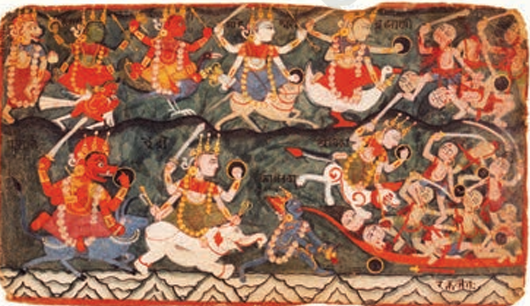
Regional saints and their messages
There are many saints who have given messages to the people which help to become united –
- Kabir → Kabir spoke of one God and rejected the empty rituals of both Hinduism and Islam.
- Ravidas → Taught equality, broke caste barriers.
- Guru Nanak → Spread message of one God and equality; teachings are in Guru Granth Sahib.
- Mirabai → Mirabai, a devotee of Krishna, sang songs of love and devotion.
- Chaitanya Mahaprabhu → Spread devotion through dance and music in Bengal.
- Tukaram, Dnyaneshwar, Namdev → Spread Bhakti in Maharashtra.
- Purandaradasa → Father of Carnatic music, composed thousands of devotional songs.
- Alvars and Nayanars → Tamil saints who sang hymns for Vishnu and Shiva.
Sufism is a path of Islam. It focuses on love, devotion and inner search for God. Sufis believe that God can be felt through the heart, not just through rituals. Sufi saints sang qawwalis; qawwalis are devotional songs. This song is mixed with local classical music with a Sufi style. These songs spoke about love, faith and unity. The famous saints are –
- Khwaja Moinuddin Chishti
- Nizmuddin Aulia
Sufis also used yogic and vedantic techniques, similar to the Hindu paths of moksha. Some of the techniques are –
- Inner silence → quiet mind.
- Asceticism → giving up worldly desires.
- Meditation (zikr) → repeating God’s name.
Dara Shikoh translated some Upansishads into Persian. He believed Vedanta and Sufism both lead to the same universal truth. This created mutual respect and understanding between the religions.
Bhakti and Sufi Together
Both the Bhakti and Sufi traditions focused on love, devotion and equality. The poets combined ideas from different religions. This enriched Indian literature, music and culture with themes of unity and devotion.
Musical Traditions — Continuation and Evolution
From the ancient time, the music and dance-drama were part of daily life. They are used in temples, village fairs and social gatherings. The stories of Ramayan, Mahabharata and Puranas were told with songs, dance, puppetry and paintings. For example,
- Puppetry in Rajasthan.
- Pattachitra (cloth painting) in Odisha, Bengal, and Andhra Pradesh
There are two streams of classical music.
- Hindustani music → North India.
- Carnatic music → South India.
1. Hindustani Music
Dhrupad is a very old style; it was developed around the 15th century by Raja Mansingh Tomar of Gwalior. The great musician Tansen joined Akbar’s court and became one of the nine gems.
2. Carnatic Music
The Carnatic music grew in South India, mostly independent of Persian and Arabic influence. The Purandaradasa called the Fateher of the Carnatic Music. He composed thousands of devotional songs.
Evolution of Instruments
Many instruments were developed during this time. The sitar and tabla are the modern forms that evolved through experiments. These instruments come from older instruments like the pakhawaj, the ancestor of the table.
From Walls to Paper—Miniature Paintings
In ancient times, the paintings were on the walls and in caves. In the 10th to 11th centuries, the paper was introduced, and the artists started painting on the paper. These small, detailed works are called miniature paintings.
- Rajpur Painting: The Rajput style showed Hindu themes. The common images are lotus, elephants, banyan trees, peacocks, cows, and women with big eyes. Abul Fazal was Akbar’s court writer; he praised that the Hindu painters’ paintings were among the best in the world.
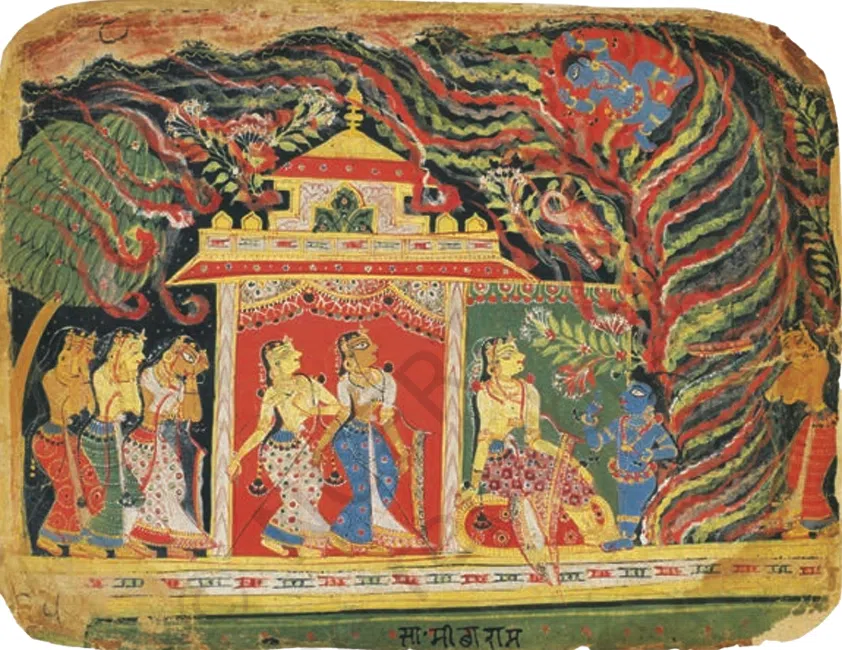
- Mughal Miniature Paintings: The Mughal style was different; it is influenced by Persian art. The theme was landscapes, court scenes, portraits, etc. The artist worked together to draw lines, another added colours and another finished details. The miniatures were also used in manuscripts, like the Persian translation of the Mahabharata.
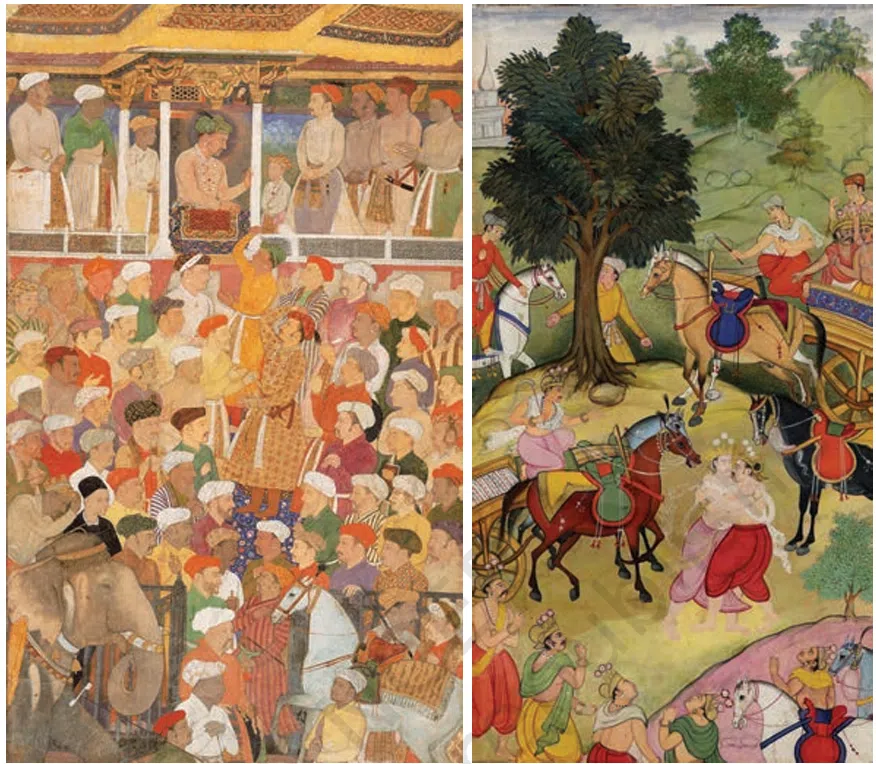
Exchange of the Style
The Rajput and Mughal styles influenced each other. The Rajput painting includes gardens, animals, and hunting scenes, which is the taste of the Mughal, and the Mughal painter moved to Bikaner and blended the Hindu style.
Changing Landscapes—Gardens
From the ancient time, the gardens are part of Indian life. Some of the old texts, like the Rigveda, Ramayana, and Mahabharata, mention gardens, which are known as udyanas, vatikas, nandanas, etc. These gardens are built near temples with ponds or tanks.
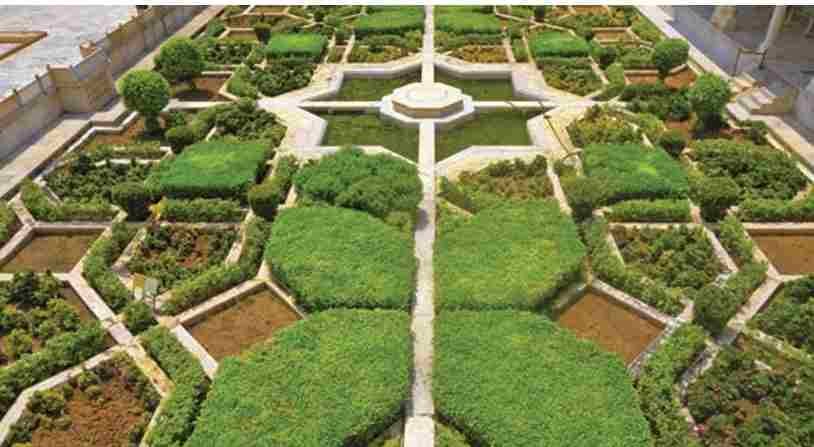
Mughal Garden: The Mughals brought the Persian Charbagh design, which is divided into four parts with water channels and fountains. These symbolised the four rivers of Paradise in the Quran. The Mughal gardens were built near forts, tombs and mosques. For example, Mughal Gardens at Rashtrapati Bhawan.
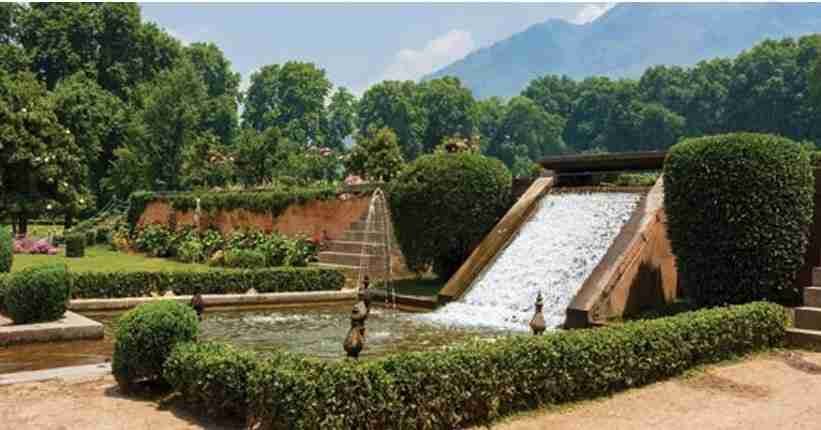
Later the Rajput rulers copied this style and made Aer Fort gardens in Jaipur.
Women in Society — Contextual Variations in Their Role and Status
In early times the women could appear in public freely, but after the 12th-century invasions, their status changed. Many women and children were taken as slaves; some committed Jauhar, which is mass self-sacrifice. To protect women, practices like purdah (veil) became common in North India. In South India the women’s rules stayed more open and active. Some of the powerful women are –
- Razia Sultan: She was the first and only woman to rule the Delhi Sultanate. She has built schools, appeared unveiled in court and proved strong leadership.
- Nur Jahan: The wife of Jahangir. She issued royal orders, coins in her name and supported art and trade.
In South India, elite women gave land to temples and built wells and halls and influenced politics. There are many women who were poets, artists and administrators.
Education and Knowledge Traditions
In mediaeval times the invasions disturbed the learning centre and the temple of India.
Institutions of learning
Gurukulas, maths, temple schools, Buddhist viharas, and Jain pallis are the places where students live with teachers and take education like Sanskrit, Prakrit grammar, astronomy, law, medicine, sacred texts, etc. The villages have patshallas, which are like small schools. The four centres of learning are –
- Kanchipuram and Sringeri → philosophy and mathematics.
- Kerala School of Mathematics → early ideas of infinite series and calculus.
- Under Muslim rule, madrasas taught Arabic, Persian, Hindavi, and Islamic studies.
Vocational education and knowledge sharing
Arts, crafts, and trade were taught through jati and shreni systems (guilds). The students learn by apprenticeship, which means they work with the masters or within families. For example, the weaving communities are called Koshtis. These weavers moved from Gujarat to Banaras with Akhar’s support and introduced zari, the gold-thread embroidery, zardozi and brocades. The Banaras silk saris become famous with nature designs and geometric patterns. These skills are passed down from generation to generation.
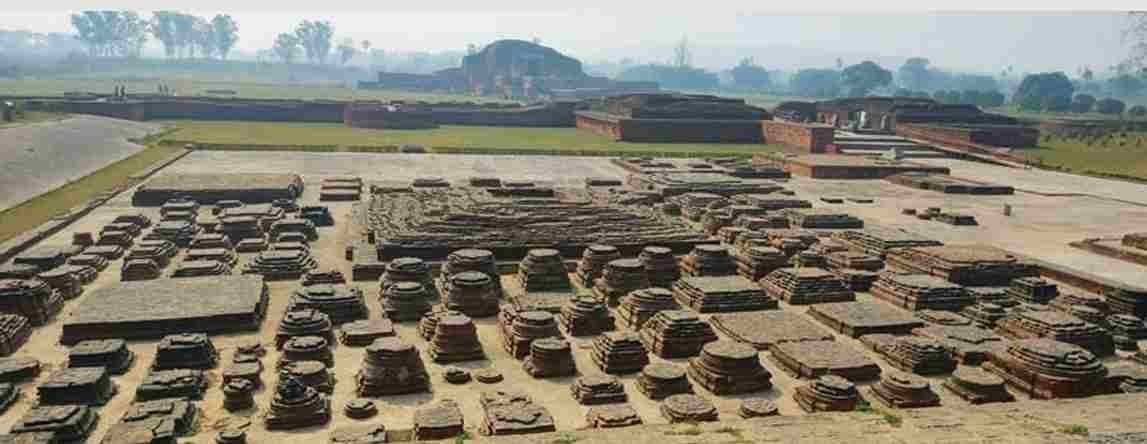
The traveller Pietro Della Valle wrote about the schools in coastal Karnataka. The children learn reading, writing, and arithmetic in simple places like a priest’s house or temple mandapa. There was the loss of Big University also; Nalanda and Vikramashila were destroyed in the later 12th century. This was the huge cultural loss; the scholars dispersed, and the knowledge centre collapsed.
Growth of Literature and Language
Many Indian languages grew in this era, like Sanskrit, Tamil, Telugu, Kannada, Odia, Hindi, Bengali, Marathi, etc. This language is used in daily life and also used in poetry and stories. The literature becomes rich and creative in this era.
- Bhakti literature: The bhakti saints wrote poems and songs in local languages, like Chitanya Mahaprubu wrote about Krishna’s life in Bengali literature and created a folk song called Dhamali. Kavindra Paramesvara translated the Mahabharata into Bengali.
- Royal Patronage: The King also supported poets and writers. The Krishnadevaraya in Vijayanagara encouraged poets and wrote himself. Gajapati kings of Odisha also supported spiritual and literary works.
- Person Influence: The Persian was the language of Mughal courts. They have produced histories, poetry and translations. For example,
- Faizi translated Lilavati (math text by Bhaskaracharya) into Persian.
- Kalhana’s Rajatarangini also translated into Persian.
The development of Urdu
The Urdu language developed in the Ganga-Yamuna plains. Urdu was a mix of Hindi/Hindavi and Arabic and Persian words. Later on it replaced Persian as the official language under the British. In South India the Urdu became Dakhini, meaning it mixed with Telugu and Marathi. The Amir Khusrau was called the father of Urdu literature. He wrote in Hindavi, Punjabi, Braj Bhasha, and Sanskrit.
Developments in Science and Technology
India always has a culture of enquiry, which means asking questions, experimenting and learning. In the time of war also the science and technology kept growing. Some of the key achievements are –
- Zinc production: India used a special distillation process to produce zinc. This process is first in the world.
- Mathematics: The Narayana Pandita wrote Ganita Kaumudi in the 14th century. The Madhava (Kerala school) used infinite series and calculus to find the exact value of π. The Nilakantha Somayaji in 1500 used the planetary model where Mercury and Venus orbited the sun.
- Chemistry: The refrigeration, perfumes, gunpowder, and cooling drink are made.
- Medicine: The Ayurveda, Siddha, Unani widely practised in India.
Regional Architectural Developments
Between the 13th and 17th centuries, the Indian architecture blended tradition and innovation. The example –
- Vijayanagara Empire: The golden age of art and temple building, like Hampi, the centre of urban planning and sacred architecture.
- Sri Ranganathaswamy Temple: It is rebuilt after destruction, showing resilience. The temple was not just religious; they showed engineering skill, prosperity and devotion.
Cultural Exchange in Daily Life
1. Food
The Indian food mixed with the foreign influencer, like spice cardamom, clove, turmeric, coriander, and black pepper, becomes common in kitchens.
The curd is used for marination, and ghee becomes popular. The food Khichri got the new flavours. The Akbar reduced eating meat in his court and was influenced by Jain and Hindu traditions. Naan comes from Persia. Samosas and jalebis were introduced later and become very popular.
2. Clothing
The Indians use jewellery, dyes, style and footwear. This production of cotton, muslin, and silk increased. New dresses like Jama and Pyjama became part of court fashion. Women wore Muslim dupattas inspired by saris. The sari continued with rich regional variations.
Disclaimer: The content that is present on our website is based on the NCERT Class 8 Social Science textbook and is provided for educational purposes only. All the content and images have been taken from Socail Science Class 8 NCERT Textbook. Images and content shown above are the property of individual organizations and are used here for reference purposes only. To make it easy to understand, some of the content and images are generated by AI and cross-checked by the teachers.