
Journey Inside the Atom Class 9 MCQ questions based on the latest CBSE Class 9 Science syllabus. This collection includes competency-based, assertion-reason, case study, and multiple-choice questions covering atomic models, subatomic particles, atomic number, mass number, electronic configuration, valency, isotopes, and isobars.
Journey Inside the Atom Class 9 MCQ
Conceptual Recall MCQs
Q1. Acharya Kanada’s smallest indivisible particle was called:
(a) Atom
(b) Parmanu
(c) Molecule
(d) Dyad
Answer: (b) Parmanu
Q2. The Greek word “atomos” means:
(a) Invisible
(b) Indivisible
(c) Infinite
(d) Smallest
Answer: (b) Indivisible
Q3. Who proposed the first scientific atomic theory in 1808?
(a) J. J. Thomson
(b) John Dalton
(c) Ernest Rutherford
(d) Democritus
Answer: (b) John Dalton
Q4. Atoms of the same element with the same atomic number but different mass numbers are called:
(a) Isobars
(b) Isotopes
(c) Isomers
(d) Ions
Answer: (b) Isotopes
Q5. Which of the following is an isotope of hydrogen containing two neutrons?
(a) Protium
(b) Deuterium
(c) Tritium
(d) Helium
Answer: (c) Tritium
Q6. Atoms of different elements having the same mass number but different atomic numbers are called _________.
(a) Isotopes
(b) Isobars
(c) Isomers
(d) Ions
Answer: (b) Isobars
Q7. The maximum number of electrons in a shell is given by:
(a) n²
(b) 2n²
(c) 8n
(d) n³
Answer: (b) 2n²
Q8. The maximum number of electrons that can be accommodated in the outermost shell is:
(a) 2
(b) 4
(c) 6
(d) 8
Answer: (d) 8
Q9. The distribution of electrons in shells is called:
(a) Atomic number
(b) Mass number
(c) Electronic configuration
(d) Valency
Answer: (c) Electronic configuration
Q10. The number of protons in the nucleus of an atom is called:
(a) Mass number
(b) Atomic number
(c) Nucleon number
(d) Neutron number
Answer: (b) Atomic number
Q11. The total number of protons and neutrons in the nucleus of an atom is called the _________.
(a) Atomic number
(b) Mass number
(c) Nucleon charge
(d) Electron number
Answer: (b) Mass number
Q12. Which of the following atoms has atomic number 2 and mass number 4?
(a) Hydrogen
(b) Helium
(c) Lithium
(d) Oxygen
Answer: (b) Helium
Q13. Who discovered the neutron in 1932?
(a) Ernest Rutherford
(b) James Chadwick
(c) J. J. Thomson
(d) Niels Bohr
Answer: (b) James Chadwick
Q14. Which subatomic particle has no charge but a mass nearly equal to a proton?
(a) Electron
(b) Proton
(c) Neutron
(d) Positron
Answer: (c) Neutron
Q15. Which atom does not contain neutrons in its nucleus?
(a) Helium
(b) Hydrogen
(c) Carbon
(d) Oxygen
Answer: (b) Hydrogen
Q16. In Bohr’s model, electrons revolve around the nucleus in the following:
(a) Random paths
(b) Fixed circular orbits called shells
(c) Straight lines
(d) Spiral paths
Answer: (b) Fixed circular orbits called shells
Q17. The first energy level (K-shell) has:
(a) The highest energy
(b) The least energy
(c) No energy
(d) Infinite energy
Answer: (b) The least energy
Q18. Bohr’s shells are represented by:
(a) A, B, C, D…
(b) K, L, M, N…
(c) X, Y, Z…
(d) P, Q, R…
Answer: (b) K, L, M, N…
Q19. Rutherford concluded from the gold foil experiment that _________.
(a) A positive charge is spread evenly in the atom.
(b) Positive charge is concentrated in a small nucleus.
(c) Electrons are inside the nucleus.
(d) Atoms are solid spheres.
Answer: (b) A positive charge is concentrated in a small nucleus.
Q20. Rutherford’s atomic model is also called the _________.
(a) Plum pudding model
(b) Planetary model
(c) Solar system model
(d) Electron cloud model
Answer: (b) Planetary model
Q21. The approximate diameter of an atom is:
(a) 10⁻¹⁵ m
(b) 10⁻¹⁰ m
(c) 10⁻⁵ m
(d) 10⁻³ m
Answer: (b) 10⁻¹⁰ m
Q22. Thomson proposed the atom to be _________.
(a) A sphere of negative charge with positive particles inside
(b) A sphere of positive charge with electrons embedded in it
(c) A nucleus surrounded by electrons
(d) A cluster of neutrons and protons only
Answer: (b) A sphere of positive charge with electrons embedded in it
Q23. Thomson’s model of the atom is popularly called the _________.
(a) Plum pudding model
(b) Chocolate bar model
(c) Orange model
(d) Solar system model
Answer: (a) Plum pudding model
Q24. If Acharya Kanada’s parmanus combine in groups of three, what is formed?
(a) Dyad
(b) Triad
(c) Molecule
(d) Atom
Answer: (b) Triad
Q25. A student observes cathode rays in a tube experiment. Which conclusion can be drawn?
(a) Atoms are indivisible.
(b) Electrons exist inside atoms.
(c) Cathode rays depend on the gas used.
(d) Atoms cannot emit particles.
Answer: (b) Electrons exist inside atoms.
Q26. Chlorine occurs in two isotopes, ³⁵Cl (75%) and ³⁷Cl (25%). What is its weighted average atomic mass?
(a) 35 u
(b) 36 u
(c) 35.5 u
(d) 37 u
Answer: (c) 35.5 u
Q27. A bromine atom has isotopes ⁷⁹Br (49.7%) and ⁸¹Br (50.3%). What is its average atomic mass?
(a) 79 u
(b) 80 u
(c) 81 u
(d) 82 u
Answer: (b) 80 u
Q28. The electronic configuration of magnesium (atomic number 12) is:
(a) 2, 8, 2
(b) 2, 6, 4
(c) 2, 8, 1
(d) 2, 8, 8
Answer: (a) 2, 8, 2
Q29. An atom has atomic number 16. What is its electronic configuration?
(a) 2, 8, 6
(b) 2, 6, 8
(c) 2, 8, 4, 2
(d) 2, 10, 4
Answer: (a) 2, 8, 6
Q30. An atom has 20 protons and a mass number of 41. How many neutrons does it have?
(a) 20
(b) 21
(c) 41
(d) 61
Answer: (b) 21
Q31. An atom has atomic number 17 and 18 neutrons. What is its mass number?
(a) 17
(b) 18
(c) 35
(d) 34
Answer: (c) 35
Q32. A helium atom has 2 protons and 2 neutrons. What is its approximate mass compared to hydrogen (1 proton)?
(a) Twice
(b) Four times
(c) Equal
(d) Half
Answer: (b) Four times
Q33. Why do heavier atoms like uranium need more neutrons than protons?
(a) To increase atomic size
(b) To reduce repulsion between protons and strengthen nuclear force
(c) To balance electrons
(d) To make atoms lighter
Answer: (b) To reduce repulsion between protons and strengthen nuclear force
Q34. If an electron moves from the K shell (n = 1) to the L shell (n = 2), it must:
(a) Lose energy
(b) Absorb energy equal to the difference between the two levels
(c) Remain unchanged
(d) Collapse into the nucleus
Answer: (b) Absorb energy equal to the difference between the two levels
Q35. Why does Bohr’s model explain atomic stability better than Rutherford’s?
(a) Electrons lose energy continuously.
(b) Electrons in stationary states do not lose energy while revolving.
(c) Electrons are inside the nucleus.
(d) Electrons move randomly.
Answer: (b) Electrons in stationary states do not lose energy while revolving.
Q36. If an atom were the size of a cricket ground (100 m), the nucleus would be _________.
(a) The size of a football
(b) The size of a black pepper grain
(c) The size of a marble
(d) The size of a seed
Answer: (b) The size of a black pepper grain
Q37. A sheet of paper is 0.1 mm thick. If the diameter of one atom is 10⁻¹⁰ m, how many atoms are stacked to make the sheet?
(a) 10³
(b) 10⁶
(c) 10⁹
(d) 10¹²
Answer: (b) 10⁶
Q38. In the watermelon analogy for Thomson’s model:
(a) Red pulp = electrons, seeds = positive charge
(b) Red pulp = positive charge, seeds = electrons
(c) Seeds = protons, pulp = neutrons
(d) Seeds = neutrons, pulp = electrons
Answer: (b) Red pulp = positive charge, seeds = electrons
Q39. According to Thomson’s model, what should have happened when alpha particles were passed through gold foil?
(a) Most particles should pass straight through or be slightly deflected.
(b) All particles should bounce back.
(c) All particles should stop at the foil.
(d) Particles should move in circular paths.
Answer: (a) Most particles should pass straight through or be slightly deflected.
Assertion–Reason MCQs
Q40. Assertion (A): Dalton’s atomic theory was based on experiments.
Reason (R): Earlier atomic ideas were imaginary and not supported by experiments.
(a) Both A and R are true, and R is the correct explanation.
(b) Both A and R are true; R is not an explanation.
(c) A true, R false
(d) A is false, R is true.
Answer: (a) Both A and R are true, and R explains A.
Q41. Assertion (A): Cathode rays are streams of negatively charged particles.
Reason (R): Their nature depends on the material of the cathode.
(a) Both A and R are true, and R is the correct explanation.
(b) Both A and R are true; R is not an explanation.
(c) A true, R false
(d) A is false, R is true.
Answer: (c) A is true, R is false.
Q42. Assertion (A): Isotopes of an element have similar chemical properties.
Reason (R): They have the same number of electrons and identical electronic configuration.
(a) Both A and R are true, and R is the correct explanation.
(b) Both A and R are true; R is not an explanation.
(c) A true, R false
(d) A is false, R is true.
Answer: (a) Both A and R are true, and R is the correct explanation.
Q43. Assertion (A): Isotopes differ in their physical properties.
Reason (R): They have different numbers of neutrons and hence different masses.
(a) Both A and R are true, and R is the correct explanation.
(b) Both A and R are true; R is not an explanation.
(c) A true, R false
(d) A is false, R is true.
Answer: (a) Both A and R are true, and R is the correct explanation.
Q44. Assertion (A): Atoms with complete octet are stable and unreactive.
Reason (R): They have 8 electrons in their outermost shell.
(a) Both A and R are true, and R is the correct explanation.
(b) Both A and R are true; R is not an explanation.
(c) A true, R false
(d) A is false, R is true.
Answer: (a) Both A and R are true, and R is the correct explanation.
Q45. Assertion (A): Sodium has valency 1.
Reason (R): Its electronic configuration is 2, 8, 1, and it loses one electron to complete its octet.
(a) Both A and R are true, and R is the correct explanation.
(b) Both A and R are true; R is not an explanation.
(c) A true, R false
(d) A is false, R is true.
Answer: (a) Both A and R are true, and R is the correct explanation.
Q46. Assertion (A): Atomic number uniquely identifies an element.
Reason (R): Atomic number is equal to the number of protons in the nucleus.
(a) Both A and R are true, and R is the correct explanation.
(b) Both A and R are true; R is not an explanation.
(c) A true, R false
(d) A is false, R is true.
Answer: (a) Both A and R are true, and R is the correct explanation.
Q47. Assertion (A): Electrons contribute significantly to the mass of an atom.
Reason (R): Electrons have negligible mass compared to protons and neutrons.
(a) Both A and R are true, and R is the correct explanation.
(b) Both A and R are true; R is not an explanation.
(c) A true, R false
(d) A is false, R is true.
Answer: (c) A true, R false
Q48. Assertion (A): Neutrons help bind protons together in the nucleus.
Reason (R): Neutrons are neutral and reduce repulsion between positively charged protons.
(a) Both A and R are true, and R is the correct explanation.
(b) Both A and R are true; R is not an explanation.
(c) A true, R false
(d) A is false, R is true.
Answer: (a) Both A and R are true, and R is the correct explanation.
Q49. Assertion (A): The mass of an atom comes mainly from protons and neutrons.
Reason (R): Electrons are very light, and their mass can be ignored.
(a) Both A and R are true, and R is the correct explanation.
(b) Both A and R are true; R is not an explanation.
(c) A true, R false
(d) A is false, R is true.
Answer: (a) Both A and R are true, and R is the correct explanation.
Q50. Assertion (A): Energy of electrons increases as we move away from the nucleus.
Reason (R): The L-shell has more energy than the K-shell.
(a) Both A and R are true, and R is the correct explanation.
(b) Both A and R are true; R is not an explanation.
(c) A true, R false
(d) A is false, R is true.
Answer: (a) Both A and R are true, and R is the correct explanation.
Q51. Assertion (A): Electrons can revolve only in allowed shells.
Reason (R): Electrons can exist in between shells.
(a) Both A and R are true, and R is the correct explanation.
(b) Both A and R are true; R is not an explanation.
(c) A true, R false
(d) A is false, R is true.
Answer: (c) A is true, R is false.
Q52. Assertion (A): Rutherford’s model explained the presence of a dense nucleus.
Reason (R): Most α-particles passed through undeflected, showing atoms are mostly empty space.
(a) Both A and R are true, and R is the correct explanation.
(b) Both A and R are true; R is not an explanation.
(c) A true, R false
(d) A is false, R is true.
Answer: (a) Both A and R are true, and R is the correct explanation.
Q53. Assertion (A): Rutherford’s model could not explain atomic stability.
Reason (R): Electrons moving in circular paths should lose energy and fall into the nucleus.
(a) Both A and R are true, and R is the correct explanation.
(b) Both A and R are true; R is not an explanation.
(c) A true, R false
(d) A is false, R is true.
Answer: (a) Both A and R are true, and R is the correct explanation.
Q54. Assertion (A): Thomson’s model explained how positive and negative charges stay balanced in an atom.
Reason (R): He proposed electrons embedded in a sphere of positive charge.
(a) Both A and R are true, and R is the correct explanation.
(b) Both A and R are true; R is not an explanation.
(c) A true, R false
(d) A is false, R is true.
Answer: (a) Both A and R are true, and R is the correct explanation.
Q55. Assertion (A): Rutherford’s gold foil experiment showed that some alpha particles were deflected at large angles.
Reason (R): The positive charge in the atom is concentrated in a small nucleus.
(a) Both A and R are true, and R is the correct explanation.
(b) Both A and R are true; R is not an explanation.
(c) A true, R false
(d) A is false, R is true.
Answer: (a) Both A and R are true, and R is the correct explanation.
Case-Based MCQ
Q56. A scientist in 1897 passes high voltage through a gas at low pressure in a glass tube. He observes rays moving from cathode to anode.
(a) J. J. Thomson, Electron: Atoms have sub-particles.
(b) John Dalton, Atom: Atoms are indivisible.
(c) Ernest Rutherford, Proton, Atoms indivisible
(d) Democritus, atom, atoms are indivisible
Answer: (a) J. J. Thomson discovered the electron, proving atoms have sub-particles.
Q57. A scientist studies three atoms:
- Atom A: 6 protons, 6 neutrons
- Atom B: 6 protons, 7 neutrons
- Atom C: 6 protons, 8 neutrons
What are these atoms called?
(a) Isobars of carbon
(b) Isotopes of carbon
(c) Isomers of carbon
(d) Ions of carbon
Answer: (b) Isotopes of carbon
Q58. An atom has mass number 23 and 11 protons. It is a soft metal that reacts vigorously with water. Identify the atom and calculate its neutrons.
(a) Sodium, 12 neutrons
(b) Magnesium, 11 neutrons
(c) Lithium, 10 neutrons
(d) Potassium, 12 neutrons
Answer: (a) Sodium, 12 neutrons
Q59. An atom has 26 protons, 26 electrons, and 30 neutrons. What is its atomic number and mass number?
(a) Atomic number = 26, mass number = 56
(b) Atomic number = 30, mass number = 56
(c) Atomic number = 56, mass number = 26
(d) Atomic number = 26, mass number = 30
Answer: (a) Atomic number = 26, mass number = 56
Q60. James Chadwick discovered a particle with mass nearly equal to a proton but no charge. This explained why helium’s mass was four times hydrogen’s, not double. Which particle was this?
(a) Electron
(b) Proton
(c) Neutron
(d) Positron
Answer: (c) Neutron
Q61. A student excites an electron in a hydrogen atom from the K-shell (n = 1) to the M-shell (n = 3). What must happen?
(a) The electron loses energy equal to the difference between shells.
(b) The electron absorbs energy equal to the difference between shells.
(c) The electron collapses into the nucleus.
(d) The atom becomes unstable and disappears.
Answer: (b) The electron absorbs energy equal to the difference between shells.
Q62. In Rutherford’s gold foil experiment, most α-particles passed straight through, but a few were deflected at large angles. What did this prove?
(a) Atoms are solid spheres.
(b) Positive charge is spread evenly.
(c) Positive charge and mass are concentrated in a small nucleus.
(d) Electrons are inside the nucleus.
Answer: (c) Positive charge and mass are concentrated in a small nucleus.
Q63. In Rutherford’s gold foil experiment, a narrow beam of alpha particles was aimed at thin gold foil. Most particles passed through undeflected, but some were sharply deflected or bounced back. What conclusion was drawn?
(a) Atoms are solid spheres of positive charge.
(b) Positive charge is spread evenly throughout the atom.
(c) Positive charge and mass are concentrated in a small nucleus.
(d) Electrons occupy the nucleus.
Answer: (c) Positive charge and mass are concentrated in a small nucleus.
Diagram-Based MCQ
Q64. In the cathode ray tube diagram, rays travel:
(a) From anode (+) to cathode ( –)
(b) From cathode (–) to anode (+)
(c) In both directions
(d) Only when gas is changed
Answer: (b) From cathode (–) to anode (+)
Q65. In the gold foil experiment diagram, the deflection of alpha particles is called:
(a) Reflection
(b) Refraction
(c) Scattering
(d) Absorption
Answer: (c) Scattering
Q66. In Rutherford’s model, electrons revolve around the nucleus similarly to _________.
(a) Seeds in a watermelon
(b) Planets orbiting the Sun
(c) Balls in a box
(d) Clouds around a mountain
Answer: (b) Planets orbiting the Sun
Q67. In Bohr’s diagram of the atom, the shells are shown as:
(a) Straight lines around the nucleus
(b) Fixed circular paths (orbits) around the nucleus
(c) Random dots around the nucleus
(d) Spiral paths around the nucleus
Answer: (b) Fixed circular paths (orbits) around the nucleus
Q 68. Which of the following is the correct symbol and charge for a proton?
(a) e⁻, –1
(b) p⁺, +1
(c) n⁰, 0
(d) H, neutral
Answer: (b) p⁺, +1
Q69. In the standard notation of an atom, the symbol is written as:
(a) Atomic number above, mass number below
(b) Mass number above, atomic number below
(c) Atomic number on the right, mass number on the left
(d) Atomic number inside brackets, mass number outside
Answer: (b) Mass number above, atomic number below
Q70. In Figure, the electronic configuration of neon (atomic number 10) is shown as the following:
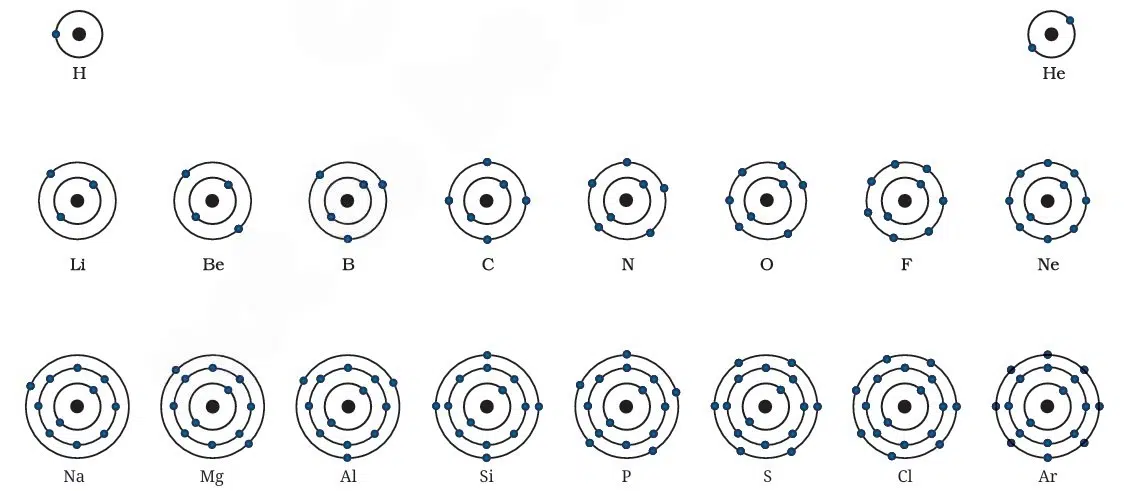
(a) 2, 8
(b) 2, 6, 2
(c) 2, 4, 4
(d) 2, 2, 6
Answer: (a) 2, 8
Q71. In Figure, hydrogen isotopes are shown. Which isotope has one proton and one neutron?
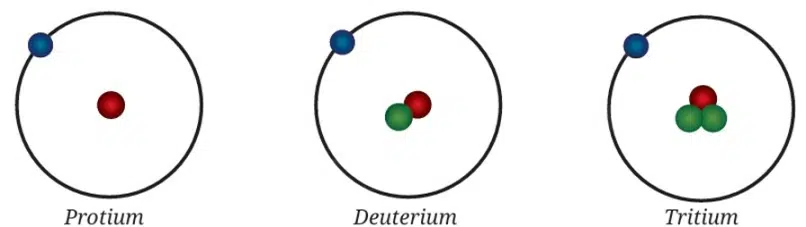
(a) Protium
(b) Deuterium
(c) Tritium
(d) Helium
Answer: (b) Deuterium
Disclaimer: The content that is present on our website is based on the NCERT Class 9 Science textbook and is provided for educational purposes only. All the content and images have been taken from Science Class 9 NCERT Textbook and CBSE Support material. Images and content shown above are the property of individual organizations and are used here for reference purposes only. To make it easy to understand, some of the content and images are generated by AI and cross-checked by the teachers.