
← Back to Class 9 Science NCERT Solutions
Journey Inside the Atom Class 9 NCERT Solutions provides easy, accurate, and step-by-step solutions to all the NCERT textbook questions. The answers are written in simple language so that Class 9 students can easily understand the concepts of atoms, electrons, protons, neutrons, atomic structure, isotopes, and ions. These solutions are perfect for quick revision, homework, and exam preparation.
Journey Inside the Atom Class 9 NCERT Solutions
Q1. Are atoms the smallest indivisible particles?
Answer: No, atoms are not the smallest indivisible particles. Earlier, scientists thought that atoms could not be divided. But later, it was discovered that atoms are made up of smaller particles called electrons, protons, and neutrons. Therefore, atoms are divisible and are not the smallest particles.
Q2. Why do electrons not fall into the nucleus even though they are attracted to protons in it?
Answer: Electrons do not fall into the nucleus because they move in fixed shells around it. In these shells, they do not lose energy. This was explained by Bohr’s model, which showed why atoms are stable.
Q3. Why did scientists keep modifying atomic models?
Answer: Scientists kept changing atomic models because new experiments gave new results. Each old model could not explain everything. So, scientists made better models step by step.
Q4. Suppose you made up your own ‘atom’, as Thomson described, using clay for the positive charge and small beads for the electrons spread through it. What will happen if:
(i) the positive charge on the clay is lesser than the total negative charge of the beads?
(ii) by mistake, the clay itself carries a bit of negative charge? Would your model still represent a neutral atom?
Answer:
- (i) If the positive charge is less than the negative charge, the atom will not be neutral. It will have extra negative charge.
- (ii) If the clay itself has negative charge, then the atom will also not be neutral.
Q5. Could an orange or a lemon, which also contain seeds inside soft pulp, be a good comparison? In what ways does it match Thomson’s idea and where does it fall short?
Answer: Yes, an orange or lemon can be compared to Thomson’s model. The soft pulp is like the positive charge, and the seeds are like electrons spread inside.
But it is not perfect. In fruits, seeds are not evenly spread, while in Thomson’s model electrons are spread throughout the atom.
Q6. Why did Thomson conclude that electrons are present in all atoms?
Answer: Thomson saw that cathode rays always had the same tiny particles, no matter which gas or material was used. These particles were electrons. So he concluded that electrons must be present in all atoms.
Q7. What do you think would happen if α-particles were replaced with negatively charged particles in Rutherford’s gold foil experiment?
Answer: If α-particles were replaced with negatively charged particles, the result would be very different. The nucleus has positive charge, so instead of bouncing back, the negative particles would be attracted toward the nucleus.
Q8. Rutherford found that a few α-particles bounced back sharply. How does this single surprising result completely rule out Thomson’s ʻplum pudding modelʼ of the atom?
Answer: Rutherford saw that a few α-particles bounced back from the gold foil. This meant the positive charge was in a small, dense nucleus.
In Thomson’s plum pudding model, positive charge was spread everywhere, so sharp bouncing back was impossible.
Q9. If you could ask Rutherford one question about his work, what would it be?
Answer: I would ask Rutherford: “How did you feel when you saw some α-particles bounce back?”
Q10. Assertion (A): Rutherford concluded that most of the mass of an atom is concentrated in a small region at the centre called the nucleus.
Reason (R): According to Thomson’s model, electrons are embedded in a uniformly distributed positive charge sphere.
Choose the correct option:
(i) Both A and R are true, and R is the correct explanation of A.
(ii) Both A and R are true, but R is not the correct explanation of A.
(iii) A is true, but R is false.
(iv) A is false, but R is true.
Answer: (ii) Both A and R are true, but R is not the correct explanation of A.
Q11. An atom had no empty space? How would this have affected the size of various objects?
Answer: If an atom had no empty space, all particles would be packed tightly. This would make objects much smaller and very heavy.
Q12. Imagine you are a scientist who has discovered a new element. Name this element after yourself and justify that the symbol you have chosen follows the IUPAC rules.
Answer: I will name my new element Anurium. Its symbol will be An.
This follows IUPAC rules because:
- The first letter A is capital.
- The second letter n is small.
- It is clear and simple, like other element symbols.
Q13. What problems could arise if every scientist used different symbols for the same element?
Answer: If every scientist used different symbols for the same element, it would cause confusion. People would not understand which element is being talked about. Scientists in different countries could not share ideas clearly.
Q14. An atom with an atomic number of 26 has 56 nucleons. Find out its number of electrons, protons and neutrons.
Answer:
- Atomic number = 26 → Protons = 26
- In a neutral atom, Electrons = 26
- Total nucleons = 56 → Nucleons = Protons + Neutrons
- So, Neutrons = 56 − 26 = 30
Final: Protons = 26, Electrons = 26, Neutrons = 30
Q15. The nucleus of an atom contains 20 protons. If its mass number is 41, find the number of neutrons in it.
Answer:
- Protons = 20 (given)
- Mass number = 41 → Protons + Neutrons = 41
- Neutrons = 41 − 20 = 21
Final: Protons = 20, Neutrons = 21
Q16. An atom has 18 neutrons and an atomic number of 17. What is its mass number?
Answer:
- Atomic number = 17 → Protons = 17
- Neutrons = 18 (given)
- Mass number = Protons + Neutrons = 17 + 18 = 35
Final: Mass number = 35
Q17. An atom 23A has 11 electrons. Find the number of neutrons in it.
Answer:
- Atom = 23A → Mass number = 23
- Electrons = 11 → so Protons = 11 (atomic number = 11)
- Neutrons = Mass number − Protons = 23 − 11 = 12
Final: Protons = 11, Electrons = 11, Neutrons = 12
Q18. Identify the number of electrons in the outermost shell of the following elements:
(i) 12/6 C
(ii) 19/9 F
(iii) 28/14 Si
Answer:
\[ \begin{align} \text{(i) } \, ^{12}_{6}C &: \text{Atomic number} = 6 \\ &\Rightarrow \text{Electrons} = 6 \\ &\Rightarrow \text{Shells} = 2,4 \\ &\Rightarrow \text{Outermost} = 4 \end{align} \]\[ \begin{align} \text{(ii) } \, ^{19}_{9}F &: \text{Atomic number} = 9 \\ &\Rightarrow \text{Electrons} = 9 \\ &\Rightarrow \text{Shells} = 2,7 \\ &\Rightarrow \text{Outermost} = 7 \end{align} \]\[ \begin{align} \text{(iii) } \, ^{28}_{14}Si &: \text{Atomic number} = 14 \\ &\Rightarrow \text{Electrons} = 14 \\ &\Rightarrow \text{Shells} = 2,8,4 \\ &\Rightarrow \text{Outermost} = 4 \end{align} \]Final:
- Carbon (C) = 4
- Fluorine (F) = 7
- Silicon (Si) = 4
Q19. Write the electronic configuration of the elements having atomic numbers 12, 16 and 18.
Answer:
- Atomic number 12 (Magnesium) → Electrons = 12 → 2,8,2
- Atomic number 16 (Sulphur) → Electrons = 16 → 2,8,6
- Atomic number 18 (Argon) → Electrons = 18 → 2,8,8
Final:
- Magnesium = 2,8,2
- Sulphur = 2,8,6
- Argon = 2,8,8
Q20. Solve this riddle: I am an atom with a mass number of 23 and 11 protons. am a soft metal and react vigorously with water. Who am I and how many neutrons do I have? You can also create one such riddle.
Answer:
The riddle says:
- Mass number = 23
- Protons = 11 → Element = Sodium (Na)
- Neutrons = 23 − 11 = 12
Final: You are Sodium (Na), a soft metal that reacts strongly with water, and you have 12 neutrons.
Riddle:
I am an atom with a mass number of 16 and 8 protons. I help you breathe and burn fuels. Who am I and how many neutrons do I have?
Answer:
- Protons = 8 → Oxygen (O)
- Neutrons = 16 − 8 = 8
You are Oxygen (O), with 8 neutrons.
Q21. Two different atoms have 11 protons each, but one has 12 neutrons, and the other has 13 neutrons. How do their atomic numbers and mass numbers compare? Are they the same element or different elements?
Answer:
- Both atoms have 11 protons → so Atomic number = 11 for both.
- Mass number = Protons + Neutrons:
- Atom 1 → 11 + 12 = 23
- Atom 2 → 11 + 13 = 24
- Same atomic number means they are the same element (Sodium, Na).
- Different mass numbers means they are isotopes of Sodium.
Same element (Sodium), Atomic number = 11, Mass numbers = 23 and 24, isotopes.
Q22. If a bromine atom is available in the form of, say two isotopers, 79 35 Br (49.7%) and 81 35 Br (50.3%), calculate the average atomic mass of the bromine atom.
Answer:
We calculate average atomic mass using the formula:
\[ \text{Average atomic mass} = \frac{(79 \times 49.7) + (81 \times 50.3)}{100} \]Step by step:
- 79 × 49.7 = 3926.3
- 81 × 50.3 = 4074.3
- Total = 3926.3 + 4074.3 = 8000.6
- Divide by 100 → 80.0 u
Average atomic mass of Bromine = 80 u
Q23. Choose the correct options and explain the reason for the correct and incorrect options in the context of Ernest Rutherford’s gold foil experiment:
(i) The experiment clearly showed the existence of neutrons in the nucleus.
(ii) The results disproved the plum pudding model and led to the idea of a nucleus at the centre of the atom.
(iii) The large deflection of a few alpha particles indicated that most of the mass of the atom and positive charge are packed into a tiny centre.
(iv) The way alpha particles were deflected showed that electrons move around the nucleus.
Answer: Correct option is –
- (i) The experiment clearly showed the existence of neutrons in the nucleus.
- (ii) The results disproved the plum pudding model and led to the idea of a nucleus at the centre of the atom.
Q24. Which of the following statements are correct or incorrect according to the Bohr’s atomic model? Give a reason for each statement.
(i) Electrons lose energy while moving in fixed orbits and slowly fall into the nucleus.
(ii) Electrons can exist anywhere around the nucleus with no fixed energy.
(iii) Electrons revolve around the nucleus in orbits of fixed energy without losing energy.
(iv) Electrons can be found between energy levels as they move around the nucleus.
Answer: (iii) Electrons revolve around the nucleus in orbits of fixed energy without losing energy.
Q25. The composition of the nuclei of three atomic species X, Y, and Z are given as follows.
| X | Y | Z | |
|---|---|---|---|
| Number of protons | 18 | 17 | 17 |
| Number of neutrons | 19 | 18 | 20 |
Explain the relation between the following:
(i) Y and Z
(ii) Z and X
Answer:
We are comparing Y and Z:
- Y → Protons = 17, Neutrons = 18 → Mass number = 35
- Z → Protons = 17, Neutrons = 20 → Mass number = 37
- Same protons (17) → Same atomic number = 17 → Same element (Chlorine)
- Different neutrons → Different mass numbers (35 and 37) → Isotopes of Chlorine
Y and Z are isotopes of the same element (Chlorine).
Q26. What conclusion did Rutherford draw about the position and characteristics of the atom’s positively charged part based on the few alpha particles that bounced back or were deflected at large angles in the gold foil experiment?
Answer: Rutherford saw that a few α-particles bounced back or deflected sharply. From this, he concluded:
- The atom’s positive charge is not spread out but is concentrated in a tiny central nucleus.
- This nucleus is very dense and contains most of the atom’s mass.
- The rest of the atom is mostly empty space, allowing most α-particles to pass through.
Positive charge and mass are packed in a small nucleus at the centre of the atom.
Q27. Explain and arrange the following statements in the correct chronological order to show how atomic models have evolved over time.
(i) Bohr’s model proposed that electrons move in fixed orbits around the nucleus, each with a definite energy.
(ii) Thomson’s model depicted the atom as a ʻplum puddingʼ with electrons embedded in a sphere of positive charge.
(iii) Rutherford’s model proposed that atoms have a dense central nucleus.
(iv) Dalton’s model described atoms as indivisible particles.
Answer: Chronological order of atomic models:
- (iv) Dalton’s model → Atoms are indivisible particles.
- (ii) Thomson’s model → Plum pudding: electrons in a positive sphere.
- (iii) Rutherford’s model → Dense nucleus at centre, atom mostly empty space.
- (i) Bohr’s model → Electrons move in fixed energy orbits around nucleus.
Q28. Electrons move around the nucleus in orbits. Why do they not fly away from the atom? Explain what keeps them attracted to the nucleus.
Answer: Electrons do not fly away because they are attracted to the nucleus by the electrostatic force.
- The nucleus has positive protons.
- Electrons are negative.
- Opposite charges attract, so electrons are pulled toward the nucleus.
- At the same time, electrons move in fixed energy shells (Bohr’s model). This balance keeps them from collapsing into the nucleus or escaping away.
Q29. Assertion (A): The discovery of subatomic particles helped in understanding the atomic structure.
Reason (R): The number of electrons is equal to the number of protons in an atom.
Choose the correct option:
(i) Both A and R are true, and R is the correct explanation of A.
(ii) Both A and R are true, but R is not the correct explanation of A.
(iii) A is true, but R is false.
(iv) A is false, but R is true.
Answer: (ii) Both A and R are true, but R is not the correct explanation of A.
Q30. Magnesium is essential for many biological processes, including muscle contraction. For an atom of magnesium with a mass number
of 24 and atomic number 12, determine the number of
(i) protons,
(ii) neutrons,
(iii) electrons, and also illustrate the arrangement of electrons in a magnesium atom.
Answer: For Magnesium atom:
- Atomic number = 12 → Protons = 12
- Mass number = 24 → Neutrons = 24 − 12 = 12
- In a neutral atom → Electrons = 12
Electronic arrangement:
- Shells fill as 2,8,2 →
- K-shell = 2
- L-shell = 8
- M-shell = 2
Protons = 12, Neutrons = 12, Electrons = 12, Electronic configuration = 2,8,2
Q31. Find the following information for the elements shown in Fig. 8.17:
(i) Name of the element
(ii) Symbol
(iii) Total number of electrons
(iv) Number of valence electrons
(v) Valency of the element
(vi) Number of protons
(vii) Atomic number
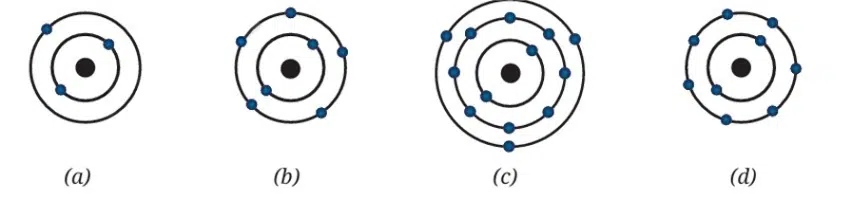
Answer:
(a)
- Element name: Beryllium
- Symbol: Be
- Total electrons: 4
- Valence electrons: 2
- Valency: 2
- Protons: 4
- Atomic number: 4
(b)
- Element name: Carbon
- Symbol: C
- Total electrons: 6
- Valence electrons: 4
- Valency: 4
- Protons: 6
- Atomic number: 6
(c)
- Element name: Sodium
- Symbol: Na
- Total electrons: 11
- Valence electrons: 1
- Valency: 1
- Protons: 11
- Atomic number: 11
(d)
- Element name: Nitrogen
- Symbol: N
- Total electrons: 7
- Valence electrons: 5
- Valency: 3
- Protons: 7
- Atomic number: 7
Final summary:
- (a) Beryllium (Be) → 2 valence electrons, valency 2
- (b) Carbon (C) → 4 valence electrons, valency 4
- (c) Sodium (Na) → 1 valence electron, valency 1
- (d) Nitrogen (N) → 5 valence electrons, valency 3
Q32. Both Rutherford’s and Bohr’s models have electrons orbiting the nucleus. Why did Rutherford’s model fail to explain atomic stability, while Bohr’s model succeeded?
Answer: Bohr’s model: Solved this problem. He said electrons move only in fixed energy shells (orbits). In these shells, electrons do not lose energy. They stay stable unless they jump to another orbit.
Rutherford failed because he could not explain why electrons don’t lose energy, while Bohr succeeded by introducing fixed energy levels.
Q33. An atom 70 X has 31 electrons. How many neutrons are there in its nucleus?
Answer:
Atom given: 70𝑋 with 31 electrons.
- Electrons = 31 → so Protons = 31 (atomic number = 31).
- Mass number = 70.
- Neutrons = Mass number − Protons = 70 − 31 = 39.
Protons = 31, Electrons = 31, Neutrons = 39.
This element is Gallium (Ga), atomic number 31.
Q34. An atom has 79 protons and a mass number of 197. Calculate
(i) the number of neutrons, and
(ii) the number of electrons.
Answer:
Atom given:
- Protons = 79 → Atomic number = 79 → Element = Gold (Au)
- Mass number = 197
Step by step:
- (i) Neutrons = Mass number − Protons = 197 − 79 = 118
- (ii) Electrons = Protons = 79 (for a neutral atom)
Protons = 79, Neutrons = 118, Electrons = 79
Q35. Complete the Table 8.5:
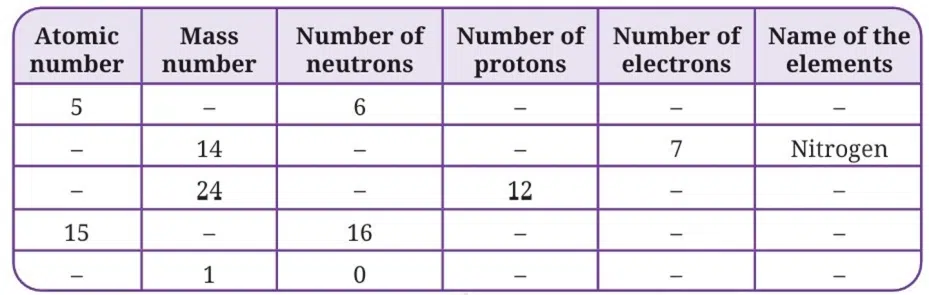
Answer:
| Atomic number | Mass number | Number of neutrons | Number of protons | Number of electrons | Name of the elements |
|---|---|---|---|---|---|
| 5 | 11 | 6 | 5 | 5 | Boron |
| 7 | 14 | 7 | 7 | 7 | Nitrogen |
| 12 | 24 | 12 | 12 | 12 | Magnesium |
| 15 | 31 | 16 | 15 | 15 | Phosphorus |
| 1 | 1 | 0 | 1 | 1 | Hydrogen |
Q36. Aman was discussing the structure of atom with his classmates. During the discussion, he learnt that an element X has a mass number of 35 and contains 18 neutrons. Based on this information, answer the following questions:
(i) How many electrons and protons does element X have?
(ii) What is its atomic number?
(iii) Identify the element X.
(iv) Write its electronic configuration.
(v) How many valence electrons does it have?
(vi) What will be the mass number if two neutrons are added to its nucleus?
(vii) What will be the relation of X with the new atom?
Answer: Element X → Mass number = 35, Neutrons = 18
- (i) Protons = Mass number − Neutrons = 35 − 18 = 17 → Electrons = 17 (neutral atom)
- (ii) Atomic number = 17
- (iii) Element with atomic number 17 = Chlorine
- (iv) Electronic configuration = 2,8,7
- (v) Valence electrons = 7
- (vi) If 2 neutrons are added → New mass number = 35 + 2 = 37
- (vii) Relation: X and new atom are isotopes of Chlorine (same element, different neutrons).
Q37. In an atom, there are 12 protons and 12 neutrons in the nucleus. Now, imagine that all the electrons are replaced with some hypothetical particles that have the same charge as electrons but are 500 times heavier. What effect will this replacement have on the atom’s:
(i) Atomic number
(ii) Atomic mass
(iii) Mass number
(iv) Overall charge
Answer: Atom has 12 protons + 12 neutrons in nucleus (Magnesium). Now electrons are replaced with heavier particles (same charge but 500× heavier).
- (i) Atomic number → stays 12 (depends only on protons, not electrons).
- (ii) Atomic mass → increases a lot, because electrons are now 500× heavier. Normally electron mass is negligible, but here it adds significantly.
- (iii) Mass number → stays 24 (mass number = protons + neutrons only, electrons not counted).
- (iv) Overall charge → remains neutral, because number of negative particles = number of protons.
Disclaimer: The content that is present on our website is based on the NCERT Class 9 Science textbook and is provided for educational purposes only. All the content and images have been taken from Science Class 9 NCERT Textbook and CBSE Support material. Images and content shown above are the property of individual organizations and are used here for reference purposes only. To make it easy to understand, some of the content and images are generated by AI and cross-checked by the teachers.