
Test your understanding of Natural Resources and Their Use Class 8 with these multiple-choice questions. This MCQ collection covers important concepts related to natural resources, their uses, conservation, and the need for sustainable use. These questions are useful for Class 8 Science revision, practice, and exam preparation.
Natural Resources and Their Use Class 8 MCQ
Conceptual Recall
Q. When does nature become a resource?
A. When humans worship it
B. When humans use it for sustenance or consumption
C. When it exists independently of humans
D. When it is inaccessible
Answer: B. When humans use it for sustenance or consumption
Q. Which of the following is a renewable resource?
A. Coal
B. Petroleum
C. Timber from forests
D. Gold
Answer: C. Timber from forests
Q. Why are natural resources unevenly distributed across the Earth?
A. Because of human settlements
B. Because of geographical and geological factors
C. Because of trade patterns
D. Because of wars
Answer: B. Geographical and geological factors
Q. What does the term Paradox of Plenty mean?
A. Countries with abundant resources always become rich
B. Countries with abundant resources may grow slowly
C. Countries with no resources grow faster
D. Countries with resources never face conflicts
Answer: B. Countries with abundant resources may grow slowly
Q. What was the main reason for overexploitation of groundwater in Punjab during the Green Revolution?
A. Use of traditional seeds
B. Free power supply and high-yielding crops
C. Less rainfall in the region
D. Lack of irrigation canals
Answer: B. Free power supply and high-yielding crops
Q. In 2016, which Indian state became 100% organic?
A. Punjab
B. Rajasthan
C. Sikkim
D. Karnataka
Answer: C. Sikkim
Application-Based
Q. A company discovers petroleum deep under the ocean. However, they cannot extract it because the cost is too high. Which condition of a resource is missing here?
A. Technological accessibility
B. Economic feasibility
C. Cultural acceptance
D. Natural occurrence
Answer: B. Economic feasibility
Q. A glacier in the Himalayas is melting faster than rainfall can replace it. What is the direct consequence?
A. Increase in forest cover
B. Water security issues in plains
C. More renewable energy sources
D. Rise in fish population
Answer: B. Water security issues in plains
Q. Industries often develop near resource-rich areas. What is one positive and one negative implication of this?
A. Positive: Employment opportunities; Negative: Displacement of local people
B. Positive: Sacred places protected; Negative: No modern facilities
C. Positive: Trade decreases; Negative: Conflicts reduce
D. Positive: Less economic growth; Negative: More wars
Answer: A. Employment opportunities; Displacement of local people
Q. India has avoided the resource curse mainly because:
A. It exports all raw materials
B. It invests in industries to process resources
C. It does not use natural resources
D. It depends only on agriculture
Answer: B. It invests in industries to process resources
Q. Cement factories are listed among the most polluting industries. Which of the following is a direct effect of cement dust?
A. Increase in crop yield
B. Damage to lungs of humans and animals
C. Improvement of soil fertility
D. Reduction of water pollution
Answer: B. Damage to lungs of humans and animals
Q. Pema’s family initially faced lower yields after switching to organic farming. Why?
A. Lack of rainfall
B. Soil recovering from chemical use
C. No government support
D. Too many crops grown
Answer: B. Soil recovering from chemical use
Assertion–Reason
Q. Assertion (A): Cutting trees in sacred groves is not considered acceptable.
Reason (R): Cultural traditions influence whether nature can be used as a resource.
A. Both A and R are true, and R is the correct explanation of A
B. Both A and R are true, but R is not the correct explanation of A
C. A is true, R is false
D. A is false, R is true
Answer: A. Both A and R are true, and R is the correct explanation of A
Q. Assertion (A): Over-fishing of tuna disturbs the ocean ecosystem.
Reason (R): Tuna help maintain balance by consuming smaller fish and shrimps.
A. Both A and R are true, and R explains A
B. Both A and R are true, but R does not explain A
C. A is true, R is false
D. A is false, R is true
Answer: A. Both A and R are true, and R explains A
Q. Assertion (A): Many wars have been fought to gain control over natural resources.
Reason (R): Natural resources are evenly distributed across the world.
A. Both A and R are true, and R explains A
B. Both A and R are true, but R does not explain A
C. A is true, R is false
D. A is false, R is true
Answer: C. A is true, R is false
Q. Assertion (A): Overuse of chemical fertilisers leads to soil degradation.
Reason (R): Traditional farming practices like mulching and cow dung maintain soil health.
A. Both A and R are true, and R explains A
B. Both A and R are true, but R does not explain A
C. A is true, R is false
D. A is false, R is true
Answer: A. Both A and R are true, and R explains A
Q. Assertion (A): Vṛikṣāyurveda promotes sustainable farming practices.
Reason (R): It recommends crop rotation, mixed cropping, and natural pest management.
A. Both A and R are true, and R explains A
B. Both A and R are true, but R does not explain A
C. A is true, R is false
D. A is false, R is true
Answer: A. Both A and R are true, and R explains A
Q. Assertion (A): India launched the International Solar Alliance in 2015 with France.
Reason (R): The alliance focuses on countries with abundant sunlight.
A. Both A and R are true, and R explains A
B. Both A and R are true, but R does not explain A
C. A is true, R is false
D. A is false, R is true
Answer: A. Both A and R are true, and R explains A
Case Study Based
Q. Case: A village depends on a nearby river for drinking water, farming, and fishing. Recently, a factory upstream started polluting the river. The villagers are worried about their survival. Based on the case, which category of natural resources is most directly affected?
A. Resources for materials
B. Resources for energy
C. Resources essential for life
D. Non-renewable resources
Answer: C. Resources essential for life
Q. Case: A factory discharges untreated waste into a river. The river becomes poisonous and cannot support life. Which principle of nature is disturbed here?
A. Restoration and regeneration
B. Economic feasibility
C. Cultural acceptance
D. Exploitation
Answer: A. Restoration and regeneration
Q. Case: The Kaveri River flows through Karnataka, Tamil Nadu, Kerala, and Puducherry. States often argue over sharing its water. What does this case highlight?
A. Nature respects political boundaries
B. Sharing of resources across states is easy
C. Natural resources often cross political boundaries, leading to disputes
D. Water is a non-renewable resource
Answer: C. Natural resources often cross political boundaries, leading to disputes
Q. Case: Farmers extract groundwater faster than it is replenished. Cities face water shortages. Which principle of nature is being violated?
A. Restoration and regeneration
B. Economic feasibility
C. Cultural acceptance
D. Exploitation
Answer: A. Restoration and regeneration
Q. Case: In Punjab, groundwater has fallen to depths of 30 metres, and chemicals from fertilisers have dissolved in it. What are the two major consequences of this situation?
A. Food security and biodiversity increase
B. Water scarcity and health hazards
C. More rainfall and soil fertility
D. Cultural acceptance and economic growth
Answer: B. Water scarcity and health hazards
Q. Case: In cities, many poor communities lack regular drinking water supply, while air pollution affects those unable to protect themselves. What broader issue does this case highlight?
A. Uneven distribution and access to resources
B. Overuse of renewable energy
C. Cultural acceptance of pollution
D. Economic prosperity from resources
Answer: A. Uneven distribution and access to resources
Diagram/Visual-Based
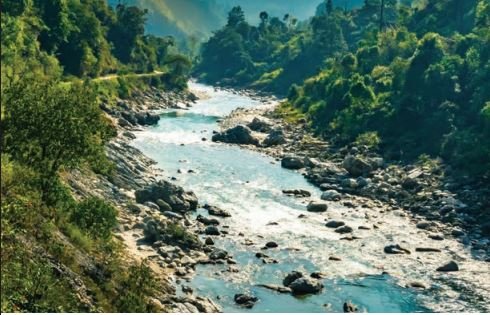
Q. Refer to Figure, River water, a renewable resource as long as glaciers and forests exist. What principle of nature does this figure highlight?
A. Exploitation of resources
B. Regeneration and restoration
C. Economic feasibility
D. Cultural acceptance
Answer: B. Regeneration and restoration
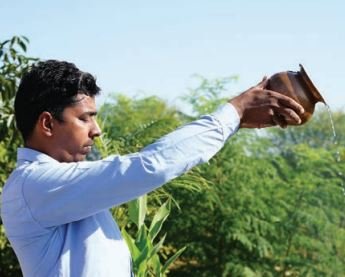
Q. Refer to Figure (Offering arghyam to Sūrya, the sun-god). What renewable resource is being symbolically acknowledged in this figure?
A. Wind energy
B. Solar energy
C. Timber
D. Water
Answer: B. Solar energy
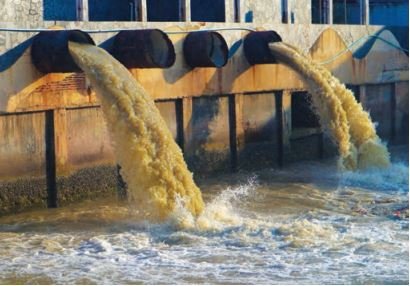
Q. Refer to Figure (Waste from industries disposed without treatment). What is the environmental impact shown in this figure?
A. Forest regeneration
B. River pollution disrupting cycles
C. Increase in fish population
D. Sustainable farming
Answer: B. River pollution disrupting cycles
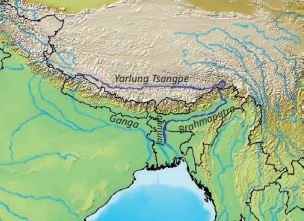
Q. Refer to Figure (Shared waters of the Brahmaputra river). What challenge does this figure represent?
A. Easy sharing of water between countries
B. International disputes over shared rivers
C. Mining of coal reserves
D. Distribution of gold mines
Answer: B. International disputes over shared rivers
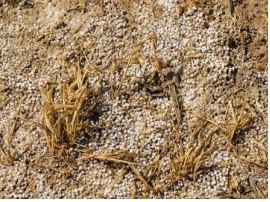
Q. Refer to Figure (Crop failure due to injudicious use of chemical fertilisers). What lesson does this figure highlight?
A. Fertilisers always improve soil fertility
B. Excessive fertiliser use damages soil and crops
C. Soil degradation cannot be prevented
D. Traditional practices are outdated
Answer: B. Excessive fertiliser use damages soil and crops
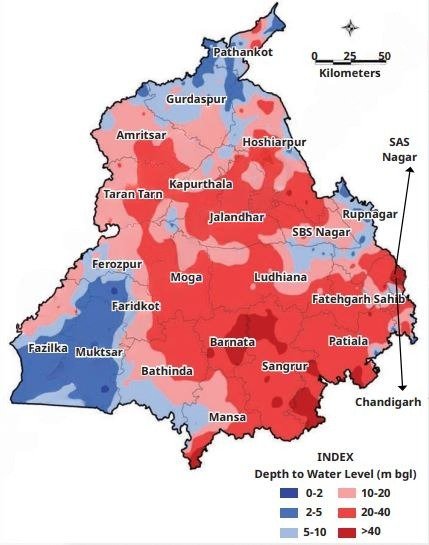
Q. Refer to Figure (Depth to water level map of Punjab and Chandigarh, June 2022). What does the dark-shaded region (>40 m bgl) indicate?
A. Areas with abundant groundwater
B. Areas classified as “overexploited”
C. Areas with shallow water levels
D. Areas with no agriculture
Answer: B. Areas classified as “overexploited”
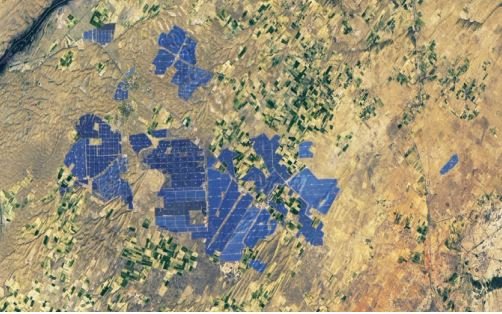
Q. Refer to Figure(Satellite image of Bhadla Solar Park, Rajasthan). What does this figure represent?
A. A coal mining site
B. One of the largest solar parks in the world
C. A traditional mud fort
D. A cement factory
Answer: B. One of the largest solar parks in the world
Disclaimer: The content that is present on our website is based on the NCERT Class 8 Social Science textbook and is provided for educational purposes only. All the content and images have been taken from Socail Science Class 8 NCERT Textbook. Images and content shown above are the property of individual organizations and are used here for reference purposes only. To make it easy to understand, some of the content and images are generated by AI and cross-checked by the teachers.