
← Back to Class 9 Science Notes
Patterns in Life Diversity and Classification Class 9 Notes explain how the amazing variety of living organisms is grouped based on their similarities and differences. These notes cover biodiversity, the need for classification, the five-kingdom system, plant and animal classification, scientific naming (binomial nomenclature), fossils, adaptations, and biodiversity conservation in simple, easy-to-understand language according to the latest CBSE Class 9 Science syllabus.
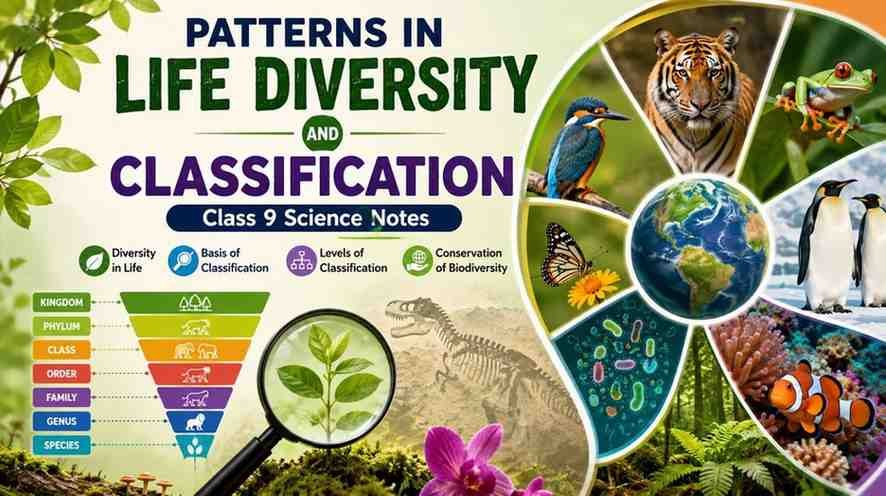
Patterns in Life Diversity and Classification Class 9 Notes
Every living organism plays an important job in nature. There are so many organisms on Earth; scientists group them based on the similarities. This grouping is called “classification”. Classification makes it easy to understand the living organisms.
What is biodiversity?
Biodiversity means the variety of living organisms found on earth, like plants, animals, fungi, bacteria, and other microorganisms. This living organism is found in deserts, forests, mountains, oceans, rivers, and many other places.
Why is biodiversity important?
- Every organism helps nature to keep healthy.
- Plants make food and release oxygen.
- Bees, birds, and bats help in pollination.
- Fungi and bacteria break down the waste material and make the soil fertile.
- Tiny algae in oceans produce much of the oxygen we breathe.
Without biodiversity, life on Earth would not be possible.
How Does Biodiversity Help Humans?
Biodiversity provides us with many useful things like food, medicines, clothes, shelter, and better crop varieties.
India as a Biodiversity Hotspot
India is rich in biodiversity; India has many different types of natural landscapes, such as
- Mountains in the north
- Desert in the west
- Rainforests in Northeast India
- Plateaus in the south
- Long coastlines in the Arabian Sea and the Bay of Bengal.
Every landscape has different soil, different temperature, and different rainfall. Because of these different conditions, many different types of plants and animals live in India.
What are endemic species?
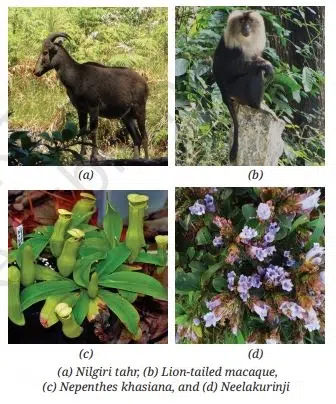
Endemic Species are plants or animals which found only in one particular place or region and nowhere else in the world. For example,
- Nilgiri Tahr
- Lion-tailed Macaque
- Nepenthes khasiana (Pitcher Plant)
- Neelakurinji
What are biodiversity hotspots?
The biodiversity hotspot is an area where endemic species are found and lost their natural habitat due to human activities. These areas need special protection to save plants and animals. Some of the biodiversity hotspots in India are the Western Ghats, the Himalayas, Indo-Burma, and Sundaland, which includes the Nicobar Islands.
Why are biodiversity hotspots important?
The biodiversity hotspots help to
- Protect rare plants and species.
- It supports food chains and food webs.
- Help maintain the balance of nature.
- Keeps ecosystems healthy.
- It also helps to conserve biodiversity for future generations.
How has the biodiversity evolved?
The biodiversity evolved over a very long time. Today the plants and animals we see on earth are not always the same. Living organisms changed slowly. Some of the organisms developed with small useful differences that helped them to survive better in their surroundings. This useful difference passed to their young. After many generations these changes resulted in the formation of new kinds of organisms.
What is classification?
There are millions of different organisms on the earth; scientists use classification to study them. Classification is a process where the living organisms are grouped based on their similarities and differences.
How to Classify Organisms?
Criteria Used by Scientists to Classify Organisms
| Criterion | What Do Scientists Observe? | Example |
|---|---|---|
| External Features | Shape, size, and body structure of the organism. | Birds have feathers and wings. Fish have fins and scales. |
| Mode of Nutrition | How the organism gets its food. | Autotrophs: Green plants make their own food. Heterotrophs: Animals and fungi depend on others for food. |
| Internal Structure | Skeleton, organs, and different tissues inside the body. | Humans have a backbone. Earthworms do not have bones. |
| Cell Structure | Type of cells, number of cells, and presence of a cell wall. | Bacteria: Unicellular, prokaryotic. Plants: Multicellular, eukaryotic, cell wall present. Animals: Multicellular, eukaryotic, no cell wall. |
| Ecological Role | The role of the organism in the ecosystem. | Producers: Green plants. Consumers: Deer, tiger, humans. Decomposers: Fungi and bacteria. |
| Reproduction | How the organism produces young ones. | Asexual: Amoeba, bacteria. Sexual: Humans, birds, flowering plants. |
| Genetic Similarity | Similarities in DNA (genetic material). | Humans and chimpanzees have similar DNA, showing they are closely related. |
The Need for Classification
What is Biological Classification?
Biological classification is the scientific method of grouping living organisms into categories. It is based on similarities, differences, and evolutionary relationships. The aim is to make the study of biodiversity systematic and meaningful.
Biological classification helps us in various ways, such as —
- It makes the study of living organisms more organised and systematic.
- It helps us understand the similarities and differences among living beings.
- It helps us understand how different organisms are related to one another and how they interact.
- It helps us in identifying and naming the newly discovered organisms.
- It supports biodiversity conservation by identifying the organisms that are under the threat of extinction.
- It allows scientists all over the world to discuss about organisms using a common system.
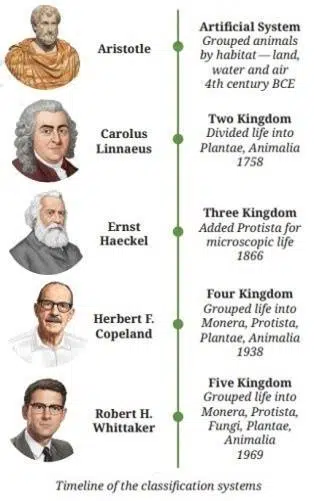
Biological Classification Systems Over Time
Scientists learn more about the living organism, and they improved the classification system. New discoveries and better microscopes helped to classify organisms more accurately.
Aristotle’s Classification
In around the 4th century BCE, Aristotle was the first scientist who classified living organisms. He grouped animals based on habitat (where they live) and external appearance (how they look). But it was not a correct way to classify the living organisms.
Two-Kingdom Classification
In the 18th century, the scientists divided all living organisms into two kingdoms.
| Kingdom | Characteristics | Examples |
|---|---|---|
| Plantae | Do not move from one place to another and make their own food. | Mango tree, Rose, Grass |
| Animalia | Move from one place to another and depend on other organisms for food. | Lion, Cow, Human |
It is also not a correct way to classify the living organisms because some organisms like amoeba, Paramecium and bacteria did not fit properly into either kingdom.
Three-Kingdom Classification
Scientists added a third kingdom called Protista. Protista are mostly unicellular (single-celled) organisms, but amoeba and Paramecium move like animals.
| Kingdom | Number of Cells | Food | Movement |
|---|---|---|---|
| Plantae | Multicellular | Make their own food | Do not move |
| Animalia | Multicellular | Depend on other organisms | Usually move |
| Protista | Mostly unicellular | Some make food, some depend on others | Many can move |
Four-Kingdom Classification
Scientists discovered that bacteria are different from protista because amoeba have a true nucleus. Bacteria do not have a true nucleus. So, bacteria were placed in a new kingdom called Monera.
| Kingdom | Example |
|---|---|
| Monera | Bacteria |
| Protista | Amoeba, Paramecium |
| Plantae | Plants |
| Animalia | Animals |
Five-Kingdom Classification
Later, scientists found that the fungi are different from plants. Because fungi do not make their own food and absorb nutrients from dead and decaying matter or other organisms. So, fungi were placed in a separate kingdom.
| Kingdom | Main Characteristics | Examples |
|---|---|---|
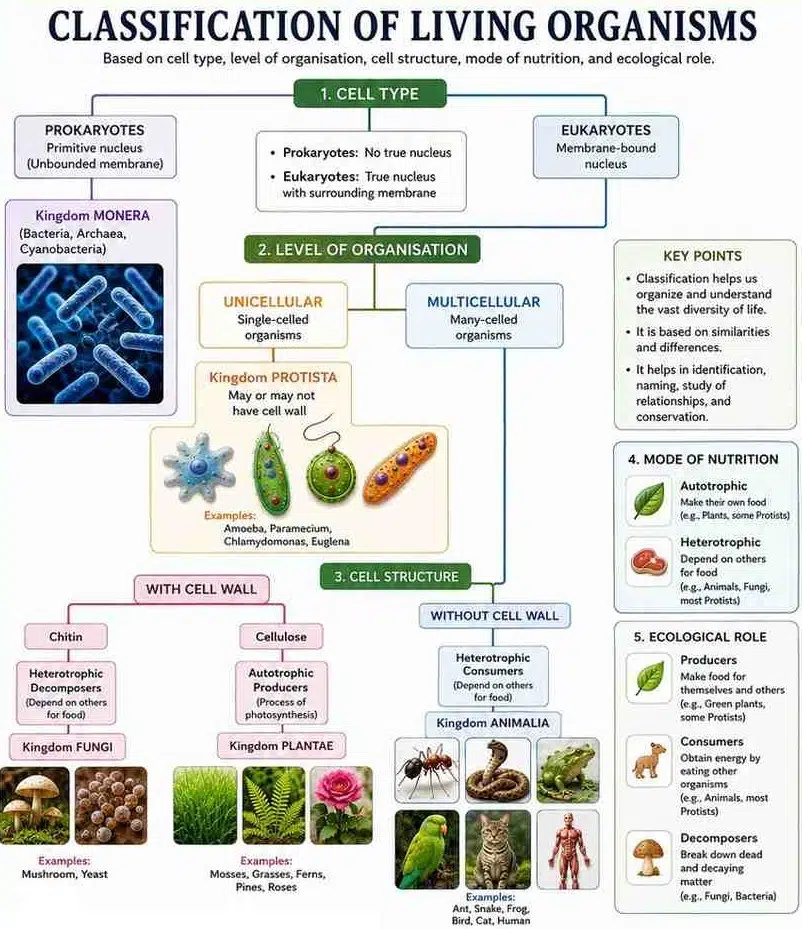
| Monera | Unicellular, no true nucleus (prokaryotic) | Bacteria |
| Protista | Mostly unicellular, true nucleus (eukaryotic) | Amoeba, Paramecium |
| Fungi | Heterotrophic, absorb food | Mushroom, Yeast |
| Plantae | Make their own food (autotrophic) | Mango tree, Grass |
| Animalia | Heterotrophic and can move | Human, Lion |
Kingdom Monera — Unicellular prokaryotes
What is Kingdom Monera?
Kingdom Monera is the biological group of unicellular prokaryotes. The kingdom Monera includes the simplest and smallest living organisms. They are unicellular (single-celled) organisms. Their cells are prokaryotic, meaning they do not have a true nucleus or membrane-bound organelles.
Where are the bacteria found?
Bacteria are found in soil, water, air, hot springs, extreme environments, and inside the human body.
Some of the bacteria are useful, like Lactobacillus, which helps in making curd (yogurt). Rhizobium helps to fix nitrogen and make soil fertile. Some bacteria help in the production of biogas from animal dung.
There are some harmful bacteria, like pathogens, which cause diseases in humans, animals, and plants.
Kingdom Protista — Unicellular eukaryotes
What is Kingdom Protista?
Kingdom Protista are single-celled (unicellular) eukaryotic organisms mostly found in water or moist places. Their cells have a true nucleus and membrane-bound organelles. Some of the protists do not have a cell wall. Some others have a cell wall made of cellulose. They are microscopic and show great diversity.
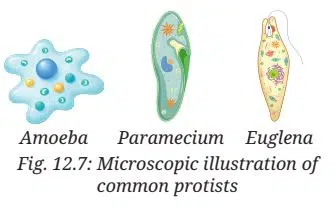
Importance of Protists
- Some of the protists produce oxygen through photosynthesis.
- They serve as food for many small aquatic animals.
- They form an important part of aquatic food chains.
- Some of the protists act as decomposers, which helps to break down the dead matter.
Kingdom Fungi—Multicellular, heterotrophic eukaryotes with a cell wall.
What is the kingdom Fungi?
Fungi are mostly multicellular eukaryotes. Their cell wall is made of chitin, and their cells have a true nucleus. Fungi do not make their own food. They absorb the nutrients from the dead and decaying organic matter.
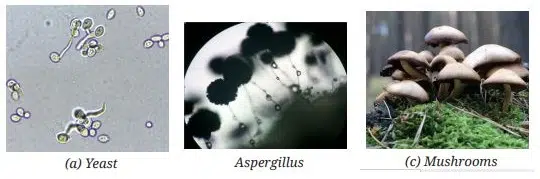
Importance of Fungi
- It acts like a decomposer.
- It returns the minerals and nutrients to the soil.
- It helps to make soil fertile and ecologically balanced.
- Some fungi are used to make antibiotics and enzymes.
- Yeast is used in baking and fermentation.
Reproduction in Fungi
Fungi reproduce both sexually and asexually. Most fungi reproduce by forming spores, which grow into new fungi under suitable conditions.
Kingdom Plantae — Multicellular, autotrophic eukaryotes with a cell wall
What is Kingdom Plantae?
The kingdom Plantae includes all plants. Plants are multicellular and eukaryotic organisms. They make their own food by photosynthesis using sunlight, water, and carbon dioxide. Their cell walls are made of cellulose, which helps to give protection and strength to plants.
Importance of Plants
- Produce their own food using photosynthesis.
- Release oxygen, which is important for the survival of living organisms.
- Provide food directly or indirectly to all animals.
- It helps to make the balance between oxygen and carbon dioxide.
- It provides food, medicines, wood, fibers, paper, etc.
- Helps to prevent soil erosion and support biodiversity.
Kingdom Plantae is divided into five classes.
- Thallophyta
- Bryophyta
- Pteridophyta
- Gymnosperm
- Angiosperm

Thallophyta (algae) — Primitive plants
What is Thallophyta?
Thallophyta is the simplest group of plants in Kingdom Plantae. They do not have true roots, stems or leaves. The word “Thallophyta” comes from “thallos”, meaning “undifferentiated body”, and “phyton”, meaning “plant”. These plants have a simple body structure called a thallus.
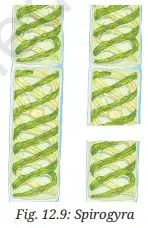
Importance of Thallophyta
- Produce oxygen through photosynthesis.
- Serve as food for many aquatic animals.
- It helps to maintain the balance of gases in the environment.
- It is the base of many aquatic food chains.
Bryophyta – First steps on land, still need water
What is Bryophyta?
Bryophyta is the second group of plants in Kingdom Plantae. The word “Bryophyta” comes from “bryon”, meaning moss, and “phyton”, meaning plant. Bryophytes were the first plants to grow on land, but they still required water for reproduction. The bryophyta are found in moist soil, damp rocks, old walls and shady places.
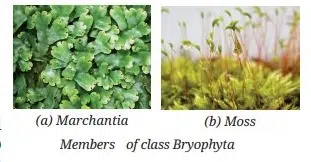
Importance of Bryophytes
- It helps in soil formation.
- Retain moisture in the soil.
- Prevent soil erosion.
- Helps to maintain ecological balance.
Why are Bryophytes Called the “Amphibians of the Plant Kingdom”?
The bryophytes are called the amphibians of the plant kingdom because they live on land, but they need water to reproduce, which means they depend on land and water both during their life cycle.
Pteridophyta — Adaptation to land and having a structural transport system
What is Pteridophyta?
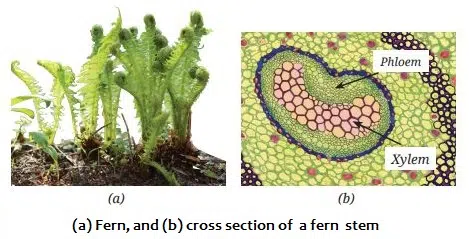
Pteridophyta is the third group of plants in Kingdom Plantae. The word “Pteridophyta” comes from “pteron”, meaning “feather”, and “phyton”, meaning “plant”. Pteridophyta are the first plants to develop vascular tissues for transporting water and food. They have true roots, stems and leaves. Pteridophytes have a well-developed water and food transport system.
Importance of Pteridophytes
- It helps to maintain ecological balance.
- Prevent soil erosion in forests.
- Some ferns are grown as ornamental plants.
- Contribute to nutrient cycling in ecosystems.
Difference Between Bryophytes and Pteridophytes
| Feature | Bryophytes | Pteridophytes |
|---|---|---|
| Plant Body | Simple body with stem-like and leaf-like structures | Well-developed body with true roots, stems, and leaves |
| Roots | Rhizoids (root-like structures) | True roots present |
| Stem | Stem-like structure | True stem present |
| Leaves | Simple leaf-like structures | True leaves present |
| Vascular Tissue | Absent | Present (xylem and phloem) |
| Transport of Water and Food | By diffusion from cell to cell | Through xylem and phloem |
| Size | Small plants | Usually larger than bryophytes |
| Examples | Moss, Marchantia | Fern, Horsetail |
Gymnosperms — Reproduction without water
What are gymnosperms?
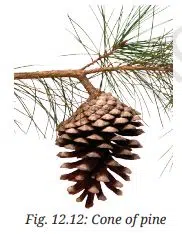
Gymnosperms are seed-producing plants with naked seeds. The word “gymnosperm” comes from “gymnos”, meaning “naked”, and “spermos”, meaning “seed”. Produce seeds but do not produce fruits. They are well adapted to cold and dry regions.
Importance of Gymnosperms
- Provide timber and wood.
- Used in the paper industry.
- Many are grown as ornamental plants.
- Helps to maintain ecological balance.
Angiosperms — Efficient reproduction and seed dispersal
What are angiosperms?
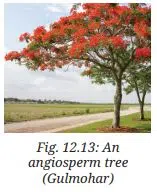
Angiosperms are flowering plants. The word ‘angiosperm’ comes from ‘angion’, meaning ‘vessel’ or ‘enclosed’, and ‘spermos’, meaning ‘seed’. They are the most advanced and diverse group of plants. Their seeds are enclosed inside the fruits.
Why are Angiosperms the Most Successful Plants?
The angiosperms can grow in a wide variety of environments. It can reproduce through flowers. Fruits protect and disperse seeds. Angiosperms can produce a large number of seeds and great diversity in size, shape and habitat.
Kingdom Animalia — Multicellular, heterotrophic eukaryotes
What is Kingdom Animalia?
The kingdom Animalia includes all animals. Animals are multicellular and eukaryotic organisms. They could not make food on their own, so they are heterotrophs. Most of the animals can move from one place to another place. They can respond quickly.
Classification of Kingdom Animalia
Animals are classified based on the presence of a notochord. The notochord is a flexible, rod‑shaped structure that gives support and keeps the body straight. In vertebrates, the notochord develops into the backbone (vertebral column).
- Non-Chordata (Invertebrates): The animals that do not have a notochord/backbone. For example, jellyfish, worms, crabs, spiders, etc.
- Chordata: The animals that have a notochord. In vertebrates, the notochord develops into the vertebral column (backbone).
Invertebrates — Animals without a notochord
What are invertebrates?
Invertebrates are the animals that do not have a notochord or backbone. They are the largest group of animals. On Earth, 95% of all animal species are invertebrates. They have a wide variety of body structures, from simple to complex. Major groups include Porifera, Cnidaria, Platyhelminthes, Nematoda, Annelida, and Arthropoda.
Porifera (pore-bearers) — Multicellularity without tissues
What are porifera?
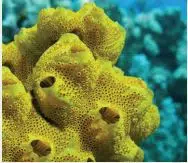
Porifera live in water and are fixed in one place. Porifera are multicellular but have no tissues or organs. The porifera body has many pores; these pores help in water flowing in and out. Water brings food and oxygen directly to the cells and removes waste.
Cnidaria — True tissues and active feeding
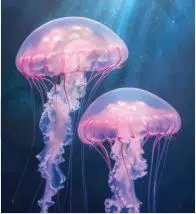
What are cnidaria?
Cnidaria have true tissues. This tissue has specialized cells for special jobs. They use tentacles to catch prey. Their body has only one opening from where they take food and remove waste. For example, hydra, jellyfish, or corals.
Platyhelminthes (flatworms) — Bilateral symmetry and directional movement
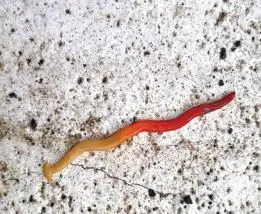
What are platyhelminthes?
Platyhelminthes are called flatworms because their bodies are thin and flat. They are the first animals to show bilateral symmetry, meaning their bodies can be divided into two equal halves along one line. They have a head‑tail and front‑back region; this helps in directional movement.
Nematoda (roundworms) — Efficient body design with two openings
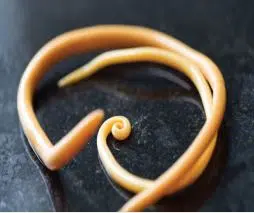
What are nematoda?
Nematoda are roundworms with a long cylindrical body. They are more advanced than the flatworms because they have two separate openings: a mouth for taking in food and an anus for removing waste. They can live in soil, water, or inside hosts. Males and females are separate.
Annelida (segmented worms) — segmentation and body cavities
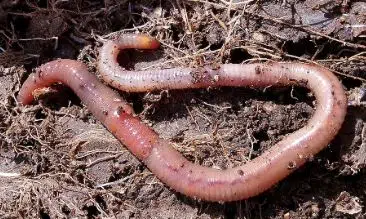
What are annelida?
Annelids are worms with a segmented body. Their body is divided into many ring-like segments. This segment helps in better movement control. Their organs are well developed, and the nerve cord helps in coordination.
Arthropoda — Jointed appendages and an external skeleton
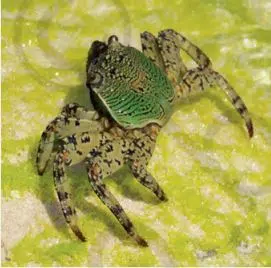
What are arthropoda?
Arthropoda is the largest group in the animal kingdom. The word “Arthropoda” means “jointed appendages (legs).” “Arthropods are covered by a hard external skeleton (exoskeleton). An exoskeleton gives protection, prevents water loss, and supports strong muscles. This allows them to survive in dry and exposed environments.
Mollusca — Organ system level organisation with soft bodies
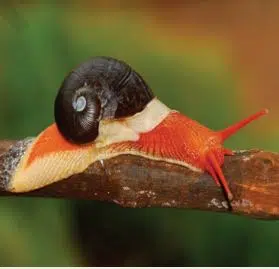
What are mollusca?
Mollusca are animals with soft bodies and organ-system-level organization. Many molluscs have a hard shell that protects their soft body. For example: snails, squids, and octopuses.
Echinodermata — Internal support without a notochord
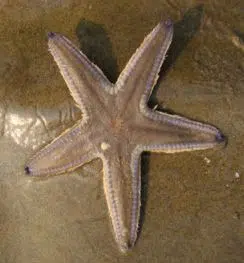
What are echinodermata?
Echinodermata means “spiny skin.” They have a hard internal skeleton made of calcium carbonate. No notochord, but skeleton gives support and protection. Basically found in sea environments. For example, starfish, sea urchins, etc.
Looking across invertebrates
From sponges to echinoderms, animal body structure shows a pattern of increasing complexity in body organisation. New structural features improve feeding, movement and protection but often introduce new challenges. These help explain survival in diverse environments.
Protochordates — The appearance of the notochord
In protochordates, the notochord is present at least once during their life. Unlike a hard backbone, the notochord does not restrict movement. It allows the animal to bend and swim freely.
Vertebrates — Animals with a backbone.
Vertebrates are animals that have a vertebral column (backbone). This backbone is part of an internal skeleton that supports the body and protects important organs like the brain and spinal cord.
Vertebrates are divided into five main groups based on their habitat, body covering, and reproduction:
- Fish: live in water, breathe with gills, and have bodies covered with scales.
- Amphibians: live in water and on land, have moist skin, and lay eggs in water.
- Reptiles: dry scaly skin, lay eggs on land.
- Birds: feathers, wings, lay eggs, most can fly.
- Mammals: have hair or fur, give birth to young ones, and feed milk.
Adaptations as Outcomes of Structural Change
Today animals have a different body structure because they have changed gradually over time. This structure helps them to survive in their habitats and is called an adaptation.
What are adaptations?
Adaptations are the special body features or characteristics that help an organism to survive in its environment. They developed over many generations, and different habitats have different adaptations based on their environment.
The hierarchical nature of classification
Scientists classify living organisms in a step-by-step order from broad groups to more specific groups.
When we move downward in the classification
- Groups become smaller.
- Organisms share more common features.
- Every lower group is part of the group above it.
Kingdom → Phylum → Class → Order → Family → Genus → Species
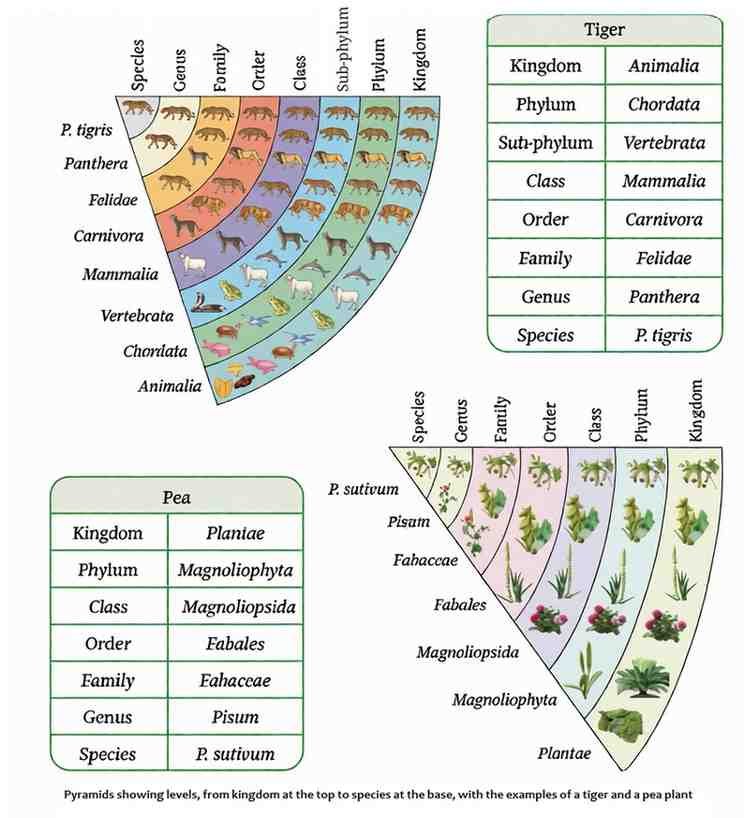
Scientific Naming — The Binomial System
Different languages use different names for the same organism. For example, a tiger is called “Bagh” in Hindi, “Puli” in Tamil, “Tiger” in English, and “Tigre” in French. To avoid confusion, scientists use a common scientific name that is accepted worldwide.
What is binomial nomenclature?
Binomial nomenclature is the scientific name for naming living organisms. These names are written in Latin or a Latinized form. Every organism is given a two-word scientific name, and all over the world, scientists use the same scientific name. This scientific name was introduced by Carolus Linnaeus in the 18th century.
Rules for writing the scientific names
Every scientific name has two words: genus name and species name.
- Genus Name: The genus name begins with a capital letter and comes first, followed by the species name, which is written in small letters (lower case).
- Species Name: The scientific name is written in italics when printed or underlined when handwritten.
Fossils as Evidence
Fossils provide important evidence about the history of life on earth. They help the scientists to understand how plants and animals have changed over millions of years.
Biodiversity Under Threat
Biodiversity means the variety of living organisms such as plants, animals, and microorganisms found on Earth. Every species plays an important role in maintaining the balance of nature. Human activities are reducing biodiversity. The major threats are pollution, deforestation, overuse of natural resources, and climate change.
Disclaimer: The content that is present on our website is based on the NCERT Class 9 Science textbook and is provided for educational purposes only. All the content and images have been taken from Science Class 9 NCERT Textbook and CBSE Support material. Images and content shown above are the property of individual organizations and are used here for reference purposes only. To make it easy to understand, some of the content and images are generated by AI and cross-checked by the teachers.