
← Back to Class 10 Study Material
Practice The Human Eye and the Colourful World Class 10 MCQs based on the NCERT Science textbook. These MCQs cover important concepts such as the human eye, accommodation, defects of vision, correction of eye defects, dispersion of light, atmospheric refraction, and the scattering of light.
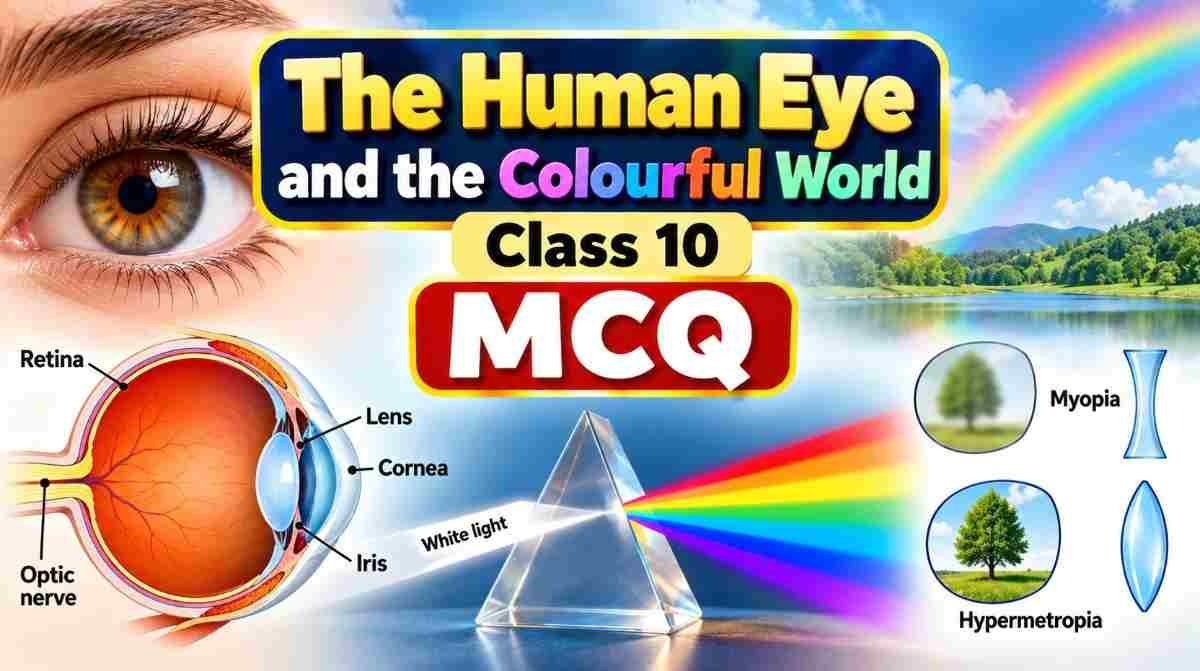
The Human Eye and the Colourful World Class 10 MCQ
Conceptual Recall
Q. Which part of the human eye acts as a light-sensitive screen?
a) Cornea
b) Iris
c) Retina
d) Pupil
Answer: c) Retina
Q. The transparent bulge on the front surface of the eyeball is called:
a) Iris
b) Cornea
c) Retina
d) Optic nerve
Answer: b) Cornea
Q. The ability of the eye lens to adjust its focal length is called:
a) Persistence of vision
b) Accommodation
c) Refraction
d) Dispersion
Answer: b) Accommodation
Q. For a normal young adult, the least distance of distinct vision is:
a) 20 cm
b) 25 cm
c) 50 cm
d) 100 cm
Answer: b) 25 cm
Q. The angle between the two refracting surfaces of a prism is called:
a) Angle of deviation
b) Angle of incidence
c) Angle of the prism
d) Angle of emergence
Answer: c) Angle of the prism
Q. The splitting of white light into its constituent colours is called:
a) Reflection
b) Refraction
c) Scattering
d) Dispersion
Answer: d) Dispersion
Q. Twinkling of stars is caused by:
a) Reflection of light
b) Dispersion of light
c) Atmospheric refraction
d) Scattering of light only
Answer: c) Atmospheric refraction
Q. The phenomenon in which a beam of light becomes visible due to scattering by colloidal particles is called:
a) Atmospheric refraction
b) Tyndall effect
c) Dispersion
d) Internal reflection
Answer: b) Tyndall effect
Application-Based
Q. A person enters a brightly lit room from a dark area. Which part of the eye adjusts the amount of light entering the eye?
a) Retina
b) Optic nerve
c) Cornea
d) Iris
Answer: d) Iris
Q. Most of the refraction of light entering the human eye takes place at the:
a) Retina
b) Optic nerve
c) Outer surface of the cornea
d) Iris
Answer: c) Outer surface of the cornea
Q. The image formed by the eye lens on the retina is:
a) Virtual and erect
b) Real and inverted
c) Virtual and inverted
d) Real and erect
Answer: b) Real and inverted
Q. While reading a book, the ciliary muscles of the eye contract. As a result, the eye lens becomes:
a) Thinner and focal length increases
b) Thicker and focal length decreases
c) Thinner and focal length decreases
d) Thicker and focal length increases
Answer: b) Thicker and focal length decreases
Q. A person can see nearby objects clearly but cannot see distant objects distinctly. The person is suffering from:
a) Hypermetropia
b) Presbyopia
c) Myopia
d) Cataract
Answer: c) Myopia
Q. A student has difficulty reading a book held at 25 cm from the eyes but can see distant objects clearly. Which defect does the student have?
a) Myopia
b) Cataract
c) Colour blindness
d) Hypermetropia
Answer: d) Hypermetropia
Q. When white light passes through a glass prism, the colour that deviates the least is:
a) Violet
b) Blue
c) Red
d) Green
Answer: c) Red
Q. A student observes a band of seven colours on a screen after passing sunlight through a prism. This band of colours is known as:
a) Image
b) Spectrum
c) Shadow
d) Reflection
Answer: b) Spectrum
Q. During the formation of a rainbow, water droplets act like tiny:
a) Mirrors
b) Lenses
c) Prisms
d) Screens
Answer: c) Prisms
Q. A star appears slightly higher than its actual position near the horizon. This is due to:
a) Reflection of light by clouds
b) Atmospheric refraction
c) Dispersion by water droplets
d) Total internal reflection
Answer: b) Atmospheric refraction
Q. Why do planets generally not twinkle like stars?
a) They emit their own light
b) They are farther away than stars
c) They appear as extended sources of light
d) Their light is not refracted by the atmosphere
Answer: c) They appear as extended sources of light
Q. Danger signals are red in colour because red light:
a) Has the shortest wavelength
b) Travels fastest in air
c) Is scattered the most
d) Is scattered the least by fog and smoke
Answer: d) Is scattered the least by fog and smoke
Assertion–Reason
Q. Assertion (A): The crystalline lens helps the eye focus objects at different distances.
Reason (R): The crystalline lens provides fine adjustment of focal length.
a) Both A and R are true, and R is the correct explanation of A
b) Both A and R are true, but R is not the correct explanation of A
c) A is true, but R is false
d) A is false, but R is true
Answer: a) Both A and R are true, and R is the correct explanation of A
Q. Assertion (A): The pupil controls the amount of light entering the eye.
Reason (R): The size of the pupil is controlled by the iris.
a) Both A and R are true, and R is the correct explanation of A
b) Both A and R are true, but R is not the correct explanation of A
c) A is true, but R is false
d) A is false, but R is true
Answer: a) Both A and R are true, and R is the correct explanation of A
Q. Assertion (A): Myopia can be corrected using a concave lens.
Reason (R): A concave lens helps bring the image of a distant object back onto the retina.
a) Both A and R are true, and R is the correct explanation of A
b) Both A and R are true, but R is not the correct explanation of A
c) A is true, but R is false
d) A is false, but R is true
Answer: a) Both A and R are true, and R is the correct explanation of A
Q. Assertion (A): Hypermetropia can be corrected using a convex lens.
Reason (R): A convex lens provides additional converging power to form the image on the retina.
a) Both A and R are true, and R is the correct explanation of A
b) Both A and R are true, but R is not the correct explanation of A
c) A is true, but R is false
d) A is false, but R is true
Answer: a) Both A and R are true, and R is the correct explanation of A
Q. Assertion (A): The emergent ray from a prism is not parallel to the incident ray.
Reason (R): The refracting surfaces of the prism are inclined to each other.
a) Both A and R are true, and R is the correct explanation of A
b) Both A and R are true, but R is not the correct explanation of A
c) A is true, but R is false
d) A is false, but R is true
Answer: a) Both A and R are true, and R is the correct explanation of A
Q. Assertion (A): Violet light deviates more than red light in a prism.
Reason (R): Different colours of light bend through different angles in a prism.
a) Both A and R are true, and R is the correct explanation of A
b) Both A and R are true, but R is not the correct explanation of A
c) A is true, but R is false
d) A is false, but R is true
Answer: a) Both A and R are true, and R is the correct explanation of A
Q. Assertion (A): The Sun is visible for a short time before actual sunrise.
Reason (R): Atmospheric refraction bends sunlight towards the observer.
a) Both A and R are true, and R is the correct explanation of A
b) Both A and R are true, but R is not the correct explanation of A
c) A is true, but R is false
d) A is false, but R is true
Answer: a) Both A and R are true, and R is the correct explanation of A
Q. Assertion (A): The sky appears blue during the day.
Reason (R): Fine particles in the atmosphere scatter shorter wavelengths of light more strongly.
a) Both A and R are true, and R is the correct explanation of A
b) Both A and R are true, but R is not the correct explanation of A
c) A is true, but R is false
d) A is false, but R is true
Answer: a) Both A and R are true, and R is the correct explanation of A
Case Study-Based
Case Study: Light enters the eye through the cornea and undergoes refraction. The eye lens focuses the light on the retina, where light-sensitive cells generate electrical signals. These signals travel to the brain through the optic nerve, enabling us to perceive objects.
Q. Which structure converts light into electrical signals?
a) Cornea
b) Retina
c) Iris
d) Pupil
Answer: b) Retina
Q. The electrical signals generated in the retina are carried to the brain through the:
a) Cornea
b) Eye lens
c) Optic nerve
d) Iris
Answer: c) Optic nerve
Case Study: An elderly person experiences difficulty in reading newspapers and books held at normal reading distance. The doctor explains that the power of accommodation has decreased due to ageing. The person is advised to use spectacles.
Q. The defect described in the passage is:
a) Myopia
b) Presbyopia
c) Cataract
d) Astigmatism
Answer: b) Presbyopia
Q. Presbyopia occurs mainly because of:
a) Weakening of ciliary muscles and reduced flexibility of the eye lens
b) Excessive curvature of the cornea
c) Shortening of the optic nerve
d) Damage to the retina
Answer: a) Weakening of ciliary muscles and reduced flexibility of the eye lens
Case Study: A student passes a narrow beam of sunlight through a glass prism and observes a colourful band on a white screen. The colours appear in the order Violet, Indigo, Blue, Green, Yellow, Orange and Red. The student further notices that the red colour bends the least while the violet colour bends the most.
Q. Which phenomenon is responsible for the formation of the colour band?
a) Reflection
b) Scattering
c) Dispersion
d) Diffraction
Answer: c) Dispersion
Q. Which colour is formed at the most deviated end of the spectrum?
a) Red
b) Yellow
c) Green
d) Violet
Answer: d) Violet
Case Study: A beam of sunlight enters a smoke-filled room through a small hole. The path of the light beam becomes clearly visible. On another day, a student travelling in an aeroplane at very high altitude notices that the sky appears much darker than it does on the ground.
Q. The visibility of the light beam in the smoke-filled room is due to:
a) Reflection
b) Tyndall effect
c) Refraction
d) Dispersion
Answer: b) Tyndall effect
Q. The sky appears darker at very high altitudes because:
a) The Sun becomes less bright
b) There is no atmosphere at all
c) Scattering of light is much less prominent
d) Blue light is completely absorbed
Answer: c) Scattering of light is much less prominent
Diagram/Visual-Based
Q. Refer to Figure. Which part of the eye is the dark muscular diaphragm that controls the size of the pupil?
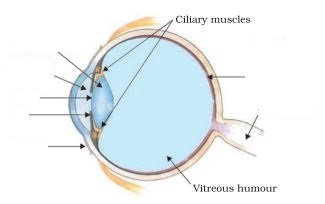
a) Retina
b) Cornea
c) Optic nerve
d) Iris
Answer: d) Iris
Q. Refer to Figure. What is the approximate diameter of the human eyeball?
a) 1.3 cm
b) 2.3 cm
c) 3.3 cm
d) 4.3 cm
Answer: b) 2.3 cm
Q. Refer to Figure. In a myopic eye, the image of a distant object is formed:
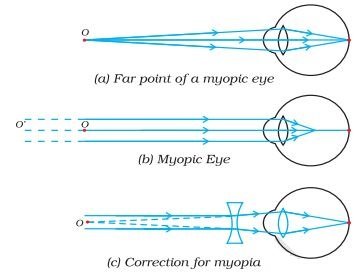
a) Behind the retina
b) On the retina
c) In front of the retina
d) At the blind spot
Answer: c) In front of the retina
Q. Refer to Figure. Which lens is used to correct hypermetropia?
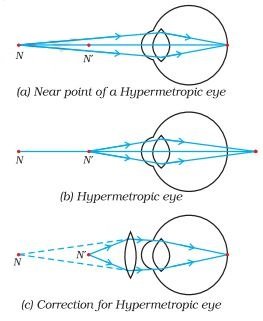
a) Concave lens
b) Convex lens
c) Bifocal lens only
d) Cylindrical lens
Answer: b) Convex lens
Q. Refer to Figure. The angle between the direction of the incident ray and the emergent ray is called:
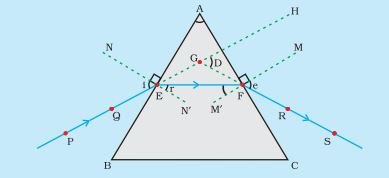
a) Angle of incidence
b) Angle of emergence
c) Angle of deviation
d) Angle of refraction
Answer: c) Angle of deviation
Q. Refer to Figure. Which sequence correctly represents the colours of the visible spectrum obtained through a prism?
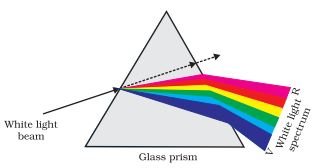
a) VIBGYOR
b) ROYGBIV
c) VIOGRBY
d) YORGBIV
Answer: a) VIBGYOR
Q. Refer to Figure. The apparent position of a star is shown higher than its actual position due to:
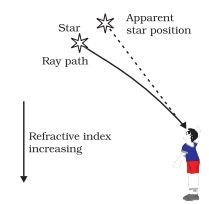
a) Reflection by clouds
b) Dispersion by the atmosphere
c) Atmospheric refraction
d) Scattering by dust particles
Answer: c) Atmospheric refraction
Q. Refer to Figure. During rainbow formation, water droplets act as small prisms and cause:
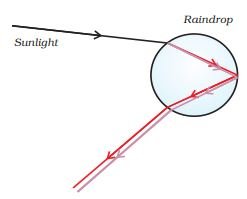
a) Reflection only
b) Refraction only
c) Dispersion, internal reflection and refraction
d) Scattering only
Answer: c) Dispersion, internal reflection and refraction
Disclaimer: The content that is present on our website is based on the NCERT Class 10 Science textbook and is provided for educational purposes only. All the content and images have been taken from Science Class 10 NCERT Textbook. Images and content shown above are the property of individual organizations and are used here for reference purposes only. To make it easy to understand, some of the content and images are generated by AI and cross-checked by the teachers.