
← Back to Class 9 Science Notes
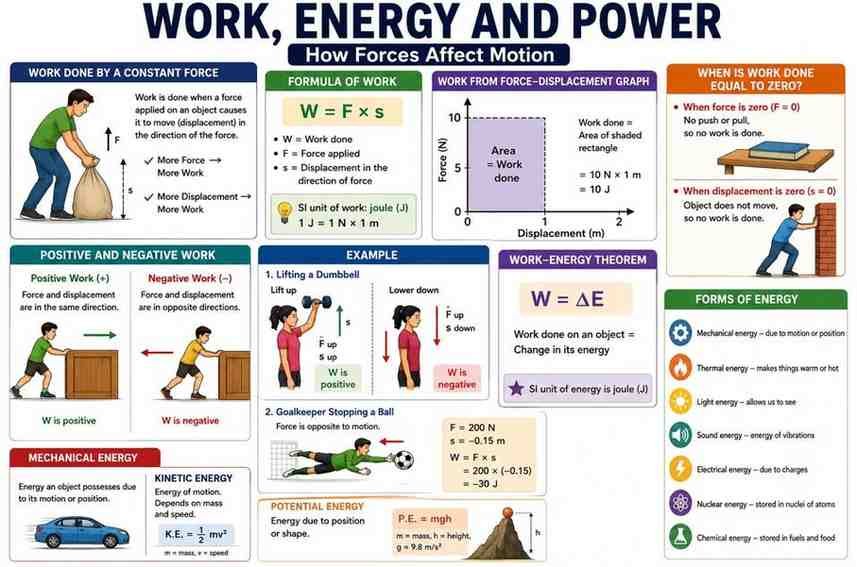
Work, Energy and Simple Machines Class 9 Notes help students understand how force is used to perform work and how energy enables objects to do tasks. This chapter introduces important concepts such as work done by a force, kinetic energy, potential energy, conservation of mechanical energy, power, and the work-energy theorem.
Work Energy and Simple Machines Class 9 Notes
Work Done by a Constant Force
Let’s understand this concept using a simple real-life example. For example, suppose you lift a 5 kg wheat bag from the floor to the height of 1 metre.
- The force acting downside is a gravitational force (mg).
- To lift the bag, you apply equal upward force.
- The bog moves upward (displacement) in the same direction as the force.
When you lift a 5 kg wheat bag, it means you have done work.
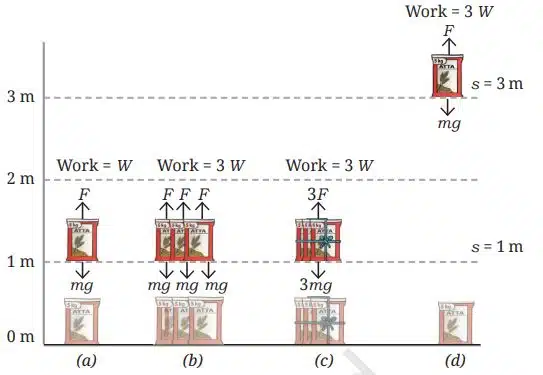
- Case 1: Increasing Force: What happens if you lift 3 bags one by one or together? If you lift 3 bags one by one, then the work becomes 3 times. If you left 3 bags together, then you would apply 3 times more force. In both cases the work done is 3 times more. Conclusion: Work increases when force increases.
- Case 2: Increasing Distance: Suppose you left the same bag at 3 metres instead of 1 metre; then the work becomes 3 times more. The conclusion is work increases when distance (displacement) increases.
Scientific Definition: Work is done when a force is applied, when the force is applyed then an object moves (displacement). The movement is the direction of the force.
Formula of Work
W = F × s
Where:
- W = Work done
- F = Force applied
- s = Displacement in direction of force
The SI unit of work done is the joule, which is represented by ‘J’. The SI unit of force is the newton (N), and the SI unit of displacement is the metre (m).
Definition of 1 Joule
1 J = 1 N × 1 m
This means that 1 joule of work is done when a force of 1 newton moves an object by 1 metre in the direction of force.
In the graph shown, the force on an object is plotted on the y-axis against the displacement in the direction of force on the x-axis. In this case, the work done on the object by the force is equal to the area of the shaded rectangle in the graph, which is 10 N × 1 m = 10 J.
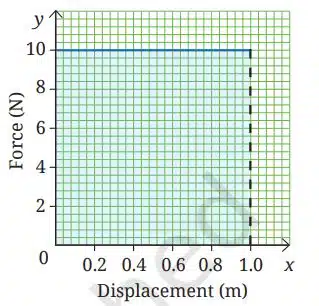
Even when the force is not constant, work done can still be calculated by finding the area under the force-displacement graph between the initial and the final positions.
When is work done equal to zero?
Formula of Work
W = F × s
a. When force is zero (F=0)
If no force is applied on an object, then there is no push or pull. So no work is done. For example, a book lying on a table without any force acting on it.
b. When displacement is zero (s = 0)
If the object does not move, then the displacement = 0. For example, you are trying to push a wall; you apply force, but the wall does not move. So, scientifically no work is done.
Positive and negative work done
The work done by a force on an object can either be positive or negative depending upon the relative directions of the force and the displacement.
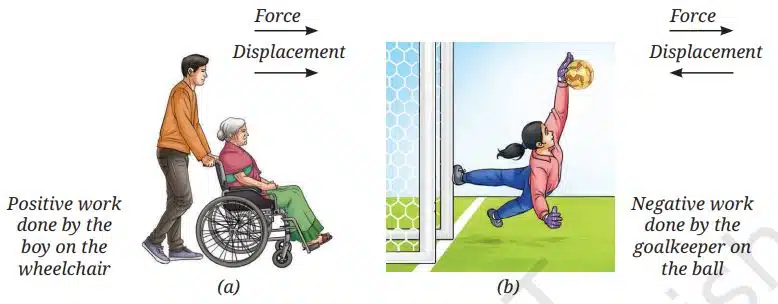
- Work is positive when the force and displacement are in the same direction. For example, pushing a wheelchair forward or lifting an object upward. In both cases the force and motion are in the same direction.
- Work is negative when the force and displacement are in the opposite direction. For example, a goalkeeper stopping a ball or using the brake on a moving vehicle. In this situation the force is applied opposite to the motion.
Formula of Work
W = F × s
- If force and displacement are in the same direction, then W is positive.
- If force and displacement are in opposite directions, then W is negative.
Example 1: Lifting a Dumbbell
A girl lifts a dumbbell and then lowers it here. While lifting up the dumbbell, the force is 1 and the displacement is 1, meaning the work is positive. When the girl lowers down the dumbbell, the force is 1, but displacement 1 means work is negative.
Example 2: Goalkeeper Stopping a Ball
A goalkeeper stops a ball by applying a force of 200 N, and her hand moves back by 15 cm (0.15 m).
- Force is opposite to motion.
- So, displacement is negative.
The formula:
W = 200 × (−0.15) = −30J
Work done = –30 J. Here the negative sign shows the opposite direction of force and displacement.
The Work-Energy Theorem
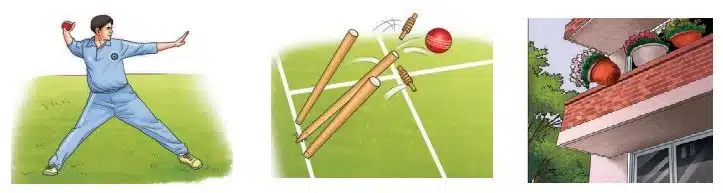
When positive work is done on an object, it gains energy. Energy is the capacity to do work, which means If an object can move or affect another object, it means it has energy. Real-life example: suppose a fielder throws a ball, and the ball hits the wicket. Here, the ball had energy to do work (move the wicket). The ball gets energy from the work done by the player. Second example, a flowerpot falling from a height – from that height, it can damage objects below. Here the pot gained energy from the work done in raising it to a height. We can say that work is done on an object; it gains energy.
Work–Energy Theorem
The relationship between work and energy is given by:
W = ΔE
Work done on an object = change in its energy.
The SI unit of energy is the same as the SI unit of work, the joule (J).
Forms of Energy
We know that energy is the capacity to do work. We have discussed only mechanical energy, but energy exists in many different forms in our daily life.
- Mechanical energy: Energy due to motion or position of objects
- Thermal energy: Energy that makes things warm or hot
- Light energy: Energy that allows us to see
- Sound energy: Energy of vibrations of air or other molecules
- Electrical energy: Energy related to position or motion of charges
- Nuclear energy: Energy stored in the nuclei of atoms.
- Chemical energy: Energy stored in fuels and food in the form of chemical bonds between atoms.

1. Mechanical Energy
Mechanical energy is the energy that an object possesses due to its motion or position. Let us try to quantify mechanical energy by using the concept of work.
2. Kinetic energy
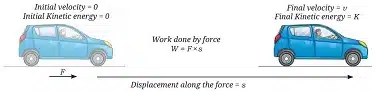
The energy possessed by an object due to its motion is called kinetic energy. Every moving object has kinetic energy. For example, a moving bicycle, a rolling ball, and a flying cricket ball. When the object is at rest, then its kinetic energy is zero.
How is kinetic energy developed?
When you kick the ball, your foot applies a force. The ball starts moving (displacement), energy is applied on the ball, and this energy does not disappear; it gets stored in the ball. This energy is called kinetic energy.
The formula of Kinetic energy:
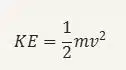
- 𝑚 = mass of the object (in kilograms)
- 𝑣 = velocity (speed) of the object (in meters per second)
- The unit is joule (J)
Example 1: Effect of Velocity
If velocity becomes double (2v):
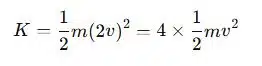
Kinetic energy becomes 4 times
Example 2: Cricket Ball
- Mass = 0.2 kg
- Velocity = 43 m/s
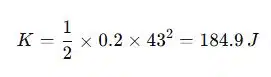
Kinetic energy = 184.9 J
Example 3: Jet Aircraft
- Mass = 15000 kg
- Force = 367500 N
- Distance = 100 m
Using work-energy theorem:
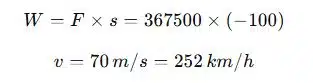
The aircraft’s velocity before stopping = 70 m/s
3. Potential energy
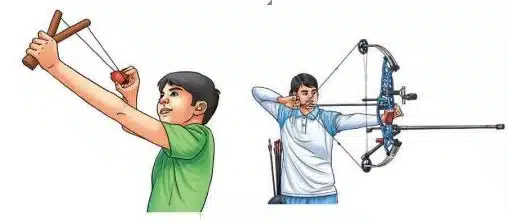
The energy stored by an object as a result of its deformation or in a system of objects due to their relative positions is called the potential energy. For example, take one rubber band. In normal condition, no energy is stored, but when you stretch the rubber band, you apply force, and you do work; the rubber band changes its shape.
Now the rubber band stores the energy; this energy is called ‘potential energy’. When you release the rubber band, then it quickly comes back to its original shape, and it can hit your finger. Here the stored potential energy changes into kinetic energy.
Gravitational Potential Energy
The most common type is gravitational potential energy:
PE = mgh
- m = mass of the object (kg)
- g = acceleration due to gravity (9.8 m/s2 on Earth)
- h = height above the ground (m)
The higher you lift something, the more energy it stores. If you drop it, that stored energy turns into kinetic energy as it falls. Example: A rock on a cliff has potential energy. When it falls, that energy becomes motion.
For example,
Book (2 kg) on a shelf 3 m high
PE = 2 x 9.8 x 3 = 59J
Cracket ball (0.2 kg) held 10 m above ground
PE = 0.2 x 9.8 x 10 = 19.6J
Conservation of mechanical energy
The sum of the kinetic energy and the potential energy of the object is
called its mechanical energy.
ME = KE + PE
When an object moves under gravity, potential energy decreases and kinetic energy increases, but in ideal conditions the total mechanical energy remains constant. This is called Conservation of Mechanical Energy. Imaging a ball dropped from a height, At the top: KE = 0, PE = maximum. In the middle: KE increases, PE decreases, but total energy stays constant. At the bottom: KE maximum, PE = 0, total energy still = mgh. In this example, the energy is not lost it only changes the form.
- PE -> KE while falling
- KE -> PE while going up
Simple Pendulum Example,
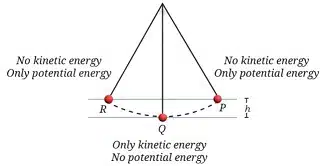
For a pendulum, at the highest point PE is maximum and KE is zero. At the lowest point KE is maximum and PE is zero. Energy keeps shifting between the two, but the total remains constant.
In real life, air resistance and friction gradually convert some mechanical energy into heat and sound, so the motion eventually stops.
Power
Power tells us how fast work is done. Power is defined as the rate at which work is done. Mathematically, the average power P is the work done W divided by the time taken t, i.e.,

Where:
- P = Power
- W = Work done
- t = Time taken
The SI unit of power is the watt (W), where 1 watt is equal to 1 joule of work done per second, i.e., 1 W = 1 J s -1.
Simple Machines
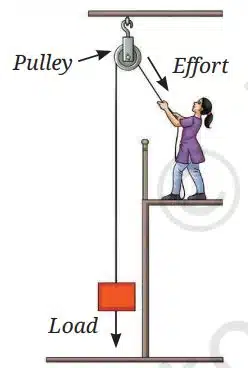
The devices that help us do this are called simple machines. We will learn three simple machines — a pulley, an inclined plane and a lever. The force we apply to a machine is called the ‘effort’, and the force that needs to be overcome is called the ‘load’. To describe how a machine changes the magnitude of the applied force, we define mechanical advantage as the ratio of the load to the effort. It can be written as

1. Pulley
A pulley is a wheel with a groove that guides a rope. A fixed pulley does not reduce the magnitude of the force required; it only changes its direction. It is easier for us to pull downward than to lift a load by applying an upward force directly.
2. Inclined plane
An inclined plane is a sloping surface (ramp) used to move objects to a height easily.
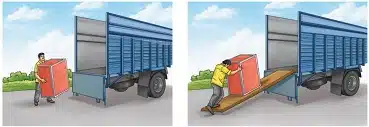
Why Do We Use an Inclined Plane?
When you lift a heavy box straight up, it needs more force. Here, if you use an inclined plane (ramp), then you push the heavy box upside with less force.
Mechanical Advantage of Inclined Plane
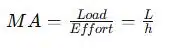
Where:
- L = Length of the slope
- h = Height
According to the work-energy theorem:
F′ × L = mgh
‘Equation’ means when L increases, then the force decreases; because of this, the longer ramp = less effort.
When lifting directly, the distance is small (height h) and the force is large. When you are using a ramp, then the distance is large (length L), but the force is small. So the total work remains the same, but the effort becomes less.
3. Lever
A lever is a rigid bar, such as your scale, that can rotate about a fixed point, such as the point of contact of the scale with the pencil.
In everyday life, levers are often used to lift heavy objects. A lever has three main parts:
- Fulcrum: a fixed point about which the lever rotates,
- Load: the force to be overcome, and
- Effort: the force applied. The distance of the load from the fulcrum is called the load arm, and the distance of the effort from the fulcrum is called the effort arm.
Important Formula
F1 x d1 = F2 x d2
Where:
- F₁ = Effort
- d₁ = Effort arm
- F₂ = Load
- d₂ = Load arm
Disclaimer: The content that is present on our website is based on the NCERT Class 9 Science textbook and is provided for educational purposes only. All the content and images have been taken from Science Class 9 NCERT Textbook and CBSE Support material. Images and content shown above are the property of individual organizations and are used here for reference purposes only. To make it easy to understand, some of the content and images are generated by AI and cross-checked by the teachers.