
← Back to Class 9 Science Notes
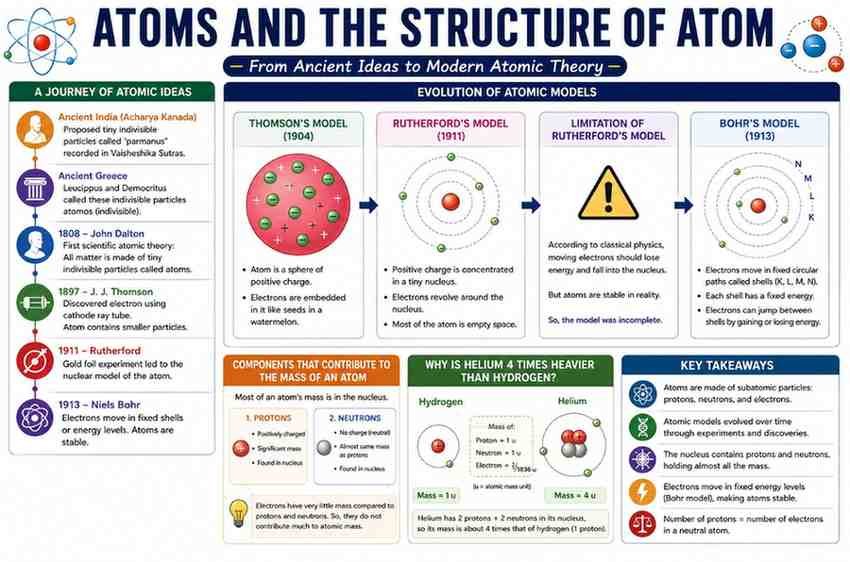
Journey Inside The Atom Class 9 Notes explains how our understanding of the atom developed from ancient ideas to the atomic models proposed by Dalton, Thomson, Rutherford, and Bohr. Students learn about subatomic particles, atomic number, mass number, electronic configuration, valency, isotopes, and isobars.
Journey Inside The Atom Class 9 Notes
Everything that we see, observe, or feel around us is matter. Matter consists of tiny particles called atoms. These atoms are so small that they cannot be seen with the naked eye.
Rediscovering the Roots of Atomic Theory
More than 2,000 years ago, great thinkers in ancient India and Greece tried to answer a very important question: “What is everything made of?”
Acharya Kanada, an ancient Indian philosopher, suggested that if matter (dravya) is divided repeatedly, we would reach a stage where we encounter the smallest particles that can no longer be divided. He called these particles ‘parmanus’. His ideas are recorded in the Sanskrit text Vaisesika Sutras. A parmanu was considered extremely small and could not be perceived by the senses.
According to this idea, combinations of parmanus formed groups of two called dyads and groups of three called triads. These combinations were considered the basis of the material universe.
The Greek philosophers Leucippus and Democritus also proposed a similar idea. They called these indivisible particles ‘atomos’, which means ‘indivisible’ in Greek. The concept of the atom originally developed as an idea rather than from experimental observations.
Many centuries later, in 1808, John Dalton proposed his atomic theory based on the scientific experiments of his time. He proposed that all matter is composed of indivisible particles called atoms.
According to Dalton’s atomic theory, atoms were considered to be indivisible particles and the fundamental building blocks of matter. His theory was based on scientific experiments of that time.
A Short Historical Journey Through Atomic Models
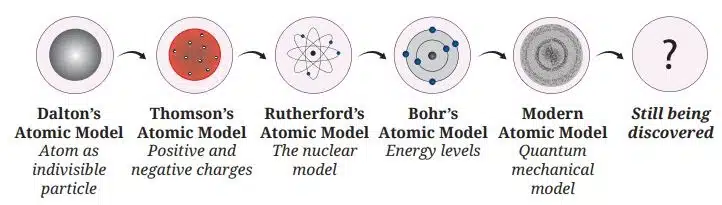
More than a hundred years ago, scientists tried to imagine what atoms might look like by proposing simple models.
Until the late 19th century, atoms were thought to be the smallest and indivisible units of matter. However, scientists discovered that certain elements emit invisible energy and particles called radiation, a phenomenon known as radioactivity. This showed that atoms must be composed of smaller particles.
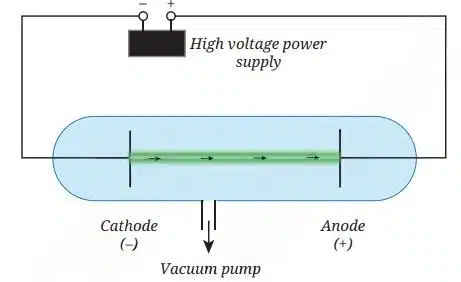
In 1897, J. J. Thomson studied the conduction of electric current through gases at very low pressure. He used a glass tube with two electrodes and applied a high voltage. He observed rays moving from the cathode (negative electrode) to the anode (positive electrode). These rays were called cathode rays.
By studying cathode rays in electric and magnetic fields, Thomson concluded that they are streams of negatively charged particles with a much smaller mass than atoms. These particles were later called electrons.
The nature of cathode rays was independent of the material of the cathode and the gas used in the tube. This showed that electrons are a fundamental component of all atoms.
The charge of an electron is −1.602 × 10⁻¹⁹ C. For convenience, its relative charge is taken as −1.
Thomson’s model of an atom
After discovering electrons, J. J. Thomson tried to explain how an atom is still neutral.
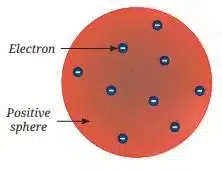
Thomson proposed that an atom is a sphere of positive charge with negatively charged electrons distributed throughout it. Because both positive and negative charges are present, they cancel each other, so the atom becomes neutral.
Thomson’s model can be compared with a watermelon, where the red pulp represents the positively charged matter and the seeds represent electrons distributed throughout the atom. This model was simple and easy to understand, but later scientists found it was not completely correct.
Testing Thomson’s model: The gold foil experiment
In 1911, Geiger and Marsden, working under Ernest Rutherford, tested Thomson’s model of the atom through the gold foil experiment.
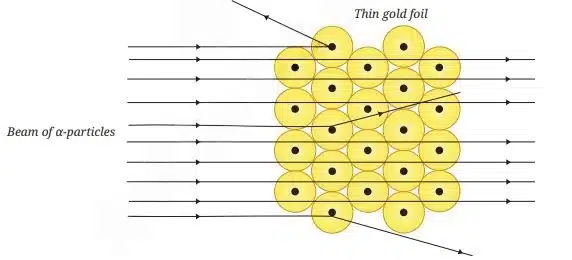
They aimed a narrow beam of alpha particles at an extremely thin sheet of gold foil. Alpha particles are positively charged particles emitted from certain radioactive elements. An alpha particle is the nucleus of a helium atom containing two protons and two neutrons.
According to Thomson’s model, the alpha particles were expected to pass straight through the gold foil or be deflected only slightly. However, most particles passed through undeflected, some were sharply deflected, and a few even bounced back.
The deflection of alpha particles from their straight path is called scattering. Therefore, the gold foil experiment is also called the alpha-ray scattering experiment.
These observations showed that the positive charge of an atom is not spread throughout the atom but is concentrated in an extremely small region called the nucleus. The results of the experiment showed that Thomson’s model was not correct and led to a new understanding of the atom.
A. Rutherford’s model of an atom
After the gold foil experiment, Ernest Rutherford gave a new model of the atom. Rutherford said that an atom has a very small, positively charged centre called the nucleus. Most of the atom is empty space, and electrons move around the nucleus.
Most of an atom is empty space, as most alpha particles passed through the gold foil without any deflection. The nucleus is dense and contains all the positive charge and most of the mass of the atom.
Electrons revolve around the nucleus somewhat like planets orbiting the Sun. Therefore, Rutherford’s model is also called the planetary model of the atom.
The nucleus is extremely small compared with the atom. The diameter of an atom is about 10⁻¹⁰ m, while the diameter of its nucleus is about 10⁻¹⁵ m. Thus, the nucleus is about 100,000 times smaller than the atom.
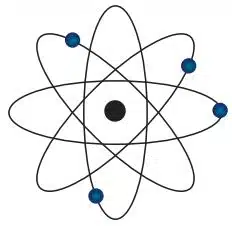
Rutherford’s atomic model was better than Thomson’s atomic model in explaining the results of the gold foil experiment.
B. Limitations of Rutherford’s model
Rutherford’s model explained the presence of a nucleus, but it had a major problem. According to the model, electrons move around the nucleus.
According to classical physics, a moving electron should continuously lose energy. As it loses energy, it would move closer to the nucleus and eventually fall into it. If this happened, atoms would become unstable. However, atoms are stable in reality. This shows that Rutherford’s model was not completely correct.
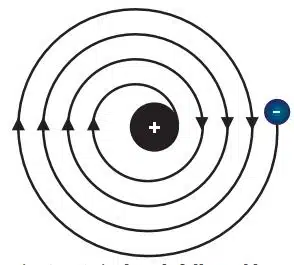
C. Discovery of the proton
Rutherford’s work showed that the nucleus contains positively charged particles. The hydrogen nucleus was later identified as the proton. Protons are much heavier than electrons and have a charge equal in magnitude and opposite in sign to that of an electron.
A proton has a positive charge that is equal in size to the negative charge of an electron. A proton is also much heavier than an electron.
For example, a helium atom has 2 protons and 2 electrons, and a sodium atom has 11 protons and 11 electrons. For an atom to be electrically neutral, the number of protons must be equal to the number of electrons.
Bohr’s model of the atom
In 1913, Niels Bohr gave a new model to explain why the atoms are stable. Bohr proposed that electrons move around the nucleus only in certain fixed circular paths called stationary states, orbits, or shells. These shells are also called energy levels because electrons in each shell have a definite amount of energy.
The shell closest to the nucleus has the lowest energy. The energy increases as we move farther from the nucleus. Electrons can revolve only in these allowed shells and not in between them. While moving in a fixed shell, an electron does not lose energy. An electron can move from one shell to another by absorbing or releasing a fixed amount of energy equal to the difference between the energies of the two levels.
Bohr’s model explained why electrons do not continuously lose energy while staying in their fixed energy levels.
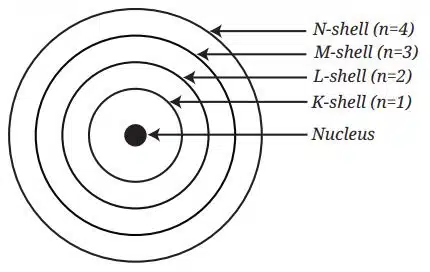
What Makes Up the Mass of an Atom?
Most of an atom’s mass is concentrated in the nucleus and mainly comes from protons and neutrons.
1. Protons
- Positively charged particles
- Each proton has significant mass.
- Found inside the nucleus
2. Neutrons
- No charge (neutral)
- Almost the same mass as protons
- Present in the nucleus of atoms, except in ordinary hydrogen atoms.
Why is helium 4 times heavier than hydrogen?
Hydrogen-1 has one proton and no neutrons, while helium-4 has two protons and two neutrons. Therefore, helium-4 has about four times the mass of hydrogen-1.
Discovery of the Neutron
In 1932, James Chadwick discovered a new subatomic particle called the neutron. It has a mass nearly equal to that of a proton but has no electrical charge.
- Has no electrical charge (neutral)
- Has a mass nearly equal to a proton
- It is usually represented by the symbol n.
Symbols and relative charges of subatomic particles
| Subatomic particle | Symbol | Relative charge |
|---|---|---|
| Electron | e⁻ | −1 |
| Proton | p⁺ | +1 |
| Neutron | n | 0 |
By 1869, scientists knew about 69 elements, most of which were found naturally on Earth.
Symbols of Elements
To make chemistry simple and universal, scientists needed a standard way to represent elements.
Early Development
- In 1803, John Dalton introduced pictorial symbols for elements.
- Later, in 1813, Jöns Jakob Berzelius proposed using letters to represent elements.
- Today, symbols are approved by the International Union of Pure and Applied Chemistry (IUPAC).
Rules for Writing Symbols
- An element’s symbol usually has one or two letters. The first letter is always written in capital form. If there is a second letter, it is written in small form.
- Examples: Hydrogen – H, Helium – He, Carbon – C, Chlorine – Cl, Zinc – Zn
- Some elements have symbols based on their Latin names. For example, iron has the symbol Fe and sodium has the symbol Na.
Names of some common elements and their symbols
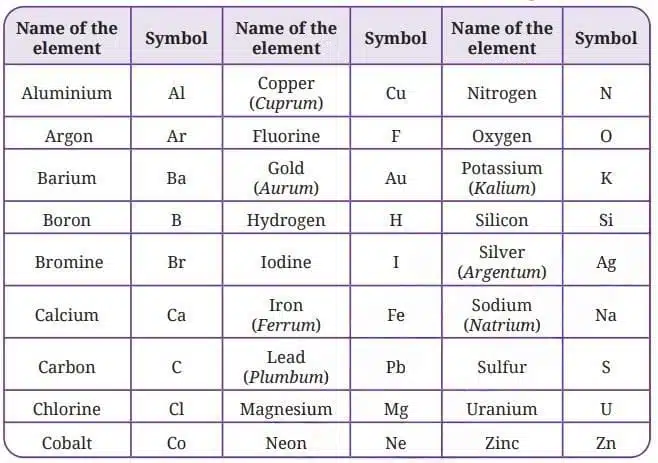
Scientists use these symbols instead of full names because they are internationally recognised and allow scientists worldwide to communicate clearly, regardless of language barriers.
Atomic Number
The atomic number of an element is the number of protons present in the nucleus of its atom.
- It is denoted by the symbol ‘Z’.
- It determines the identity of an element.
- The atomic number uniquely identifies an element. In a neutral atom, the number of electrons is equal to the number of protons and therefore also equals the atomic number.
Why is the atomic number important?
Each element has a unique atomic number; there are no two elements that can have the same atomic number. That’s why the atomic number is like an identity card of an element.
Mass Number
The mass number of an atom is the total number of protons and neutrons present in its nucleus.
- It is denoted by the symbol A
- Protons and neutrons together are called nucleons
Mass Number (A) = Number of Protons + Number of Neutrons
- The mass of an atom mainly comes from protons and neutrons
- The mass of an electron is negligible, so it is ignored
- Since protons and neutrons have nearly equal mass, they together account for atomic mass
Standard Notation of an Atom
An element is written as:

Where:
A = Mass number
Z = Atomic number
X = Symbol of element
For example, the symbol for carbon is C, its atomic number is 6, and its mass number is 12. In notation, it would be written as —

How Are Electrons Distributed in Different Energy Levels?
Scientists like Niels Bohr and Charles Bury gave rules to understand how electrons are arranged in shells (energy levels).
1. Maximum electrons in a shell
The maximum number of electrons that a shell can hold is given by:
- Maximum number of electrons = 2n²
- Where n is the shell number.
| Shell | n | Maximum electrons |
|---|---|---|
| K | 1 | 2 |
| L | 2 | 8 |
| M | 3 | 18 |
| N | 4 | 32 |
Important: Although the M shell can hold up to 18 electrons according to the formula 2n², the electron configurations of the first 18 elements are filled as 2, 8, 8. Therefore, for the first 18 elements, the M shell contains a maximum of 8 electrons.
2. Outermost shell rule
The first shell (K) can hold a maximum of 2 electrons. The maximum number of electrons that can be accommodated in the outermost shell is 8, while the first shell can accommodate a maximum of 2 electrons.
3. Order of filling shells
- Electrons fill shells from inner to outer:
- K → L → M → N
- Electrons are first placed in the shell closest to the nucleus.
- The inner shells are filled before electrons are placed in the outer shells.
Building Up Atoms
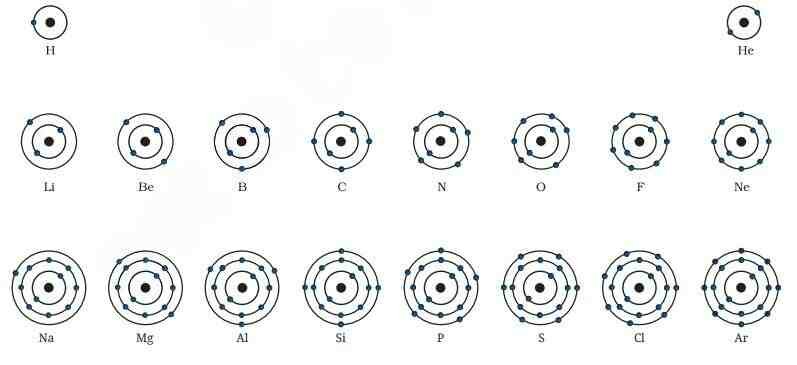
The arrangement of electrons in different shells of an atom is called its electronic configuration. Electrons are filled in shells starting from the shell closest to the nucleus.
For the first 18 elements, electrons are arranged as 2, 8, 8 in the first three shells.
Examples:
- Hydrogen = 1
- Helium = 2
- Lithium = 2, 1
- Carbon = 2, 4
- Oxygen = 2, 6
- Neon = 2, 8
- Sodium = 2, 8, 1
- Chlorine = 2, 8, 7
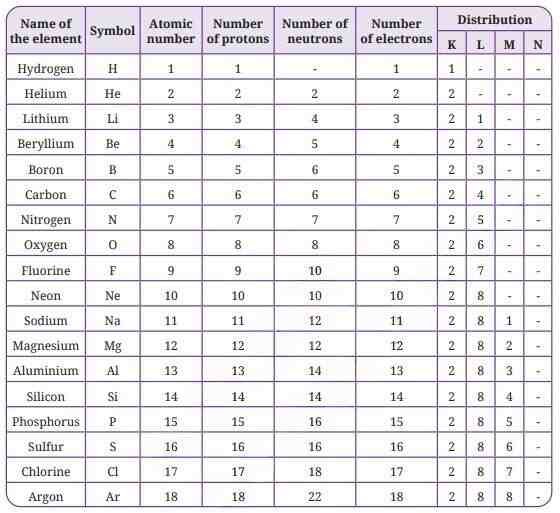
Symbols, atomic numbers, number of protons, number of neutrons, number of electrons, and the electronic distribution of atoms of the first eighteen elements
Combining Capacity of an Atom: Valency
Valency is the combining capacity of an atom. It is the number of electrons an atom gains, loses, or shares to achieve a stable electronic configuration.
- In H₂O, oxygen has a valency of 2.
- In NH₃, nitrogen has a valency of 3.
- In MgCl₂, magnesium has a valency of 2.
The outermost shell containing electrons in an atom is called its valence shell. The electrons present in the valence shell are called valence electrons.
If the outermost shell has 8 electrons, it is called an octet. Atoms with a complete octet, or 2 electrons in the case of helium, are generally stable and less reactive.
Examples of Valency
- Sodium: Sodium has the electronic configuration 2, 8, 1. It can lose one electron to achieve a stable octet. Therefore, its valency is 1.
- Oxygen: Oxygen has the electronic configuration 2, 6. It can gain two electrons to complete its octet. Therefore, its valency is 2.
- Carbon: Carbon has the electronic configuration 2, 4. It has four valence electrons and can share four electrons with other atoms to complete its octet. Therefore, its valency is 4.
A Deeper Look into Atomic Structure
Isotopes
Earlier, John Dalton proposed that all atoms of the same element are identical in mass and properties. Later, the discovery of isotopes showed that atoms of the same element can have different masses.
- Same number of protons (same atomic number)
- Different number of neutrons and therefore different mass numbers
These atoms are called isotopes.
Isotopes are atoms of the same element that have the same atomic number but different mass numbers.
Isotopes of an element have the same number of electrons and the same electronic configuration. Therefore, they have similar chemical properties but may have different physical properties.
Number of neutrons = Mass number − Atomic number
Example: Isotopes of Hydrogen
Hydrogen has three isotopes: protium, deuterium, and tritium. Protium and deuterium occur naturally, while tritium is present naturally only in trace amounts and is also produced artificially. All three have one proton, but they contain different numbers of neutrons.
- Protium: 1 proton, 0 neutrons
- Deuterium: 1 proton, 1 neutron
- Tritium: 1 proton, 2 neutrons
Thus, all three are isotopes of hydrogen because they have the same atomic number (1) but different mass numbers.
Applications of Isotopes
Some isotopes have useful applications in medicine, industry, energy, and scientific research.
| Isotope | Application |
|---|---|
| Uranium-235 (U-235) | Used as nuclear fuel |
| Cobalt-60 (Co-60) | Used in radiation therapy for cancer treatment |
| Iodine-131 (I-131) | Used in the diagnosis and treatment of thyroid disorders |
| Carbon-14 (C-14) | Used to estimate the age of ancient organic remains and fossils |
A. Average atomic mass
The average atomic mass of an element may not be a whole number because it is calculated using the masses and relative abundances of its naturally occurring isotopes. This is because different isotopes exist in different proportions in nature.
We calculate atomic mass using percentage abundance:
Average atomic mass = Σ (isotopic mass × relative abundance)
For two isotopes: Average atomic mass = (mass₁ × abundance₁/100) + (mass₂ × abundance₂/100)
Example: Chlorine has two commonly occurring isotopes, chlorine-35 and chlorine-37, present in approximately 75% and 25% abundance, respectively.

Solving:
- (75/100 × 35) = 26.25
- (25/100 × 37) = 9.25
Total = 35.5 u
Isobars
Isobars are atoms of different elements that have the same mass number but different atomic numbers.
| Element | Atomic Number (Z) | Mass Number (A) |
|---|---|---|
| Calcium (Ca) | 20 | 40 |
| Potassium (K) | 19 | 40 |
| Argon (Ar) | 18 | 40 |
These elements have the same mass number (40) but different atomic numbers and different numbers of protons.
Difference Between Isotopes and Isobars
| Property | Isotopes | Isobars |
|---|---|---|
| Elements | Atoms of the same element | Atoms of different elements |
| Atomic number | Same | Different |
| Mass number | Different | Same |
| Number of protons | Same | Different |
| Example | ¹H, ²H, ³H | ⁴⁰Ar, ⁴⁰K, ⁴⁰Ca |
Journey Inside the Atom: At-a-Glance Revision
| Topic | Key Point |
|---|---|
| Atom | Tiny particle that makes up matter |
| Electron | Negatively charged subatomic particle |
| Proton | Positively charged particle present in the nucleus |
| Neutron | Neutral particle present in the nucleus |
| Atomic Number (Z) | Number of protons |
| Mass Number (A) | Number of protons + neutrons |
| Nucleons | Protons + neutrons |
| Electronic Configuration | Arrangement of electrons in shells |
| Valence Electrons | Electrons in the outermost shell |
| Valency | Combining capacity of an atom |
| Isotopes | Same atomic number, different mass numbers |
| Isobars | Same mass number, different atomic numbers |
| Rutherford Model | Atom has a small, dense, positive nucleus |
| Bohr Model | Electrons occupy specific energy levels |
| 2n² Rule | Maximum theoretical electrons in shell n |
Important Formulas from Journey Inside the Atom
1. Mass Number
- A = Z + N
Where:
- A = Mass number
- Z = Atomic number
- N = Number of neutrons
Therefore,
- N = A − Z
2. Atomic Number
- Z = Number of protons
For a neutral atom:
- Number of electrons = Number of protons = Z
3. Maximum Electrons in a Shell
- 2n2
Where n is the shell number.
Examples:
- K shell: 2(1)2 = 2
- L shell: 2(2)2 = 8
- M shell: 2(3)2 = 18
- N shell: 2(4)2 = 32
Important: For the first 18 elements, electron distribution follows 2, 8, 8.
4. Average Atomic Mass

For two isotopes:

where m is isotopic mass and a is percentage abundance.
The study of atomic structure is still developing. Scientists later found that Bohr’s model was not completely correct. Electrons do not follow fixed paths around the nucleus; instead, they exist in regions called electron clouds, where they are most likely to be found. This modern understanding is studied in higher grades.
Quick Check
Q1. What determines the identity of an element?
Answer: Atomic number.
Q2. What is the difference between isotopes and isobars?
Answer: Isotopes have the same atomic number but different mass numbers, whereas isobars have the same mass number but different atomic numbers.
Q3. How are neutrons calculated?
Answer: N = A − Z
Q4. What is the maximum theoretical number of electrons in the third shell?
Answer: 18.
Q5. What is the electronic configuration of carbon?
Answer: 2, 4.
Q6. What is the valency of carbon?
Answer: 4.
Disclaimer: The content that is present on our website is based on the NCERT Class 9 Science textbook and is provided for educational purposes only. All the content and images have been taken from Science Class 9 NCERT Textbook and CBSE Support material. Images and content shown above are the property of individual organizations and are used here for reference purposes only. To make it easy to understand, some of the content and images are generated by AI and cross-checked by the teachers.
More extra questions
https://cbseskilleducation.com/journey-inside-the-atom-class-9-mcq/