
The Rise of the Marathas Class 8 Notes with these simple, well-organized, and easy-to-understand study notes based on the latest NCERT syllabus. These notes cover the rise of Chhatrapati Shivaji Maharaj, the Maratha administration, military system, cultural revival, important battles, and the Maratha legacy in short points.
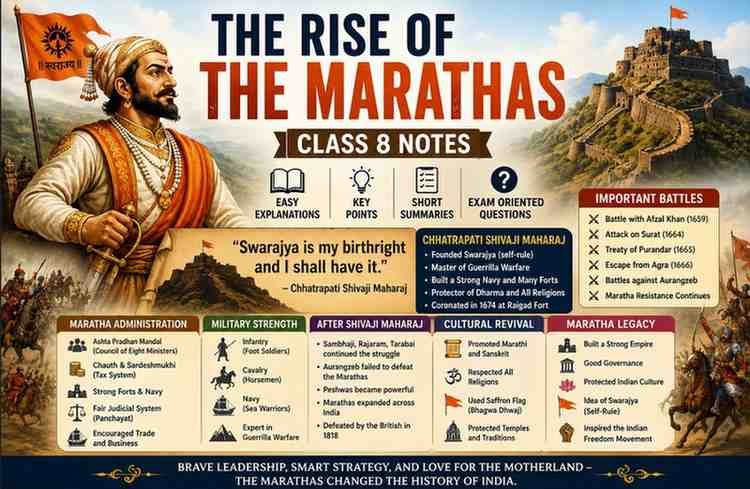
The Rise of the Marathas Class 8 Notes
Who are the Marathas?
The Marathas are the people from Maharashtra. Chhatrapati Shivaji Maharaj united the Marathas and built a strong Maratha kingdom. Bhakti saints like Dnyaneshwar, Namdev, Tukaram, and Ramdas spread devotion and unity before Shivaji’s rise.
Foundation of Maratha Power and the Rise of Chhatrapati Shivaji
Chhatrapati Shivaji Maharaj was born in 1630. His father was Shahji Bonsle, and his mother was Jijabai.
At the age of 16, Shivaji Maharaj started capturing small forts and repaired and strengthened these forts. His dream was to build an independent kingdom called Swarajya (self-rule).
The Maratha Navy became one of his greatest achievements of Shivaji Maharaj. Shivaji also expanded southwards in the Dakshina Digvijaya, conquering parts of Karnataka and Tamil Nadu.
Shivaji used guerrilla warfare; this war focused on the following:
- Attack suddenly.
- Use small groups of soldiers.
- Know the hills and forests well.
- Surprise the enemy.
The Bijapur Sultan sent Afzal Khan to kill Shivaji. They met near Pratapgad Fort. Afzal Khan tried to attack Shivaji, but Shivaji defended himself and killed Afzal Khan.
The Mughal general Shaista Khan attacked Maharashtra. After three years Shivaji attacked his camp at night with few soldiers, and Shaista Khan escaped from them and lost some fingers, and later on he left Maharashtra.
Shivaji attacked the rich city of Surat. He collected a large amount of treasure and did not damage temples, mosques, or other religious places.
Mughal emperor Aurangzeb wanted to stop Chhatrapati Shivaji Maharaj. So, he sent his general Mirza Raja Jai Singh. Jai Singh’s army was much bigger and stronger than Shivaji’s army. Shivaji fought bravely but could not win. So, he signed an agreement called the Treaty of Purandar (1665). According to the treaty, Shivaji gave some of his forts to the Mughals. His son Sambhaji stayed with the Mughal army for some time as part of the agreement.
Shivaji went to Agra to meet Aurangzeb; he insulted him and kept him under house arrest. Shivaji escaped by hiding inside the baskets of fruits and sweets with his son Sambhaji. Aurangzeb could never catch him again.
In 1674, Shivaji became king at Raigad Fort. He was given the title “Shri Raja Shiva Chhatrapati.” He started a new era called Rajyabhisheka Shaka.
During his coronation, Shivaji performed Vedic rituals to show he was a Hindu king and protector of dharma.
Shivaji also gave importance to Hindu traditions but respected all religions equally.
Shivaji Maharaj became famous across India and even in Europe. The European writer compares Shivaji to Alexander the Great because of the military skills.
The Marathas after Chhatrapati Shivaji
After Chhatrapati Shivaji died, his son Sambhaji became the new king of the Maratha kingdom. Mughal emperor Aurangzeb wanted to destroy the Maratha kingdom. Aurangzeb captured Sambhaji, but Sambhaji was executed by Aurangzeb.
After Sambhaji’s death, his brother Rajaram became the Chhatrapati. The Maratha continued fighting with the Mughals. Marathas use guerrilla warfare to defeat the Mughal army many times.
After the death of Rajaram, his wife Tarabai led the Maratha kingdom, and she fought bravely against the Mughals.
Aurangzeb could not defeat the Marathas, and he died in the Deccan in 1707 without winning the war. His death marked the decline of Mughal power.
Later, Ahilyabai Holkar became another famous Maratha woman ruler, known for justice and temple building. She rebuilt the Kashi Vishwanath temple in Varanasi.
Later, the peshwa became very powerful. The Chhatrapati remained the king, but the peshwa looked after most of the government work. Some of the most important pashwas are
- Peshwa Bajirao I
- Nanasaheb Peshwa
- Peshwa Madhavrao I
Battle of Panipat (1761)
The Marathas fought the Afghans in the third battle of Panipat (1761). They were defeated. Despite defeat, under Peshwa Madhavrao I, the Marathas regained strength and stability.
The British become the Marathas’ biggest enemy, and they have fought three Anglo-Maratha wars between 1775 and 1818. The British won because the Marathas were not united.
The Marathas had formed a confederacy under chiefs like the Holkars, Scindias, and Gaekwads, who ruled different regions.
In 1818, the British defeated the Marathas, and after that, British rule spread over most of India.
Maratha Administration
1. Civilian administration
- Chhatrapati Shivaji established a strong central government.
- Shivaji was helped by a Council of Eight Ministers called the Ashta Pradhan Mandal. These ministers helped him in running the kingdom.
- The Marathas collected two important taxes like Chauth and Sardeshmukhi.
- Shivaji introduced salary-based officials instead of hereditary posts to reduce corruption.
- The Modi script was used in administration for official records.
2. Military administration
- The Maratha Army has three parts: Infantry (foot soldiers), Cavalry (soldiers on horses), and Navy (soldiers who fought at sea).
- Chhatrapati Shivaji built and captured many forts. These forts helped to protect the kingdom, control important routes, and hide and protect the army during guerrilla warfare.
3. Maritime supremacy
- Chhatrapati Shivaji created a strong navy and basically protected the west coast of India and sea trade.
- The Europeans had very powerful navies, and they controlled much of the sea trade around India.
4. Judicial system
- The Marathas had a good and fair judicial system.
- The Panchayat was a group of local officials and respected people. They heard disputes and gave justice.
5. Trade networks
- Chhatrapati Shivaji wanted the Maratha kingdom wealthy, so he encouraged trade and business.
6. Cultural Revival
- The Marathas protect and promote the Indian culture.
- Shivaji encouraged the use of Marathi and Sanskrit.
- He respected all religions and never forced people to change their religion.
- Shivaji used the saffron (bhagwa) flag, which became the symbol of the Marathas.
The Maratha legacy
- Strong Empire: The Marathas built a large and powerful empire. Marathas ruled many parts of central and northern India.
- Good Government: The Marathas created a good system of administration and work for people’s welfare.
- Protection of Indian Culture: The Maratha supported Hindu traditions and culture and respected all religions.
- Idea of Swarajya: The Marathas believed in Swarajya (self rules).
- Inspiration for Freedom: Their idea of Swarajya later helped the Indian freedom movement.
Disclaimer: The content that is present on our website is based on the NCERT Class 8 Social Science textbook and is provided for educational purposes only. All the content and images have been taken from Socail Science Class 8 NCERT Textbook. Images and content shown above are the property of individual organizations and are used here for reference purposes only. To make it easy to understand, some of the content and images are generated by AI and cross-checked by the teachers.