
Reshaping India’s Political Map Class 8 Notes, The medieval period in India witnessed the rise and fall of powerful kingdoms, foreign invasions, and the establishment of the Delhi Sultanate and the Mughal Empire. It was also marked by regional resistance, administrative reforms, and significant developments in society, trade, and culture.
Reshaping India’s Political Map Class 8 Notes
In Indian history, the term ‘medieval’ means ‘between two ages’; this term was first used in Europe. In Europe, it was the time when the fall of the Roman Empire (5th century CE) occurred, leading to the Renaissance (14th–16th centuries). In India, the medieval period means the time from the 11th century to the 17th century.
Around the 11th century, India entered a new era where invasions came from the Hindu Kush Mountains and changed India’s political map. Many invaders come from Central Asia, mainly from Turkic and Afghan regions. They come to India for:
- Riches (wealth and treasures)
- Land and power (territory)
- They sometimes used force and violence to spread their religion.
Rise and Fall of the Delhi Sultanate
The Delhi Sultanate was established after King Prithviraj Chauhan was defeated in 1192 CE. The Delhi Sultanate was ruled by five Turkic-Afghan dynasties:
- Mamluk (Slave Dynasty)
- Khilji (Khalji) Dynasty
- Tughlaq Dynasty
- Sayyid Dynasty
- Lodi (Lodhi) Dynasty
Delhi becomes an important political center in North India. Not all of India came under the Delhi Sultanate; some kingdoms fought back and stayed independent, like the Eastern Gangas (East India) and the Hoysalas (South India).
Features of the Sultanate Period
- Political instability
- Violent successions
- The average reign of a sultan is about 9 years.
- Villages, cities, temples, and learning centers are destroyed.
- Hindu, Jain, and Buddhist temples were attacked.
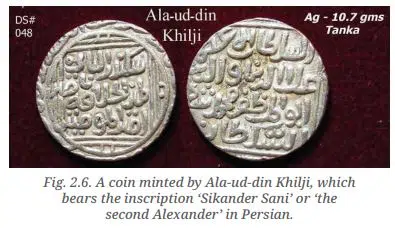
1. Ala-ud-din Khilji
Alauddin Khilji ruled around 1300 CE. He captured many places in North and Central India. He also stopped attacks from the Mongols who wanted to capture India. Malik Kafur was Aladdin Khilji’s general. He led the army to South India and attacked famous temples like Srirangam, Madurai, Chidambaram, and possibly Rameswaram.
2. Muhammad bin Tughlaq
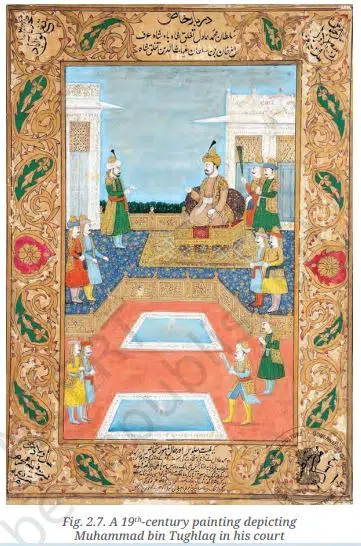
Muhammad bin Tughlaq expanded the empire; at that time, most of India came under one ruler. He moved her capital from Delhi to Daulatabad. That time, people traveled more than 1000 km. Later, he moved the capital back to Delhi. Because of this decision many people suffered during these journeys. He made copper coins equal in value to gold and silver coins. That time many people made fake copper coins; because of the fake coins, the economy became weak. Due to fake coins, trade was also not successful.
Some of the sultans collect tax from the non-Muslim people, which is known as the Jizya tax. The people who paid this tax got protection from the sultan and exemption from military service. This tax was not fair because only non-Muslims had to pay, so some of the people accepted Islam to avoid paying this tax.
3. Timur
In the 14th century, a ruler named Timur came from Central Asia. He attacked Delhi; he wanted to fight with non-Muslims and wanted to take their wealth. That time, many people were killed and made slaves. The Delhi sultans were badly destroyed, and Timur took a lot of gold, silver, and other valuable things with him and left Delhi in great trouble.
4. Lodi dynasty
After Timur, the Lodi dynasty came to power, and they became the last rulers of the Delhi Sultanate. In his time the Delhi Sultanate had become much smaller; at that time many Indian kingdoms had become stronger and had taken back their lands.
Resistance to the Delhi Sultanate
The Delhi Sultanate faced many enemies during its rule. Many Indian kingdoms fought against the Delhi Sultanate. Some kingdoms were defeated, but many remained independent.
1. Eastern Ganga Kingdom
The Eastern Ganga kingdom was in present-day Odisha and parts of Bengal and Andhra Pradesh. The Delhi Sultanate could not conquer this kingdom. The famous ruler was Narasimhadeva I. Narasimhadeva I had a strong army and defeated the governor of Bengal from the Delhi Sultanate. To celebrate his victories, he built the famous Konak Sun Temple.
2. Hoysala Kingdom
The Hoysala Kingdom ruled most of present-day Karnataka. The Delhi Sultanate attacked many times in the Hoysala kingdom. The Hoysalas fought bravely and remained independent for a long time. In the mid 14th century, the kingdom became part of the Vijayanagara Empire.
3. Regional Sultanates
The Delhi Sultanate also had a problem from the new Muslim kingdoms. One important kingdom was the Bahmani Sultanate. The ruler rules a large part of the Deccan.
4. Resistance in Rajasthan
Rajasthan also stayed outside the control of the Delhi Sultanate. Rana Kumbha, the ruler of the Kingdom of Mewar, strongly resisted the sultanates and successfully defeated several invasions.
The Vijayanagara Empire
When the Delhi Sultanate became weak and unstable, then a new powerful kingdom rose in South India in the 14th century. There were two brothers, Harihara I and Bukka Raya I. Both have started the kingdom. At first, they worked as governors under Muhammad bin Tughlaq. Later, they refused to obey the Delhi Sultan and founded their own independent kingdom. This kingdom became the Vijayanagara Empire.
The biggest enemy of the Vijayanagara Empire was the Bahmani Sultanate. Later, the Bahmani Sultanate broke into five smaller kingdoms. These were called the Deccan Sultanates. The five Deccan Sultanates were:
- Bijapur Sultanate
- Golconda Sultanate
- Berar Sultanate
- Ahmadnagar Sultanate
- Bidar Sultanate
Krishnadevaraya
Krishnadevaraya was the great ruler of the Vijayanagara Empire. During his rule the empire became very powerful and won many battles. He supported poets and scholars in Sanskrit, Telugu, and Kannada. Krishnadevaraya himself wrote a famous Telugu poem called Amuktamalyada.
Krishnadevaraya gave money and land to many temples. Some famous temples he supported were:
- Tirumala Venkateswara Temple
- Vittala Temple
- His capital, Vijayanagara, had many beautiful temples, palaces, and other buildings.
- Fall of the Vijayanagara Empire
In 1529 Krishnadevaraya died due to illness. The rulers who came after him were not as strong. The five Deccan Sultanates decided to join together to fight the Vijayanagara Empire. The Vijayanagara army was led by Aliya Rama Raya, who was Krishnadevaraya’s son-in-law. In 1565, both sides fought the Battle of Talikota. The Deccan Sultanates won the battle, and Rama Raya was captured and killed.
The Mughals
When the Delhi Sultanate became weak, then the new ruler who came to India was named “Babur.” Babur was a Turkic-Mongol ruler and a skilled military commander. He was a descendant of Tamur. The Babur lost their kingdom of Samarkand (Uzbekistan) and decided to conquer India.
First Battle of Panipat (1526)
In 1526, Babur fought with Ibrahim Lodi; this is called the First Battle of Panipat. Babur’s army used gunpowder, cannons, and matchlock guns in this fight. Their weapons are new in Indian warfare. Babur defeated Ibrahim Lodi and killed him in the battle. After the victory of Babur, the Delhi Sultanate ended. Babar became the ruler of Delhi and founded the Mughal Empire.
Humayun and Sher Shah Suri
Babur died in 1530, and his son Humayun became emperor of the Delhi Sultanate. Humayun struggled to keep the empire united; many enemies challenged him. One of them was Sher Shah Suri. He was a powerful Afghan leader; he defected from Humayun and founded the Sur Empire. He ruled most in North India. He has introduced many good reforms like better roads, better administration, and a better tax system.
Hemu (Hemchandra Vikramaditya)
Before Humayun there was one powerful leader named Hemu. Hemu was a great military commander and also the chief minister (Wazir) of one of the last Suri rulers. He captured Delhi and became the king of the Delhi Sultanate and took the royal name Hemchandra Vikramadity. But later he fought with Akbar, Babur’s grandson. This battle was called the Second Battle of Panipat. In the Second Battle of Panipat, Hemu was captured and brought before Akbar and executed. After the victory of Akbar, he regained Delhi and strengthened the Mughal Empire.
Akbar
Akbar became the Mughal emperor when he was 13 years old. His father, Humayun, died in an accident. Akbar was a brave and ambitious ruler; he wanted to bring all of India under Mughal rule.
Siege of Chittor –
One of Akbar’s most famous battles was against the Chittorgarh Fort. The fort was protected by Rajput soldiers, and they have fought.
Aurangzeb
In 1965, Shah Jahan became ill. He wanted his eldest son, Dara Shikoh, to become the next emperor, but Aurangzeb wanted the throne for himself. Aurangzeb fought a series of battles against his brothers. He defeated Dara Shikoh and later had him executed.
To make sure no one challenged him, Aurangzeb also imprisoned his father, Shah Jahan, in Agra Fort. Shah Jahan stayed there until his death.
In 1658, Aurangzeb became emperor and took the title “Alamgir,” which means “Conqueror of the World.” Auranggzeb ruled for about 49 years. He was a skilled military commander, and he fought many wars, especially in South India (the Deccan). During his reign the Mughal Empire became the largest in its history.
He introduced several religious policies.
- Ban on Music and Dance
- He brought back the Jizya tax on non-Muslims.
- He also imposed a pilgrimage tax on Hindus visiting their holy places.
- According to historical records, temples at places such as
- Kashi Vishwanath Temple (Banaras/Varanasi)
- Krishna Janmabhoomi (Mathura)
Somnath Temple were destroyed during his reign, along with some Jain temples and Sikh gurdwaras.
Resistance to the Mughals
Many people do not accept Mughal rule. They fought against the Mughal Empire because of the following:
- Heavy taxes.
- Harsh treatment by Mughal officials.
- Attempts to take their land.
- Attempts to control their regions.
The Jat Rebellion: The Jats were mainly farmers. Mughal officers treated the Jat people cruelly. They collect high taxes; because of this, Jats become angry and start a rebellion.
Resistance by Tribal Groups: Many tribal communities also fought against the Mughals. Some of the tribes are Bhils, Gonds, Santhals, etc. The Mughals tried to take control of their lands and collect taxes from them.
Surge of the Rajputs
The Rajputs were famous for their bravery, courage, and love for their kingdom. Rajputs lived in Rajasthan and nearby areas. Rajasthan is in northwest India; the Rajputs often fought against foreign invaders. Rajputs want to protect their land and people. Two powerful Rajput kingdoms became important:
- Kingdom of Mewar
- Kingdom of Marwar
1. Rana Sanga
Rana Sanga was the greatest Rajput ruler; he ruled in the early 16th century. He united many Rajput clans. He won several battles against different sultans, and later he fought with Babur in the Battle of Khanwa. Babur defeated Rana Sanga, but Rana Sanga became a symbol of Rajput bravery.
2. Maharana Pratap
After Rana Sanga, Maharana Pratap became the ruler of Mewar. He inherited a kingdom that had become weak. The Mughal emperor Akbar wanted Maharana Pratap to accept Mughal rule. Maharana Pratap refused because he wanted Mewar to be independent.
Battle of Haldighati (1576)
Maharana Pratap fought the Mughal army in the Battle of Haldighati. The Mughal army was strong. Maharana Pratap escaped safely and lives in the Aravalli Hills. He continued fighting the Mughals using guerrilla warfare. Even though life was very difficult, Maharana Pratap never gave up his independence.
The Ahoms
The Ahom are the group of people who came from present-day Myanmar in the 13th century.
- They settled in the Brahmaputra Valley.
- They established the Ahom kingdom.
- They ruled much of Assam for many centuries.
Ahom rulers bravely defended their kingdom from both the Delhi Sultanate and the Mughal Empire; many rulers tried to capture Assam. The Ahoms fought back and protected their kingdom. Because of strong resistance, they remain independent.
The Ahoms had a special system called the Paik System. In this system every adult man had to serve the kingdom. He could work for public projects like roads, canals, and buildings, or he would have to serve as a soldier in the army.
Battle of Saraighat (1671)
The most famous battle was the Battle of Saraighat in 1671. The battle took place on the Brahmaputra River near Guwahati. The Ahom army was led by Lachit Borphukan. Even the Mughal army was much larger, but Lachit Borphukan and the Ahoms won the battle.
The Rise of the Sikhs
The Guru Nanak started Sikhism in Punjab during the 15th century. He tought:
- There is one God (Ik Onkār).
- All people are equal.
- Be kind and help others.
- Always speak the truth.
- His followers were called Sikhs.
Guru Arjan
The 5th Sikh Guru was Guru Arjan. During the Mughal rule of Jahangir. The Mughal emperor Jahangir believed that Guru Arjan had helped his son. So, Guru Arjan was arrested and put to death. Guru Arjan became the first Sikh Guru to die for his faith.
Guru Hargobind
After Guru Arjan, his son Guru Hargobind became the 6th Sikh Guru, and he thought the Sikhs should be able to protect themselves. So, he trained Sikhs to fight, formed a Sikh army, and fought many battles against the Mughal army.
Guru Tegh Bahadur
The 9th Sikh Guru was Tegh Bahadur. In 1675, some Kashmiri pandits come to him for help. The Kashmiri pandits say that they are forced to change their religion. Guru Tegh Bahadur decided to help them. The Mughal emperor Aurangzeb asked him to accept Islam.
- Guru Tegh Bahadur said no.
- He was tortured.
- But he did not change his religion.
- Finally, he was beheaded at Chandni Chowk in Delhi.
Guru Gobind Singh and the Khalsa
After Guru Tegh Bahadur, his son Guru Gobind Singh became the 10th Sikh Guru. In 1699 he started the Khalsa. The Khalsa taught:
- Be brave.
- Fight against injustice.
- Help weak people.
- Protect their religion.
Maharaja Ranjit Singh
Later, Maharaja Ranjit Singh united them and started the Sikh Empire. He was
- A brave ruler.
- A good army leader.
- Kind to people of all religions.
Administering India
Administration under the Delhi Sultanate
The Delhi Sultanate was a strong government. The ruler controls both the government and the army. He takes support from ministers and local officers to manage the kingdom.
- The Sultan was a supreme ruler.
- He was the political head and military head.
The main duties are to protect the kingdom, collect taxes, maintain law and order, and look after public affairs.
- The Sultan takes help from the Council of Ministers.
- Each minister looked after a different department, like finance, the army, and administration.
- The Iqta System
- The sultan divides the kingdom into areas called “iqtas.”
- These are given to the officers called Iqtadars.
- These Iqtadars collect taxes from the people.
- These Iqtadars use this money for local expenses and send tax returns to the Sultan’s treasury.
- They also help to maintain soldiers for the Sultan.
- The post of an Iqtadar was not hereditary.
- Tax Collection
- The texts were collected on trade and agriculture.
- The peasants (farmers) had to pay the highest taxes.
The Mughal administrative framework
The Mughals have a well-organized administration. Akbar made some changes to improve government efficiency. Akbar appointed ministers for different departments and introduced the Mansahbari System to strengthen the army.
- In Akbar’s time, different ministers looked after different departments.
- The empire was divided into 12 provinces (Subahs).
- Each province had its own officers.
- Villages continued to manage their local affairs using self-government.
- The Mansabdari System
- Akbar introduced the Mansabdari System.
- Officers were called Mansabdars.
- Each mansabdar had a mansab (rank).
- The rank is decided based on the number of soldiers, horses, elephants, and camels.
- Officers were regularly inspected.
People’s Lives
India was one of the richest countries in the world. The main occupation in India is farming. Trade, crafts, and industries also grew this time. Local systems like guilds (śhrenis), jatis (work communities), and credit systems helped people work together.
Farming: Agriculture was the backbone of the Indian economy. Rulers capture the land for taxes, mostly one-fifth of crops. In India farmers grew rice, wheat, barley, sugarcane, pulses, silk, wool, jute, etc.
Craft and Trade: The craftspeople made textiles, utensils, weapons, and jewelry. These goods were exported from Calicut, Mangalore, Surat, Hooghly, and Masulipatnam. India exported more than it imported, including horses, silk, luxury goods, etc. From different countries merchants lived in Indian ports. The Hundi system is used for safe money transfer without carrying coins.
Currency: Sultanate rulers introduced coins, which are made from different metals. Mughals used repaya (silver) and dam (copper).
Society and Culture: People from different faiths lived together; communities kept their art and traditions alive, adapting to changes.
Disclaimer: The content that is present on our website is based on the NCERT Class 8 Social Science textbook and is provided for educational purposes only. All the content and images have been taken from Social Science Class 8 NCERT Textbook. Images and content shown above are the property of individual organizations and are used here for reference purposes only. To make it easy to understand, some of the content and images are generated by AI and cross-checked by the teachers.