
Cell the Building Blocks of Life Class 9 MCQ are designed to help Class 9 students revise important concepts quickly and prepare confidently for school exams, unit tests, and annual examinations. The MCQs cover all major topics.
Cell the Building Blocks of Life Class 9 MCQ
Conceptual Recall MCQ
1. Which scientist first observed cells in a thin slice of cork using a microscope?
A. Robert Brown
B. Robert Hooke
C. Anton van Leeuwenhoek
D. Matthias Schleiden
Answer: B. Robert Hooke
Explanation: Robert Hooke was the first scientist who looked at a thin slice of cork under a microscope, and he saw tiny box-like structures and gave them a name called “cells.”
2. What is the primary substance that makes up the plant cell wall?
A. Protein
B. Cellulose
C. Lipid
D. Starch
Answer: B. Cellulose
Explanation: A plant cell wall is mainly made of cellulose, which is a strong, sugar-like substance that gives shape and support to the plants.
3. Which organelle is known as the “house of coded instructions”?
A. Ribosome
B. Nucleus
C. Endoplasmic Reticulum
D. Golgi body
Answer: B. Nucleus
Explanation: The nucleus stores DNA, and DNA is like the coded instruction of the cell; that’s why it is called the “house of coded instructions”.
4. Which organelle is known as the “packaging and shipping centre” of the cell?
A. Ribosome
B. Golgi apparatus
C. Lysosome
D. Endoplasmic Reticulum
Answer: B. Golgi apparatus
Explanation: The Golgi apparatus basically packs and sends proteins and other materials to different parts of the cell; it works just like a post office inside the cell.
5. Which molecule acts as the “energy currency” of the cell?
A. Glucose
B. ATP
C. DNA
D. Protein
Answer: B. ATP
Explanation: ATP is known as the energy currency of the cell; it stores and gives energy to all cell activities.
6. Which plastids give bright colours to flowers and fruits?
A. Chloroplasts
B. Chromoplasts
C. Leucoplasts
D. Mitochondria
Answer: B. Chromoplasts
Explanation: Chromoplasts are plastids that give bright colours to the flowers and fruits. This colour helps the plants to attract insects and animals.
7. What is the process by which onion root tip cells continuously divide?
A. Photosynthesis
B. Respiration
C. Cell division
D. Osmosis
Answer: C. Cell division
Explanation: Onion root tip cells keep dividing by cell division; this helps the root to grow longer.
8. Which type of cell division produces two genetically identical daughter cells?
A. Meiosis
B. Mitosis
C. Binary fission
D. Budding
Answer: B. Mitosis
Explanation: Mitosis makes two daughter cells, and both cells are exact copies of the parent cell. This helps for growth and repair.
9. Who stated that new cells arise only from pre-existing cells?
A. Matthias Schleiden
B. Theodor Schwann
C. Rudolf Virchow
D. Camillo Golgi
Answer: C. Rudolf Virchow
Explanation: Rudolf Virchow said, “New cells come from pre-existing cells.” This becomes a key part of cell theory.
Application-Based MCQ
10. A potato piece is placed in plain water and another in 20% salt solution. What will happen?
A. Both pieces swell
B. Both pieces shrink.
C. A piece in water swells; a piece in salt shrinks.
D. A piece in water shrinks; a piece in salt swells.
Answer: C. Piece in water swells; piece in salt shrinks.
Explanation: In plain water, water enters the potato cells, and they swell. In a 20% salt solution, water leaves the potato cells, and they shrink.
11. A scientist grows a complete plant from a single mature plant cell under suitable conditions. Which property of plant cells does this demonstrate?
A. Contact inhibition
B. Totipotency
C. Osmosis
D. Photosynthesis
Answer: B. Totipotency
Explanation: A single plant cell can grow into a whole plant; this special ability is called totipotency. It means that the plant has the complete power to make a new plant.
12. A cut on the skin heals because of which process?
A. Meiosis in skin cells
B. Mitosis in skin cells
C. Photosynthesis in skin cells
D. Osmosis in skin cells
Answer: B. Mitosis in skin cells
Explanation: The cut on the skin heals because skin cells divide, and this division is mitosis. Mitosis helps to make new cells to replace damaged ones.
13. A small cut on the skin heals after a few days. Which cellular process is responsible for this healing?
A. Cell enlargement
B. Cell division
C. Cell respiration
D. Cell shrinkage
Answer: B. Cell division
Explanation: Healing happens due to cell division; when new cells are formed, then they cover the cut.
14. A potato cell stores starch in special plastids. Which plastids are these?
A. Chromoplasts
B. Chloroplasts
C. Leucoplasts
D. Vacuoles
Answer: C. Leucoplasts
Explanation: Potatoes store starch in leucoplasts; these plastids store food like starch, oils, and proteins.
15. A plant cell is placed in sunlight. Which organelle will absorb light energy and help in food synthesis?
A. Mitochondria
B. Chloroplast
C. Ribosome
D. Lysosome
Answer: B. Chloroplast
Explanation: Chloroplasts absorb light energy during sunlight. They helped the plant to make food by photosynthesis.
16. A cell accumulates damaged proteins and worn-out organelles. Which organelle will help clean up these wastes?
A. Ribosome
B. Golgi apparatus
C. Lysosome
D. Nucleus
Answer: C. Lysosome
Explanation: The lysosomes clean the cell and digest damaged proteins and worn-out parts, so that’s why they are called the “suicidal bags” of the cell.
17. Mature human red blood cells lack a nucleus. What advantage does this provide?
A. They can divide faster.
B. They can carry more haemoglobin.
C. They can repair themselves easily.
D. They live longer.
Answer: B. They can carry more haemoglobin.
Explanation: Mature human RBCs have no nucleus; this gives more space to carry haemoglobin. More haemoglobin means more oxygen transport.
18. An onion peel cell is placed in a concentrated sugar solution. What will be observed?
A. The whole cell shrinks in size.
B. The cell wall breaks down.
C. The cell membrane pulls away from the cell wall.
D. The cell bursts due to water intake.
Answer: C. The cell membrane pulls away from the cell wall.
Explanation: In a concentrated sugar solution, water leaves the onion cell. The cell membrane pulls away from the cell wall. This process is called plasmolysis.
Assertion–Reason MCQ
19. Assertion (A): The cell membrane is selectively permeable.
Reason (R): It allows only water molecules to pass through, blocking all other molecules.
A. Both A and R are true, and R is the correct explanation of A.
B. Both A and R are true, but R is not the correct explanation of A.
C. A is true but R is false.
D. A is false, but R is true.
Answer: C. A is true, but R is false.
20. Assertion (A): Cancer cells divide uncontrollably.
Reason (R): Cancer cells lose the property of contact inhibition.
A. Both A and R are true, and R is the correct explanation of A.
B. Both A and R are true, but R is not the correct explanation of A.
C. A is true but R is false.
D. A is false, but R is true.
Answer: A. Both A and R are true, and R is the correct explanation of A.
21. Assertion (A): Meiosis is important for sexual reproduction.
Reason (R): Meiosis produces gametes with half the number of chromosomes.
A. Both A and R are true, and R is the correct explanation of A.
B. Both A and R are true, but R is not the correct explanation of A.
C. A is true but R is false.
D. A is false, but R is true.
Answer: A. Both A and R are true, and R is the correct explanation of A.
22. Assertion (A): Growth of the body happens because cells divide.
Reason (R): Cells can grow indefinitely in size without dividing.
A. Both A and R are true, and R is the correct explanation of A.
B. Both A and R are true, but R is not the correct explanation of A.
C. A is true but R is false.
D. A is false, but R is true.
Answer: C. A is true, but R is false.
23. Assertion (A): Vacuoles help maintain firmness of plant cells.
Reason (R): Vacuoles store water and create pressure inside the cell.
A. Both A and R are true, and R is the correct explanation of A.
B. Both A and R are true, but R is not the correct explanation of A.
C. A is true but R is false.
D. A is false, but R is true.
Answer: A. Both A and R are true, and R is the correct explanation of A.
24. Assertion (A): Mitochondria and plastids can make some of their own proteins.
Reason (R): They contain their own DNA and ribosomes.
A. Both A and R are true, and R is the correct explanation of A.
B. Both A and R are true, but R is not the correct explanation of A.
C. A is true but R is false.
D. A is false, but R is true.
Answer: A. Both A and R are true, and R is the correct explanation of A.
25. Assertion (A): Golgi apparatus modifies and packages proteins into vesicles.
Reason (R): Golgi apparatus is functionally linked to the ER and cell membrane.
A. Both A and R are true, and R is the correct explanation of A.
B. Both A and R are true, but R is not the correct explanation of A.
C. A is true but R is false.
D. A is false, but R is true.
Answer: A. Both A and R are true, and R is the correct explanation of A.
26. Assertion (A): Rough Endoplasmic Reticulum (RER) is mainly involved in protein synthesis.
Reason (R): RER has ribosomes attached to its surface.
A. Both A and R are true, and R is the correct explanation of A.
B. Both A and R are true, but R is not the correct explanation of A.
C. A is true but R is false.
D. A is false, but R is true.
Answer: A. Both A and R are true, and R is the correct explanation of A.
27. Assertion (A): Animal cells shrink when placed in concentrated sugar solution.
Reason (R): Animal cells lack a rigid cell wall.
A. Both A and R are true, and R is the correct explanation of A.
B. Both A and R are true, but R is not the correct explanation of A.
C. A is true but R is false.
D. A is false, but R is true.
Answer: A. Both A and R are true, and R is the correct explanation of A.
Case Study Based MCQ
28. Scientists studied hot springs in Ladakh and found calcium carbonate deposits forming rapidly. These deposits protected early organic molecules. Based on this case, answer:
(i) Which type of organisms live in such hot springs?
A. Thermophiles
B. Amoeba
C. Yeast
D. Viruses
Answers: (i) A. Thermophiles
(ii) What role did calcium carbonate deposits play?
A. Increased harmful radiation
B. Protected molecules from radiation
C. Helped in photosynthesis
D. Destroyed organic molecules
Answers: (ii) B. Protected molecules from radiation
29. A student reads about three scientists: Schleiden, Schwann, and Virchow.
(i) What did Schleiden contribute to cell theory?
A. All animals are made of cells.
B. All plants are made of cells.
C. All cells arise from pre-existing cells.
D. Cells contain DNA.
Answers: (i) B. All plants are made of cells.
(ii) What did Schwann contribute?
A. All animals are made of cells.
B. All plants are made of cells.
C. Cells have totipotency.
D. Cells divide by mitosis.
Answers: (ii) A. All animals are made of cells.
30. A scientist observes gamete formation in plants.
(i) In which part of the plant does meiosis occur to form pollen grains?
A. Roots
B. Stem
C. Anthers
D. Leaves
Answers: (i) C. Anthers
(ii) What is the chromosome number in gametes compared to parent cells?
A. Same
B. Double
C. Half
D. None
Answers: (ii) C. Half
31. A student prepares onion root tip slides using aceto-carmine stain and observes cells under a microscope.
(i) Why do the cells show different structures?
A. Because they are damaged
B. Because they are at different stages of cell division
C. Because they are different types of cells
D. Because they are stained unevenly
Answers: (i) B. Different stages of cell division
(ii) Which stage comes first during cell division?
A. Metaphase
B. Anaphase
C. Prophase
D. Telophase
Answers: (ii) C. Prophase
32. A plant is not watered for several days.
(i) What happens to the vacuoles inside its cells?
A. They gain water
B. They lose water.
C. They divide rapidly.
D. They store more starch.
Answers: (i) B. They lose water
(ii) What will be the visible effect on the plant?
A. It becomes firmer.
B. It wilts.
C. It grows faster.
D. It changes colour.
Answers: (ii) B. It wilts.
33. A student compares mitochondria and chloroplasts.
(i) Which organelle releases energy by breaking down glucose?
A. Chloroplast
B. Mitochondria
C. Ribosome
D. Golgi apparatus
Answers: (i) B. Mitochondria
(ii) Which organelle stores starch granules after photosynthesis?
A. Lysosome
B. Chloroplast
C. Nucleus
D. Mitochondria
Answers: (ii) B. Chloroplast
34. A scientist observes that in certain cells, waste materials are not broken down and accumulate inside the cytoplasm.
(i) Which organelle is likely malfunctioning?
A. Ribosome
B. Lysosome
C. Golgi apparatus
D. Nucleus
Answers: (i) B. Lysosome
(ii) What would be the consequence of this malfunction?
A. The cell becomes clean and healthy.
B. The cell accumulates waste and may die.
C. The cell produces more proteins.
D. The cell divides faster.
Answers: (ii) B. The cell accumulates waste and may die.
35. A student observes cells under a microscope. In some cells, DNA is present inside a well-defined nucleus, while in others, DNA is found in a nucleoid region without a membrane.
(i) Which type of cells have a nucleoid?
A. Plant cells
B. Animal cells
C. Bacterial cells
D. Fungal cells
Answers: (i) C. Bacterial cells
(ii) What term is used for cells with a well-defined nucleus?
A. Prokaryotic
B. Eukaryotic
C. Primitive cells
D. Enucleate cells
Answers: (ii) B. Eukaryotic
36. A student places two potato pieces of equal size in different beakers: one with plain water and one with concentrated sugar solution.
(i) What will happen to the potato in the sugar solution?
A. It will swell.
B. It will shrink.
C. It will remain unchanged.
D. It will burst.
Answers: (ii) B. It will shrink.
Diagram-Based MCQ
37. Refer to the diagram of a light microscope. Which part is used for fine focusing of the image?
A. Stage
B. Mirror
C. Fine adjustment knob
D. Objective lens
Answer: C. Fine adjustment knob
38. Refer to Fig. 2.10. Which of the following is a prokaryotic cell?
A. Plant cell
B. Animal cell
C. Bacterial cell
D. Both plant and animal cells
Answer: C. Bacterial cell
39. Refer to Fig. 2.11 (structure of nucleus). Which part allows the transfer of material between the nucleus and cytoplasm?
A. Chromatin
B. Nuclear pore
C. Nucleolus
D. Nuclear membrane
Answer: B. Nuclear pore
40. Refer to Fig. (ER and Golgi apparatus). Which structure is directly involved in protein synthesis before packaging in the Golgi?
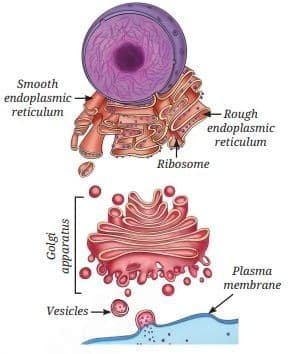
A. Smooth ER
B. Rough ER
C. Lysosome
D. Plasma membrane
Answer: B. Rough ER
41. Refer to Fig. (mitochondrion). What is the function of cristae?
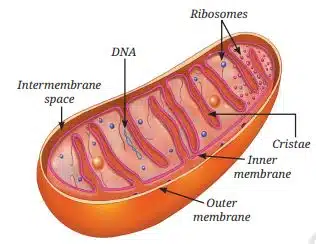
A. Store starch granules
B. Increase surface area for chemical reactions
C. Absorb sunlight
D. Transport proteins
Answer: B. Increase surface area for chemical reactions
42. In Fig. 2.9 (Cradle lily leaf cells in water vs sugar solution), why do plant cells maintain their outer shape even when placed in a sugar solution?
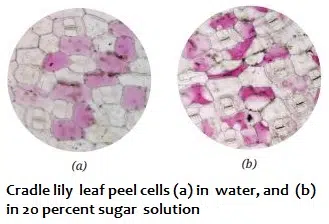
A. Because of the cell membrane
B. Because of the vacuole
C. Because of the cell wall
D. Because of chromoplasts
Answer: C. Because of the cell wall
43. In Fig. (onion bulb in water), why are onion roots used to study cell division?
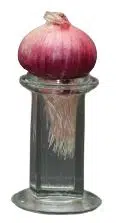
A. Roots grow continuously, showing dividing cells.
B. Roots are easy to cut.
C. Roots contain chlorophyll.
D. Roots do not have vacuoles.
Answer: A. Roots grow continuously, showing dividing cells.
44. Refer to Fig. (meiosis). How many daughter cells are produced at the end of meiosis?
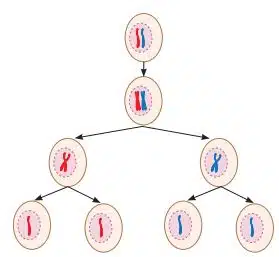
A. Two identical cells
B. Four identical cells
C. Four non-identical cells
D. Two non-identical cells
Answer: C. Four non-identical cells
45. In Fig. (cell division stages), which principle of cell theory is demonstrated?
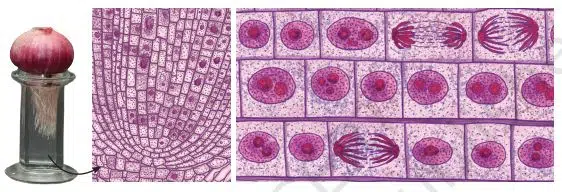
A. Cells are the basic unit of life.
B. All cells arise from pre-existing cells.
C. All organisms are made of chloroplasts.
D. Cells never die.
Answer: B. All cells arise from pre-existing cells.
Disclaimer: The content that is present on our website is based on the NCERT Class 9 Science textbook and is provided for educational purposes only. All the content and images have been taken from Science Class 9 NCERT Textbook and CBSE Support material. Images and content shown above are the property of individual organizations and are used here for reference purposes only. To make it easy to understand, some of the content and images are generated by AI and cross-checked by the teachers.