
← Back to Class 9 Social Science Notes
Atmosphere and Climate Class 9 Notes provide easy-to-understand explanations of all the important concepts covered in the chapter. These notes explain the composition and layers of the atmosphere, weather and climate, factors affecting climate, global wind patterns, rainfall, and the different climatic regions of the world in simple language.
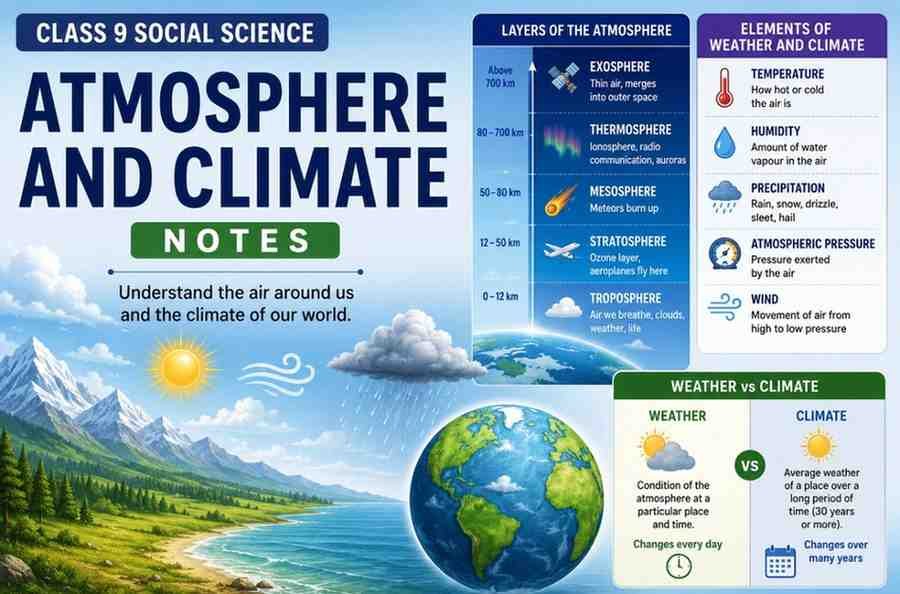
Atmosphere and Climate Class 9 Notes
The atmosphere is a blanket of gases that surrounds the earth. The air is very important for all living things, like humans, animals and plants, to survive. The atmosphere also protects us in many different ways.
- I block harmful rays from the sun.
- It keeps the Earth warm.
- It helps to create weather.
- It affects the Earth’s climate.
Composition and Structure of the Atmosphere
Composition of the Atmosphere
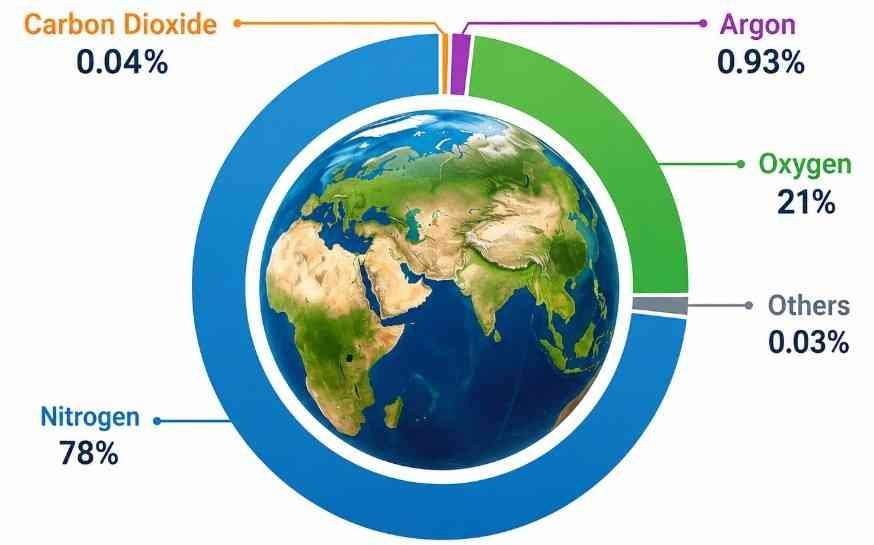
The atmosphere is a mixture of gases. The main gases in the atmosphere are nitrogen (78%) and oxygen (21%). There are small amounts of carbon dioxide, argon, helium, neon, krypton, xenon, ozone and hydrogen present in the atmosphere. The atmosphere also has water vapour (0.1% – 0.4%) and tiny dust particles. This water vapour helps in making clouds and rainfall. The gases’ composition changes with height (altitude).
Structure of the Atmosphere (Layers)
The atmosphere is divided into five main layers. Each layer has different features and plays an important role.
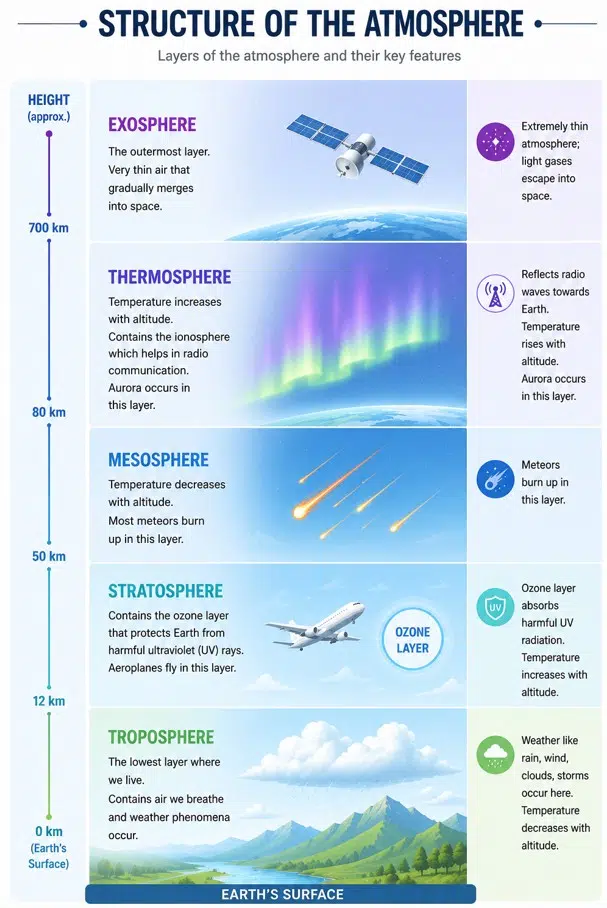
- Troposphere (0-12 km): It is the lowest layer of the atmosphere, and we live in this layer. It contains air we breathe, water vapor and clouds. The weather activity is done in this layer, and when we go up, the temperature decreases.
- Stratosphere (12-50 km): It is above the troposphere. In this layer there is very little weather activity, so the aeroplanes often fly here. This layer contains ozone gases, which helps to protect the earth from ultraviolet (UV) rays from the sun.
- Mesosphere (50-80 km): It is the third layer of the atmosphere. In this layer meteors burn up before reaching the earth. This is a very cold layer.
- Thermosphere (80-700 km): This layer is very hot because it absorbs the sun’s x-rays and ultraviolet rays. It contains the ionosphere, which helps in radio communication. Northern lights and southern lights, which are known as ‘auroras’, are seen in this layer.
- Exosphere (Above 700 km): It is the outermost layer of the atmosphere. In this layer of air, very thin and light gases like helium and hydrogen slowly escape into space. This layer gradually merges into outer space.
Layers of the Atmosphere at a Glance
| Layer | Height | Main Features |
|---|---|---|
| Troposphere | 0–12 km | Air we breathe, clouds, weather, life |
| Stratosphere | 12–50 km | Ozone layer, aeroplanes fly here |
| Mesosphere | 50–80 km | Meteors burn up |
| Thermosphere | 80–700 km | Ionosphere, radio communication, auroras |
| Exosphere | Above 700 km | Thin air, merges into outer space |
Weather and Climate
Weather is the condition of the atmosphere at a particular place and time. It can change from hour to hour or from day to day. For example, a sunny morning, rain in the afternoon and a cool windy evening.
The climate is the average weather of a place over a long period of time, mainly 30 years or more. For example, Rajasthan has a hot and dry climate, and Himachal Pradesh has a cool climate.
Weather vs Climate
| Weather | Climate |
|---|---|
| Changes every day | Changes over many years |
| Short-term condition | Long-term average condition |
| Example: It is raining today. | Example: Kerala has a humid climate. |
Elements of Weather and Climate
The weather and climate depend on five main elements:
- Temperature
- Humidity
- Precipitation
- Atmospheric Pressure
- Wind
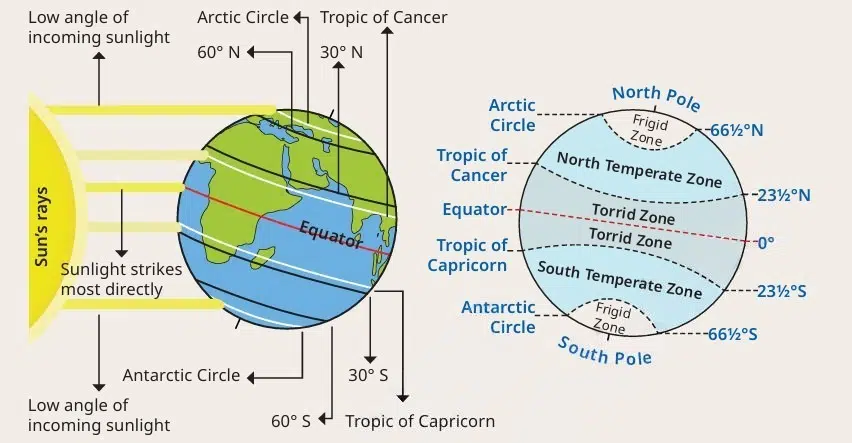
Temperature: The temperature helps us understand how hot or cold the air is. For example, summer is characterised by high temperatures, while winter is associated with low temperatures. The earth receives heat from the sun. This heat is called ‘insolation’, meaning incoming solar radiation. Places near the equator will be hot and cold near the poles.
Humidity: When the sun heats rivers, lakes, oceans and land water, it changes into water vapour and mixes with the air. The amount of water vapour in the air is called humidity. If the humidity is high, then the air contains more water vapour. If the humidity is low, then the air is dry, meaning less water vapour.
Precipitation: When the water vapour cools, then it converts into tiny water droplets or ice crystals and falls to the earth. This is called precipitation. There are different types of precipitation: rain, snow, drizzle, sleet and hail.
Atmospheric Pressure: Air has a weight. This weight creates the pressure on the earth’s surface, which is called atmospheric pressure or air pressure. The air pressure will be highest at sea level and decrease as we go higher in the atmosphere.
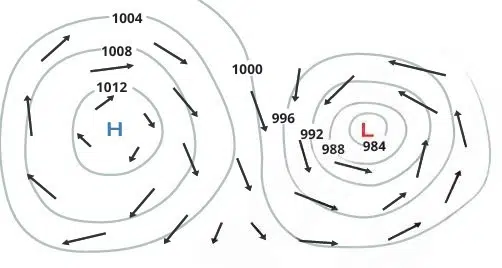
Wind: The wind is the movement of the air from a high-pressure area to a low-pressure area. Wind can be a gentle breeze, a strong wind or a storm. Some winds affect only a small area, like sea breeze and land breeze.
- Sea Breeze – Blows from the sea towards the land during the day.
- Land Breeze – Blows from the land towards the sea during the night.
Wind speeds and their common effects
| Wind | Speed (km/hr) | Common Effects |
|---|---|---|
| Calm | 0–1 | Calm, smoke rises vertically. |
| Light breeze | 6–11 | Wind can be felt on the face. Leaves rustle. An ordinary vane moves by winds. |
| Strong breeze | 39–49 | Large branches sway in the wind. Umbrellas are difficult to use. |
| Storm | 103–117 | It is very rarely experienced. Usually accompanied by widespread damage. |
Seasons in India
Weather can change day to day, but over several weeks or months we notice a regular pattern. Based on these patterns, the year is divided into seasons. The common seasons are spring, summer, the rainy season, autumn and winter. Every season has its own typical weather condition.
India has a tropical monsoon climate. The Indian Meteorological Department (IMD) says that there are four main seasons. In the Himalayas there are two extra seasons, like autumn and spring. The seasons in India are
- Winter Season (December to Early April)
- Summer (Pre-Monsoon) Season (April to June)
- Monsoon (Rainy) Season (June to September)
- Post-Monsoon (Retreating Monsoon) Season (October to December)
Monsoon
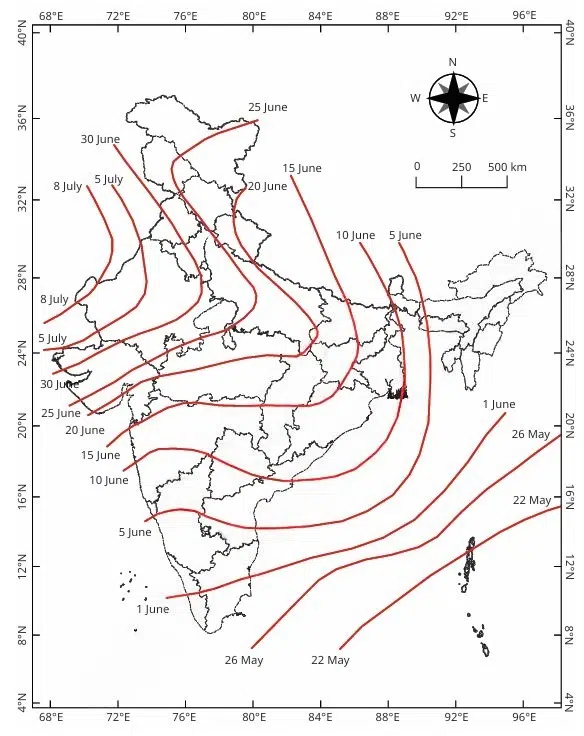
India’s climate is mainly affected by the monsoon winds. These winds bring most of the rainfall in India.
What is a monsoon?
The word “monsoon” comes from the Arabic word “mausim”, which means “season”. A monsoon is a seasonal wind that changes its direction during different times of the year and brings rainfall.
Types of Monsoon Winds
India experiences two types of monsoon winds –
- South-West Monsoon (Summer Monsoon)
- North-East Monsoon (Winter Monsoon)
South-West Monsoon (Summer Monsoon)
The south-west monsoon is very important in India; most of the rain happens during the months of June to September. During the summer, when the land heats up faster than the sea, then the hot land creates a low-pressure area, and the sea remains cooler and has high pressure; the wind moves from high pressure to low pressure and brings heavy rainfall.
Where Do These Winds Come From?
The south-west monsoon winds blow from the following:
- Indian Ocean
- Arabian Sea
- Bay of Bengal
Importance of the South-West Monsoon
- Provides water for farming.
- Fills rivers, lakes, dams, and wells.
- Supplies drinking water.
- Helps plants and forests grow.
North-East Monsoon (Winter Monsoon)
Winter monsoons happen during the months of October to February. During winter the land cools faster than the sea, and cold land develops high pressure. The sea remains warmer and has low pressure; at that time, winds blow from land to sea. This wind is cold and dry and does not bring rain.
States That Receive Rain
- Tamil Nadu
- Andhra Pradesh
- Parts of Karnataka
Why is the monsoon important?
The monsoon is very important because it supports the lives of millions of people in India.
Benefits of a Good Monsoon
- Helps farmers grow crops.
- Fills rivers, lakes, reservoirs, and wells.
- Provides drinking water.
- Supports electricity generation from dams.
- Helps forests and wildlife survive.
- Supports jobs and the country’s economy.
Climate Change
Climate change means the long-term change in the earth’s climate, such as changes in temperature, rainfall and wind patterns. This is mainly due to the human activities.
What Causes Climate Change?
Human activities release greenhouse gases into the atmosphere. These gases trap heat and make the Earth warmer.
Main Causes
- Burning fossil fuels like coal, petrol, diesel and natural gas.
- Deforestation means cutting down the trees.
- Industrial pollution which releases harmful gases into the atmosphere.
Greenhouse Gases
The greenhouse gases trap the sun’s heat and warm the Earth. The main greenhouse gases are
- Carbon dioxide (CO₂)
- Methane (CH₄)
- Nitrous oxide (N₂O)
- Water vapour
These gases create a greenhouse effect, causing the Earth’s temperature to rise.
Effects of Climate Change
Climate change is affecting people, animals, and the environment.
- Rising Temperature.
- Melting of Glaciers
- Rising Sea Levels
- More Floods
- More Droughts
- Loss of biodiversity
- Effect on agriculture
- Effect on human health
- Impact on people’s livelihoods
How Can We Reduce Climate Change?
Everyone can help protect the Earth by taking small but important steps.
- Plant more trees.
- Save Electricity.
- Use renewable energy.
- Reduce, reuse and recycle.
- Use public transport or walk.
- Avoid wasting water.
- protect forests
Punjab Floods 2025: A Case Study
In 2025, Punjab had severe floods due to heavy monsoon rains. Rivers like Satluj, Beas, Ravi and Ghaggar overflowed, and villages, farms, houses, roads and bridges were badly damaged. The floods caused economic loss, social problems and environmental damages.
Causes of Floods
Natural Causes
- Very heavy monsoon rains.
- Extra rain from western disturbances.
- Rivers were already full before rains.
- Overflow from hills and local rainfall.
Human-made Causes
- Weak and old river embankments (dhūsī bāndh).
- Houses and farms built too close to rivers.
- Silt and mud reduced river and dam capacity.
- Late or unclear flood warnings.
Effects of Floods
- Many people lost their lives.
- Thousands moved to relief camps.
- Farmland and crops (like paddy) were destroyed.
- Poultry and dairy farms were damaged; animals died.
- Roads, bridges, and public buildings are broken.
- Stagnant dirty water spreads diseases.
Disclaimer: The content that is present on our website is based on the NCERT Class 9 Social Science textbook and is provided for educational purposes only. All the content and images have been taken from Social Science Class 9 NCERT Textbook and CBSE Support material. Images and content shown above are the property of individual organizations and are used here for reference purposes only. To make it easy to understand, some of the content and images are generated by AI and cross-checked by the teachers.