
← Back to Class 9 Social Science Notes
Early Humans and Beginning of Civilisation Class 9 Notes provide simple and well-organized explanations of all the important topics covered in the chapter. These notes explain the evolution of early humans, the Stone Age, the discovery of fire, the development of tools, the beginning of farming, the domestication of animals, the rise of permanent settlements, and the growth of the earliest civilizations in easy language.
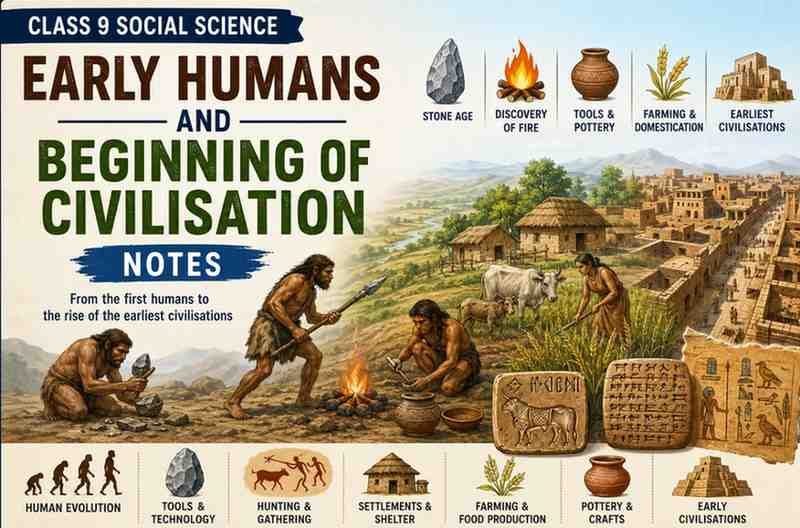
Early Humans and Beginning of Civilisation Class 9 Notes
The time period before writing is called the Prehistoric Period. In this period people are not able to write; we learn about their lives through archaeological evidence such as
- Stone tools
- Bones
- Pottery
- Fossils
- Caves
- Rock paintings
The Beginning of Writing
Writing does not begin everywhere at the same time. Different civilisations developed their own writing systems. The invention of writing helps the people to record the information.
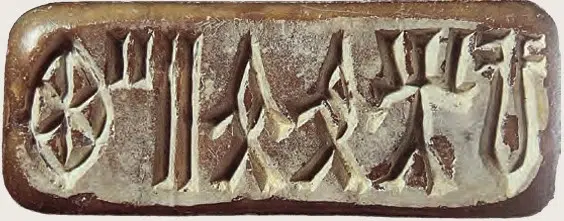
Harappan Script (Sindhu Lipi): The Sindhu-Sarasvati civilisation, which is also called the Indus Valley civilisation or Harappan civilisation, is the earliest writing system. People wrote using small pictures or symbols called a pictographic script. This writing has been found on seals, pottery and other objects. Scientists have not yet been able to read or understand this script; the script is known as the Harappan script or Sindhu lipi.
Cuneiform (Sumerians, Mesopotamia): The cuneiform script developed around 5000 years ago and was used by the Sumerians and developed in Mesopotamia; this is written by pressing a pointed tool into soft clay tablets. The Cuneiform scripts have been successfully deciphered.
Hieroglyphics (Ancient Egypt): In ancient Egypt, they used pictures and symbols on walls, stones and papyrus. The hieroglyphic scripts have been successfully deciphered.
Scripts in India
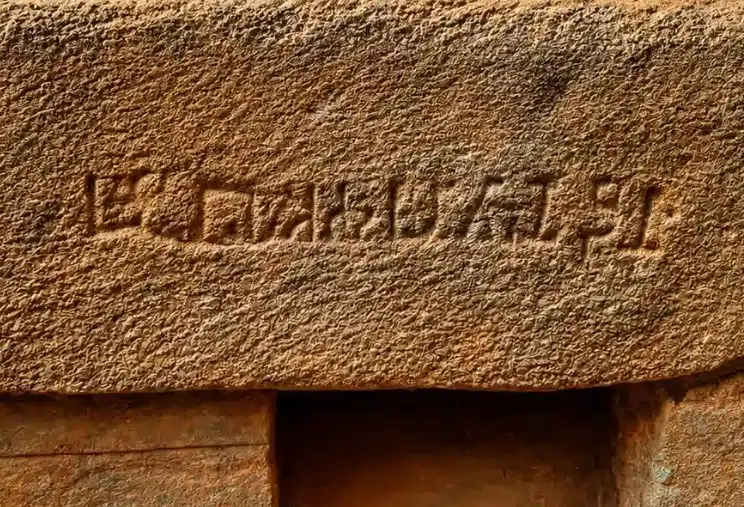
Around 400 BCE, the brahmi script was used in southern India and the Ganga Valley. Emperor Ashoka used and promoted the Brahmi script in his inscriptions. Many modern Indian scripts have developed from Brahmi.
| Before | After | |
|---|---|---|
| Human History | More than 99 per cent of human history falls under this period (from about 3 million years ago to 5000 years ago). | Less than 1 per cent of human history falls under the category of this period, the last 5000 years, including the present. |
| Main Source for Reconstruction | Tools, implements, and other material objects made by humans (artefacts) are the major sources for reconstructing people’s ways of living. | Both material remains and written documents are sources for reconstructing the lives of people and society. |
| Lives of the People | It is generally difficult to understand the thoughts and ideas of people. | Literature (written documents) provides information about names; events; and social, political, and cultural life. |
| Measurement of Time | Measurement of time is approximate, that is, dating events and cultures is only approximate. | Dating of cultures and events becomes relatively accurate because written documents mention specific dates of events such as coronation, wars, etc. |
Why Should We Study Early Human History?
The study of early human history helps us understand the long process of humankind’s biological and cultural evolution in relation to changes in climate and the environment.
What is Biological Evolution?
Biological evolution means how the human body and genes changed over millions of years. Our earliest ancestors were Australopithecines. ‘Australis’ means ‘southern’, and ‘Pithecus’ means ‘ape’ or ‘primate’. These early ancestors evolved into Homo sapiens, the scientific name for modern humans.
What is cultural evolution?
The cultural evolution means the changes in the way humans lived and survived. In cultural evolution, humans learnt new skills and developed ways of living which help the humans to survive in different climates. They learn –
- Make stone tools
- Hunt animals
- Gather fruits and plants
- Use fire.
- Build shelters
- Wear clothes
- Farm crops
- Domesticate animals
The Quaternary Period
Most of the human evolution took place during the Quaternary Period, which began about 2.6 million years ago and continues today. During this time –
- The Earth’s climate changed many times.
- Ice ages came and went.
- Humans learned to adapt to changing environments.
Where Did Humans First Evolve?
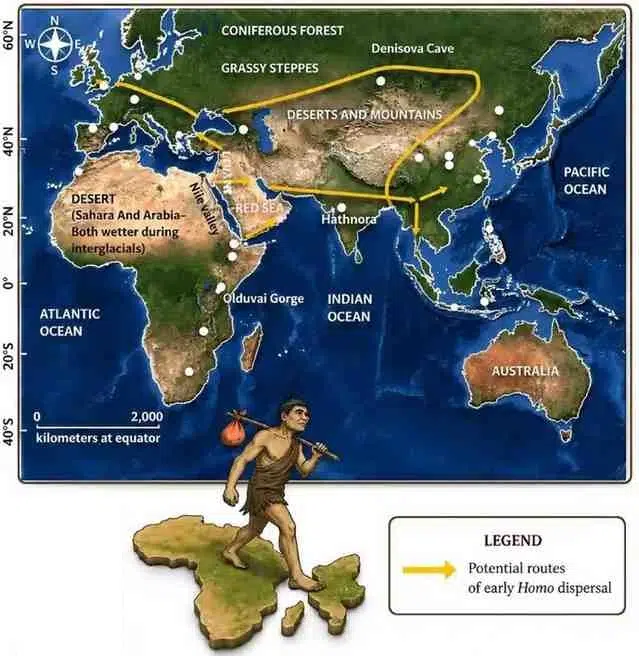
The scientists believe that the humans first evolved in Africa. Around 2 million years ago the early human ancestor migrated from Africa to Asia and Europe; this ancestor is called Homo erectus. Homo erectus:
- Walked upright.
- Made stone tools.
- Used hand axes and cleavers.
- Travelled to parts of Asia and Europe.
Homo sapiens – Modern Humans
Another big migration was about 125,000 years ago. Many people, who are known as Homo sapiens, migrated from Africa to different parts of the world. Nowadays, homo sapiens live on every continent except Antarctica.
Who Were Our Human Ancestors?
The earliest human ancestors lived in Africa, Asia, and Europe. These regions are called the Old World. Around 3.3 million years ago, early humans made the first stone tools for cutting meat, digging roots, scraping animal skin, breaking bones, etc. These early humans are called hominins.
Important Human Ancestors
- Homo habilis (Handy Man): The Homo habilis lived in Africa, especially in Olduvai Gorge (Tanzania) and Kenya. They made simple stone choppers, and they are the earliest toolmakers.
- Homo erectus: Homo erectus lived about 2 million years ago. They made hand axes and cleavers. Homo erectus was the first to move out from Africa.
- Homo neanderthalensis (Neanderthals): The Homo neanderthalensis lived in Europe and Southwest Asia. They survived until about 40,000 years ago. They made Middle Palaeolithic flake tools. They are skilled hunters.
- Homo sapiens (Modern Humans): The only human species alive today, developed advanced technology. They made a bow and arrow and used microblades. They have painted caves and made jewelry from stone, bone, and shells.
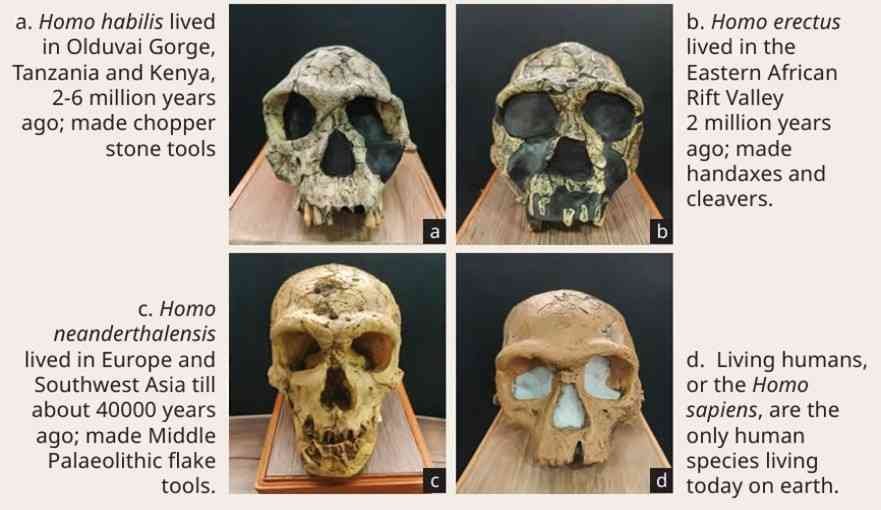
Changes in Human Skulls
When the humans evolved different skills, then—
- Brain size became larger.
- The face became straighter.
- The jaw became smaller.
- The forehead became higher.
- Modern humans developed a more rounded skull.
These changes helped humans think, learn, and solve problems better.
Periods of Early Human History (Stone Age)
Early human history is divided into different periods based on the tools people used and their way of life.
| Period | Main Features |
|---|---|
| Palaeolithic (Old Stone Age) | Hunting and gathering, simple stone tools |
| Mesolithic (Middle Stone Age) | Small stone tools (microliths), beginning of farming |
| Neolithic (New Stone Age) | Farming, settled life, polished stone tools, domestication of animals |
| Chalcolithic (Copper and Stone Age) | Stone and copper tools used together |
| Bronze Age | Bronze tools, trade, towns, early civilizations |
| Iron Age | Iron tools and weapons, advanced societies |
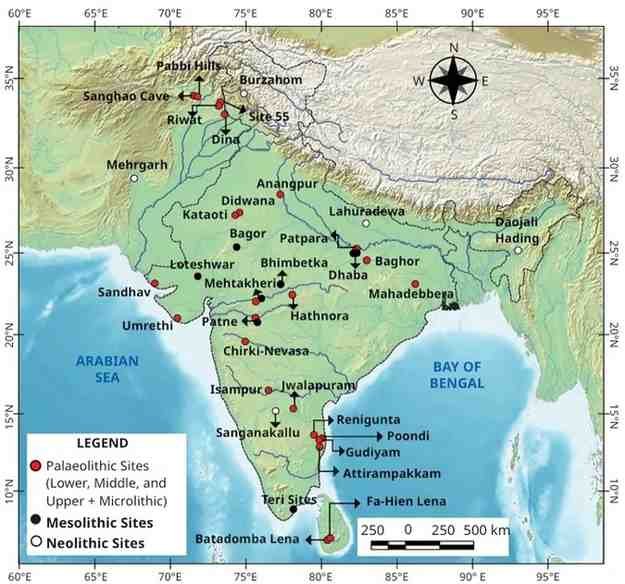
Palaeolithic (Old Stone Age)
The Palaeolithic Age was the period when humans used simple stone tools and survived by hunting and gathering. People:
- Lived as hunters and gatherers.
- Hunted animals and collected fruits, roots, and nuts.
- Used simple stone tools.
- Lived in caves or temporary shelters.
Mesolithic (Middle Stone Age)
The Mesolithic Period began about 12,000 years ago after the Palaeolithic (Old Stone Age). In this time climate became warmer, and forests and grasslands expanded, providing more food and resources for humans.
Features of the Mesolithic Period
- Climate became warmer.
- Forests and grasslands expanded.
- People hunted small animals and collected wild grains.
- Fishing became an important occupation.
- Small stone tools called microliths were used.
- Cave paintings and rock art became common.
- People lived in caves and rock shelters.
Neolithic Revolution (New Stone Age)
The Neolithic Revolution was the change from hunting and gathering to farming and settled life. They called it a revolution because it completely changed the way people lived. People began to
- Grow crops
- Domesticate animals
- Build permanent houses
- Live in villages
Neolithic Period in the Indian Subcontinent
The oldest Neolithic site in the Indian subcontinent was Mehrgarh (present-day Pakistan), located on the Bolan River in 7000 BCE, and this was the beginning and growth of the Sindhu-Sarasvati (Indus Valley) Civilization.
People of Mehrgarh
- Built sun-dried brick houses.
- Built granaries to store grains.
- Grew wheat and barley.
- Reared sheep, goats, and zebu (humped cattle).
- Made ornaments from lapis lazuli, carnelian, and shells.
- Started making copper objects around 4000 BCE (Chalcolithic Age).
Neolithic Life in India
By 2500 BCE, most parts of the Indian subcontinent had farming villages. People:
- Grew cereals, millets, and pulses.
- Reared cattle, sheep, and goats.
- Lived in permanent villages.
Early Human Sites in India
Early humans lived in the Indian subcontinent millions of years ago. Some of the oldest human sites in India are:
- Attirampakkam (Tamil Nadu): About 1.5 – 1.7 million years old. In attirampakkam stone tools are found their.
- Isampur (Karnataka): About 1.2 million years old. Hand axes, cleaves and other tools have been discovered.
Sindhu–Sarasvatī Civilisation
The Sindhu-Sarasvati civilisation is also called the Indus Valley civilisation. It is developed from the earlier farming village of Mehragarh.
Around 7000 BCE, people of Mehragarh started farming and living in the village. They learnt how to use copper tools, which helps to increase food production and helps settlements grow.
By 2600 BCE, these settlements developed into the Sindhu-Sarasvati Civilisation and one of the world’s earliest urban civilisations.
Development of the Civilisation
- Mehrgarh (7000 BCE): People started farming and living in permanent villages.
- Early Chalcolithic Period (4000 BCE): People began using copper tools, farming improved and food production was better. Pottery and crafts become more advanced.
- Early Harappan Period (4000–2600 BCE): Villages become large and trade increases. Pottery, beads and copper work were improved, and the first seals and early writing appeared.
- Mature Harappan Civilisation (2600 BCE): Well-planned cities were built. An advanced drainage system was used. Standard writing and seals were widely used, and trade flourished.
Why Did the Civilisation Grow?
The use of copper tools helped people:
- Grow more crops.
- Make better pottery.
- Produce better tools.
- Increase trade and prosperity.
Harappan Script and Seals
Early Harappans:
- Used symbols (graffiti) on pottery.
- Made seals with animal designs.
- These later developed into the Harappan script.
- The Harappan script has not yet been deciphered.
Early Harappan Sites
Some important early Harappan sites are the following:
- Mehrgarh (Present-day Pakistan)
- Harappa (Pakistan)
- Kunal (Haryana)
- Bhirrana (Haryana)
- Datrana (Gujarat)
- Rehman Dheri (Pakistan)
Bronze Age Civilisations Outside India
The Bronze Age was the period when the people learned to make and use bronze tools and weapons. The bronze was made up of copper and tin. Bronze is stronger than copper and widely used for making tools and weapons.
Four Major Bronze Age Civilisations
Around the same period, four great civilisations developed in different river valleys.
| Civilisation | River | Present-day Location |
|---|---|---|
| Sindhu–Sarasvatī (Harappan) | Indus (Sindhu) and Sarasvatī | India and Pakistan |
| Mesopotamian | Tigris and Euphrates | Iraq (West Asia) |
| Egyptian | Nile | Egypt |
| Chinese | Huang He (Yellow River) | China |
Mesopotamian Civilisation
The Mesopotamian civilisation developed between the Tigris and Euphrates rivers, nowadays in Iraq. It was very close to the Harappan civilisation because of trading goods with each other and having strong cultural and economic contact.
How Did the Civilisation Develop?
- Step 1: Farming Started (12000 years ago)
- Step 2: Copper Tools Arrived (4500 BCE)
- Step 3: Small Villages Became City-States
Four Major Mesopotamian Civilisations
The textbook says that four civilisations ruled Mesopotamia one after another.
| Civilisation | Time | Main Contribution |
|---|---|---|
| Sumerian | 3500 BCE onwards | First cities, irrigation, writing |
| Akkadian | 2334 BCE | First empire, trade with Harappans |
| Assyrian | 2154 BCE onwards | Expanded military power |
| Babylonian | 1900 BCE onwards | Code of Hammurabi |
A. The Sumerians: The Sumerians were the first people to build cities in Mesopotamia. They built dams and canals for irrigation. Used mud bricks and burnt bricks. Built houses and city walls and developed farming. They have made a large step-shaped temple for the city’s main god; the temple is known as the Ziggurat.
B. The Akkadians: Around 2334 BCE, the Akkadians became powerful. Their capital was Akkad. The Akkadians created the world’s first dynastic empire by bringing many city-states under one ruler.
C. The Assyrians: Around 2154 BCE, the Assyrians became powerful. Their capital was Assur. They expanded their kingdom and controlled much of Mesopotamia and nearby regions.
D. The Babylonians: Around 1900 BCE, Babylonia became the most powerful kingdom. The greatest Babylonian king was Hammurabi. Hammurabi prepared a set of laws called the Code of Hammurabi.
Egyptian Civilisation
The Egyptian civilisation was one of the earliest civilisations in the world. It is famous for :
- Pyramids
- Pharaohs (Kings)
- Mummies
- Writing on papyrus
- The Nile River
Writing & Records
Egyptians wrote on papyrus scrolls (paper made from a plant). Because of this record, historians know a lot about their ruler, religion, daily life, festivals, etc. The Egyptians even had libraries around 2000 BCE. They stored papyrus scrolls in jars. Egyptians made one of the earliest calendars, which is divided into 3 seasons.
How Did Egyptian Civilisation Develop?
Around 3000 BCE the population increased, and more people started living near the Nile River. Every year the Nile River flooded. When the floodwater went back, it left rich black soil called ‘Kemet’. This soil was excellent for farming.
- People learn to dig canals, build ditches and store water in reservoirs.
- It helps to grow crops even after the floods.
- To build the canals, ditches and reservoirs, many people work together.
- This led to the beginning of local government.
- When the society becomes organised, then the powerful rulers called Pharaohs come to power.
- People believed the pharaoh was chosen by gods.
- When the pharaoh died, then the body of the pharaoh was preserved by mummification.
- They built a mastaba (a rectangular tomb).
Why Were Pyramids Built?
The Egyptians believed that every person had a Ka. People believe that if the body remained safe, then the Ka would continue to live after death. So, they –
- preserved the body,
- wrapped it carefully (mummy),
- built pyramids to protect it.
The Chinese Civilisation
The Chinese civilisation developed near two major rivers, the Huang He (Yellow River) and the Yangtze River. This river helps Chinese civilisation to grow.
Early Settlements (7000 BCE)
- Around 7000 BCE, people started living in villages near the Yellow River and Yangtze River.
- Around 2000 BCE, people learned to make copper and bronze tools. These tools helped in farming, producing better crafts and making better weapons and tools.
- Around 1600 BCE the farmer became more productive, crafts developed and metalwork improved. The small villages become large cities. This is marked as a beginning of the Chinese Bronze Age civilisation.
The Chinese Dynasties
A Chinese dynasty is a period when the same family rules a country for many generations. For example, if one king dies, then the son becomes king, then his grandson. This family rule is called a dynasty. The important dynasties are –
- Shang Dynasty (1600–1046 BCE): First important Bronze Age dynasty. This time the city was developed, and they have improved bronze technology.
- Zhou Dynasty (1046–256 BCE): The Zhou Dynasty ruled after the Sang Dynasty. In this dynasty continued the growth of Chinese civilisation.
- Qin Dynasty (221–206 BCE): This is the first dynasty to unify China. The name “China” comes from Qin (Ch’in).
- Han Dynasty (206 BCE–220 CE): One of the greatest dynasties. This time the trade was expanded, and silk became famous throughout the world.
Disclaimer: The content that is present on our website is based on the NCERT Class 9 Social Science textbook and is provided for educational purposes only. All the content and images have been taken from Social Science Class 9 NCERT Textbook and CBSE Support material. Images and content shown above are the property of individual organizations and are used here for reference purposes only. To make it easy to understand, some of the content and images are generated by AI and cross-checked by the teachers.
Nice note that the best for the exam
Wow ! Very nice notes buttt. Found after examsss . 🙃🙃🙃😶😶💗💗
Tomorrow is my last date of Note submission and this site help me a lot because I doesn’t even know where to start before I think this chapter is too hard but this notes help me a lot and thank you for giving me notes 🩷
It is really very good i read this after watching one shot and hand’s off it is literally in very easy language as compared to NCERT and those who wanted to learn the before exam use this site no doubt i am paid for saying this but for sure it is effective and useful a lot i read it one day before my exams and my all the doubt and question are clear lucky to find this 😭✨✨🤌🙌🙌🙌🙌🙌
lifesaving
Thank you so muchhhh yrr because of you I was saved from this history exams otherwise I would have not been able to make it !!!🎀🍁😭👍🏻🤞🏻💗💓
This notes is very useful for our future
this notes is very useful for me and the notes help us to understand the chapter more clearly in a short time thankyou so much
I study on my own and sometimes I need notes, because I am unable to make notes of difficult chapter but this platform provides me very good notes.
These notes are very useful to me and I am very happy. Thanks
Thankyou for this note this note is very well and nice
Very nice notes