
← Back to Class 9 Social Science Notes
Elections Class 9 Notes provide simple and easy-to-understand explanations of all the important topics from the latest CBSE Class 9 Social Science syllabus. These notes cover the meaning and importance of elections, the electoral system, the Election Commission of India (ECI), political parties, voting process, and free and fair elections.
Elections Class 9 Notes
Why Do Elections Matter?
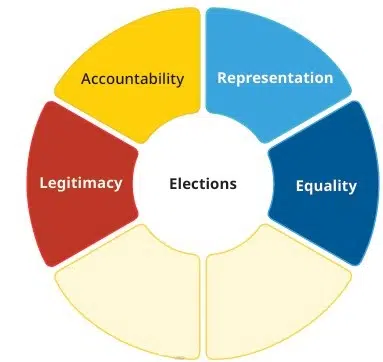
Elections are the heart of democracy. They help the people to choose representatives who make decisions on their behalf. In India, direct elections are held every five years for the Lok Sabha, Vidhan Sabha and local bodies. Indirect elections are used to elect the president, vice president and Rajya Sabha members.
Elections must be regular and periodic. Governments cannot continue beyond their term without seeking people’s approval. Citizens exercise their right to vote (universal adult franchise) to hold leaders accountable.
Inside India’s Election Machinery
Elections in India must be free, fair, and transparent. In India, millions of voters across thousands of constituencies take part, so a strong system is needed. The Election Commission of India (ECI) manages elections at the national, state, and local levels.
Other important stakeholders are political parties, civil society, media, and the voters. The Constitution and parliamentary laws define their powers and responsibilities. Together, they ensure elections are organised properly and democracy is upheld.
The Electoral System
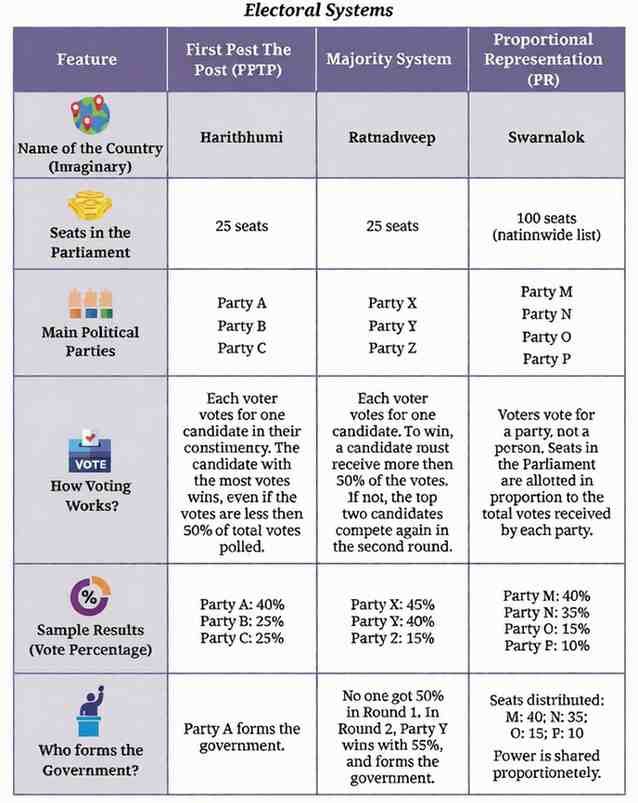
India uses two methods to elect leaders. The first is the First‑Past‑The‑Post (FPTP) system, where the candidate who gets the most votes wins. This is used for Lok Sabha and Vidhan Sabha elections.
The second is the proportional representation system, where seats are given according to the share of votes. This is used for the Rajya Sabha, the President, the Vice President, and the Vidhan Parishad in some states.
The Vidhan Sabha is directly elected by the people, while the Vidhan Parishad members are chosen by local bodies, teachers, and graduates, and some are nominated by the governor.
The Laws
India’s elections are guided by three main laws:
- Representation of the People Act, 1950: The Representation of the People Act, 1950, decides seats, constituencies, and voter lists. It makes sure that every citizen 18 years and above can vote.
- Representation of the People Act, 1951: The Representation of the People Act, 1951, explains how elections are conducted — like candidate nomination, campaigns, voting, and solving disputes.
- Presidential and Vice‑Presidential Elections Act, 1952: The Presidential and Vice‑Presidential Elections Act, 1952, is for electing the president and vice president.
Together, these laws make elections fair, transparent, and accountable.
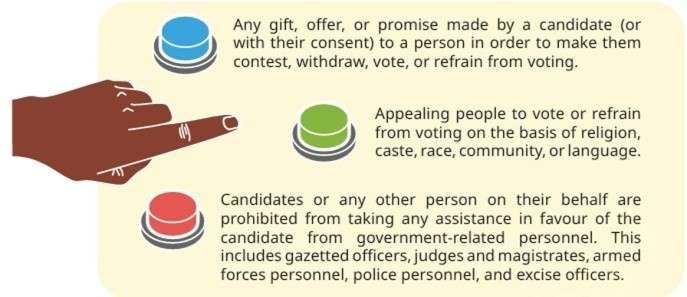
The Representation of the People Act, 1951 also lists out the electoral offences and corrupt practices. For example:
Delimitation Commission
In India, the areas called constituencies (from where MPs and MLAs are elected) are not fixed forever. As the population grows or changes, the boundaries of these areas are changed. This process is called delimitation.
The Delimitation Commission does this work. Its job is to make sure that each representative covers almost the same number of people. This keeps elections fair because one MP should not represent only 5 lakh people while another represents 25 lakh.
Election Commission of India (ECI)
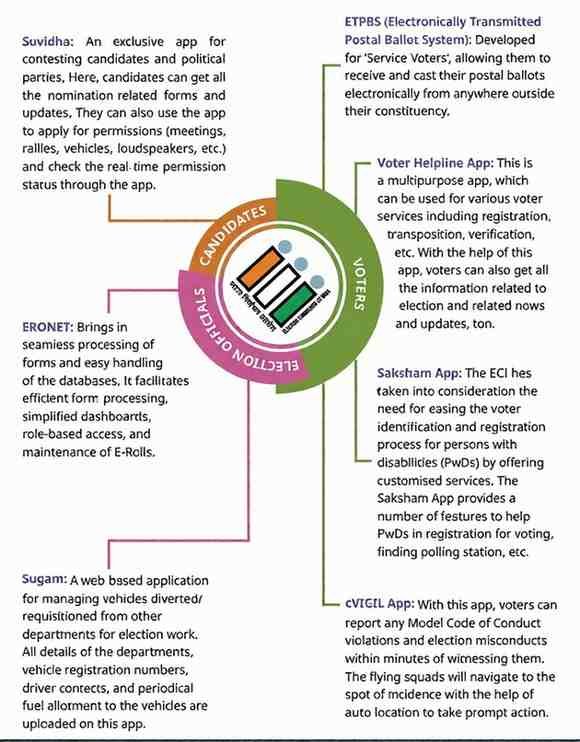
The Election Commission of India (ECI) is an independent constitutional body that conducts free, fair, and transparent elections in India. It prepares and updates the voter list, announces election dates, registers political parties, allots election symbols, and supervises the entire election process.
The ECI also ensures that every eligible citizen can vote, including senior citizens and persons with disabilities, making elections fair, inclusive, and trustworthy.
Main Functions of ECI
- Prepares electoral roll: Makes the voter list, adds new voters (18+), removes names of ineligible voters.
- Decides election schedule: Fixes dates considering weather, exams, festivals, etc.
- Registers political parties: Gives recognition and election symbols, ensures inner‑party democracy.
- Ensures free and fair elections: Monitors campaigns, voting, counting, and results. Uses EVMs, VVPAT, awareness campaigns, and technology.
- Inclusive steps: Facilities for senior citizens (85+), persons with disabilities, transgender persons, tribal groups. Example: Voting from home for PwDs and senior citizens in 2024.
Political Parties
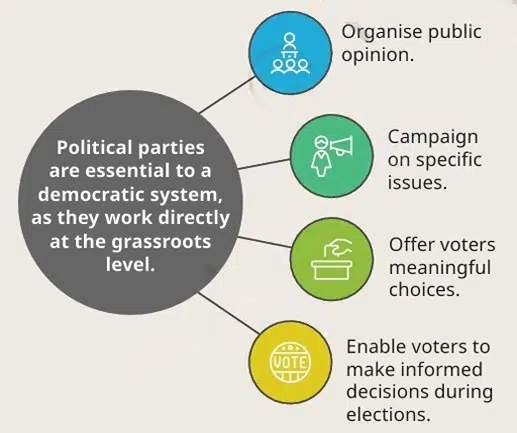
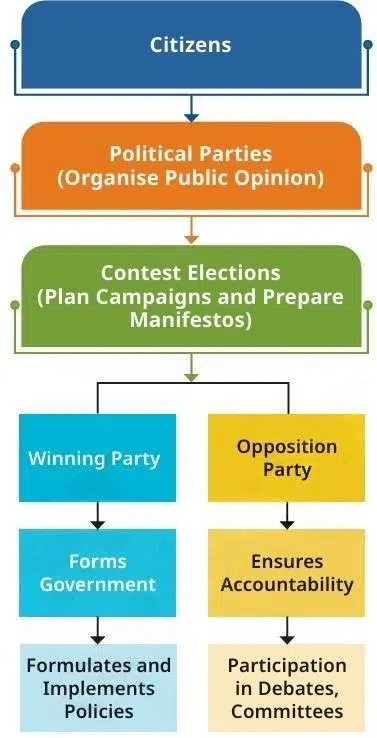
Political parties play an important role in a democracy. They contest elections, choose candidates, and tell people about their policies, promises, and plans for development. India follows a multi-party system, where many political parties compete in elections.
The Election Commission of India (ECI) registers and recognises political parties. If an elected representative leaves the party on whose ticket they won the election, it is called defection.
Challenges to Free and Fair Elections
India has more than 96 crore voters and thousands of polling stations, so conducting elections is a big challenge. Problems like misinformation, fake news, intimidation, and unfair practices can make elections less free and fair.
To stop these problems, the Election Commission of India (ECI) uses laws like the Representation of the People Acts (1950 & 1951), the Model Code of Conduct, Electronic Voting Machines (EVMs), Voter Verifiable Paper Audit Trail (VVPAT), and voter awareness campaigns.
With constant checks and active participation of citizens, elections can remain fair, representative, and democratic.
Disclaimer: The content that is present on our website is based on the NCERT Class 9 Social Science textbook and is provided for educational purposes only. All the content and images have been taken from Social Science Class 9 NCERT Textbook and CBSE Support material. Images and content shown above are the property of individual organizations and are used here for reference purposes only. To make it easy to understand, some of the content and images are generated by AI and cross-checked by the teachers.