
← Back to Class 9 Social Science Notes
State and Society up to 1000 CE Class 9 Notes, designed according to the latest CBSE syllabus. These easy-to-understand notes explain the evolution of early Indian states, administration, social structure, varṇa and jāti, family life, the role of women, religion, the Bhakti tradition, education, agriculture, trade, guilds, and the economy in simple language.
State and Society up to 1000 CE Class 9 Notes
In this chapter we will learn about society and kingdoms developed in ancient India up to 1000 CE. In the beginning, people lived in small families (kula) and tribes (jana). Later, these groups grew into janapadas, then mahājanapadas, and finally into large empires like the Maurya Empire, Gupta Empire, and Chola Empire.
Understanding Early Indian State and Society
What is society?
A society is a group of people living together in the same place and following common customs, traditions, and culture. The rulers help the people to live peacefully and work together. The society include:
- Families
- Customs and tradition
- Marriage
- Shared culture and values.
What is a state?
The state is an organized political system that makes the rules and laws to govern people. The state has a:
- Rights and duties
- Laws and rules
- Rights and duties
- Law and order
- Government and administration
- State and Administration
The Vedic Period
The Vedic Period is the earliest source of information about ancient India. The Vedas were first passed orally and later written down. The Vedic period is important because—
- The Vedic literary texts help to understand the ancient society, politics, economy, and religion.
- The Rigveda is the earliest literacy source composed in the Sapta-Sindhu region.
The four Vedas
- Rigveda: The Rigveda is the oldest Veda. The Rigveda contains 1028 hymns (prayers). These prayers are dedicated to different gods. It also talks about nature, life, birth, and death.
- Yajurvda: The Yajurvda explains about yajñas (fire sacrifices). It gives the rules and steps for religious rituals.
- Sāmaveda: Sāmaveda contains hymns from the Rigveda. These hymns are sung like songs during worship. It is considered the foundation of Indian classical music.
- Atharvaveda: It contains prayers for good health, protection, and peace. It also includes hymns to protect people from diseases and evil.
Parts of Every Veda
Each Veda has four parts:
- Samhitā – Collection of hymns.
- Brāhmaṇa – Explains rituals and sacrifices.
- Āraṇyaka – Philosophical ideas of forest sages.
- Upaniṣhad – Explains the Ātman (Self) and Brahman (Ultimate Reality).
Political Institutions in the Vedic Period
In the Vedic Period, the people live in janas (tribes or clans). The jana was made up of the people who were related to each other. The Rigveda mentions 30 janas. The first five janas were important and called the Pañchajana (Five Peoples):
- Yadu
- Turvaśha
- Puru
- Anu
- Druhyu
The Bharata Jana was one of the famous tribes. The name “Bharat” comes from this tribe.
The Raja (King)
The Raja was the leader of the jana. The raja protected the people, maintained peace and order, and led the army during the war. The Raja did not rule alone; they took the advice of different assemblies. There were three important assemblies:
- Sabhā: Small group of important people. Helped in justice and solved disputes.
- Samiti: Large assembly of the people. Discussed government and important decisions.
- Vidhata: Discussed war, politics, and other public matters.
Early Kingdoms and Republics
Over time, these janas settled in one place and formed a janapada. “Jana” means “people,” and “pada” means “land.” “Janapada” means the land where the tribal people lived. Later on, many janapadas become large and strong. These larger states were called Mahājanapadas.
Mahājanapadas
Around 600 BCE there were 16 Mahājanapadas existing in India. They were very powerful and larger compared to Janapadas. The most powerful Mahājanapada was Magadha (present-day Bihar). Magadha is powerful due to fertile land, good location, strong rulers, and agriculture and trade. Later, Magadha became the center of the Mauryan Empire.
Types of states
There are two different types of political systems:
- Monarchy (Rājya): the monarchy ruled by only one king.
- Republic (Gaṇa or Saṁgha): In a republic, decisions are taken from a group of leaders. No single ruler had complete power.
Early Kingdoms of South India
In South India, the important kingdoms are
- Cholas
- Cheras
- Pandyas
These kingdoms are described in Sangam literature (300 BCE–300 CE).
Royal Symbols
| Kingdom | Symbol |
|---|---|
| Cholas | Tiger |
| Cheras | Bow |
| Pandyas | Fish |
These kingdoms were famous for:
- Rice farming
- Trade
- Strong rulers
Duties and Ideals of the King
From 600 BCE, rulers were called Rājā, Mahārāja, and Samrāṭ. Ancient books like the Arthaśhāstra, Yajurveda, and Mahābhārata explain the qualities and duties of a good king.
Qualities and duties of a good king
- A good king should be hardworking, fair, and just.
- The king’s main duty was to protect the people and maintain law and order.
- Kings were expected to work for the welfare of their subjects.
Kauṭilya’s Arthaśhāstra says that when a king works hard, his officers also work sincerely.
Punishments
People who committed serious crimes received strict punishments. Some serious crimes included the following:
- Theft
- Robbery
- Abduction
- Adultery
- Treachery (betraying the kingdom)
- Killing a cow
- Drinking intoxicating liquor
Selection of the King
The hereditary rules are followed, meaning the king’s son will become the next king. Sometimes the people or leader chose a king. The king could also be removed from power if he failed to rule properly.
Idea of a Universal Ruler
Many Indian kings want to become rulers of the entire Indian subcontinent. This ideal was called the Chakravarti Samrāṭ (Universal Ruler).
Famous rulers like Aśhoka, Nedunjeral Adan, and Rajendra Chola I expressed this ideal of kingship.
- Emperor Aśhoka wanted peace and unity across Jambudvīpa.
- Chera king Nedunjeral Adan claimed victories up to the Himalayas.
- Rajendra Chola I took the title “Gangaikonda” after his successful northern campaign.
Council of Ministers
In ancient India, kings did not rule alone; they took the help of a council of ministers, which was known as the Mantri-Parishad. The Mantri-parishad gave advice to the king and helped the king to run the kingdom smoothly.
Kauṭilya’s Saptāṅga Theory
According to Kauṭilya’s Arthaśāstra, a strong state has seven important parts, called Saptāṅga. All seven parts must work together for a kingdom to function well.
| Part | Meaning |
|---|---|
| King (Swāmi) | The ruler of the kingdom. |
| Ministers (Amātya) | Advisers who help the king. |
| Janapada | The land and the people of the kingdom. |
| Durga | Forts and protected cities. |
| Koṣha | Treasury (wealth of the kingdom). |
| Daṇḍa | Army that protects the kingdom and maintains law and order. |
| Mitra | Friendly neighbouring states (allies). |
Role of the Council
An inscription of Emperor Aśhoka shows that during the king’s absence, the Council of Ministers could take important decisions in the interest of the people. The roles of the council members are
- Helped the king in administration.
- Gave advice on important matters.
- Managed different departments.
- Took decisions when necessary.
Junagadh Rock Inscription
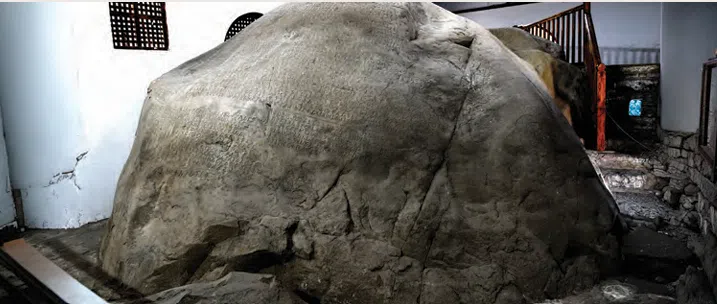
The Junagadh Rock Inscription in Gujarat is a very important historical source of three different rulers over a period of about 700 years.
- Ashoka: Spread the message of Dhamma and good governance.
- Rudradaman I: Described his achievements and repaired the Sudarshana Lake.
- Skandagupta: Restored the Sudarshana Lake after it was damaged.
How Were Empires Administered?
In ancient India, empires were too big for one king to manage. Therefore, they were divided into small administrative units for better governance. The empire was divided into
Empire → Province → District → Group of Villages → Village
The village was the smallest administrative unit. Different officers helped the king in running the empire.
- Provincial Governors—Managed the provinces.
- District Officers (Pradeśhikas)—Looked after administration and justice.
- City Governors – Collected taxes and maintained law and order.
- Grāmika (Village Headman) – Managed the village.
Administration During the Gupta Period
The Guptas have a well-organized administration. The important officers included in the Gupta administration are
- Mantri – Head of the civil administration.
- Commander-in-Chief – Head of the army.
- Chief of Palace Guards
- Minister of Peace and War (Sāndhivigrahika) – Managed peace and war.
- Kumārāmātyas – Local and provincial administrators.
Administration in South India
The Pallavas divided their kingdom into
- Provinces
- Districts
- Taluks
- Villages
They gave tax-free land to some village that is known as Brahmadeya Village. This village has small committees called Variyams to manage the temple, gardens, and irrigation.
Chālukya Administration
The Chālukya also formed a similar administrative system. Instead of Brahmadeya villages, they gave the land to Brahmins. This is called Agrahārams. Many Agrahārams later become centers of learning.
Gurjara–Pratihāras, Pālas, and Rāṣhṭrakūṭas
These three kingdoms also followed similar administrative systems. Their kingdoms were divided into
- Provinces
- Districts
- Villages
The village remained the smallest and mostly self-governing unit. These kingdoms fought to control Kannauj, and this conflict is called the Tripartite Struggle.
Chola Administration
The Cholas had one of the best administrative systems. The empire was divided into four groups—
- Manḍalam – Province
- Valanāḍu – District
- Nāḍu – Group of villages
- Ur – Village
The village assembly looked after tax collection, land management, irrigation, records, roads, and settling disputes. The villages were self-reliant and managed most local work independently.
Uttaramerur Inscription
The Uttaramerur Inscription explains how village administration worked during the Chola period. It describes the Kudavolai System.
- Kudavolai System
- Names of eligible candidates were written on palm leaves.
- The leaves were placed in a pot.
- A young child picked the names.
- The selected people became members of the village assembly.
This ensures a fair and transparent election. The elected members worked in different committees (Variyams). These committees looked after village administration, justice, tax collection, and irrigation.
Ethics: The Foundation of Law and Life
Ethics means what is right and wrong. In ancient India, ethics was considered the foundation of both law and daily life. Ancient texts like the Vedas, Mahabharata, and Bhagavad Gita taught people how to live a good and moral life. The teachings of ancient Indian texts are
- Vedas: The Vedas teach truth, good behavior, right conduct, and living in harmony with nature.
- Bhagavad Gita: The Bhagavad Gita teaches knowledge, good karma, faith, virtue, and honest living.
Important Ethical Principles
- Samatva (Equality): Samatva means treating everyone equally.
- Ṛita (Natural Order): Rita means the natural order and balance of the universe.
- Dharma: Dharma does not mean religion here. It means duty, responsibility, righteousness, and moral behavior.
Dhamma in Buddhism
In Buddhism, the word “Dhamma” has a similar meaning to “good conduct,” “nonviolence,” “kindness,” “living an ethical life,” and “compassion.”
Ethic in Governance
Ancient Indian rulers were expected to rule with justice and morality. Ashoka promoted Dhamma through his inscription. He encouraged:
- Moral behavior
- Respect for parents and elders
- Compassion
- Non-violence
- Peaceful living
Ethics in Literature
Ancient books like Kāmandaka’s Nītisāra and Bāṇabhaṭṭa’s Kādambarī also teach the following:
- A ruler should be honest.
- A ruler should be just.
- A ruler should care for the welfare of the people.
Social Structures and Everyday Life
Varṇa and Jāti
In the early Vedic period, a person’s position in society was not fixed by birth. They depend on many factors like
- Their occupation (work)
- The place where they lived
- Their family or clan (gotra)
- Their language
- Their community
People can change their occupations based on interest. Same members in the family can do different kinds of work. This shows that jobs were flexible and not passed down strictly from parents to children.
The First Mention of the Four Varṇas
The Ṛigveda contains one of the earliest references to the four varṇas in a hymn called the Puruṣhasūkta. Over time, each varṇa became linked with certain responsibilities.
- Brāhmaṇas: Brāhmaṇas were people whose main jobs were to learn, teach, and perform religious duties.
- Kṣhatriyas: They protect the people and fight wars when needed. They support religious ceremonies and charity.
- Vaishyas: They are farmers, animal rearers, and traders. They help to grow the economy and also took part in religious learning and charity.
- Śhūdras: They are assisted people of other varnas. They worked in farming, trade, animal husbandry, arts, crafts, and many skilled occupations.
Why Was the Varṇa System Created?
The varṇa system was mainly based on the type of work people did.
It gave importance to the following:
- Knowledge
- Political power
- Wealth
What is Jāti?
As time passed, society became less flexible. People found it harder to change their occupations, and social roles slowly became fixed. Later, another social system called jāti developed. A jāti is a smaller social group within society. Many jātis were formed because of:
- Marriages between different communities.
- People moving to new places and forming their own groups.
- Differences in regions and occupations.
Unlike the four varṇas, there was no fixed number of jātis. As new occupations and communities appeared, more and more jātis were formed.
Family and Society
In Vedic society, the family (kula) was the smallest and most important unit of society. Several families together formed a village (grama). The social structure was
- Kula → Family
- Grāma → Village (made up of many families)
- Viśha → Group of villages
- Jana → A larger community of people ruled by a king (Rājā)
- Family (Kula) → Village (Grāma) → Group of Villages (Viśha) → People/Kingdom (Jana)
What is Gotra?
A gotra is a family lineage or clan that traces its origin to a common male ancestor, usually an ancient Vedic sage (rishi). People of the same gotra were considered members of the same extended family. Gotra was important while deciding marriages.
Four Stages of Life (Āśramas)
In ancient India, society divided a person’s life into four stages, which are called Āśhramas.
- Brahmacharya (Student Life): It is the time when the person can gain knowledge.
- Gṛihastha (Householder Life): Gets married and raises a family and supports society.
- Vānaprastha (Retired Life): Slowly hands over responsibilities to the next generation and spends time in spiritual activity.
- Sannyāsa (Life of Renunciation): Gives up worldly attachments and focuses on spiritual life and self-realization.
Sixteen Saṁskāras
In a person’s life there are sixteen special ceremonies, which are called Ṣhoḍaśha Saṁskāras. The ceremonies were performed from birth to death, which guides the person through different stages of life.
Four Goals of Life (Puruṣhārthas)
Ancient Indian philosophy describes four main goals of human life.
- Dharma (Righteousness)
- Artha (Wealth)
- Kāma (Desires)
- Mokṣha (Liberation)
Role of Women in Vedic Society
In the Vedic period, women have respect and an important position. They can—
- Received education.
- Studied religious texts.
- Took part in religious ceremonies.
- Participated in social gatherings.
- Sometimes even joined chariot races.
Some women became famous scholars and composed hymns in the Ṛigveda, including:
- Apālā
- Viśhvavārā
- Ghoṣhā
- Lopāmudrā
Women were also respected through the worship of goddesses such as
- Uṣha – Goddess of Dawn
- Aditi – Mother of the gods
Changes in the Position of Women
Due to social and political development, the position of women changed. Although their status declined in some periods, many women continued to
- Manage households.
- Work in agriculture.
- Practice crafts.
- Take part in religious activities.
Many women also became educated, queens, administrators, poets, and donors.
Examples
- Prabhāvatī Gupta ruled the Vākāṭaka kingdom as a regent and issued land grants in her own name.
- Avvaiyar was a famous Tamil poetess.
- Vennikuyattiyar was a well-known woman poet and potter mentioned in Sangam literature.
- Sembiyan Mahādevī of the Chola period supported temple construction and religious institutions.
Religious Life and the Emergence of Bhakti
The Vedic people worshipped many gods and goddesses. They believed that different deities had different powers and no single god was always considered the greatest. Each of the deities was connected with nature, such as
- Surya – Sun
- Agni – Fire
- Indra – Rain and Thunder
- Prithvi – Earth
- Uṣha – Dawn
Yajñas (Sacrificial Rituals)
People worshipped the gods by performing yajñas. A yajna is a religious ceremony in which offerings such as ghee, grains and herbs are placed into the sacred fire while prayers are recited. People believed that these rituals would:
- Please, the gods.
- Bring rain and good harvests.
- Protect people from difficulties.
- Bring peace and prosperity.
Respect for Nature
Some people depend on nature for food, water and survival; they treat nature with great respect. Even today, some festivals continue this tradition, such as
- Chhath Puja – Worship of the Sun.
- Makar Sankranti – A festival connected with the sun.
What is Bhakti?
Over time, a new way of worship was introduced, which is called Bhakti. Bhakti means deep love and devotion towards God. Instead of performing difficult rituals people believed they could worship God through –
- Love
- Faith
- Prayer
- Singing devotional songs
The Āḻvārs and Nāyanmārs
The Bhakti movement became very popular in Tamil Nadu around the 6th century CE.
- Āḻvārs
- Twelve saint-poets.
- Worshipped Lord Viṣhṇu.
- Wrote beautiful devotional songs (hymns).
- Nāyanmārs
- Sixty-three saint-poets.
- Worshipped Lord Śhiva.
- Composed many devotional hymns.
Their songs became an important part of Tamil Bhakti literature.
The Quest for Knowledge
Education was very important in ancient India. The education was not only to get knowledge but also to become a good, disciplined, and responsible person. Students were taught values such as the following:
- Truthfulness
- Patience
- Humility
- Self-control
- Respect for nature
- Respect for all living beings
Guru–Śhiṣhya Paramparā
Education was given through the Guru–Śhiṣhya Paramparā (teacher–student tradition).
- The Guru was the teacher.
- The Śhiṣhya was the student.
Students lived in the Gurukula, which was the teacher’s home.
There they are:
- Studied with the guru.
- Helped in daily work.
- Lived a simple and disciplined life.
- Learned good behaviour along with their studies.
Economy
Agriculture and Land Revenue
The main occupation in Ancient India was agriculture; during this period, the Mauryan Empire encouraged farming because it was the main source of food and income. The government—
- Divided farmland into individual plots for farmers.
- Kept common land for grazing cattle.
- Protected some forests while clearing others for farming.
- Encouraged the cultivation of new land.
Land Revenue (Tax)
Farmers have to pay a land tax to the government. This tax was usually one-sixth (1/6) of the agricultural produce. The government also classified land into different types such as
- Cultivated land
- Fallow (unused) land
- Dry land
- Sown fields
- Groves (areas with trees)
Trade Routes
There are two important trade routes connected to the different parts of India.
- Uttarāpatha: This route is connected to northern India and linked to many cities and trade centers.
- Dakṣhiṇāpatha: This route is connected with northern India with southern India. This route helps to transport goods across the country.
India also traded with other countries through sea routes. The important ports are
- Muziris
- Kāveripaṭṭinam
- Arikameḍu
- Masulipaṭnam
Indian merchants traded with countries like Rome and regions around the Indian Ocean.
They exported:
- Spices
- Cotton
- Silk
- Pearls
- Precious stones
Guilds (Śhreṇīs)
A guild (Śhreṇī) was an association of people doing the same profession or craft.
For example:
- Weavers formed a guild.
- Potters formed a guild.
- Goldsmiths formed a guild.
What did guilds do?
Guilds:
Maintained the quality of goods.
- Fixed fair prices.
- Solved disputes among members.
- Protected the interests of workers.
- Sometimes worked like banks by lending and keeping money safely.
Industries
Many industries developed in ancient India. Important industries included:
- Cotton weaving
- Silk weaving
- Wool weaving
- Linen weaving
- Metal work
- Handicrafts
Famous textile centers were
- Mathurā
- Kāśhī (Varanasi)
- Kāmarūpa (Assam)
Importance of the Economy
A strong economy helped ancient India to:
- Increase food production.
- Expand trade.
- Develop industries.
- Earn revenue for the government.
- Improve people’s standard of living.
- Build prosperous kingdoms.
Disclaimer: The content that is present on our website is based on the NCERT Class 9 Social Science textbook and is provided for educational purposes only. All the content and images have been taken from Social Science Class 9 NCERT Textbook and CBSE Support material. Images and content shown above are the property of individual organizations and are used here for reference purposes only. To make it easy to understand, some of the content and images are generated by AI and cross-checked by the teachers.
It help me to learn just 20 minutes before exam.
It helped me very muchh..!!
One of the best
Very thank you from the behalf of all class 9 students ,as you people provide meaningful and short notes of various difficult and lengthy chapters🥰
Really a good web site for understanding such a big chapter in NCERT
Hey I was very stressed about this chapter cuz my exam is Tommorow but than I found this website and it is really very helpful for a student who r studying one night before exam like me . I really appreciate the person who make this much of easiest notes for revision. Thank u very much ✨😌😄
These notes help me a lot
I am studying it one day before exam
But you solve my problem
Great website for learning , saves so much time and makes us learn effectively! No topic is left yet it is short concise and point to point ❤️🔥
Thank you so muchhhh yrr you are the reason I am being able to learn properly!!! Thank youu soo soo muchhhhhhhh 💓🍁❣️🎀🤞🏻🙃
better than the book
Best for last minute revision 👌👍
Thank you ,you saved me so much time
Yes this notes is very important
Konichiwa everybody it is very nice notes provided by them , and I topped in my school with great marks 🧿✨
Clear and very easy to learn.🤩🤩
Very easy notes easy to learn
Thanku
Very thankyou 🙏🙏🙏
Thanks for your notes
I do this Note in 3 4 hrs
But I make notes yourself in 4 6 days thanks for time save
Very very happy
These notes are very helpful for a student . I really thanks to CBSE for providing us this helpful source .
Yep your correct 🫶🏻👍🏻
Yes these notes are very helpful and excellent also.
These notes are excellent. I studied from them for my exams and achieved high marks. Thank you, CBSESKILLEDEDUCATION.
Thanks helpfullll
Very helpful notes.
Yes these notes are very helpful
These are easy to learn